
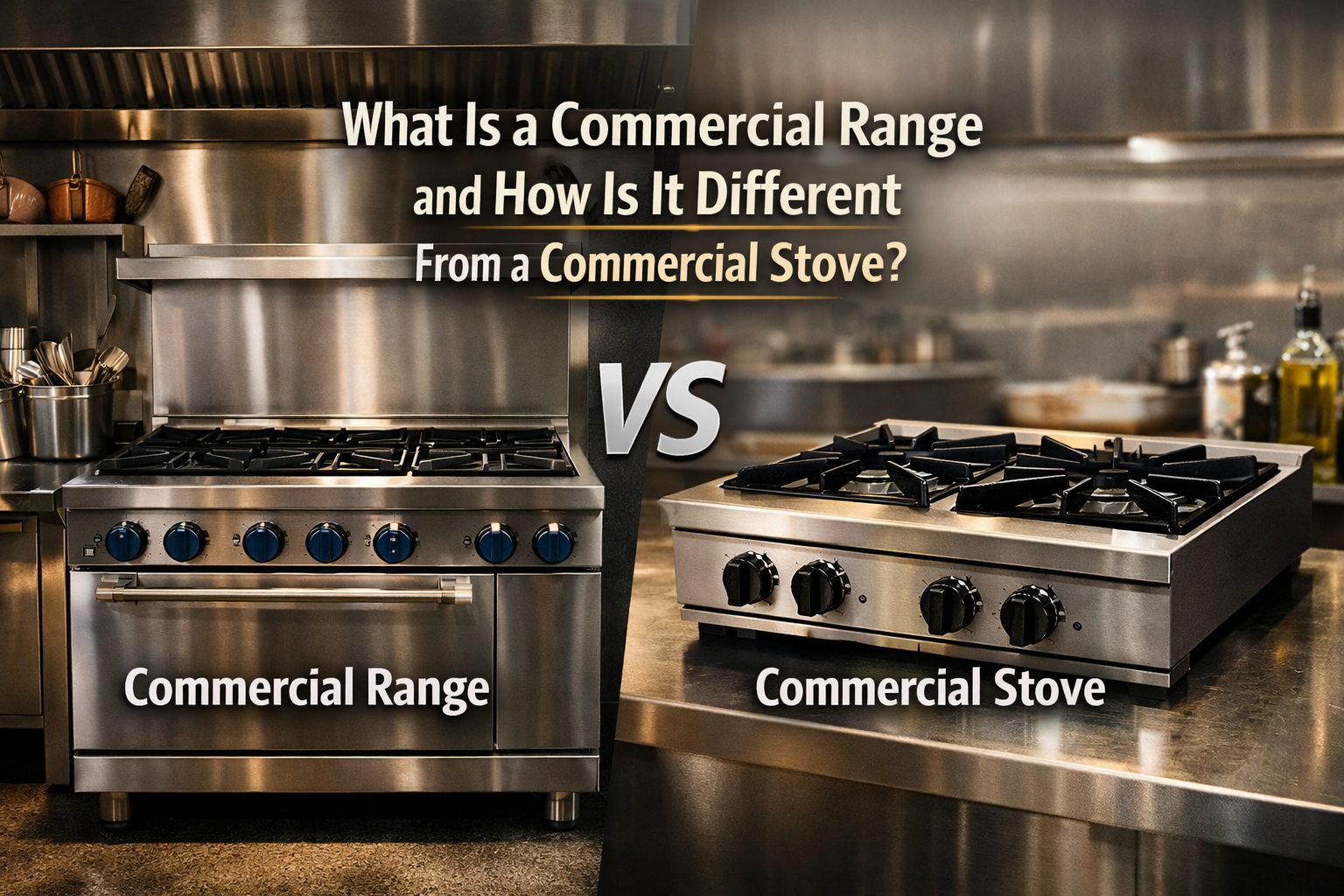
When people shop for restaurant equipment, they often use the terms commercial range and commercial stove as if they mean exactly the same thing. In casual conversation, that is understandable. In many kitchens, staff members, sales teams, installers, and even suppliers use these words loosely. But if you are buying equipment for a restaurant, café, deli, catering operation, hotel kitchen, school cafeteria, or commissary, that loose language can create confusion at the exact moment when precision matters most.
The difference is not just semantic. It affects what you buy, how you plan your line, how much cooking capacity you get, how much space you use, and whether the unit you choose actually supports your menu during peak service. A business owner might think they need a “commercial stove” when what they really need is a commercial range with an oven base. Another operator may assume every range is a full all-in-one cooking station, when in reality some setups are better served by separate stock pot ranges, griddles, convection ovens, or specialty commercial cooking equipment. In other words, understanding the terminology is not about sounding technical. It is about avoiding expensive mismatches.
This is why the best equipment decisions begin with clarity. Before comparing burners, ovens, widths, or fuel types, you need to understand what each piece of equipment is designed to do. Once you do, the entire buying process becomes easier. You can evaluate your kitchen based on production needs instead of vague product names, and you can choose equipment that fits your workflow instead of forcing your workflow to adapt to the wrong setup.
This guide breaks down exactly what a commercial range is, what people usually mean by a commercial stove, where the terms overlap, where they differ, and how to decide which setup makes the most sense for your kitchen. If you are building a new line, replacing aging equipment, or trying to create a more efficient cooking station, this is the distinction that should come first.
Why This Distinction Matters More Than Most Buyers Think
In a home kitchen, the line between a stove and a range is usually not a big operational concern. In a commercial kitchen, it is different. Restaurant equipment is not purchased for convenience alone. It is purchased for volume, speed, menu execution, labor flow, and service consistency.
That means a vague understanding of cooking equipment can lead to practical mistakes. A buyer may choose a unit based on appearance or price without realizing the oven cavity is too small, the burner layout does not match the menu, or the footprint does not make sense for the rest of the line. A chef may ask for a “commercial stove” but actually need a heavy-duty commercial range with six burners and a standard oven base. A new operator opening a smaller concept may buy a full-size range when a more compact countertop cooking setup plus a separate oven would have been more efficient.
The reason this happens so often is simple: the words overlap in everyday speech. But in foodservice equipment buying, overlap is not the same as equivalence. Understanding the difference helps you make decisions more like an operator and less like a casual shopper.
What Is a Commercial Range?
A commercial range is a professional cooking unit designed to perform multiple cooking functions in one footprint. In most cases, it combines a top cooking surface with a lower base. The top may include open burners, hot tops, griddles, charbroiler sections, or a combination of these. The base may include a standard oven, convection oven, cabinet base, refrigerated base, or other commercial configuration depending on the model and application.
This is what makes the commercial range such a central piece of equipment in restaurant kitchens. It is not just a heating surface. It is an integrated cooking platform. It allows a kitchen to sauté, simmer, boil, pan-fry, finish sauces, hold pots, and bake or roast from a single unified unit. That combination of versatility and footprint efficiency is exactly why commercial ranges remain one of the most important categories in foodservice equipment.
In practical terms, a commercial range is often the anchor of the hot line. In many kitchens, it is the piece of equipment that connects the pace of service with the structure of the menu. If your operation prepares soups, sauces, proteins, sides, pasta, egg dishes, sautéed items, or oven-finished entrées, the range often becomes the center of production. That is why buying the right one matters so much. A strong range improves rhythm. A poorly matched one slows everything down.
What Do People Mean by “Commercial Stove”?
The phrase commercial stove is less precise. In common use, it often refers to the upper cooking portion of a commercial range, especially the burner area. Some people use it to describe any professional gas or electric cooking appliance with burners. Others use it as a casual synonym for a full commercial range. That is where the confusion begins.
In one conversation, “commercial stove” may mean a six-burner restaurant range with an oven. In another, it may mean only the top burner section. In another, it may simply mean any large professional stove-like cooking appliance in a restaurant. That is why the term feels familiar but is less useful when you are comparing equipment seriously.
The important thing to understand is this: a commercial stove is often part of a commercial range, but a commercial range is usually a more complete, more specific product category. The stove language tends to describe the cooking surface or the general idea of the equipment. The range language describes the actual class of foodservice equipment being sold, specified, and installed.
If you are buying equipment online, this distinction matters because category pages, product specs, and manufacturer terminology usually organize these products under commercial ranges, not under a vague stove label. That means buyers who search only for “commercial stove” may miss the broader configuration details that actually determine whether the unit is right for the kitchen.
The Simplest Way to Understand the Difference
The easiest way to explain it is this:
A commercial range is usually a complete professional cooking unit.
A commercial stove usually refers to the top cooking function or is used informally to describe the same equipment.
So when someone says, “We need a new commercial stove,” the real follow-up question should be:
Do you mean the full range, or are you talking specifically about the burner section?
That one clarification can completely change the buying decision.
If the kitchen needs burners plus baking or roasting capability, a commercial range with an oven base may be the correct choice. If the kitchen already has plenty of oven capacity and only needs top cooking space, then a different configuration may make more sense. If the operator is really looking for specialty cooking, a range may not even be the best answer at all.
That is why the difference is not just technical language. It is a way of thinking clearly about the cooking job the equipment needs to perform.
Why Commercial Ranges Are So Common in Restaurant Kitchens
The biggest reason commercial ranges are so common is efficiency. Restaurants need equipment that can support multiple cooking tasks without consuming excessive line space. A commercial range solves that problem well because it combines flexibility and capacity in one unit.
For many concepts, this matters more than having the most specialized equipment possible. A diner, bistro, café with hot food, neighborhood restaurant, or casual full-service concept often needs one piece of equipment that can handle a broad range of cooking tasks. Open burners can run sauce pots, sauté pans, and stock pots. The oven base can bake, roast, reheat, or hold trays. This all-in-one functionality makes the range one of the most practical choices in commercial kitchens.
It is also one of the most adaptable categories. Some kitchens need compact models for lighter production. Others need larger high-output ranges with more burners and heavier construction. Some need range-top flexibility more than oven capacity. Others care deeply about the oven because it supports menu execution all day. The commercial range category can serve all of these needs, but only if the buyer understands which configuration actually matches the kitchen.
Where Buyers Get Confused
Most confusion happens in three places.
The first is terminology. Many people search for commercial stoves when they are really shopping for commercial ranges. That is normal, but it can lead to shallow comparisons. If you stop at the word “stove,” you may focus too much on burners and not enough on the overall configuration.
The second is assumption. Buyers sometimes assume that every commercial range is basically the same product with different dimensions. That is not true. Burner count, oven base type, top configuration, gas ranges versus electric ranges, width, and production level all matter. A four-burner range for a smaller café is not functionally equivalent to a heavy-duty range for a high-volume restaurant.
The third is workflow mismatch. Some buyers choose a range because it feels like the standard or safe choice, even when their kitchen may be better served by separate components. A compact concept that relies heavily on baking may need a stronger oven solution and fewer burners. A high-volume sauté-heavy restaurant may need more top-fire capacity than a standard oven-range combination can comfortably support. The problem is not the range itself. The problem is choosing equipment by label instead of by use.
The Main Components of a Commercial Range
To understand the category fully, it helps to break the range into parts.
The top cooking surface is what many people casually think of as the stove portion. This may include open burners, hot tops, or specialty top configurations. This area supports direct stovetop cooking such as boiling, simmering, sautéing, reducing, and finishing.
The base is where the category becomes more than just a stove. A range base may include an oven, which adds baking and roasting capability. In some cases it may be a cabinet base instead, which is useful if the kitchen already has enough dedicated oven capacity elsewhere. Some configurations may include storage or other practical base options depending on the kitchen’s needs.
This layered structure is the reason the term commercial range is more useful than the term commercial stove. It describes the full equipment package rather than only the top function.
Commercial Range vs Commercial Stove: The Real Operational Difference
If you want the real-world difference in one sentence, it is this:
A commercial range is selected as a complete line-cooking solution, while a commercial stove is usually described in terms of surface cooking.
That is the operational distinction.
If the kitchen needs a centerpiece unit that handles burners plus oven work, the commercial range is the relevant category. If the conversation is only about burners, top cooking, or the upper working surface, the word stove may show up more often. But from a purchasing standpoint, range is the more complete and more useful term.
This is also why equipment category pages and product specifications tend to organize these units under commercial ranges. The buyer needs to evaluate more than just the top heat source. The whole unit matters.
Which One Is Better for a Restaurant?
This question is slightly misleading, because in many cases the two terms point to the same equipment family. The better question is: what type of cooking setup is better for your restaurant?
If your operation benefits from an all-in-one cooking station with burners and an oven, a commercial range is often one of the best investments you can make. It is especially useful in kitchens that need flexibility across many menu items and cannot dedicate separate footprints to every cooking task.
If your operation already has dedicated ovens, griddles, or specialty cooking equipment, and only needs surface cooking support, then you may focus less on the oven base and more on the top configuration. In that case, the stove function becomes the priority, even though the equipment may still technically be a range.
The answer depends on the kitchen’s structure. There is no universal winner. The right choice is the one that supports the menu, the service style, and the daily production rhythm.
How to Decide What Your Kitchen Actually Needs
The best buyers do not start with terminology. They start with workload.
Think about what the unit needs to do during the busiest hour of the day. How many pans are active at the same time? How many menu items rely on top cooking? Do you need an oven directly under the burners, or do you already have enough oven capacity elsewhere? Are you cooking delicate sauces and proteins, or are you moving heavy sauté volume and large pots all day? Is line space tight enough that one integrated unit makes more sense than two separate pieces of equipment?
Once you answer those questions, the language becomes easier to sort out. You stop worrying about whether people call it a stove or a range and start focusing on the configuration that will actually perform.
This is always the better approach. Commercial equipment should be chosen by production logic, not by whatever phrase people use most casually.
When a Commercial Range Makes the Most Sense
A commercial range usually makes the most sense when the kitchen needs versatility in a limited footprint. It is ideal for operations that prepare a broad menu and benefit from having burners and oven capability in one place. Restaurants with mixed cooking styles often rely on ranges because they support multiple stations and menu types without forcing the business to purchase several separate appliances at once.
They are especially useful in kitchens where line space is valuable and every piece of equipment must justify its footprint. If one unit can sauté, simmer, boil, finish, and bake, it becomes easier to maintain a compact but capable hot line.
This is also why commercial ranges are often one of the first major cooking equipment decisions a restaurant makes. They are not just another appliance. In many cases, they are the structural core of the cooking setup.
When the Word “Stove” Can Lead You in the Wrong Direction
The problem with searching only for a commercial stove is that it can flatten the decision too much. It makes the buying process sound simpler than it really is. Buyers may focus only on burners and overlook the oven base, dimensions, utility needs, or how the unit fits into the rest of the cooking line.
That is not to say the term is wrong. It is just incomplete.
If you are writing a shopping list, “commercial stove” may feel natural. But if you are selecting real equipment for a real kitchen, it is smarter to move quickly into range-specific thinking. What base does it have? How many burners? What width? What menu will it support? Is the oven important or secondary? Does the kitchen need a general-purpose range or something more specialized?
Those questions are what lead to good purchasing decisions.
Why This Topic Matters for Long-Term Kitchen Performance
The difference between a well-matched range and a poorly matched one shows up every day. It shows up in prep speed, line rhythm, ticket times, consistency, labor movement, and even maintenance burden. Equipment that aligns with the kitchen tends to disappear into the workflow in the best possible way. It feels natural. Staff do not have to work around it. It supports the menu instead of interfering with it.
That is what buyers should really care about. Not whether one label sounds better than another, but whether the equipment selection creates a stronger kitchen.
That is also why the range-versus-stove distinction matters long after the purchase is made. The decision affects daily operations, not just product terminology.
Final Thoughts
A commercial range is a complete professional cooking unit designed to support multiple functions from one footprint, often combining a top cooking surface with an oven or base configuration. A commercial stove is a more casual and less precise term, usually referring to the burner area or being used informally to describe the same category of equipment.
In everyday speech, the two terms often overlap. In real restaurant equipment buying, the difference matters because a range is a full equipment decision, not just a surface-cooking idea.
If you are choosing equipment for a commercial kitchen, think beyond the label. Focus on the cooking tasks, the menu, the production volume, the footprint, and the role the unit will play during service. Once you do that, the terminology becomes much less confusing, and the right purchase becomes much easier to identify.
The most useful takeaway is simple:
If you are shopping seriously, think in terms of commercial ranges, not just commercial stoves. That mindset leads to better comparisons, better planning, and better long-term results in the kitchen.