
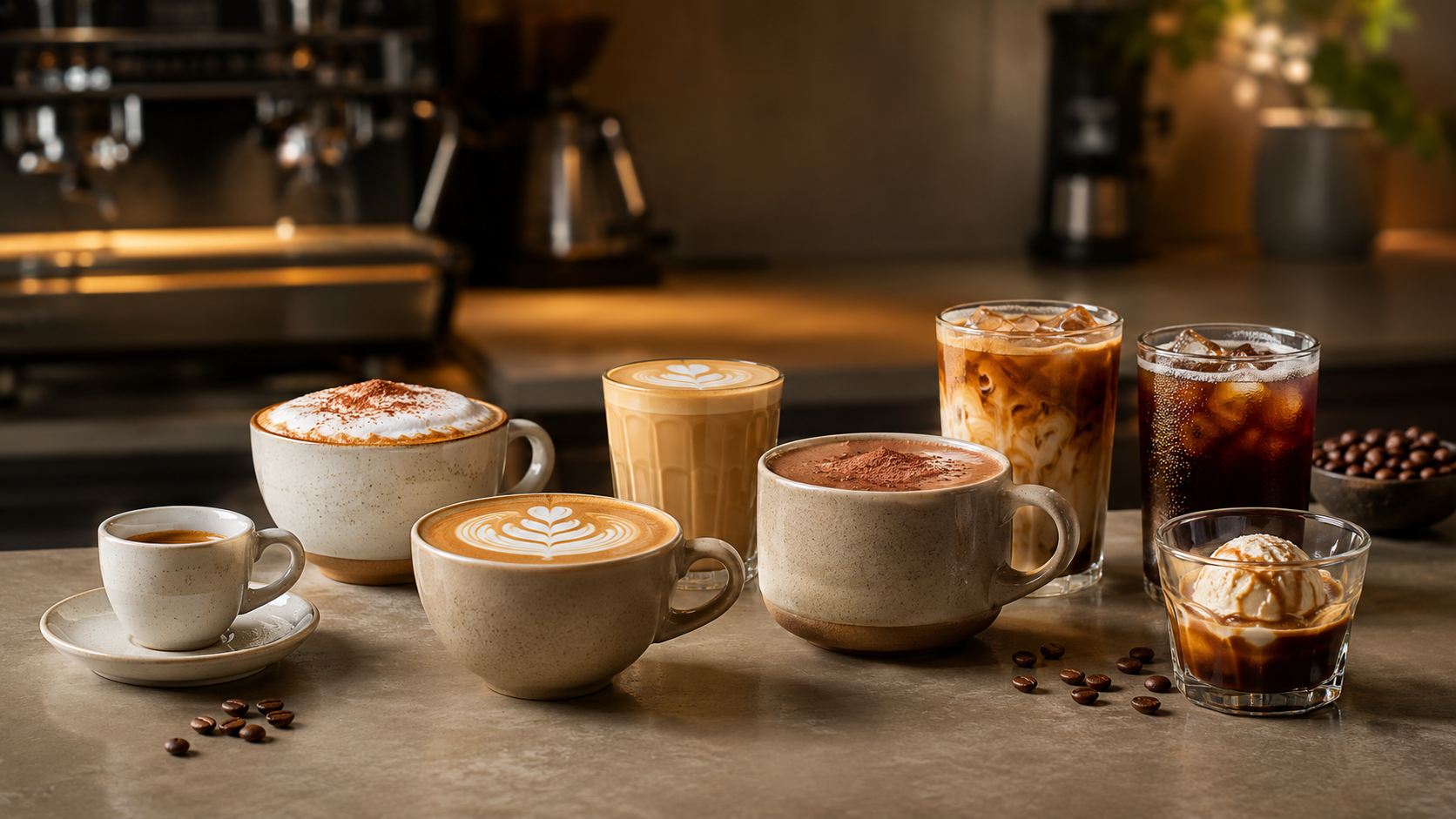
Complete Guide for Cafes, Restaurants, and Coffee Lovers
Coffee menus have grown far beyond “regular” and “decaf.” Today, a customer might walk into a café and choose between an espresso, cortado, flat white, cappuccino, cold brew, iced latte, mocha, affogato, or a seasonal drink with cold foam and flavored syrup. For coffee shop owners, restaurant operators, hotel breakfast programs, bakeries, and cafés, understanding the different types of coffee drinks is essential for building a profitable menu and helping customers order with confidence.
The good news is that most coffee drinks are built from a few core elements: brewed coffee, espresso, milk, foam, ice, sweeteners, and flavorings. Once you understand how these ingredients work together, it becomes much easier to design a coffee menu, train staff, choose the right cups, and create drinks that taste consistent every time.
This guide explains the most popular types of coffee drinks, how they are made, what makes each one different, and how foodservice operators can use them to create a stronger beverage program.
What Are the Main Types of Coffee Drinks?

Most coffee drinks fall into six main categories:
-
Black coffee drinks — brewed coffee, pour-over, French press, cold brew, and similar drinks served without milk.
-
Espresso drinks — espresso, doppio, ristretto, lungo, Americano, and long black.
-
Espresso and milk drinks — cappuccino, latte, flat white, cortado, macchiato, breve, and mocha.
-
Iced coffee drinks — iced coffee, iced Americano, iced latte, iced mocha, and iced espresso drinks.
-
Cold brew drinks — cold brew, nitro cold brew, cold brew latte, and flavored cold brew.
-
Dessert and specialty coffee drinks — affogato, Vienna coffee, frappé-style drinks, coffee cocktails, and seasonal café beverages.
For commercial menus, espresso-based drinks deserve special attention. According to the National Coffee Association, past-week espresso-based beverage consumption in the U.S. increased from 40% in 2022 to 45% in 2026, with lattes and espresso showing notable growth.
Coffee Brewing Methods Explained
Before comparing individual drinks, it helps to understand how the coffee itself is brewed. The brewing method affects body, bitterness, aroma, caffeine perception, and the types of drinks you can create.
Drip Coffee
Drip coffee is made by passing hot water through ground coffee in a filter. It is the standard coffee service method for diners, offices, breakfast buffets, bakeries, and restaurants. It is efficient, easy to batch, and ideal for high-volume service.
Best for: regular coffee, breakfast service, refills, coffee stations
Common cup size: 8–12 oz
Operator tip: Use airpots or thermal servers to maintain freshness without burning the coffee.
Pour-Over Coffee
Pour-over coffee is made by manually pouring hot water over coffee grounds in a cone or dripper. It offers greater control over extraction and is popular in specialty coffee shops.
Best for: premium single-origin coffee, slow bar menus, specialty cafés
Common cup size: 8–12 oz
Operator tip: Pour-over service is labor-intensive, so price it accordingly.
French Press
French press coffee is brewed by steeping coarse coffee grounds in hot water, then pressing them through a metal filter. It produces a heavier body because more oils remain in the cup.
Best for: tableside service, premium breakfast programs, café menus
Common cup size: 8–12 oz
Operator tip: French press coffee should be served immediately after brewing to avoid over-extraction.
Cold Brew
Cold brew is made by steeping coarse coffee grounds in cold or room-temperature water for an extended period, usually 12–24 hours. It is smoother and less acidic than many hot-brewed coffees.
Best for: iced coffee menus, bottled coffee, summer drinks, grab-and-go programs
Common cup size: 12–20 oz
Operator tip: Cold brew can be prepared in batches, making it useful for high-volume service.
Cold coffee is not just a seasonal add-on anymore. The Specialty Coffee Association reported in 2026 that 60% of past-day specialty coffee drinkers had cold specialty coffee, while 76% had hot specialty coffee.
Espresso
Espresso is a concentrated coffee brewed by forcing hot water through finely ground coffee under pressure. The Specialty Coffee Association’s heritage definition describes espresso as a 25–35 ml beverage prepared with pressurized water, a short brew time, and visible crema.
Best for: cappuccino, latte, Americano, mocha, macchiato, cortado, flat white
Common serving size: 1–2 oz
Operator tip: Espresso quality depends heavily on grind size, dose, tamping, water temperature, pressure, and machine maintenance.
Quick Coffee Drink Ratio Chart
| Drink | Main Ingredients | Typical Ratio | Common Serving Size |
|---|---|---|---|
| Espresso | Espresso only | 1 shot | 1–2 oz |
| Doppio | Double espresso | 2 shots | 2–3 oz |
| Ristretto | Short espresso | Less water, same coffee dose | 0.5–1 oz |
| Lungo | Long espresso | More water through espresso puck | 2–3 oz |
| Americano | Espresso + hot water | 1–2 shots + hot water | 6–12 oz |
| Long Black | Hot water + espresso | Water first, espresso second | 6–8 oz |
| Macchiato | Espresso + small milk foam mark | Espresso + 1–2 tsp foam | 2–3 oz |
| Cortado | Espresso + steamed milk | 1:1 espresso to milk | 4–5 oz |
| Cappuccino | Espresso + steamed milk + foam | Roughly equal parts | 5–6 oz |
| Flat White | Espresso + microfoam milk | More coffee-forward than latte | 5–6 oz |
| Latte | Espresso + steamed milk + light foam | Milk-forward | 8–16 oz |
| Mocha | Espresso + chocolate + milk | Latte base + chocolate | 8–16 oz |
| Breve | Espresso + steamed half-and-half | Richer latte-style drink | 6–8 oz |
| Café au Lait | Brewed coffee + hot milk | 1:1 coffee to milk | 8–12 oz |
| Iced Latte | Espresso + milk + ice | Espresso + cold milk | 12–20 oz |
| Cold Brew | Cold-brewed coffee | Concentrate + water/milk | 12–20 oz |
| Affogato | Espresso + ice cream | Espresso over gelato/ice cream | Dessert cup |
Ratios can vary by café, country, cup size, and customer preference. For a commercial menu, consistency matters more than copying one universal formula. Choose your house standard and train every barista to follow it.
Espresso-Based Coffee Drinks
1. Espresso
Espresso is the foundation of most café coffee drinks. It is served as a small, intense shot with a syrupy body and crema on top. A well-made espresso should taste balanced, not harsh or burnt.
Ingredients: finely ground coffee and water
Typical size: 1–2 oz
Best cup: demitasse or espresso cup
Menu note: Offer single and double espresso options.
2. Doppio
A doppio is a double espresso. It uses twice the amount of espresso and is stronger than a single shot.
Ingredients: two espresso shots
Typical size: 2–3 oz
Best cup: demitasse or small espresso cup
Menu note: Many cafés use a double shot as the default base for milk drinks.
3. Ristretto
A ristretto is a shorter espresso extraction. It uses less water, creating a smaller, more concentrated shot. It often tastes sweeter and more intense than a standard espresso.
Ingredients: espresso brewed with less water
Typical size: 0.5–1 oz
Best cup: espresso cup
Menu note: Good for specialty cafés that want to highlight espresso technique.
4. Lungo
A lungo is the opposite of a ristretto. More water passes through the espresso puck, creating a longer, more diluted shot.
Ingredients: espresso brewed with more water
Typical size: 2–3 oz
Best cup: espresso cup or small coffee cup
Menu note: A lungo is not the same as an Americano because the extra water is brewed through the coffee grounds.
5. Americano
An Americano is made by adding hot water to espresso. It has the strength and aroma of espresso but a lighter body closer to brewed coffee.
Ingredients: espresso and hot water
Typical size: 6–12 oz
Best cup: coffee mug or glass mug
Menu note: A good option for customers who want black coffee but prefer espresso-based flavor.
6. Long Black
A long black is similar to an Americano but is usually prepared by pouring espresso over hot water. This method helps preserve more crema.
Ingredients: hot water and espresso
Typical size: 6–8 oz
Best cup: glass mug or ceramic cup
Menu note: Popular in Australia and New Zealand-style coffee menus.
7. Red Eye
A red eye combines brewed coffee with one shot of espresso. It is made for customers who want a stronger caffeine kick than regular drip coffee.
Ingredients: drip coffee and one espresso shot
Typical size: 8–12 oz
Best cup: coffee mug
Menu note: Easy to add if you already serve both drip coffee and espresso.
8. Black Eye
A black eye is a stronger version of a red eye, made with brewed coffee and two espresso shots.
Ingredients: drip coffee and two espresso shots
Typical size: 8–12 oz
Best cup: coffee mug
Menu note: Mark it clearly as a high-caffeine drink.
Milk-Based Espresso Drinks
9. Macchiato
A traditional espresso macchiato is espresso “marked” with a small amount of steamed milk or foam. It is not the same as a large flavored caramel macchiato served by some chains.
Ingredients: espresso and a small spoon of milk foam
Typical size: 2–3 oz
Best cup: espresso cup
Flavor profile: strong espresso with a light milk finish
Menu note: Clarify “traditional macchiato” if your customers may expect a sweet, large-format drink.
10. Long Macchiato
A long macchiato is usually made with a double espresso and a small amount of milk or foam. It is taller than a traditional macchiato but still coffee-forward.
Ingredients: double espresso and a small amount of milk
Typical size: 4–5 oz
Best cup: small glass
Menu note: Good for menus inspired by Australian café culture.
11. Cortado
A cortado is made with roughly equal parts espresso and steamed milk. The milk softens acidity without turning the drink into a large, milk-heavy beverage.
Ingredients: espresso and steamed milk
Typical ratio: 1:1
Typical size: 4–5 oz
Best cup: small glass
Flavor profile: balanced, smooth, coffee-forward
Menu note: A great option for customers who want less milk than a latte.
12. Cappuccino
A cappuccino is made with espresso, steamed milk, and foam. It is smaller and foamier than a latte, with a stronger coffee taste. In specialty coffee, cappuccino is commonly associated with a 5–6 oz cup size.
Ingredients: espresso, steamed milk, milk foam
Typical size: 5–6 oz
Best cup: cappuccino cup
Flavor profile: bold espresso, sweet milk, velvety foam
Menu note: Cappuccino should not simply be a small latte; the texture and foam structure matter.
13. Dry Cappuccino
A dry cappuccino has more foam and less steamed milk than a standard cappuccino.
Ingredients: espresso and extra milk foam
Typical size: 5–6 oz
Best cup: cappuccino cup
Flavor profile: lighter body, more foam texture
Menu note: Offer as a customization rather than a core menu item.
14. Wet Cappuccino
A wet cappuccino has more steamed milk and less foam. It is closer to a small latte but still served in a cappuccino format.
Ingredients: espresso, more steamed milk, lighter foam
Typical size: 5–6 oz
Best cup: cappuccino cup
Menu note: Useful for customers who like cappuccino flavor but want a creamier drink.
15. Flat White
A flat white is made with espresso and steamed milk with fine microfoam. It is typically smaller and more coffee-forward than a latte. Perfect Daily Grind notes that a flat white is generally more concentrated and has a stronger coffee taste than a latte.
Ingredients: espresso and microfoam milk
Typical size: 5–6 oz
Best cup: ceramic cup or glass
Flavor profile: smooth, creamy, espresso-forward
Menu note: A flat white should have integrated microfoam, not a thick foam cap.
16. Latte
A latte is one of the most popular coffee drinks because it is smooth, customizable, and approachable. It uses espresso with a larger amount of steamed milk and a thin layer of foam.
Ingredients: espresso, steamed milk, light foam
Typical size: 8–16 oz
Best cup: latte cup or takeaway cup
Flavor profile: creamy, mild, highly customizable
Menu note: Lattes are ideal for syrups, seasonal flavors, alternative milks, and iced versions.
17. Piccolo Latte
A piccolo latte is a small milk drink made with espresso or ristretto and steamed milk. It is similar to a tiny latte but more concentrated.
Ingredients: ristretto or espresso and steamed milk
Typical size: 3–4 oz
Best cup: small glass
Menu note: Good for specialty cafés and tasting menus.
18. Breve
A breve is made with espresso and steamed half-and-half instead of milk. It is richer, creamier, and heavier than a standard latte.
Ingredients: espresso and steamed half-and-half
Typical size: 6–8 oz
Best cup: small latte cup
Flavor profile: rich, creamy, dessert-like
Menu note: Because it uses half-and-half, ingredient cost and calories are higher.
19. Mocha
A mocha combines espresso, chocolate, steamed milk, and sometimes whipped cream. It is essentially a chocolate latte.
Ingredients: espresso, chocolate syrup or cocoa, steamed milk, optional whipped cream
Typical size: 8–16 oz
Best cup: latte mug or takeaway cup
Flavor profile: sweet, chocolatey, creamy
Menu note: Offer dark chocolate, white chocolate, peppermint, or salted caramel variations.
20. White Mocha
A white mocha uses white chocolate instead of regular chocolate. It is sweeter and creamier than a classic mocha.
Ingredients: espresso, white chocolate sauce, steamed milk
Typical size: 8–16 oz
Best cup: latte cup
Menu note: Works well as a seasonal or premium drink.
Brewed Coffee Drinks
21. Black Coffee
Black coffee is brewed coffee served without milk or sugar. It may be made with drip, pour-over, French press, or batch brewing equipment.
Ingredients: brewed coffee
Typical size: 8–12 oz
Best cup: coffee mug
Menu note: Quality still matters. Freshness, grind size, water quality, and holding time all affect flavor.
22. Café au Lait
Café au lait is made with brewed coffee and hot milk, usually in a roughly equal ratio. Unlike a latte, it does not require espresso.
Ingredients: brewed coffee and hot milk
Typical ratio: 1:1
Typical size: 8–12 oz
Best cup: coffee mug
Menu note: A good option for restaurants that do not have an espresso machine.
23. Misto
A misto is similar to café au lait and usually refers to brewed coffee mixed with steamed milk.
Ingredients: brewed coffee and steamed milk
Typical size: 8–16 oz
Best cup: coffee mug or takeaway cup
Menu note: Easy to execute with batch coffee and a milk steamer.
24. Turkish Coffee
Turkish coffee is made by simmering very finely ground coffee with water, often in a small pot called a cezve or ibrik. It is served unfiltered, usually in small cups.
Ingredients: very finely ground coffee and water
Typical size: 2–3 oz
Best cup: Turkish coffee cup
Menu note: Requires specific preparation and customer education.
25. Greek Coffee
Greek coffee is similar to Turkish coffee in preparation, using finely ground coffee simmered in a small pot.
Ingredients: finely ground coffee and water
Typical size: 2–3 oz
Best cup: small demitasse-style cup
Menu note: Good for Mediterranean, Greek, and Middle Eastern restaurant menus.
Iced Coffee Drinks
26. Iced Coffee
Iced coffee is brewed coffee served cold over ice. It can be made by chilling hot brewed coffee or brewing directly over ice.
Ingredients: brewed coffee and ice
Typical size: 12–20 oz
Best cup: clear plastic cup or iced beverage glass
Menu note: Use stronger coffee or coffee ice cubes to avoid watery flavor.
27. Japanese Iced Coffee
Japanese iced coffee is brewed hot directly over ice. The hot water extracts aromatics quickly, while the ice chills the coffee immediately.
Ingredients: hot-brewed coffee over ice
Typical size: 10–16 oz
Best cup: glass or clear cup
Menu note: Brighter and more aromatic than many cold brew drinks.
28. Iced Americano
An iced Americano is made with espresso, cold water, and ice. It is clean, refreshing, and lower in milk cost than iced lattes.
Ingredients: espresso, cold water, ice
Typical size: 12–20 oz
Best cup: iced beverage cup
Menu note: Add espresso last for better visual layering.
29. Iced Latte
An iced latte is made with espresso, cold milk, and ice. It is one of the most popular cold espresso drinks.
Ingredients: espresso, milk, ice
Typical size: 12–20 oz
Best cup: clear iced cup
Menu note: Works well with vanilla, caramel, hazelnut, lavender, brown sugar, and seasonal syrups.
30. Iced Mocha
An iced mocha is a cold version of a mocha, made with espresso, chocolate, milk, and ice.
Ingredients: espresso, chocolate sauce, milk, ice
Typical size: 12–20 oz
Best cup: clear iced cup
Menu note: Shake or stir chocolate thoroughly so it does not settle at the bottom.
31. Iced Macchiato-Style Drink
A large iced macchiato-style drink is often layered with milk, syrup, espresso, and ice. This is different from a traditional espresso macchiato.
Ingredients: milk, syrup, espresso, ice
Typical size: 12–20 oz
Best cup: clear iced cup
Menu note: Great for visual appeal and social media-friendly presentation.
Cold Brew Coffee Drinks
32. Cold Brew
Cold brew is brewed slowly with cold or room-temperature water. It is usually served over ice and may be diluted with water or milk.
Ingredients: cold brew concentrate, water or milk, ice
Typical size: 12–20 oz
Best cup: clear iced cup
Menu note: Batch production helps speed up service during rush hours.
33. Nitro Cold Brew
Nitro cold brew is infused with nitrogen gas, creating a creamy texture and cascading appearance. It is usually served without ice.
Ingredients: cold brew infused with nitrogen
Typical size: 10–16 oz
Best cup: clear glass or cup
Menu note: Requires a keg system, nitrogen tank, and tap setup.
34. Cold Brew Latte
A cold brew latte combines cold brew concentrate with milk and ice.
Ingredients: cold brew, milk, ice
Typical size: 12–20 oz
Best cup: clear iced cup
Menu note: Easier to make than an iced latte if you do not want to pull espresso shots during rush periods.
35. Sweet Cream Cold Brew
Sweet cream cold brew is cold brew topped with sweetened cream or cold foam.
Ingredients: cold brew, ice, sweet cream or cold foam
Typical size: 12–20 oz
Best cup: clear iced cup
Menu note: Cold foam and flavored cream toppings are strong upsell opportunities.
Dessert and Specialty Coffee Drinks
36. Affogato
An affogato is made by pouring hot espresso over vanilla gelato or ice cream. It is more of a dessert than a traditional beverage.
Ingredients: espresso and vanilla gelato or ice cream
Typical size: dessert portion
Best cup: dessert glass or small bowl
Menu note: Excellent for restaurants, dessert cafés, and Italian menus.
37. Vienna Coffee
Vienna coffee is commonly made with strong coffee or espresso topped with whipped cream.
Ingredients: espresso or strong coffee and whipped cream
Typical size: 5–8 oz
Best cup: glass mug
Menu note: Works well as a dessert drink.
38. Frappé
A frappé is a cold, foamy coffee drink. In some traditions, it is made with instant coffee, water, sugar, and ice. In modern cafés, the term may refer to blended iced coffee drinks.
Ingredients: coffee, ice, milk or water, optional sugar
Typical size: 12–20 oz
Best cup: clear cold cup
Menu note: Define your recipe clearly so customers know whether it is shaken, blended, or instant coffee-based.
39. Blended Coffee Drink
Blended coffee drinks combine coffee, milk, ice, syrups, and sometimes whipped cream. They are often sweet and dessert-like.
Ingredients: coffee or espresso, milk, ice, syrup, optional whipped cream
Typical size: 12–24 oz
Best cup: clear plastic cup with dome lid
Menu note: These drinks can have strong profit margins but require a reliable commercial blender.
40. Coffee Milkshake
A coffee milkshake blends coffee or espresso with ice cream and milk.
Ingredients: espresso or coffee, ice cream, milk
Typical size: 12–20 oz
Best cup: milkshake glass or clear cup
Menu note: Good for diners, dessert shops, and casual restaurants.
Coffee Drink Differences Customers Ask About
Cappuccino vs Latte
A cappuccino is smaller, foamier, and more coffee-forward. A latte is larger, milkier, and usually has only a thin layer of foam. Cappuccinos are typically served around 5–6 oz, while lattes are often 8–16 oz depending on the shop.
Latte vs Flat White
A latte is milkier and usually larger. A flat white is smaller, more concentrated, and uses fine microfoam. Flat whites are often chosen by customers who want a creamy drink but still want the espresso flavor to stand out.
Cortado vs Flat White
A cortado is smaller and usually closer to a 1:1 ratio of espresso to milk. A flat white is larger, with more milk and a silkier microfoam texture.
Americano vs Long Black
Both use espresso and hot water. In an Americano, espresso is commonly diluted with hot water. In a long black, espresso is usually poured over hot water, helping preserve crema.
Iced Coffee vs Cold Brew
Iced coffee is brewed hot and served cold over ice. Cold brew is brewed with cold or room-temperature water over a long period. Iced coffee often tastes brighter and more acidic, while cold brew is smoother and less bitter.
Mocha vs Latte
A mocha is a latte with chocolate. Both contain espresso and milk, but mocha is sweeter and more dessert-like.
How to Build a Better Coffee Menu
A strong coffee menu should be easy to understand, profitable, and operationally realistic. Offering too many drinks can slow down service, increase waste, and make staff training harder.
1. Start With Core Drinks
A practical café or restaurant coffee menu can start with:
-
Espresso
-
Americano
-
Cappuccino
-
Latte
-
Mocha
-
Macchiato
-
Cortado
-
Drip coffee
-
Iced coffee
-
Cold brew
-
Iced latte
This gives customers enough choice without overwhelming your operation.
2. Add Customization Carefully
Popular customizations include:
-
Vanilla syrup
-
Caramel syrup
-
Hazelnut syrup
-
Mocha sauce
-
White chocolate sauce
-
Oat milk
-
Almond milk
-
Extra espresso shot
-
Cold foam
-
Whipped cream
Customizations increase average ticket size, but they should be easy for staff to execute consistently.
3. Offer Hot and Iced Versions
Cold drinks continue to be a major part of specialty coffee demand. If you serve lattes, mochas, and Americanos, offer iced versions as well. This expands your menu without requiring completely new recipes.
4. Use Seasonal Drinks
Seasonal drinks create repeat visits and make your menu feel fresh. Examples include:
-
Pumpkin spice latte
-
Peppermint mocha
-
Brown sugar iced latte
-
Toasted marshmallow cold brew
-
Lavender honey latte
-
Maple cinnamon cappuccino
-
Pistachio latte
-
Salted caramel mocha
Keep seasonal drinks limited so they feel special and do not complicate daily operations too much.
5. Match Cups to Drinks
Cup size affects taste. A cappuccino served in a 12 oz cup becomes too milky. A cortado served in a large cup loses its identity. Standardize cup sizes for each drink so your baristas can maintain the intended flavor.
Commercial Equipment Needed for Coffee Service
The right coffee equipment depends on your menu, volume, and service style.
For Basic Coffee Service
Restaurants, offices, bakeries, and breakfast operations usually need:
-
Commercial coffee brewer
-
Coffee grinder
-
Airpots or thermal servers
-
Coffee filters
-
Decaf service setup
-
Insulated dispensers
-
Mugs or disposable cups
-
Creamer station supplies
For Espresso-Based Drinks
Cafés and restaurants serving espresso drinks need:
-
Commercial espresso machine
-
Espresso grinder
-
Knock box
-
Milk pitchers
-
Tampers
-
Scales
-
Shot glasses
-
Cleaning tablets and brushes
-
Water filtration system
For Iced and Cold Coffee
Cold beverage programs may require:
-
Cold brew system
-
Refrigerated storage
-
Clear cold cups
-
Lids and straws
-
Syrup pumps
-
Cold foam blender or frother
For foodservice operators, the coffee menu should be built around the equipment you can support. A restaurant with no espresso machine may still serve excellent drip coffee, café au lait, iced coffee, and cold brew. A café with a full espresso bar can expand into lattes, cappuccinos, flat whites, cortados, mochas, and seasonal drinks.
Tips for Serving Better Coffee in a Commercial Setting
Use Fresh Coffee
Coffee loses aroma after grinding. For better flavor, grind coffee as close to brewing as possible.
Control Water Quality
Coffee is mostly water, so poor water quality can ruin even excellent beans. A water filtration system can improve taste and help protect equipment from scale.
Train Staff on Milk Texture
Milk texture is one of the biggest differences between a good latte, cappuccino, and flat white. Staff should understand the difference between dry foam, wet foam, and microfoam.
Keep Equipment Clean
Old coffee oils, milk residue, and mineral buildup can damage flavor and equipment performance. Daily cleaning is essential for espresso machines, steam wands, grinders, brewers, and cold brew systems.
Standardize Recipes
Write down your espresso dose, shot time, milk amount, syrup pumps, cup size, and garnish for each drink. Consistency is what turns a good menu into a reliable beverage program.