
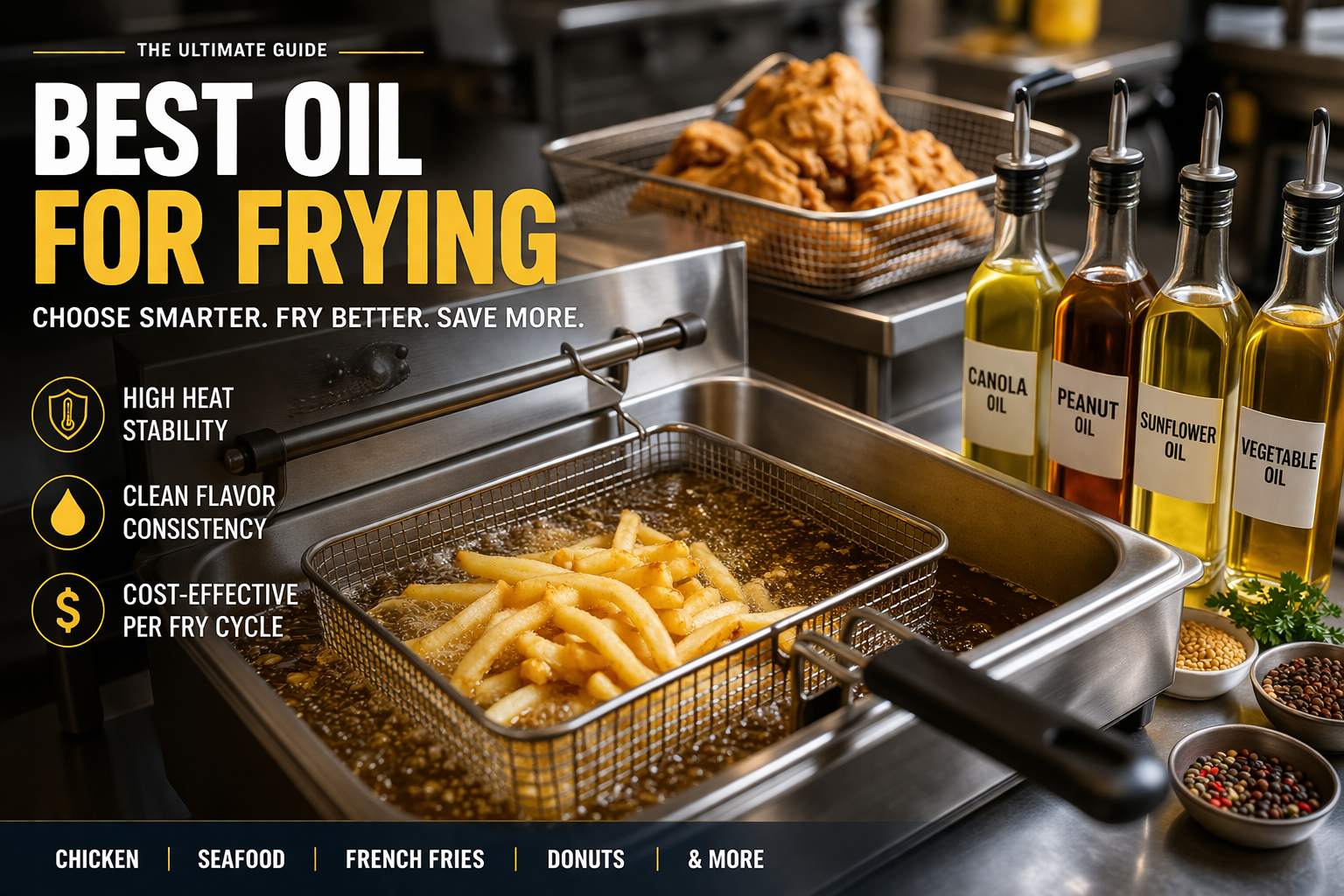
There’s a big difference between reading about frying oil and actually running a commercial fryer all day.
Most guides on the internet talk about smoke point and call it a day. In reality, if you’ve ever worked in a busy kitchen, you already know the truth: oil is one of the biggest hidden cost drivers in your operation, and one of the fastest ways to ruin food quality if you get it wrong.
Choosing the best oil for frying isn’t about picking the one with the highest temperature tolerance. It’s about understanding how that oil behaves after hour two, after batch ten, and after it’s been pushed through a full service.
Because that’s where the real differences show up.

What You Notice After a Full Day of Frying
When a commercial kitchen is running at volume, oil stops behaving like it does in theory.
At the beginning of the day, almost any decent oil will perform well. Fries come out crisp, chicken looks golden, and everything feels consistent. But as service continues, weaker oils start to break down. The color darkens faster, the smell changes slightly, and food begins to absorb more grease than it should.
This is the point where inexperienced operators think something is wrong with the fryer.
It’s usually not.
It’s the oil.
A high-quality frying oil doesn’t just survive heat, it maintains structure under repeated stress. That means it resists oxidation, doesn’t break down quickly when exposed to air and food particles, and most importantly, keeps delivering the same result from the first batch to the last.
That consistency is what separates a smooth kitchen operation from a chaotic one.
Why Cheap Oil Almost Always Becomes Expensive
One of the most common mistakes I see is operators trying to save money by buying the cheapest oil available.
On paper, it makes sense. Lower cost per gallon feels like a win.
In practice, it almost never is.
Lower-quality oils degrade faster. That means more frequent oil changes, inconsistent food quality, and higher labor cost because your team is constantly managing oil instead of focusing on production.
Over time, this creates a cycle where you're not actually saving money, you're just shifting the cost into different areas of your operation.
Experienced kitchens think differently. They don’t ask “what’s the cheapest oil?”
They ask:
“How long does this oil last under pressure?”
Because that’s the number that actually matters.
The Oils That Actually Hold Up in Commercial Use
After working with different kitchens and setups, certain oils consistently outperform others. Not because of marketing, but because of how they behave during real service.
Canola oil is one of the most widely used for a reason. It’s balanced. It doesn’t interfere with flavor, it handles heat well, and it’s cost-efficient at scale. In a kitchen that needs versatility, it’s often the safest choice.
Peanut oil sits in a different category. It’s what many kitchens move to once they care deeply about frying quality. It handles higher temperatures, lasts longer under continuous use, and produces a noticeably cleaner, crispier result, especially with chicken. It’s more expensive upfront, but it earns that cost back in performance.
Vegetable oil blends are the workhorses. They’re not the best at anything, but they’re reliable across the board. If a kitchen has a wide menu and needs something flexible, this is often where they land.
Then there are more specialized options like sunflower oil, which works exceptionally well for seafood because it stays light and doesn’t mask flavor, or corn oil, which performs well in high-volume fry stations where consistency matters more than nuance.
And finally, there’s avocado oil. You don’t see it everywhere, not because it’s not good, but because it’s expensive. But in kitchens where branding, health positioning, or premium quality matters, it becomes part of the strategy, not just the cooking process.
Matching the Oil to the Menu
One of the biggest mistakes is trying to use a single oil for everything without thinking about what’s actually being fried.
Chicken needs stability. It cooks longer, at high temperatures, and any breakdown in oil quality shows immediately in texture. This is where stronger oils like peanut or canola perform best.
Seafood is more sensitive. A heavier oil can completely kill the flavor profile. Lighter oils like sunflower or clean vegetable blends are usually a better fit because they let the product speak for itself.
Fries are deceptively simple but require consistency. If your oil breaks down mid-service, fries start coming out darker and heavier. Oils like canola or corn tend to hold up well here because they maintain structure over repeated batches.
This isn’t about preference. It’s about how oil interacts with food under heat.
The Role of Your Equipment
Here’s something most content completely ignores: your fryer plays a huge role in how your oil performs.
A high-quality commercial fryer with proper temperature control and filtration will extend the life of your oil significantly. It reduces contamination, keeps heat consistent, and allows oil to perform the way it’s supposed to.
On the other hand, inconsistent temperature or poor filtration accelerates oil breakdown no matter how good the oil is.
That’s why experienced operators don’t think of oil and equipment separately. They treat them as a system.
The right oil in the wrong fryer still underperforms.
The right combination creates consistency, speed, and better margins.
So What’s Actually the Best Oil for Frying?
There isn’t a single answer, and anyone who tells you there is probably hasn’t spent much time in a real kitchen.
The best oil is the one that matches your operation.
If you’re running high volume and need balance, canola is hard to beat.
If you’re focused on premium frying quality, peanut oil stands out.
If you need flexibility across different menu items, vegetable oil blends are reliable.
If you’re working with delicate products like fish, lighter oils make more sense.
What matters is not the oil itself, but how it performs in your specific setup.
At the end of the day, frying oil is not just an ingredient.
It’s a system decision.
It affects your food quality, your costs, your workflow, and ultimately how your customers experience your brand.
Most kitchens don’t realize how much control they actually have here.
The ones that do usually run smoother, waste less, and deliver more consistent food without even working harder.
And in a competitive market, that difference shows up faster than you think.