
In cooking, small measurements can create big results. A teaspoon of salt can balance a sauce. A tablespoon of oil can change the texture of a dressing. A teaspoon of baking powder can help a cake rise, while a tablespoon by mistake can ruin the entire batch.
That is why understanding the difference between a tablespoon and a teaspoon is more than a basic kitchen detail. It is a recipe accuracy issue, a baking consistency issue, and in commercial kitchens, a portion control issue.

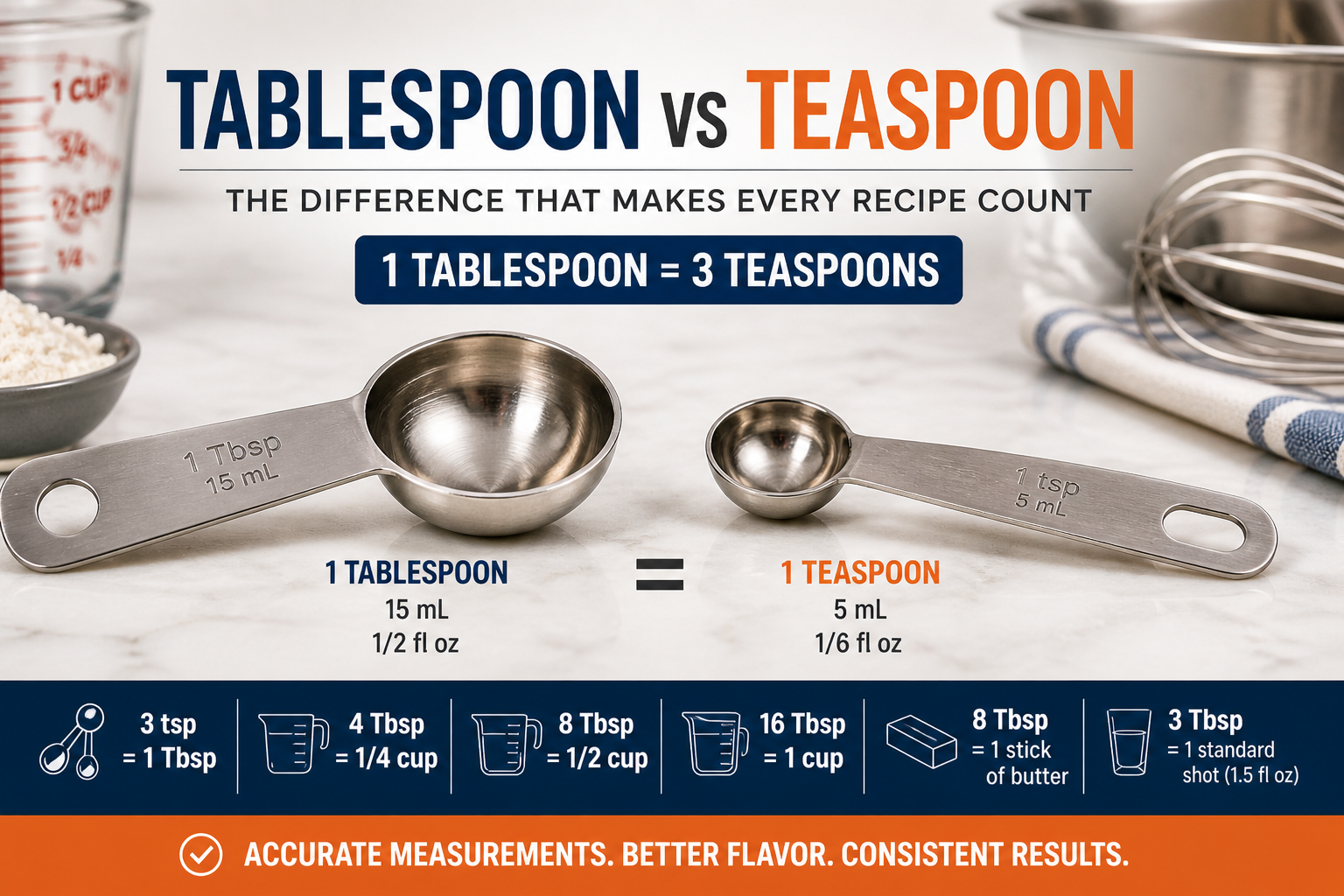
A tablespoon is three times larger than a teaspoon. In U.S. kitchen measurements, 1 tablespoon equals 3 teaspoons. A teaspoon is commonly listed as 5 mL, while a tablespoon is commonly listed as 15 mL. NIST’s kitchen measurement equivalencies list 5 mL as 1 teaspoon and 15 mL as 1 tablespoon, which is also 1/2 fluid ounce.
For home cooks, this helps prevent simple recipe mistakes. For restaurants, bakeries, cafes, catering companies, and foodservice operations, it supports consistency. If one employee uses a teaspoon and another uses a tablespoon for the same ingredient, the final product will not taste the same, cost the same, or perform the same.
Tablespoon vs Teaspoon: The Simple Difference
The difference between a tablespoon and a teaspoon is size and volume.
A teaspoon, often abbreviated as tsp, is the smaller measurement. It is commonly used for small quantities of powerful ingredients such as salt, baking powder, yeast, cinnamon, vanilla extract, pepper, spices, extracts, and seasonings.
A tablespoon, often abbreviated as Tbsp, is larger. It is commonly used for ingredients like oil, butter, sauces, syrups, dressings, chopped herbs, condiments, and larger seasoning portions.
The key conversion is simple:
1 tablespoon = 3 teaspoons
This means if a recipe calls for 1 teaspoon and you accidentally use 1 tablespoon, you are adding three times the intended amount. With some ingredients, that may not matter much. With salt, baking powder, baking soda, yeast, chili powder, or extracts, it can completely change the final dish.
Quick Conversion Chart: Tablespoons and Teaspoons
Here are the most useful tablespoon and teaspoon conversions:
| Measurement | Equivalent |
|---|---|
| 1 teaspoon | 5 mL |
| 1 tablespoon | 3 teaspoons |
| 1 tablespoon | 15 mL |
| 1 tablespoon | 1/2 fluid ounce |
| 2 tablespoons | 6 teaspoons |
| 4 tablespoons | 1/4 cup |
| 8 tablespoons | 1/2 cup |
| 16 tablespoons | 1 cup |
| 48 teaspoons | 1 cup |
These conversions are useful for cooking, baking, prep sheets, recipe cards, and training new kitchen staff. NIST lists 1 cup as 240 mL and 1 tablespoon as 15 mL, which is why 16 tablespoons equal 1 cup in standard U.S. kitchen conversions.
What Is a Tablespoon?
A tablespoon is a kitchen measurement equal to 3 teaspoons, 15 mL, 1/2 fluid ounce, or 1/16 cup.
In a measuring spoon set, the tablespoon is usually the largest spoon. It is used for ingredients that need more volume than a teaspoon but less than a measuring cup.
Common ingredients measured by tablespoon include:
Oil
Butter
Honey
Maple syrup
Sauces
Vinegar
Soy sauce
Lemon juice
Mayonnaise
Dressing
Chopped herbs
Cream cheese
Peanut butter
Tomato paste
In restaurants, tablespoons are also useful for recipe testing and small-batch prep. A chef may use tablespoons when developing sauces, marinades, spice blends, dressings, and batters before scaling the recipe into larger production batches.
Tablespoon Abbreviations
The most common abbreviations for tablespoon are:
Tbsp
tbsp
Tbs
T
The safest abbreviation is Tbsp because it is easier to distinguish from tsp, which means teaspoon. In professional recipe writing, clarity matters. A lowercase “t” and uppercase “T” can be easy to misread during a busy service or production day, so many kitchens prefer writing out “tablespoon” or using “Tbsp” clearly.
For commercial kitchens, recipe cards should avoid confusing abbreviations whenever possible. A prep cook reading a laminated recipe sheet quickly should not have to guess whether “t” means teaspoon or tablespoon.
Is a Regular Spoon the Same as a Tablespoon?
Not exactly.
A regular dining spoon may be called a tablespoon in everyday language, but it is not the same as a standardized measuring tablespoon. Flatware sizes vary by manufacturer and style. One dining spoon may hold close to a tablespoon, while another may hold more or less.
For casual cooking, a regular spoon can sometimes work as an approximation. For baking, sauces, spice blends, marinades, and commercial food prep, it is not reliable enough. Restaurants and bakeries should use actual measuring spoons, measuring cups, portion scoops, ladles, scales, and standardized tools.
This matters because professional kitchens depend on repeatable results. A sauce that tastes perfect on Monday should taste the same on Friday. A cookie recipe should not spread differently because one employee used a dining spoon instead of a true measuring tablespoon.
Tablespoon Conversion Chart
Here are common tablespoon conversions:
| Tablespoons | Equivalent |
|---|---|
| 1 tablespoon | 3 teaspoons |
| 2 tablespoons | 1 fluid ounce |
| 4 tablespoons | 1/4 cup |
| 5 tablespoons + 1 teaspoon | 1/3 cup |
| 8 tablespoons | 1/2 cup |
| 10 tablespoons + 2 teaspoons | 2/3 cup |
| 12 tablespoons | 3/4 cup |
| 16 tablespoons | 1 cup |
The 1/3 cup conversion is one of the most useful ones to remember. Since 1/3 cup does not convert cleanly into whole tablespoons, it is usually written as 5 tablespoons plus 1 teaspoon.
What Is a Teaspoon?
A teaspoon is a small kitchen measurement equal to 5 mL or 1/3 tablespoon. It is commonly used for small amounts of concentrated ingredients.
Teaspoons are especially important in baking and seasoning because many teaspoon-level ingredients are powerful. Too much salt can ruin a soup. Too much baking soda can leave a metallic or bitter taste. Too much yeast can change fermentation. Too much extract can overpower a dessert.
Common ingredients measured by teaspoon include:
Salt
Pepper
Baking powder
Baking soda
Yeast
Cinnamon
Nutmeg
Paprika
Vanilla extract
Almond extract
Lemon zest
Garlic powder
Onion powder
Hot sauce
In a measuring spoon set, the teaspoon is usually smaller than the tablespoon but larger than the 1/2 teaspoon and 1/4 teaspoon. Many sets also include 1/8 teaspoon for very small measurements.
Teaspoon Abbreviations
The most common abbreviation for teaspoon is:
tsp
You may also see:
tsp.
t
teasp
The safest and most recognizable abbreviation is tsp. In commercial kitchens, avoid writing teaspoon as only “t” if the recipe also uses tablespoons. It is too easy to confuse “t” and “T,” especially on handwritten recipes, prep sheets, or printed instructions with small fonts.
Teaspoon Conversion Chart
Here are common teaspoon conversions:
| Teaspoons | Equivalent |
|---|---|
| 1 teaspoon | 5 mL |
| 3 teaspoons | 1 tablespoon |
| 6 teaspoons | 2 tablespoons |
| 12 teaspoons | 1/4 cup |
| 16 teaspoons | 1/3 cup |
| 24 teaspoons | 1/2 cup |
| 36 teaspoons | 3/4 cup |
| 48 teaspoons | 1 cup |
This chart is especially helpful when scaling recipes. If a recipe calls for 2 teaspoons and you triple the recipe, you now need 6 teaspoons, which is the same as 2 tablespoons.
Why This Difference Matters in Baking
Baking is less forgiving than general cooking. A soup can often be adjusted as it cooks. A sauce can be thinned, salted, reduced, or balanced. But once a cake, bread, cookie, muffin, or pastry goes into the oven, the formula has already been set.
That is why teaspoons and tablespoons matter so much in baking. Baking powder, baking soda, yeast, salt, sugar, flour, butter, eggs, and liquid all work together in a structured formula. Changing one measurement can change rise, texture, spread, browning, and flavor.
For example, if a recipe calls for 1 teaspoon of baking powder and someone uses 1 tablespoon by mistake, the recipe gets three times the intended leavening. The result may taste bitter, rise too fast, collapse, or develop an unpleasant texture.
This is also why many professional bakers prefer weighing ingredients. King Arthur Baking recommends using a digital scale for best results and provides ingredient weight charts because volume measurements can vary depending on the ingredient. For example, their chart lists 1 cup of all-purpose flour as 120 grams.
The reason is simple: a spoonful of salt is usually fairly consistent, but a cup of flour can change depending on whether it is packed, scooped, fluffed, sifted, or leveled. King Arthur notes that a cup of all-purpose flour can weigh significantly more if it is compacted, which can affect recipe results.
For Atlantic’s audience, this is an important connection. A bakery, cafe, pizzeria, donut shop, or restaurant dessert program needs more than a good recipe. It needs proper measuring tools, scales, mixers, prep tables, storage containers, and a workflow that allows staff to repeat the same result every day.
Volume vs Weight: When to Use Measuring Spoons and When to Use a Scale
Tablespoons and teaspoons are volume measurements. They measure how much space an ingredient takes up. A digital scale measures weight.
For liquids and small seasoning quantities, teaspoons and tablespoons are convenient. For flour, sugar, dough formulas, large-batch prep, and bakery production, weight is usually more accurate.
A restaurant may use teaspoons and tablespoons during recipe development, but once a recipe becomes part of daily production, it is often better to standardize it by weight, portion scoop, ladle size, or batch formula.
For example:
A dressing recipe may start as 2 tablespoons vinegar, 1 tablespoon mustard, and 1 teaspoon honey.
A larger production recipe may become 2 quarts vinegar, 1 quart mustard, and a weighed quantity of honey.
A bakery recipe may start in cups and tablespoons but later be converted into grams for consistency.
This is how small recipe testing becomes operationally reliable foodservice production.
Tablespoon vs Teaspoon in Commercial Kitchens
In a restaurant, measurement mistakes do not just affect flavor. They affect cost, speed, consistency, and training.
A home cook may accidentally oversalt one dish. A restaurant may accidentally oversalt an entire batch of soup, sauce, marinade, or dressing. That can mean wasted ingredients, delayed prep, inconsistent customer experience, and lower profit.
This is why commercial kitchens should standardize:
Measuring spoons
Measuring cups
Portion scoops
Ladles
Digital scales
Prep containers
Ingredient bins
Recipe cards
Batch sheets
Labels
Training procedures
When every cook uses the same tools and the same written recipe, the restaurant has a better chance of producing the same result every shift.
For example, a deli making tuna salad, chicken salad, or coleslaw needs consistent mayo, vinegar, salt, and seasoning ratios. A pizzeria making dough needs accurate yeast, salt, oil, and sugar. A bakery needs exact leavening and flour ratios. A cafe making sauces and syrups needs consistent sweetness and flavor intensity.
This is where small measurements become business operations.
How to Avoid Mixing Up Tablespoons and Teaspoons
The easiest way to remember the difference is:
Tbsp = tablespoon = bigger spoon
tsp = teaspoon = smaller spoon
The “b” in Tbsp can remind you of “big.” The “tsp” abbreviation is shorter and usually refers to the smaller spoon.
But memory tricks are not enough in a busy kitchen. Use systems.
First, buy measuring spoon sets where the labels are engraved or clearly printed. Cheap spoon sets can wear down over time, making the markings hard to read.
Second, use recipe cards with full words instead of confusing abbreviations. Writing “1 tablespoon” is clearer than writing “1 T.”
Third, train staff to measure before adding ingredients. Mise en place helps prevent mistakes because ingredients are portioned and organized before cooking begins.
Fourth, use separate tools for dry and wet measurements when needed. Sticky ingredients like honey, molasses, peanut butter, and syrups should be measured carefully to avoid under-measuring or over-measuring.
Fifth, move high-risk ingredients slowly. Salt, baking powder, baking soda, yeast, chili flakes, cayenne, extracts, and concentrated flavorings should never be guessed in a commercial recipe.
Common Recipe Mistakes Caused by Tablespoon and Teaspoon Confusion
The most common mistake is using a tablespoon instead of a teaspoon. Because a tablespoon is three times larger, this error can have a major impact.
Here are common examples:
Too much salt in soup, sauce, or marinade
Too much baking powder in cake or muffins
Too much baking soda in cookies or pancakes
Too much yeast in dough
Too much cinnamon, nutmeg, or clove in desserts
Too much cayenne or chili powder in sauces
Too much vanilla or almond extract in baked goods
Too much vinegar or lemon juice in dressings
The reverse mistake can also happen. If a recipe calls for 1 tablespoon of oil and a cook uses 1 teaspoon, the recipe receives only one-third of the intended amount. In baking, that may create a drier product. In sauces, it may affect texture and balance.
How to Scale Recipes with Tablespoons and Teaspoons
Scaling recipes is one of the biggest reasons kitchen teams need to understand conversions.
If you double a recipe:
1 teaspoon becomes 2 teaspoons
1 tablespoon becomes 2 tablespoons
If you triple a recipe:
1 teaspoon becomes 3 teaspoons, which equals 1 tablespoon
2 teaspoons become 6 teaspoons, which equals 2 tablespoons
1 tablespoon becomes 3 tablespoons
If you make half a recipe:
1 tablespoon becomes 1 1/2 teaspoons
2 tablespoons become 1 tablespoon
1 teaspoon becomes 1/2 teaspoon
This is especially useful for restaurants that move between test batches and production batches. A chef may test a sauce in a small bowl, then scale it for a 2-quart container, then scale it again for a catering order.
The more often a recipe is scaled, the more valuable accurate conversion becomes.
Measuring Dry Ingredients vs Liquid Ingredients
Teaspoons and tablespoons can be used for both dry and liquid ingredients, but the method matters.
For dry ingredients, use a level measurement unless the recipe says otherwise. Scoop the ingredient, then level it with a straight edge. This is especially important for baking powder, baking soda, salt, and spices.
For liquid ingredients, fill the spoon carefully to the rim without spilling. For sticky ingredients, a lightly oiled spoon can help release honey, molasses, corn syrup, or peanut butter more cleanly.
For larger liquid quantities, use a liquid measuring cup instead of many tablespoons. For production cooking, use quart containers, measuring pitchers, or scales when appropriate.
Useful Kitchen Measurement Conversions
Here are some of the most searched kitchen conversions related to tablespoons and teaspoons:
How many teaspoons are in a tablespoon?
There are 3 teaspoons in 1 tablespoon.
How many tablespoons are in a cup?
There are 16 tablespoons in 1 cup.
How many teaspoons are in a cup?
There are 48 teaspoons in 1 cup.
How many tablespoons are in 1/4 cup?
There are 4 tablespoons in 1/4 cup.
How many tablespoons are in 1/2 cup?
There are 8 tablespoons in 1/2 cup.
How many tablespoons are in 1/3 cup?
There are 5 tablespoons plus 1 teaspoon in 1/3 cup.
How many tablespoons are in a stick of butter?
In the U.S., 1 standard stick of butter is commonly 1/2 cup, which equals 8 tablespoons.
How many tablespoons are in a shot?
A standard 1.5 fluid ounce shot equals 3 tablespoons, because 1 tablespoon equals 1/2 fluid ounce.
What Equipment Helps with Accurate Measuring?
For a home kitchen, a measuring spoon set may be enough. For a commercial kitchen, measuring accuracy requires a fuller system.
Useful tools include:
Measuring spoon sets
Measuring cups
Liquid measuring pitchers
Digital portion scales
Ingredient bins
Food storage containers
Portion scoops
Ladles
Squeeze bottles
Mixing bowls
Prep tables
Commercial mixers
Commercial food processors
Labeling supplies
For bakeries, cafes, pizzerias, and restaurants, digital scales are especially important. Measuring spoons are still useful, but scales create more consistency when recipes are repeated all day.
Atlantic can naturally support this part of the conversation. A food business does not only need recipes. It needs the equipment and prep workflow to execute those recipes consistently.
Why Measurement Accuracy Affects Food Cost
Measurement is also a food cost issue.
If a cook uses too much oil, butter, cheese, sauce, meat, spice, or dressing, the recipe becomes more expensive. If another cook uses too little, the customer experience becomes inconsistent. Over time, small portion errors can become serious cost leaks.
For example, using 1 tablespoon of a premium sauce instead of 1 teaspoon triples the amount used. If that happens hundreds of times per week, the cost difference becomes noticeable.
This is why portion scoops, ladles, scales, and measuring tools matter in foodservice. They do not just help cooks follow recipes. They help restaurants protect margins.
FAQ
Is a tablespoon bigger than a teaspoon?
Yes. A tablespoon is bigger than a teaspoon. One tablespoon equals 3 teaspoons.
Is 1 tablespoon the same as 3 teaspoons?
Yes. 1 tablespoon equals 3 teaspoons.
Is 1 teaspoon 5 mL?
Yes. In standard kitchen conversions, 1 teaspoon is commonly listed as 5 mL. NIST lists 5 mL as 1 teaspoon.
Is 1 tablespoon 15 mL?
Yes. In standard kitchen conversions, 1 tablespoon is commonly listed as 15 mL. NIST lists 15 mL as 1 tablespoon.
What is the abbreviation for tablespoon?
The most common abbreviation is Tbsp.
What is the abbreviation for teaspoon?
The most common abbreviation is tsp.
Can I use a regular spoon instead of a measuring spoon?
You can use a regular spoon as a rough approximation in casual cooking, but it is not recommended for baking or commercial kitchen recipes. A dining spoon is not always the same size as a standardized measuring tablespoon or teaspoon.
Why do bakers prefer scales?
Scales measure weight, which is more consistent than volume for many ingredients. Flour is a good example because its volume can change depending on how tightly it is packed. King Arthur Baking recommends weighing ingredients with a digital scale for best results.
Which ingredients are usually measured by teaspoon?
Salt, baking powder, baking soda, yeast, spices, extracts, and strong seasonings are commonly measured by teaspoon.
Which ingredients are usually measured by tablespoon?
Oil, butter, sauces, syrups, vinegar, condiments, dressings, and larger seasoning amounts are commonly measured by tablespoon.
The difference between a tablespoon and a teaspoon is simple, but it matters. A tablespoon is three times larger than a teaspoon. That one conversion can prevent oversalted soups, bitter baked goods, weak sauces, failed doughs, and inconsistent recipes.
For restaurants and food businesses, measurement is not just a cooking detail. It is part of kitchen consistency, training, food cost control, and customer experience. The right tools, clear recipe cards, proper prep workflow, and reliable commercial kitchen equipment all help turn recipes into repeatable results.
Whether you are opening a bakery, cafe, restaurant, deli, pizzeria, or catering operation, accurate measuring is one of the foundations of professional food prep. Small measurements create big outcomes, and in a commercial kitchen, consistency is what turns a recipe into a reliable menu item.