
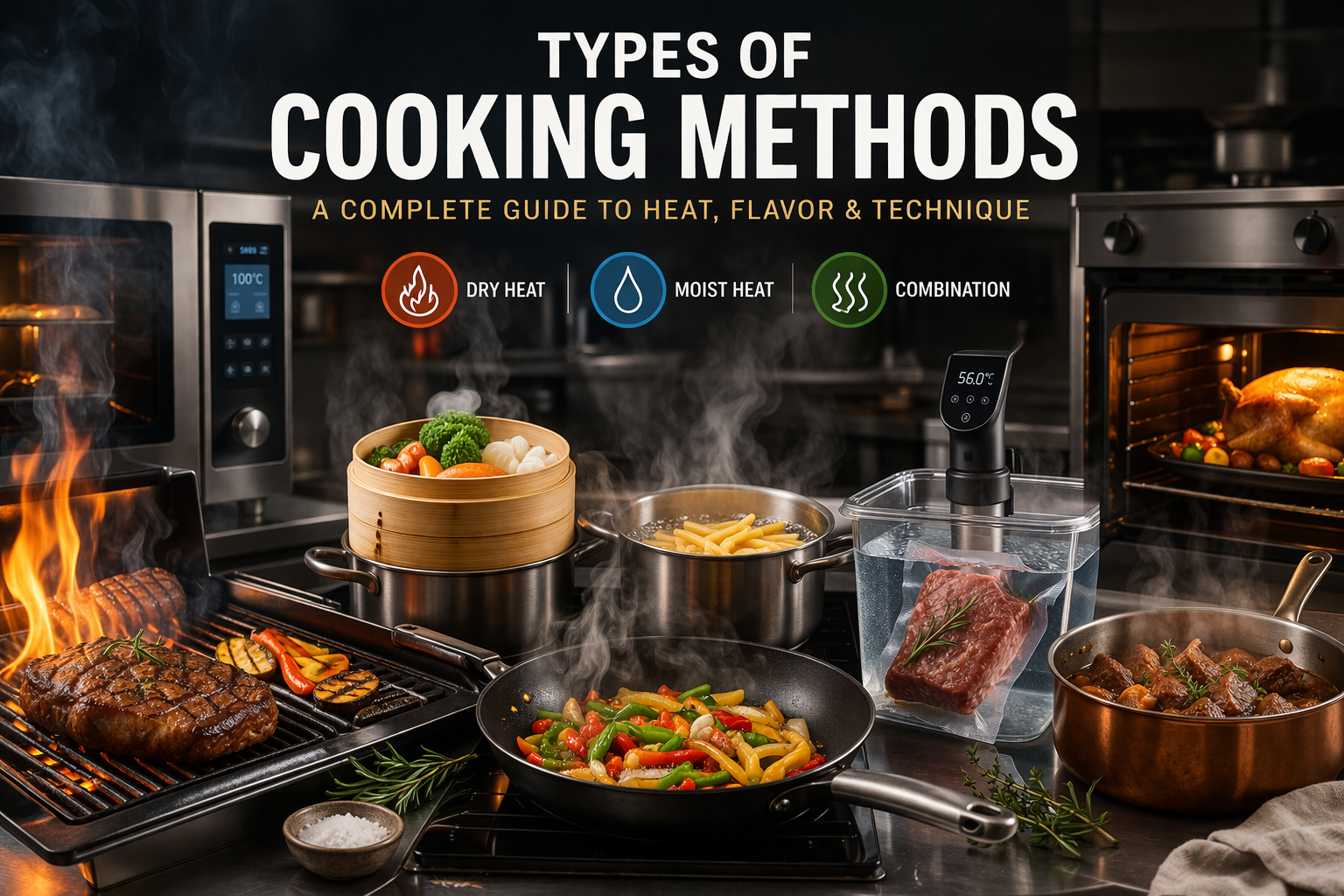
Cooking is not just a creative process. It is a controlled application of heat, moisture, and time that transforms raw ingredients into consistent, profitable menu items. In a commercial kitchen environment, understanding cooking methods is not optional. It directly impacts food cost, restaurant equipment investment, operational efficiency, and customer satisfaction.
While most guides categorize cooking into dry heat, moist heat, and combination methods, this article goes beyond classification. It explains how each method behaves at a molecular level, when to use it strategically, and how to align it with the right commercial kitchen equipment.
If you operate a restaurant, food production facility, or catering business, mastering these cooking methods will allow you to design better menus, reduce waste, and scale your kitchen operations more effectively. Understanding these cooking methods is only one part of the equation; selecting the right commercial cooking equipment ensures consistency, efficiency, and long-term kitchen performance.

The Three Core Categories of Cooking Methods
All cooking techniques fall into three fundamental categories:
- Dry heat cooking
- Moist heat cooking
- Combination cooking
Each category is defined by how heat is transferred to food and how moisture is managed during the process. The difference between a perfectly cooked steak and a dry, overcooked one often comes down to choosing the right method for the ingredient.
1. Moist Heat Cooking Methods
Moist heat cooking uses water, steam, or other liquids to transfer heat to food. This category is essential in commercial kitchens because it allows for controlled, uniform cooking while preserving moisture.
From a technical standpoint, moist heat cooking prevents surface dehydration and inhibits the Maillard reaction, meaning you will not get browning or crust formation. Instead, the focus is on tenderness, hydration, and internal consistency.
Sous Vide
Sous vide is one of the most precise cooking methods available. It involves vacuum-sealing food and cooking it in a temperature-controlled water bath.
What makes sous vide powerful is its ability to maintain exact temperatures over extended periods. Unlike traditional methods, it eliminates the risk of overcooking.
In commercial kitchens, sous vide is not just about quality. It is about consistency and labor efficiency.
Best applications:
- Steaks cooked to exact doneness levels
- Chicken breasts that remain juicy
- Fish that maintains structure and color
- Batch-prepared proteins for high-volume service
From an operational standpoint, sous vide reduces food waste and allows kitchens to prep ahead without sacrificing quality.
Poaching
Poaching operates at lower temperatures, typically between 140°F and 180°F. This method is ideal for delicate proteins that would otherwise break apart under higher heat.
The absence of agitation in the liquid ensures structural integrity, making it a preferred technique for refined menu items.
Best applications:
- Eggs for brunch service
- White fish such as cod or tilapia
- Chicken breast for salads and sandwiches
- Fruits for desserts
In a commercial context, poaching is often used where presentation and texture are critical.
Simmering
Simmering is slightly more aggressive than poaching, typically occurring between 180°F and 205°F. It allows for gradual flavor extraction and tenderization.
This method is essential for building depth in soups, sauces, and stocks.
Best applications:
- Broths and stocks
- Tough cuts of meat
- Legumes and grains
- Root vegetables
Simmering is a cornerstone technique in any professional kitchen because it transforms low-cost ingredients into high-value dishes.
Steaming
Steaming uses vaporized water to cook food without direct contact with liquid. It is one of the healthiest cooking methods because it preserves nutrients and requires no added fat.
In commercial kitchens, steaming is often executed using combi ovens or dedicated steamers.
Best applications:
- Vegetables with vibrant color and texture
- Seafood such as shellfish
- Dumplings and specialty dishes
- Custard-based desserts
Steaming is particularly valuable in high-volume operations due to its efficiency and consistency.
Boiling
Boiling occurs at 212°F and involves full submersion in rapidly moving water. While it is one of the simplest methods, it requires careful timing to avoid overcooking.
Best applications:
- Pasta
- Eggs
- Potatoes and root vegetables
From a commercial perspective, boiling is less about finesse and more about throughput and speed.
2. Dry Heat Cooking Methods
Dry heat cooking relies on air or fat to transfer heat. This category is responsible for browning, caramelization, and flavor development.
The key scientific principle here is the Maillard reaction, which creates complex flavors when proteins and sugars interact under high heat.
Baking
Baking uses indirect heat in an enclosed environment, typically an oven. It is most commonly associated with dough-based products.
Best applications:
- Bread and pastries
- Cakes and desserts
- Pizza
In commercial kitchens, baking requires precise temperature control and consistent airflow.
Grilling
Grilling uses direct radiant heat from below. It creates high temperatures quickly, resulting in charred surfaces and distinct flavor profiles.
Best applications:
- Burgers
- Steaks
- Chicken
- Firm fish
Grilling is highly desirable for its flavor output, but it requires careful monitoring to avoid moisture loss.
Roasting
Roasting is similar to baking but typically operates at higher temperatures and is used for proteins and vegetables.
It allows for even cooking while developing a browned exterior.
Best applications:
- Large cuts of meat
- Whole poultry
- Vegetables with natural sugars
Roasting is a key method for producing premium menu items with minimal active labor.
Sautéing
Sautéing uses a small amount of fat in a hot pan. It is a fast method that requires constant movement of food.
Best applications:
- Vegetables
- Small cuts of meat
- Aromatics such as onions and garlic
This method is heavily used in line cooking due to its speed and versatility.
Frying
Frying involves cooking food in hot oil. It creates a crisp exterior while sealing moisture inside.
There are three main types:
- Deep frying
- Shallow frying
- Stir frying
Best applications:
- Chicken
- Potatoes
- Breaded seafood
Frying is one of the most commercially successful cooking methods due to its strong customer appeal.
Broiling
Broiling applies intense heat from above. It is one of the fastest cooking methods and requires precise timing.
Best applications:
- Thin cuts of meat
- Fish fillets
- Vegetables
In commercial kitchens, broilers and salamanders are essential for finishing dishes quickly.
3. Combination Cooking Methods
Combination cooking uses both dry and moist heat. It is designed to break down tough fibers while still developing flavor.
This category is particularly important for cost control because it allows the use of cheaper cuts of meat.
Braising
Braising starts with searing food at high heat, followed by slow cooking in liquid.
This dual-stage process builds flavor while tenderizing the ingredient.
Best applications:
- Beef chuck
- Pork shoulder
- Lamb shank
- Root vegetables
Braising is widely used in professional kitchens to create high-margin dishes from inexpensive ingredients.
Stewing
Stewing involves fully submerging small pieces of food in liquid and cooking them slowly.
Unlike braising, the food is cut into smaller portions before cooking.
Best applications:
- Beef stew
- Chicken stew
- Vegetable-based dishes
Stewing is ideal for batch cooking and menu scalability.
How to Choose the Right Cooking Method
Selecting the correct cooking method is not random. It is a strategic decision based on several variables.
1. Cut of Meat or Ingredient Type
- Tender cuts benefit from dry heat methods like grilling or sautéing
- Tough cuts require moist or combination methods like braising
2. Desired Texture
- Crisp exterior → frying or grilling
- Soft and tender → steaming or simmering
3. Flavor Development
- Deep, complex flavors → roasting or braising
- Clean, natural flavors → steaming or poaching
4. Kitchen Efficiency
- High-volume service → boiling, frying
- Precision plating → sous vide, poaching
5. Equipment Availability
Your cooking method must align with your equipment investment. For example:
- Combi ovens allow both steaming and roasting
- Flat top grills support sautéing and searing
- Fryers enable fast, consistent output
The Relationship Between Cooking Methods and Equipment
In commercial kitchens, cooking methods are directly tied to equipment decisions. This is where many businesses fail. They choose equipment first instead of designing cooking processes first.
For example:
- If your menu relies heavily on fried items, your fryer capacity determines your peak-hour revenue
- If you use sous vide, you must invest in vacuum sealers and immersion circulators
- If steaming is a core method, a combi oven becomes a strategic asset
Understanding cooking methods allows you to build a kitchen that is not only functional but optimized for profitability.
Advanced Insight: Heat Transfer and Cooking Performance
At a technical level, cooking methods differ in how they transfer heat:
- Conduction: Direct contact, such as sautéing
- Convection: Circulating air or liquid, such as baking or boiling
- Radiation: Direct heat exposure, such as grilling or broiling
The efficiency of heat transfer impacts:
- Cooking time
- Energy consumption
- Product consistency
Professional kitchens optimize these variables to maintain speed without sacrificing quality.
Common Mistakes in Cooking Method Selection
Many kitchens underperform because they misuse cooking methods.
The most common issues include:
- Using dry heat on tough cuts, resulting in dry, chewy meat
- Overcrowding pans during sautéing, which prevents browning
- Frying at incorrect temperatures, leading to greasy food
- Boiling delicate foods that require gentler techniques
Avoiding these mistakes requires not just knowledge, but operational discipline.
Cooking methods are the foundation of every successful kitchen. They influence not only how food tastes, but how efficiently your business operates.
Understanding when to use moist heat, dry heat, or combination cooking allows you to:
- Improve food quality
- Reduce waste
- Optimize labor
- Maximize equipment ROI
In a competitive market, these are not small advantages. They are the difference between an average kitchen and a high-performing one.
If you approach cooking methods as a system rather than isolated techniques, you will gain a level of control that most kitchens never achieve.