
If you’ve ever worked in a professional kitchen, you already know this:
Not all ovens behave the same.
Two kitchens can run the same recipe at the same temperature and still get completely different results. The difference usually isn’t the chef.
It’s the oven.
And more specifically, whether that oven is convection or not.
In most professional kitchens, convection models are just one category within a broader range of commercial ovens, each designed for different cooking styles, volumes, and operational needs. Convection ovens are often described as “faster” or “more even.” That’s true—but it’s also an oversimplification. What actually matters is how they change heat transfer inside the cooking environment.
Because once you understand that, you stop guessing—and start controlling your results.

What a Convection Oven Actually Does
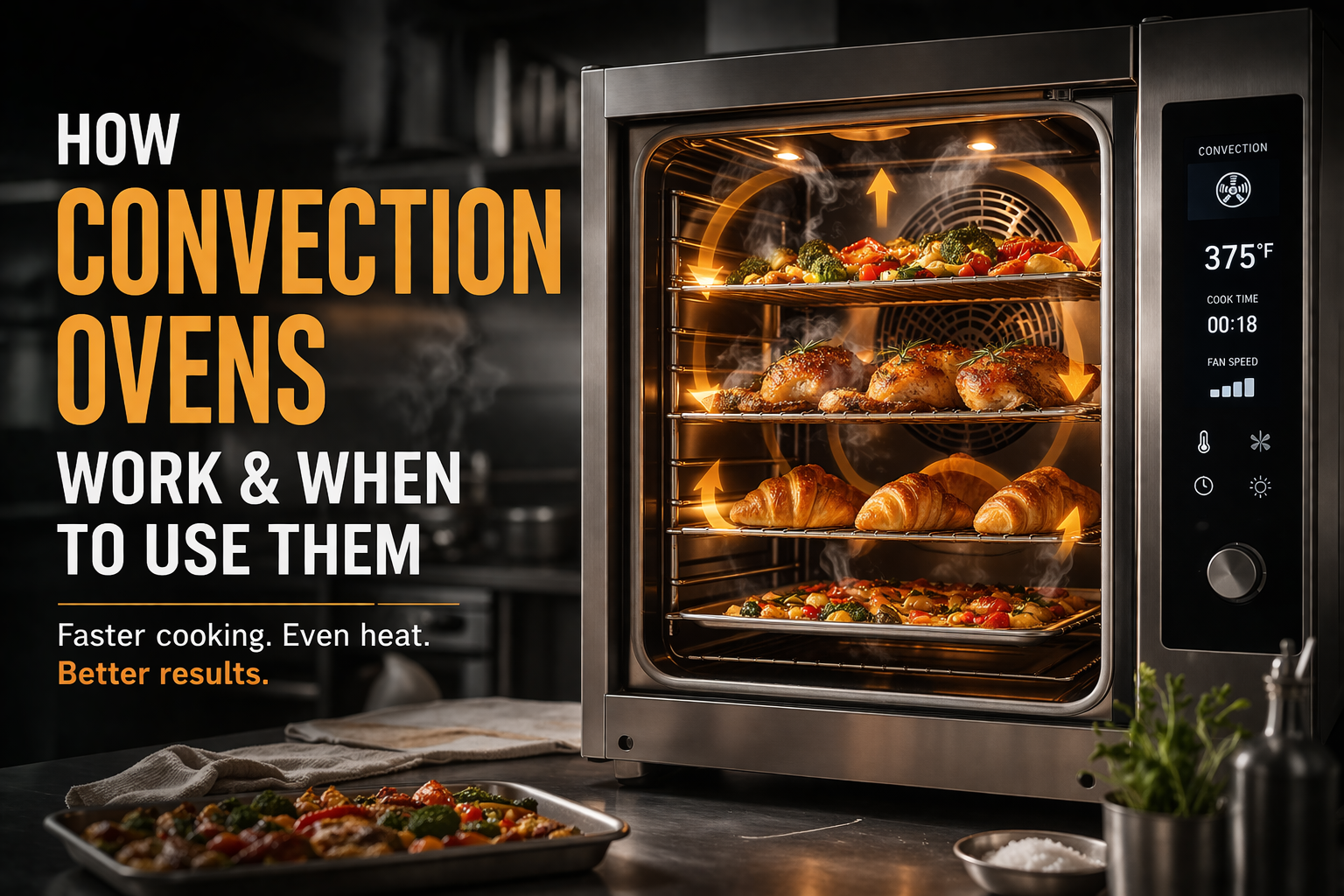
At a surface level, a convection oven uses a fan to circulate hot air.
But what’s really happening is more important.
In a standard oven, heat moves slowly and unevenly. A layer of cooler air forms around the food, acting like insulation. This slows down cooking and creates inconsistencies across the oven cavity.
A convection oven eliminates that problem.
By continuously moving hot air, it:
- Breaks the cold air barrier around food
- Increases heat transfer efficiency
- Maintains consistent temperature across the entire cavity
The result is not just faster cooking.
It’s controlled cooking.
Why Convection Changes Everything in a Commercial Kitchen
Speed is the most obvious benefit, but it’s not the most important one.
Consistency is.
In a high-volume environment, inconsistency kills efficiency. One tray cooks faster than another. One rack browns differently. One batch needs adjusting.
That slows everything down.
Convection ovens remove that variability.
Because air is constantly circulating, heat distribution becomes uniform. That means:
- Multi-rack cooking becomes reliable
- Batch-to-batch consistency improves
- Less monitoring is required
And over time, that translates directly into higher output and fewer mistakes.
The Real Reason Convection Ovens Cook Faster
You’ll often hear that convection ovens cook about 25% faster .
But speed is not magic—it’s physics.
Heat transfer happens through three main methods:
- Conduction
- Radiation
- Convection
Standard ovens rely mostly on radiation and conduction. Convection ovens actively enhance the third.
By forcing hot air onto the surface of the food, convection increases the rate at which heat is absorbed. That’s why:
- Meats develop crust faster
- Vegetables caramelize more evenly
- Pastries bake more consistently
It’s not just faster.
It’s more efficient heat delivery.
What Convection Does to Food
From a culinary perspective, convection changes how food develops on the outside and inside.
The moving dry heat accelerates evaporation on the surface. This promotes the Maillard reaction—the process responsible for browning and flavor development.
That’s why you get:
- Crisp skin on chicken
- Better crust on bread
- Even browning on cookies
At the same time, because cooking happens faster, the inside retains moisture.
This balance—dry outside, moist inside—is what most kitchens are trying to achieve.
Convection just makes it easier.
When You Should Use Convection
This is where most guides fall short.
Convection is powerful—but it’s not universal.
Where Convection Excels
Convection works best when you want:
- Browning
- Crisp texture
- Even cooking across multiple trays
Typical use cases:
- Roasting meats
- Baking cookies
- Roasting vegetables
- Toasting and finishing dishes
These are all situations where airflow improves the result.
Where Convection Can Work Against You
There are cases where airflow becomes a problem.
Delicate structures rely on stable heat, not moving air.
Examples:
- Cakes
- Soufflés
- Custards
In these cases, the fan can:
- Disrupt structure
- Cause uneven rising
- Dry out surfaces too quickly
So the rule is simple:
Use convection when you want control and browning.
Avoid it when you need stability and gentleness.
Temperature Conversion
Most operators know the rule:
Reduce temperature by about 25°F when using convection .
But in real kitchens, it’s not always that simple.
Why?
Because:
- Oven calibration varies
- Airflow strength differs by model
- Load size affects performance
So instead of relying on a fixed rule, experienced operators adjust based on:
- Product type
- Batch size
- Desired finish
The 25°F rule is a starting point—not a law.
Convection Bake vs Convection Roast
This distinction actually matters more than most people think.
Convection bake uses:
- Bottom heat + fan
This creates stable, even heat—ideal for:
- Pastries
- Cookies
- Casseroles
Convection roast adds:
- Top heat + fan
This increases surface intensity, making it better for:
- Meats
- Poultry
- High-color finishes
In simple terms:
Bake = control
Roast = intensity
Does Convection Dry Out Food?
Yes—and no.
Convection uses dry air, which removes surface moisture faster. But because it reduces cooking time, the internal moisture is often better preserved.
Problems happen when:
- Cook time is too long
- Food is not covered
- Airflow is too aggressive
The fix is simple:
- Reduce time
- Monitor earlier
- Use covers when needed
Used correctly, convection improves moisture retention—not the opposite.
The Equipment Factor
Here’s something that rarely gets discussed:
Convection performance depends heavily on the rest of your kitchen setup.
Airflow, temperature stability, prep workflow, and even how you stage food all play a role. In professional environments, convection ovens are part of a larger system of commercial kitchen equipment, not standalone tools.
That system determines:
- Throughput
- Consistency
- Labor efficiency
The oven is just one piece.
Are Convection Ovens Worth It for Restaurants?
Short answer: yes.
But not because they’re “better.”
Because they’re more predictable.
In a restaurant environment, predictability equals:
- Faster service
- Lower waste
- Better consistency
Even a 20% reduction in cook time can significantly increase output during peak hours .
That’s not a small improvement.
That’s a margin shift.
Control vs Guesswork
Traditional ovens work.
But they require more attention, more adjustment, and more guesswork.
Convection ovens reduce that.
They create a more controlled environment where results are repeatable.
And in a commercial kitchen, that’s everything.
Because consistency is what turns a good dish into a reliable one.