
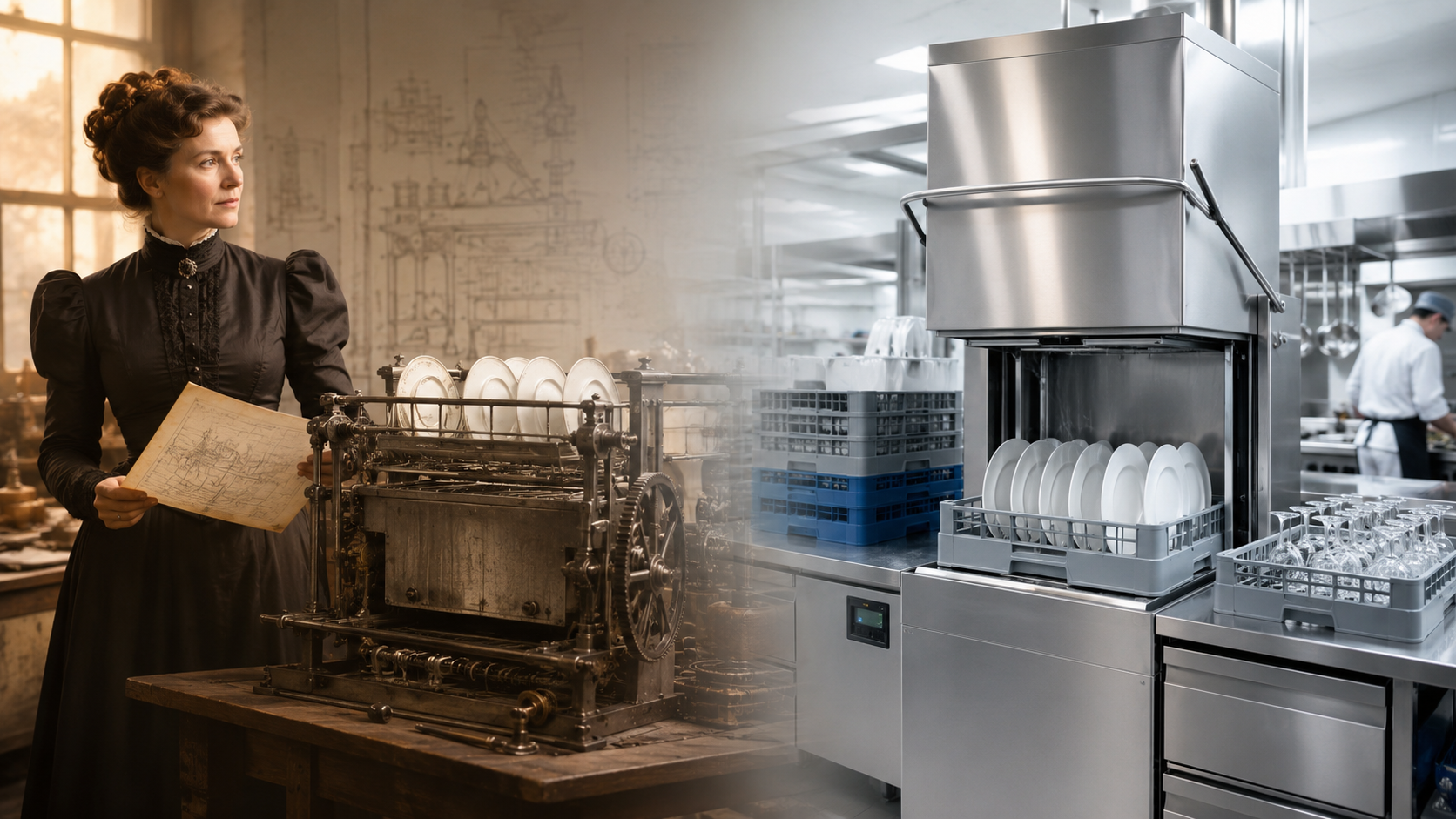
The Story Behind One of the Most Important Machines in Foodservice
Who invented the commercial dishwasher?
The commercial dishwasher, as we understand it today, traces its roots to Josephine Garis Cochrane, the American inventor who created the first practical and commercially successful dishwashing machine in the 1880s. While earlier inventors had attempted mechanical dishwashing devices, Cochrane’s design was the first to solve the problem in a way that made sense for real kitchens, especially hotels, restaurants, and other high-volume foodservice operations.
Her invention did more than wash dishes. It changed the relationship between labor, sanitation, speed, and consistency in professional kitchens. Long before modern restaurants relied on high-temperature sanitizing cycles, booster heaters, chemical sanitizers, conveyor systems, and undercounter dish machines, Cochrane had identified a problem that every foodservice operator still understands: dishes must be cleaned quickly, consistently, and without unnecessary breakage.
Today, every modern commercial dishwasher is part of a long engineering story that began with a simple but powerful idea: there had to be a better way to wash dishes than by hand.
Before Josephine Cochrane: Early Attempts at Dishwashing Machines
The idea of a mechanical dishwasher existed before Cochrane. In 1850, Joel Houghton received a U.S. patent for a hand-powered wooden machine that splashed water onto dishes. It was an important first step, but it was not very practical. The design was slow, awkward, and not effective enough to replace handwashing.
A later improvement came in the 1860s, when L.A. Alexander patented a device that used a geared mechanism to move dishes through water. This was another step forward, but it still did not solve the core problem. These early machines could move water and dishes, but they did not deliver the cleaning force, organization, durability, or efficiency needed for serious use.
That is what made Cochrane’s invention different. She did not simply want to create a novelty machine. She wanted to build a practical washing system that protected dishes, saved labor, and could be used repeatedly in a demanding environment.
Why Josephine Cochrane Invented the Dishwasher
Josephine Cochrane was not a restaurant owner or a commercial kitchen engineer. She was a woman from Shelbyville, Illinois, who became frustrated when her fine china was chipped or damaged during handwashing.
According to the well-known story, she first tried washing the dishes herself but quickly realized that handwashing was inefficient and still did not offer the protection she wanted. Her response was direct: if no one else was going to invent a better dishwashing machine, she would do it herself.
Cochrane’s motivation was practical, but her solution was highly technical. She measured plates, cups, and saucers, then designed wire compartments to hold each piece securely. Instead of relying on scrubbers, brushes, or manual rubbing, her machine used the force of hot soapy water. This was the key breakthrough. Modern dishwashers still rely on the same basic principle: properly directed water pressure, heat, detergent, and controlled cycles.
The 1886 Patent: A Turning Point in Dishwashing History
Cochrane received U.S. Patent No. 355,139 for her “Dish-Washing Machine” in 1886. Her design placed dishes into racks or cages inside a rotating wheel. As the wheel turned, hot water and soap were sprayed over the dishes. The system allowed dishes to be held in place while water did the work.
This was a major improvement over earlier devices. It reduced the risk of breakage, cleaned more efficiently, and offered a repeatable process. In many ways, Cochrane’s design introduced the logic that still defines dish machines today: secure the wares, control the water, manage the cycle, and produce consistent results.
The invention was not immediately adopted by households. At the time, the machine was expensive, and many homes did not yet have the plumbing, hot water infrastructure, or electrical systems that would later make domestic dishwashers common. But commercial users saw the value much earlier.
Why the First Successful Dishwasher Became a Commercial Machine
One of the most interesting parts of dishwasher history is that Cochrane originally imagined her machine as a solution for household dishwashing, but the strongest early demand came from commercial users.
Hotels and restaurants had a much bigger dishwashing problem than private homes. They handled large volumes of plates, glasses, cups, and utensils every day. They also needed faster turnaround, lower breakage, and more predictable cleaning. For these businesses, a dishwashing machine was not just a convenience. It was a labor-saving tool and an operational advantage.
This is why Cochrane’s invention is so important to the history of commercial dishwashers. Her machine became successful because it solved a commercial problem first. Restaurants, hotels, and institutions could justify the investment because the machine helped them process more dishes with less manual work.
In other words, the dishwasher became commercially valuable before it became a standard household appliance.
The 1893 Chicago World’s Fair and the Rise of Cochrane’s Machine
Cochrane introduced her dishwasher to a larger audience at the 1893 World’s Columbian Exposition in Chicago. The machine received recognition for its mechanical construction, durability, and suitability for its purpose.
That exposure helped validate the invention. It also connected Cochrane with the kind of buyers who could benefit most from her machine: commercial kitchens, hotels, and foodservice operations. She later founded a company to manufacture and sell her dishwashers, proving that the invention was not only technically useful but commercially viable.
This part of the story matters because many inventions fail not because the idea is bad, but because they cannot survive the market. Cochrane’s machine did survive. It found buyers. It created a business. It influenced future manufacturers. And it helped establish mechanical dishwashing as a serious category in kitchen equipment.
From Cochrane to Modern Commercial Warewashing
After Cochrane’s success, dishwasher technology continued to evolve. The company connected to her invention eventually became part of the larger appliance and warewashing industry. In the 20th century, manufacturers began developing more advanced machines for restaurants, hotels, schools, hospitals, cafeterias, and institutional kitchens.
By the 1920s, commercial dishwashing had become a more defined equipment category. Hobart, one of the best-known names in foodservice equipment, entered the warewashing market after acquiring the Crescent Washing Machine Company and launching its own dishwasher line. This helped move dishwashing from an inventive mechanical concept into a major branch of professional kitchen equipment.
As commercial kitchens grew larger and food safety expectations became stricter, dish machines became more specialized. The industry moved beyond one general machine and developed different formats for different operating needs.
How Modern Commercial Dishwashers Differ From Early Machines
Cochrane’s machine was revolutionary for its time, but modern commercial dishwashers are far more advanced. Today’s foodservice operators can choose from several types of dish machines depending on space, volume, workflow, and sanitation requirements.
Undercounter dishwashers are compact machines often used in bars, cafes, small restaurants, coffee shops, and front-of-house service areas. They fit under a counter and are ideal where space is limited.
Door-type or pass-through dishwashers are common in restaurants with moderate dish volume. Staff load a rack, close the door, run the cycle, and move the clean rack to the next station. These machines are popular because they balance capacity and footprint.
Conveyor dishwashers are built for higher-volume operations. Racks move through the machine on a conveyor, allowing continuous washing during busy service periods.
Flight-type dishwashers are designed for very high-volume facilities such as cafeterias, universities, hospitals, correctional facilities, and large institutional kitchens. Instead of using standard racks, wares are placed directly onto a moving belt or flight system.
Glasswashers are specialized for bars and beverage service, where clear, spotless glassware is essential.
Pot and pan washers are designed for larger cookware, sheet pans, mixing bowls, and preparation equipment that standard dish machines may not handle efficiently.
The basic purpose is still the same as Cochrane’s original goal: clean more wares, protect them from damage, and reduce manual labor. The difference is that modern machines also address speed, sanitization, water efficiency, energy use, chemical control, and kitchen workflow.
High-Temperature and Low-Temperature Dishwashing
One major development in modern commercial dishwashing is the difference between high-temperature and low-temperature machines.
A high-temperature commercial dishwasher uses hot water as the primary sanitizing method. These machines typically require very hot final rinse temperatures, often supported by a booster heater. They are valued for strong sanitizing performance and faster drying.
A low-temperature commercial dishwasher uses chemical sanitizer instead of extremely hot final rinse water. These machines can be useful in locations where electrical capacity, ventilation, or hot water availability is limited. They require proper chemical concentration and regular monitoring to perform correctly.
Both styles can be effective when installed, operated, and maintained properly. The right choice depends on the kitchen’s volume, utilities, local code requirements, staff workflow, and operating preferences.
Why the Commercial Dishwasher Changed Restaurants
The invention of the dishwasher had an enormous effect on restaurants and foodservice businesses. Before dish machines, dishwashing was one of the most labor-intensive parts of kitchen work. Every plate, glass, cup, fork, knife, pan, and serving piece had to be cleaned by hand.
That created several problems.
First, handwashing was slow. During busy meal periods, dirty dishes could pile up quickly and delay service.
Second, handwashing was inconsistent. Results depended heavily on the worker, water temperature, soap, scrubbing effort, and available time.
Third, breakage was expensive. Plates and glassware could be chipped, cracked, or dropped during manual washing.
Fourth, sanitation became more important as restaurants grew and public health standards became stricter. Commercial dishwashers helped create a more controlled and repeatable cleaning process.
For modern restaurants, dishwashing is not just a back-of-house chore. It affects table turnover, labor planning, food safety, customer experience, and operating cost. A slow or unreliable dish area can disrupt the entire kitchen.
The Legacy of Josephine Cochrane
Josephine Cochrane’s legacy is larger than the invention of a single appliance. She identified a real operational problem, designed a mechanical solution, secured a patent, marketed the product, and built a business around it at a time when women faced major barriers in engineering and entrepreneurship.
Her invention also proves an important point about foodservice technology: the best equipment often comes from solving a practical problem. Cochrane was not trying to create a luxury gadget. She was trying to protect dishes, save time, and improve a repetitive task. That same logic still drives commercial kitchen innovation today.
Modern dish machines may use stainless steel construction, digital controls, pumped rinse systems, chemical feeders, booster heaters, conveyor belts, and advanced wash arms, but the core idea remains connected to Cochrane’s original breakthrough. Hold the dishes securely. Direct water effectively. Clean consistently. Save labor.