
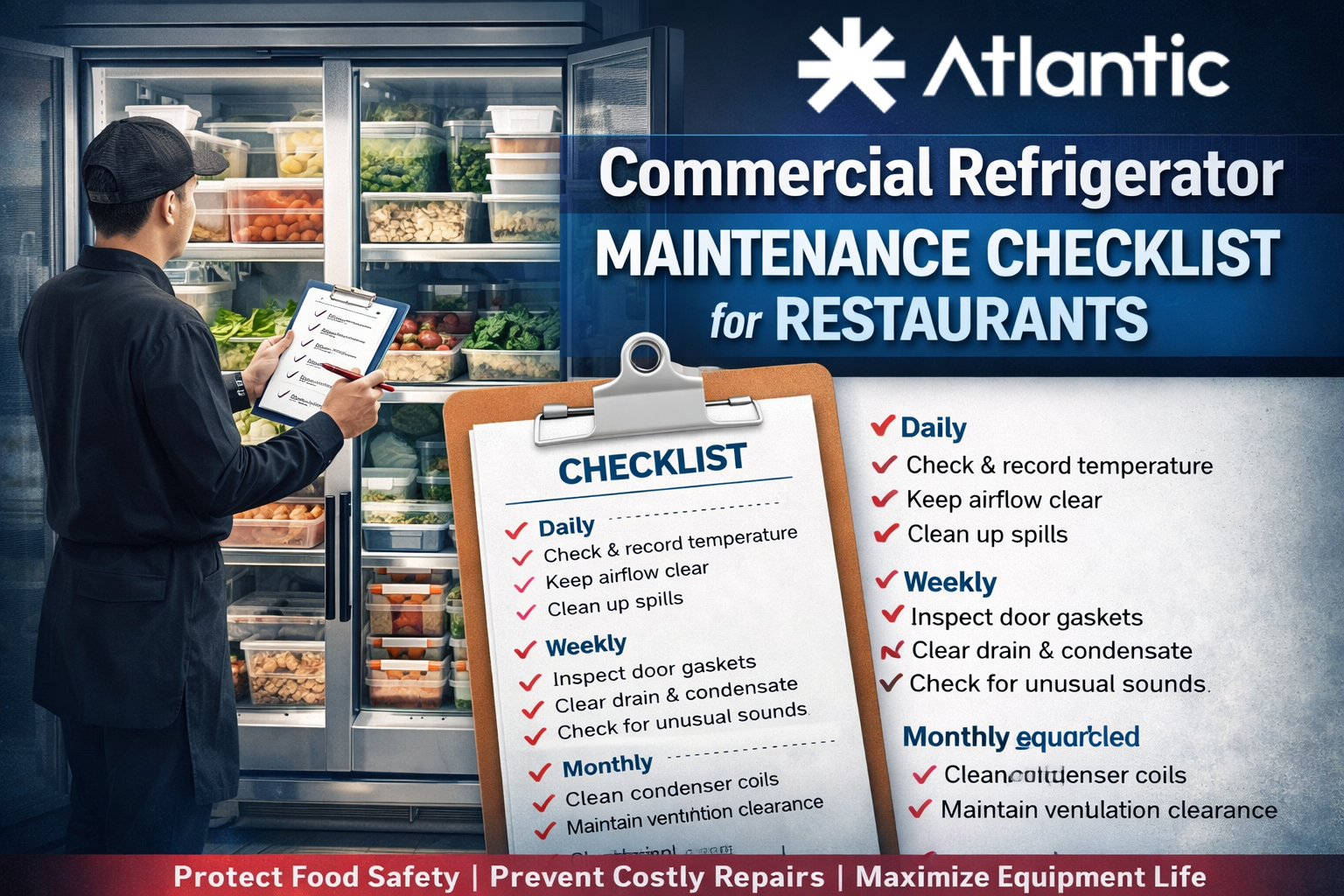
In a restaurant, refrigeration is one of those systems that operators tend to notice only when something goes wrong. A prep refrigerator starts running warm during service. A reach-in begins icing up. A merchandiser looks fine from the outside, but the product inside is not holding temperature the way it should. The common mistake is to treat these issues as isolated mechanical problems. In reality, most refrigeration failures are the final stage of neglected maintenance. Long before a compressor fails or a service call is placed, the unit has usually been giving warnings through higher energy use, slower temperature recovery, inconsistent holding performance, and added stress on key components.
That is why refrigeration maintenance matters far beyond cleanliness. It directly affects food safety, operating cost, labor efficiency, and equipment life. FDA guidance for retail and foodservice operations continues to reinforce that cold-held TCS foods should be maintained at 41°F (5°C) or below, which means maintenance is not only about protecting the asset but also about protecting the product stored inside it. Once a unit becomes unreliable, the business is exposed to food loss, compliance risk, and unnecessary downtime.
For restaurant owners, kitchen managers, deli operators, and foodservice teams, the right maintenance checklist should not be a vague “clean it regularly” reminder. It should be a practical operating system with clear daily, weekly, monthly, and scheduled tasks. That is how refrigeration moves from being a reactive expense to a managed part of the operation.
Why Refrigeration Maintenance Is a Business Issue, Not Just a Service Issue
A commercial refrigerator can still run while losing money every day. Condenser coils may be packed with dust. Door gaskets may be leaking cold air. Airflow inside the cabinet may be blocked by overloading. Drain lines may be partially obstructed. None of these issues necessarily cause immediate shutdown, but all of them reduce efficiency and increase mechanical strain. Manufacturers repeatedly emphasize condenser cleanliness because it has a direct effect on performance. True notes that condenser coils accumulate dirt and should be cleaned every 30 days or as needed, warning that a dirty coil can result in non-warranted repairs or cabinet failure. Turbo Air similarly states that condenser coils must be kept free of dust, dirt, and grease and cleaned periodically, recommending at least every 90 days or as needed depending on conditions.
This matters because refrigeration is one of the few pieces of equipment in a restaurant that operates continuously. Unlike a fryer or range, a refrigerator does not work only during peak periods. It works all day, all night, and through every service cycle. ENERGY STAR notes that commercial refrigerators and freezers can provide substantial energy savings when properly selected and operated, and restaurant-focused guidance from the program ties refrigeration efficiency directly to lower utility costs and stronger margins.
So a maintenance checklist is not simply housekeeping. It is a control system for three things restaurant operators care about most: food safety, uptime, and cost.
Daily Checklist: Protect Temperature, Airflow, and Cleanliness
Daily refrigeration maintenance begins with observation. The first check should always be temperature performance. Staff should verify that the cabinet is actually holding the expected temperature, not just that the display is lit and the unit sounds normal. For foodservice operations, the practical benchmark is straightforward: refrigerated TCS foods need to remain at 41°F or below during cold holding. If a unit is trending above that point, recovering slowly after frequent door openings, or showing large fluctuations during the day, it should be escalated immediately.
The next daily priority is interior organization and airflow. A commercial refrigerator is not just a cold box; it is an airflow-driven system. Overloading shelves, stacking product against air channels, or packing warm food tightly into an already busy cabinet reduces recovery and creates hot spots. This becomes especially important in prep refrigerators and reach-ins used heavily during service. Good daily practice means keeping air passages open, avoiding unnecessary door-open time, and making sure the unit is being used for its intended storage function rather than as overflow for everything else happening in the kitchen. Manufacturer literature highlights design features such as temperature airflow control and rapid recovery because airflow discipline is central to stable performance.
Daily cleaning also matters, but it should be done correctly. Interior spills, crumbs, food residue, and standing moisture should be removed before they become a sanitation issue or contribute to odor and contamination risk. The key is to use approved cleaners and avoid abrasive practices that can damage surfaces or seals. Turbo Air’s manuals likewise recommend warm water and mild soap for routine cleaning and specifically caution against abrasive cleaners that can scratch the unit.
A strong daily checklist should therefore include these basics: verify temperature, inspect the product load for airflow blockage, clean spills immediately, minimize door-open time, and confirm that staff are not using the refrigerator in ways that compromise performance.
Weekly Checklist: Focus on Gaskets, Drains, and Early Warning Signs
If daily maintenance is about stability, weekly maintenance is about catching deterioration before it becomes expensive. The first item here is the door gasket. Gaskets are easy to ignore because they are inexpensive compared to compressors and controls, but they have an outsized effect on efficiency. When the gasket is torn, brittle, loose, or dirty enough to prevent a tight seal, cold air escapes and warm kitchen air enters. That increases compressor run time, reduces temperature stability, and creates avoidable energy waste. Turbo Air recommends frequent gasket cleaning to maintain proper sealing, and broader troubleshooting guidance consistently identifies damaged gaskets as a major cause of performance loss.
A weekly gasket check should include more than a quick glance. Staff should look for tears, hardened corners, sections pulling away from the door, dirt buildup, and any signs that the door is not closing flush. It is also smart to watch for condensation around the door frame, which can indicate air leakage or a sealing problem. On higher-use units, especially prep tables and busy reach-ins, these checks should be taken seriously because doors may be opened hundreds of times per day.
Condensate and drain areas also deserve weekly attention. Water pooling inside or around the cabinet is not just a nuisance. It may signal a blocked drain, dirty drain pan, or moisture management issue that can lead to sanitation concerns and unnecessary service calls. FDA guidance related to ready-to-eat food control also underscores the importance of removing exposed food before cleaning coolers, freezers, condenser units, or condensate-related components, which highlights how maintenance intersects with contamination prevention.
A weekly review should also pay attention to operating behavior. Is the compressor sounding different? Is frost appearing where it normally does not? Is the cabinet taking longer to pull down after deliveries? Small changes in performance are often the earliest warning signs. Restaurants that catch them weekly avoid paying for them monthly.
Monthly Checklist: Condenser Coil Cleaning Is Non-Negotiable
If there is one maintenance task that deserves to be treated as non-negotiable, it is condenser coil inspection and cleaning. This is where many refrigeration maintenance programs succeed or fail. True’s guidance is especially blunt: condenser coils accumulate dirt and should be cleaned every 30 days or as needed, and dirty coils can lead to non-warranted repairs or cabinet failure. More recent True manuals repeat the same point and recommend checking coils every 30 days.
That recommendation matters even more in real kitchens, where grease, flour dust, lint, and general airborne debris are constant. In a restaurant with fryers, open cooking, or poor housekeeping around the mechanical side of equipment, condenser fouling can happen quickly. Turbo Air advises that condenser coils be kept free of dust, dirt, and grease and cleaned at least every three months or more often if needed. The variation in manufacturer intervals is not a contradiction; it reflects operating environment. In a clean, lower-demand setting, 90 days may be acceptable. In a hotter, greasier, higher-volume kitchen, 30-day inspection is the safer discipline.
The business case is simple. Dirty coils reduce heat rejection, drive up compressor workload, increase power consumption, and shorten component life. ENERGY STAR restaurant guidance ties efficient operation of refrigeration equipment directly to lower utility costs, and coil cleanliness is one of the most basic conditions for achieving that efficiency in the real world.
Monthly maintenance should also include checking louvers and ventilation clearance around self-contained units. If the unit cannot breathe, it cannot perform. Some equipment manuals explicitly warn against placing filter material or obstructions in front of the condensing coil. That kind of “quick fix” often creates a worse long-term problem.
Quarterly and Scheduled Maintenance: Get Beyond Basic Cleaning
A restaurant that wants to keep refrigeration reliable should not stop at daily and monthly wipe-downs. Scheduled deeper maintenance is where long equipment life is built. Depending on the model and operating environment, this may include a more detailed inspection of fans, controls, hinges, defrost operation, anti-condensate systems, and alarm behavior. Some manufacturers even build reminders into their controls. Master-Bilt, for example, notes that certain units display a blinking “CL” and buzzer at six-month intervals to remind operators to clean the condenser coil. That tells you how central condenser maintenance is to ongoing performance.
Quarterly review is also a good time to examine whether the refrigerator is being used correctly from an operational standpoint. Has the menu changed? Has throughput increased? Is a reach-in now functioning as a prep backup and bulk storage cabinet at the same time? Many refrigeration issues are operational misuse disguised as equipment trouble. A unit that is consistently overloaded, opened too often, or asked to cool product loads it was never intended to handle will age faster even if it receives surface cleaning.
This is also where restaurants should assess energy performance and maintenance history together. ENERGY STAR resources encourage businesses to benchmark and understand their energy use rather than treating utility bills as fixed overhead. If one store or one piece of equipment is becoming unusually costly to operate, maintenance history is often part of the explanation.
Food Safety Must Be Part of the Maintenance Checklist
One reason refrigeration maintenance is often undervalued is that people frame it as an engineering issue instead of a food safety issue. That is a mistake. For restaurants, the entire purpose of refrigeration is to keep food in a safe holding range. FDA materials across the Food Code, retail guidance, and inspection documentation reinforce the same operational standard: cold-held TCS foods should be maintained at 41°F or below.
That standard becomes even more important when kitchens are cooling hot foods for later service. FDA cooling guidance explains that cooked TCS food should move from 135°F to 70°F within 2 hours and from 70°F to 41°F or below within the next 4 hours. A poorly performing refrigerator or overloaded unit can interfere with that process, especially if staff assume “it’s cold enough in there” without checking actual pull-down performance.
In practical terms, a maintenance checklist should include documented temperature checks, response procedures for deviations, and clear rules for when a unit should be taken out of service pending repair. A refrigerator that looks clean but does not hold temperature is not a safe refrigerator.
What a Strong Restaurant Refrigeration Checklist Should Include
A serious checklist should separate operator tasks from technician tasks. Staff can and should handle cleaning, temperature verification, gasket inspection, loading discipline, and routine observation. Licensed service providers should handle deeper mechanical diagnosis, refrigerant-related issues, advanced electrical problems, and component replacement beyond normal operator maintenance. This distinction protects both safety and warranty expectations. Manufacturer manuals regularly instruct operators to contact licensed refrigeration service providers when dirt cannot be adequately removed or deeper service is required.
At the operator level, the essentials are clear. Daily: verify temperatures, clean spills, protect airflow, and confirm doors close properly. Weekly: clean and inspect gaskets, check drains and moisture, and note any unusual sound, frost, or recovery issues. Monthly: inspect and clean condenser coils, clear louvers, and review whether the environment around the unit is contributing dust, grease, or heat load. Quarterly or scheduled: assess hinges, controls, fan operation, door alignment, and whether the unit still matches the demands of the kitchen.
That rhythm is what separates maintenance from guesswork.
The best refrigeration maintenance checklist is not the one with the most boxes. It is the one that actually fits the pace and reality of a working restaurant. A good checklist protects three things at once: the equipment, the food, and the margin. It keeps a minor issue from becoming a late-night service call. It keeps a dirty condenser from becoming a failed compressor. It keeps a worn gasket from becoming a chronic temperature problem. And most importantly, it keeps refrigeration aligned with what restaurants truly need from it: reliable, safe, efficient cold holding every hour of every day.
For Atlantic, that is the right perspective to bring into the conversation. Restaurants do not just buy refrigeration equipment. They invest in uptime, food protection, and operational control. A strong maintenance culture is what allows that investment to pay off.