
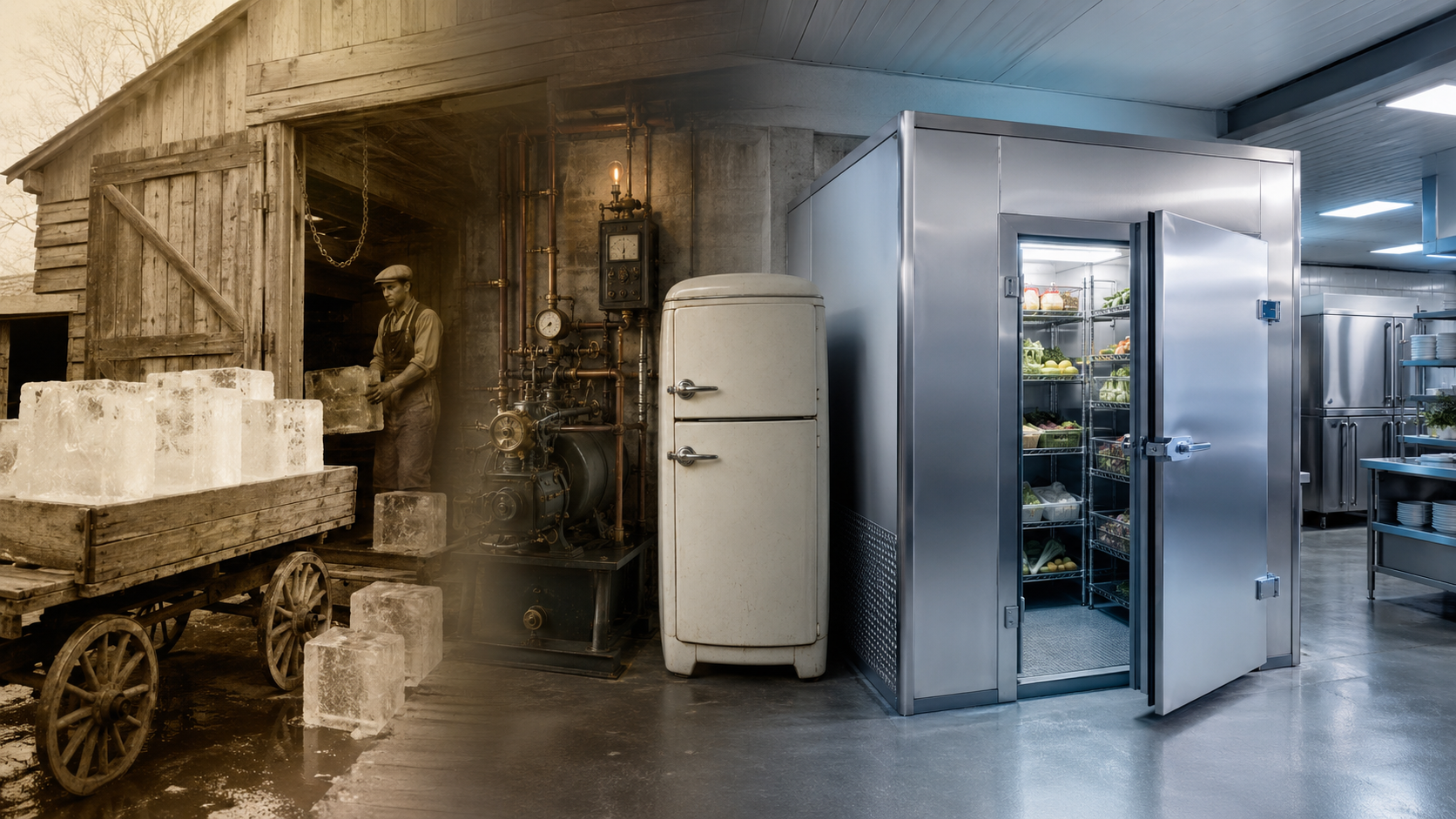
Refrigeration is one of those inventions that quietly changed almost everything. It changed how families stored food, how restaurants planned menus, how grocery stores displayed fresh products, how meat and seafood traveled across the country, and how modern food businesses became possible. Today, it is easy to walk into a kitchen, open a refrigerator, step inside a walk-in cooler, or pull frozen inventory from a commercial freezer without thinking much about the history behind it. But the story of refrigeration is much bigger than one appliance or one inventor.

So, when was the refrigerator invented?
The most accurate answer is that refrigeration was not invented in a single moment. The science of artificial refrigeration began in the 1700s, the first vapor-compression refrigeration concept appeared in the early 1800s, the first working mechanical refrigeration system was built in the 1830s, and practical household refrigerators became common much later, especially in the early 20th century. Commercial refrigeration, meanwhile, developed alongside ice production, breweries, meatpacking, cold storage, and eventually restaurants, supermarkets, convenience stores, and foodservice operations.
In simple terms, artificial refrigeration started with scientific experiments in the 1700s, became mechanical in the 1800s, entered homes in the early 1900s, and became essential to modern food businesses throughout the 20th century.
The short answer: when was the refrigerator invented?
If you are looking for the quick answer, the first working vapor-compression refrigeration system was built by Jacob Perkins in 1834. Perkins is often called one of the key inventors of the refrigerator because his machine used the basic vapor-compression cycle that still influences modern refrigeration technology today. Before Perkins, Oliver Evans had described a closed vapor-compression refrigeration system in 1805, but he did not build it. ASHRAE’s industry history timeline lists Oliver Evans’ 1805 proposal and Jacob Perkins’ 1834 mechanical refrigeration patent as major milestones in refrigeration history.
However, the answer changes depending on what someone means by “refrigerator.” If they mean the scientific discovery of artificial refrigeration, the story goes back to William Cullen’s laboratory demonstration in the 1700s. If they mean the first practical mechanical refrigerator, Jacob Perkins in the 1830s is the key figure. If they mean the first widely used home refrigerator, the answer moves into the 1900s, with electric household refrigerators becoming more practical and affordable over time. The GE Monitor Top refrigerator, introduced in 1927, became one of the best-known early affordable domestic refrigerators in the United States.
That is why a complete answer needs a timeline, not just one date.
Refrigeration before the refrigerator: ice, cellars, and natural cooling

Long before mechanical refrigeration, people still needed to keep food cool. They used underground storage, cellars, ice houses, springhouses, snow, river ice, and insulated containers. In colder climates, ice could be harvested in winter and stored for warmer months. In some parts of the world, ancient cooling structures used insulation, evaporation, wind, and underground spaces to preserve food and water.
This early period matters because refrigeration did not begin as a household appliance. It began as a human need: slowing spoilage. Meat, dairy, fish, produce, and drinks all had limited shelf life before reliable cooling. Food preservation depended on salting, drying, smoking, pickling, fermentation, or naturally cold environments.
The invention of mechanical refrigeration was revolutionary because it made cold more controllable. Instead of depending on winter ice, local climate, or underground storage, businesses could eventually produce and maintain cold temperatures on demand.
That single shift changed food commerce forever.
The science begins: William Cullen and artificial refrigeration
One of the earliest scientific milestones came from Scottish physician and professor William Cullen. In the 1700s, Cullen demonstrated artificial refrigeration by lowering pressure over a liquid, causing it to evaporate and absorb heat from the surrounding environment. This produced a cooling effect, and in some accounts, a small amount of ice. It was an important scientific demonstration, but it was not a practical refrigerator for everyday use.
This distinction is important for SEO because many people search “when was refrigeration invented” or “who invented refrigeration” expecting one simple answer. Cullen helped demonstrate the principle of artificial cooling, but his work did not directly create the refrigerator as a commercial product.
In other words, Cullen helped prove that artificial cooling was possible. Later inventors turned that idea into machinery.
Oliver Evans: the refrigerator that was designed before it was built
In 1805, American inventor Oliver Evans described a closed vapor-compression refrigeration cycle. This is one of the most important moments in refrigeration history because vapor-compression technology became the foundation for modern refrigerators, freezers, walk-in coolers, and many commercial refrigeration systems.
Evans’ design was ahead of its time. He described the concept, but he did not build a working machine. Still, his contribution was essential because he helped define the mechanical approach that later inventors would develop more fully. ASHRAE’s refrigeration chronology identifies Evans’ 1805 closed-cycle vapor-compression proposal as a major refrigeration milestone.
So, was Oliver Evans the inventor of the refrigerator?
He is better described as the inventor who designed an early vapor-compression refrigeration concept. The first working system came later.
Jacob Perkins: the first working mechanical refrigerator
Jacob Perkins is one of the most important names in refrigerator history. In 1834, Perkins built and patented a working vapor-compression refrigeration system. His machine could operate continuously in a closed cycle, making it a major step toward modern refrigeration.
This is why many sources identify Perkins as the inventor of the first practical refrigerator or the “father of the refrigerator.” His invention did not look like the home refrigerator we know today, and it was not created for modern kitchen use. But mechanically, it represented the breakthrough that made controlled artificial cooling much more realistic.
For the keyword “who invented the refrigerator,” the most useful answer is:
Jacob Perkins built the first working vapor-compression refrigeration system in 1834, based on earlier ideas such as Oliver Evans’ 1805 refrigeration concept.
That answer is both accurate and search-friendly because it recognizes the difference between concept, working machine, and mass-market appliance.
Where was the refrigerator invented?
The answer depends on which milestone you mean. William Cullen’s artificial refrigeration experiment is associated with Scotland. Oliver Evans’ vapor-compression concept came from the United States. Jacob Perkins, an American inventor working in Britain, patented his mechanical refrigeration machine in the 1830s.
For users searching “where was the refrigerator invented,” the best answer is not one single location. The refrigerator evolved through contributions from Scotland, the United States, Britain, Australia, Germany, France, and other countries. Refrigeration was a global engineering story, not just one local invention.
That said, if the question refers to the first working vapor-compression refrigeration system, Jacob Perkins’ work in Britain is usually the key reference point.
John Gorrie and the rise of ice-making
Another major figure in refrigeration history is Dr. John Gorrie, a physician in Florida. Gorrie wanted to cool hospital rooms and help patients in hot climates. In the mid-1800s, he developed a mechanical ice-making machine and received a U.S. patent in 1851. Wired’s historical account describes Gorrie’s 1850 public demonstration of mechanically produced ice as an important American refrigeration milestone.
Gorrie’s story is important because it shows how refrigeration was not only about food. It was also connected to medicine, public health, comfort, and climate control. His work helped push the idea that cold could be manufactured where natural ice was expensive or unavailable.
This idea became especially important for warmer regions, cities, shipping routes, and eventually commercial kitchens.
James Harrison and commercial ice production
In the 1850s, James Harrison, a Scottish-Australian inventor, developed mechanical refrigeration systems that were used for ice-making and industrial cooling. His work helped move refrigeration from the laboratory into commercial use.
This period was crucial because refrigeration started to become an industrial tool. Instead of only asking whether food could be cooled, businesses started asking how cooling could improve production, storage, transportation, and profit.
That question is still the heart of commercial refrigeration today. A restaurant does not buy a reach-in freezer simply because it wants cold air. It buys refrigeration to protect inventory, reduce waste, stay compliant, serve customers consistently, and keep operations running.
Carl von Linde and industrial refrigeration
By the late 1800s, refrigeration became more efficient, more commercial, and more industrial. German engineer Carl von Linde played a major role in this transition. Linde developed refrigeration systems that were especially important for breweries and industrial applications. Britannica identifies Linde as a major figure in refrigeration, cryogenics, and air separation, and his work helped bring refrigeration into large-scale industrial use.
Breweries were among the first major businesses to benefit from reliable refrigeration because beer production requires controlled temperatures. Meatpacking, cold storage warehouses, food distribution, and grocery retail also depended heavily on refrigeration as the technology improved.
This is the bridge between invention and modern business. The refrigerator was not just a household convenience. It became infrastructure.
When was the first home refrigerator invented?
The first mechanical refrigeration systems were not designed for ordinary homes. Early systems were expensive, bulky, complex, and sometimes used refrigerants that were not ideal for residential settings. Home refrigeration became more realistic in the early 20th century as electric motors, sealed systems, manufacturing, and refrigerant technology improved.
Small domestic refrigerators existed before the late 1920s, but they were often expensive. The GE Monitor Top refrigerator, sold between 1927 and 1936, became one of the best-known early electric refrigerators. The Powerhouse Collection notes that small domestic refrigerators had existed earlier, including Kelvinator in 1918, but they were costly; the GE Monitor Top helped make domestic refrigeration more affordable.
This is why many people associate the modern household refrigerator with the 1920s and 1930s. It was during this period that electric refrigerators started moving from luxury products toward common household appliances.
When were freezers invented?
Freezers developed after refrigeration technology had already advanced. The basic science of freezing was part of the same refrigeration story, but separate household freezer units became more common later than refrigerators.
Early mechanical refrigeration could produce ice and freezing temperatures, but the home freezer as a common appliance became more widespread in the 20th century, especially around and after the 1940s. The term “deep freeze” became popular during that period, and home freezer units became more practical after World War II as manufacturing and household appliance adoption expanded.
For commercial use, however, freezing was important much earlier. Ice production, cold storage, meatpacking, and frozen food distribution all depended on the ability to maintain low temperatures at scale.
Today, the distinction between refrigeration and freezing is operationally important. A commercial refrigerator typically keeps products cold above freezing, while a commercial freezer holds products at freezing temperatures. A walk-in cooler is built for refrigerated storage, while a walk-in freezer requires additional design considerations, including flooring, insulation, refrigeration capacity, and temperature control.
How refrigeration changed restaurants and food businesses
The invention of refrigeration completely changed the foodservice industry. Before reliable refrigeration, restaurants had to work around limited shelf life, frequent deliveries, seasonal availability, and higher spoilage risk. With refrigeration, food businesses could store ingredients safely, buy in larger quantities, expand menus, and serve customers more consistently.
Modern restaurants depend on several layers of refrigeration. A typical foodservice operation may use reach-in refrigerators, prep tables, undercounter units, refrigerated display cases, ice machines, walk-in coolers, walk-in freezers, and specialized storage for meat, seafood, dairy, beverages, produce, and prepared foods.
This is why refrigeration is not just equipment. It is part of the operating system of a food business.
A restaurant can have a great chef, strong branding, and a good location, but without reliable refrigeration, the business is exposed to food safety problems, inventory loss, menu interruptions, and emergency repair costs.
How refrigeration changed grocery stores and supermarkets
Supermarkets would not exist in their modern form without commercial refrigeration. Refrigerated display cases, open-air merchandisers, glass-door coolers, walk-in storage, meat cases, dairy cases, produce rooms, and frozen food aisles all depend on refrigeration.
Before modern refrigeration, grocery shopping was more limited, more local, and more seasonal. Refrigeration made it possible to centralize storage, expand selection, and keep perishable products available for longer periods.
This is especially important for high-volume food retail. A supermarket does not only need a refrigerator. It needs a refrigeration strategy. The store has to think about product zones, temperature ranges, display visibility, energy use, maintenance, redundancy, and back-of-house storage.
That is why commercial refrigeration is a major investment category for supermarkets, delis, bakeries, butcher shops, convenience stores, flower shops, and specialty food retailers.
From household refrigerators to walk-in coolers
The home refrigerator changed daily life, but the walk-in cooler changed food business operations.
A household refrigerator is designed for convenience. A walk-in cooler is designed for volume, workflow, and commercial storage. Restaurants, supermarkets, commercial kitchens, bakeries, breweries, florists, convenience stores, and food distributors use walk-in coolers because they need more than a cabinet-sized appliance.
A walk-in cooler allows a business to store bulk inventory, organize products by category, reduce spoilage, and support daily operations. For many food businesses, the walk-in cooler is one of the most important pieces of infrastructure in the building.
The historical development of refrigeration leads directly to the modern walk-in cooler. The same core goal remains: control temperature, protect product quality, and make perishable goods easier to manage.
Modern commercial refrigeration: what changed?
Modern refrigeration systems are more advanced, efficient, and specialized than early machines. Today’s commercial refrigeration equipment may include digital controllers, improved insulation, efficient compressors, better evaporator design, safer refrigerants, modular panels, remote refrigeration options, top-mounted systems, and more precise temperature control.
Refrigerants have also changed over time. Older refrigerants created safety or environmental concerns, leading to major regulatory changes. The EPA notes that new production and import of most HCFCs were phased out as of 2020, with remaining use limited mainly to servicing existing equipment.
For food businesses, this means refrigeration is not only about buying equipment. It is about choosing systems that fit current operational, energy, maintenance, and regulatory realities.
A restaurant owner buying a walk-in cooler today is making a very different decision than a business owner buying an icebox 150 years ago. But the underlying problem is the same: how to keep perishable inventory safe, fresh, and profitable.
Why the history of refrigeration still matters for buyers today
The history of refrigeration is not just an interesting timeline. It helps explain why modern refrigeration equipment is so critical.
Every major step in refrigeration history solved a business problem. Ice houses solved seasonal storage. Mechanical ice-making solved supply limitations. Industrial refrigeration helped breweries and meatpackers scale. Household refrigerators changed family food storage. Commercial refrigeration transformed restaurants and supermarkets.
Today, the same logic applies. The right refrigeration system helps a business protect inventory, reduce waste, improve workflow, meet food safety expectations, and serve customers consistently.
That is why choosing commercial refrigeration should never be treated as a simple equipment purchase. It is a business decision.
A small café may need reliable reach-in refrigeration and an undercounter prep setup. A busy restaurant may need a walk-in cooler and a separate walk-in freezer. A supermarket may need multiple display cases, storage rooms, and a planned refrigeration layout. A flower shop may need floral cooling designed around product freshness, humidity, and display needs.
The technology has changed, but the purpose remains the same: controlled cold creates commercial stability.
Atlantic and the modern refrigeration buyer
At Atlantic Restaurant & Supermarket Equipment, we work with food businesses that rely on refrigeration every day. From restaurants and delis to supermarkets, bakeries, convenience stores, and specialty food retailers, refrigeration is one of the most important investments a business can make.
Modern buyers are not just asking, “When was the refrigerator invented?” They are also asking practical questions:
What size walk-in cooler do I need? Should I choose a walk-in cooler or a walk-in freezer? Do I need a floor for my freezer? What is the difference between a top-mount and remote refrigeration system? How quickly can I get a unit delivered? Can I buy a standard quick-ship box, or do I need a custom project?
These questions show how far refrigeration has come. What started as scientific experimentation is now a critical part of restaurant and supermarket infrastructure.
Atlantic helps businesses evaluate commercial refrigeration equipment based on size, application, location, delivery requirements, and long-term operational needs. Whether a business needs a reach-in refrigerator, commercial freezer, refrigerated display case, ice machine, walk-in cooler, or walk-in freezer, the goal is the same: choose equipment that supports the business, not just the building.
Refrigerator invention timeline
Here is a simple timeline of the refrigerator and refrigeration history:
In the 1700s, William Cullen demonstrated artificial refrigeration principles in a laboratory setting.
In 1805, Oliver Evans described a closed vapor-compression refrigeration cycle.
In 1834, Jacob Perkins built and patented a working vapor-compression refrigeration system.
In the mid-1800s, inventors such as John Gorrie and James Harrison advanced mechanical ice-making and commercial refrigeration.
In the late 1800s, Carl von Linde helped make industrial refrigeration more efficient and commercially important.
In the early 1900s, household refrigerators became more practical.
In 1927, GE’s Monitor Top refrigerator became one of the best-known early affordable electric refrigerators in the United States.
In the mid-20th century, home freezers and frozen food storage became more common.
In the modern era, commercial refrigeration expanded into highly specialized systems for restaurants, supermarkets, warehouses, flower shops, convenience stores, and foodservice operations.
Frequently asked questions about refrigerator history
When was the refrigerator invented?
The first working vapor-compression refrigeration system was built by Jacob Perkins in 1834. However, the science of artificial refrigeration began earlier, and practical household refrigerators became common much later, especially in the early 20th century.
Who invented the refrigerator?
Jacob Perkins is often credited with building the first working mechanical refrigerator in 1834. Oliver Evans designed an earlier vapor-compression refrigeration concept in 1805, but he did not build it.
When was the fridge invented?
The mechanical refrigerator was developed in the 1830s, but the household fridge became practical and more common in the early 1900s. Electric domestic refrigerators became more widely adopted in the 1920s and 1930s.
When was refrigeration invented?
Artificial refrigeration began as a scientific concept in the 1700s. Mechanical refrigeration developed in the 1800s, especially with Oliver Evans’ 1805 concept and Jacob Perkins’ 1834 working system.
Who invented refrigeration?
No single person invented refrigeration alone. William Cullen demonstrated artificial cooling principles, Oliver Evans described a vapor-compression system, Jacob Perkins built a working machine, and later inventors such as John Gorrie, James Harrison, and Carl von Linde helped make refrigeration practical and commercial.
When were freezers invented?
Freezing technology developed from the same refrigeration science used for ice-making and mechanical cooling. Separate household freezers became more common in the 20th century, especially around and after the 1940s.
What was the first refrigerator?
If we mean the first working mechanical refrigeration system, Jacob Perkins’ 1834 vapor-compression machine is one of the most important answers. If we mean the first widely recognized affordable home refrigerator in the United States, the GE Monitor Top from 1927 is one of the best-known examples.
Where was the refrigerator invented?
The refrigerator developed through contributions from multiple countries. William Cullen worked in Scotland, Oliver Evans was American, Jacob Perkins was an American inventor working in Britain, and later refrigeration advances came from inventors and engineers in the United States, Europe, and Australia.
The refrigerator was not invented in one day by one person. It evolved through centuries of food preservation, scientific discovery, mechanical engineering, industrial demand, and commercial need. From William Cullen’s early artificial cooling experiments to Oliver Evans’ vapor-compression concept, Jacob Perkins’ working machine, Carl von Linde’s industrial refrigeration systems, and the rise of modern home and commercial refrigerators, the history of refrigeration is really the history of controlled cold becoming part of everyday life.
For homes, refrigeration changed how people stored food. For restaurants and supermarkets, it changed the entire business model.
Today, refrigeration is still one of the most important investments in the food industry. A reliable commercial refrigerator, freezer, ice machine, or walk-in cooler is not just a piece of equipment. It is the foundation that protects inventory, supports food safety, reduces waste, and keeps a business running.
That is why the invention of the refrigerator matters. It did not simply make food colder. It made modern food business possible.