
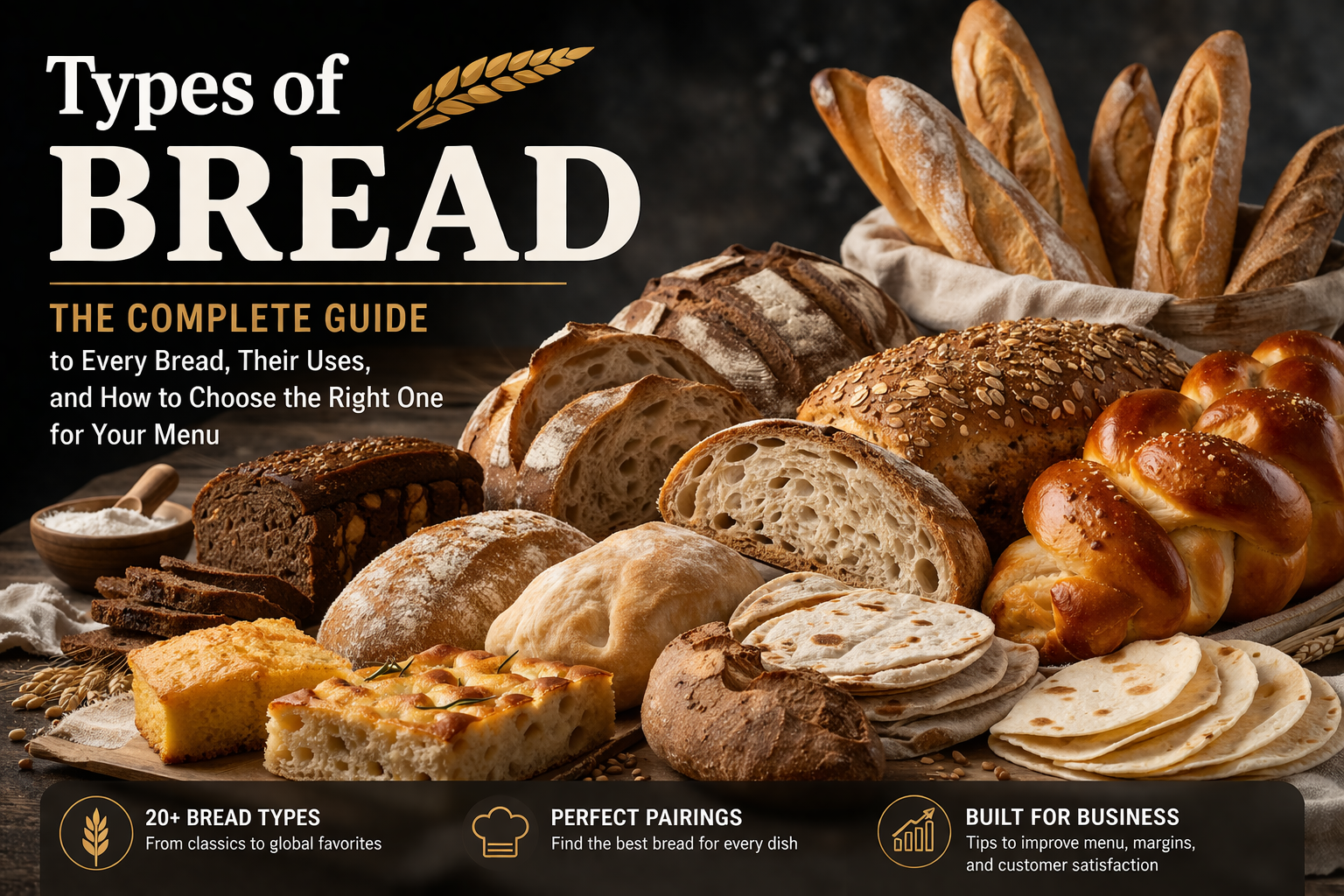
Bread is one of the oldest foods in human history, but in a commercial kitchen, it’s not just tradition, it’s a strategic decision.
The type of bread you use directly affects menu structure, plating, food cost, preparation workflow, and even how customers perceive your brand. In many successful restaurants, bread is not treated as a side item. It’s a foundation. It carries the product, absorbs flavor, and in many cases, defines the experience.
Yet most businesses still approach bread the wrong way. They think in terms of names—baguette, brioche, sourdough—rather than understanding how each bread behaves in a real kitchen environment.
If you want consistency, efficiency, and better margins, you need to think differently.

Bread Is Not One Category
From an operational standpoint, bread is not a single product category. It’s a system made up of structure, hydration, fermentation, and purpose.
Two breads can look similar on the surface but behave completely differently once they hit the plate.
A crusty baguette fractures and adds texture.
A brioche compresses and absorbs fat.
A ciabatta holds structure under pressure.
A tortilla wraps and contains.
Understanding these differences is what separates a basic menu from a well-engineered one.
The Three Structural Categories That Define All Bread
Even though there are hundreds of bread types globally, almost all of them fall into three structural systems. And this is where things start to make sense from a kitchen perspective.
1. Yeast-Fermented Breads (Structure + Flavor Development)
This is the backbone of most commercial menus.
Yeast fermentation creates gas inside the dough, which forms the internal structure. But more importantly, it develops flavor over time.
Longer fermentation:
- Improves taste
- Improves digestibility
- Creates better crust
This is why breads like sourdough and artisan loaves command higher perceived value.
Common examples:
- Baguette
- Ciabatta
- Brioche
- Sourdough
- Focaccia
From a business perspective, these breads offer the most flexibility. They can be positioned as premium, used across multiple menu items, and adapted for different cuisines.
2. Quick Breads (Speed + Control)
Quick breads eliminate fermentation entirely.
Instead of yeast, they rely on chemical leavening (baking soda or baking powder). That means no waiting time, no fermentation variability, and much more control over output.
Examples:
- Cornbread
- Soda bread
In a commercial setting, this translates to:
- Faster production
- Lower skill dependency
- More predictable results
However, they lack the depth of flavor found in fermented breads. So they’re often used as supporting elements rather than focal points.
3. Flatbreads (Efficiency + Versatility)
Flatbreads are arguably the most efficient bread system in modern foodservice.
They require minimal structure, cook quickly, and adapt across cuisines.
Examples:
- Pita
- Tortilla
Flatbreads are ideal for:
- High-volume kitchens
- Fast-casual concepts
- Delivery-focused businesses
They reduce complexity while maintaining flexibility.
Understanding Bread Through Function
Most articles categorize bread by origin.
That’s not how kitchens think.
In real operations, bread is selected based on function.
Load-Bearing Bread (Structure First)
Used for sandwiches, burgers, or anything that needs to hold weight.
Examples:
- Ciabatta
- Brioche buns
- Baguette
These breads must resist moisture, oils, and pressure without collapsing.
Absorptive Bread (Flavor Carrier)
Designed to soak sauces, oils, and juices.
Examples:
- Focaccia
- Sourdough
- Rustic artisan breads
These enhance flavor experience but require balance. Too much absorption, and the dish becomes messy.
Neutral Bread (Support Role)
Does not interfere with flavor.
Examples:
- White bread
- Multigrain
- Standard sandwich loaves
Used when the main product should dominate.
Presentation Bread (Perception Driver)
Used to elevate the perceived value of a dish.
Examples:
- Gourmet artisan loaves
- Sourdough
- Brioche
These breads don’t just serve function—they communicate quality.
The Most Important Bread Types in Foodservice
Now let’s go beyond definitions and look at how these breads behave in real kitchens.
Baguette — The Texture Specialist
Baguette is all about contrast.
A properly baked baguette delivers:
- Crisp exterior
- Light, airy interior
This makes it ideal for:
- Sandwiches
- Table bread
- Dipping applications
From an operational standpoint, baguette is efficient. It slices cleanly, plates well, and works across multiple menu items.
Brioche — The Value Multiplier
Brioche is one of the most powerful tools in menu design.
Its richness comes from butter and eggs, which create:
- Soft texture
- Slight sweetness
- Golden color
This combination increases perceived value instantly.
That’s why brioche is used in:
- Burger buns
- Premium sandwiches
- Brunch menus
It allows operators to charge more without changing the core product.
Ciabatta — The Structural Performer
Ciabatta is engineered for sandwiches.
Its open crumb structure allows it to:
- Absorb flavor
- Maintain integrity
- Handle pressure
This makes it ideal for:
- Paninis
- Pressed sandwiches
It’s one of the few breads that performs consistently under heat and compression.
Sourdough — The Brand Builder
Sourdough is not just a bread—it’s a positioning tool.
Natural fermentation creates:
- Complex flavor
- Longer shelf life
- Artisan perception
In a competitive market, sourdough signals:
- Quality
- Craftsmanship
- Authenticity
This makes it one of the most valuable breads from a branding perspective.
Focaccia — The Flavor Amplifier
Focaccia is built to absorb.
Its high oil content and open structure allow it to carry:
- Olive oil
- Herbs
- Sauces
This makes it ideal for:
- Appetizers
- Sandwich bases
- Side bread
It enhances dishes rather than just accompanying them.
Rye & Pumpernickel — The Identity Breads
These breads are not for everyone—and that’s exactly their strength.
They bring:
- Strong flavor
- Dense texture
- Cultural identity
Used correctly, they differentiate your menu.
Flatbreads (Pita & Tortilla) — The Efficiency Leaders
Flatbreads dominate modern foodservice because they solve operational problems.
They are:
- Easy to store
- Quick to serve
- Highly adaptable
They reduce prep time while increasing menu flexibility.
Storage, Shelf Life, and the Hidden Cost of Bread
This is where most operators lose money without realizing it.
Bread is highly sensitive to:
- Temperature
- Humidity
- Air exposure
Improper storage leads to:
- Staling
- Mold growth
- Waste
In many commercial kitchens, maintaining bread quality requires proper temperature control, which is why operators often rely on a commercial refrigerator to extend shelf life and maintain consistency—especially for enriched or pre-prepared bread products.
This is not just a storage decision.
It’s a cost-control decision.
Choosing the Right Bread for Your Operation
In a professional foodservice environment, bread is only one part of a much larger system, and its quality, storage, and preparation are closely tied to the overall setup of your commercial kitchen equipment. At a high level, the decision framework is simple:
If you need durability → ciabatta or baguette
If you need softness → brioche
If you need branding → sourdough
If you need speed → flatbreads
If you need cost control → standard loaves
The mistake is trying to use one bread for everything.
The best kitchens don’t simplify.
They optimize.
Bread as a Competitive Advantage
Most restaurants underestimate bread.
They treat it as a side.
But when you look closely at successful operations, you see a pattern:
They use bread intentionally.
They match it to their menu.
They use it to elevate perception.
And over time, that small detail becomes a competitive advantage.
Because in foodservice, the difference between average and great is rarely one big thing.
It’s dozens of small decisions—done right.