
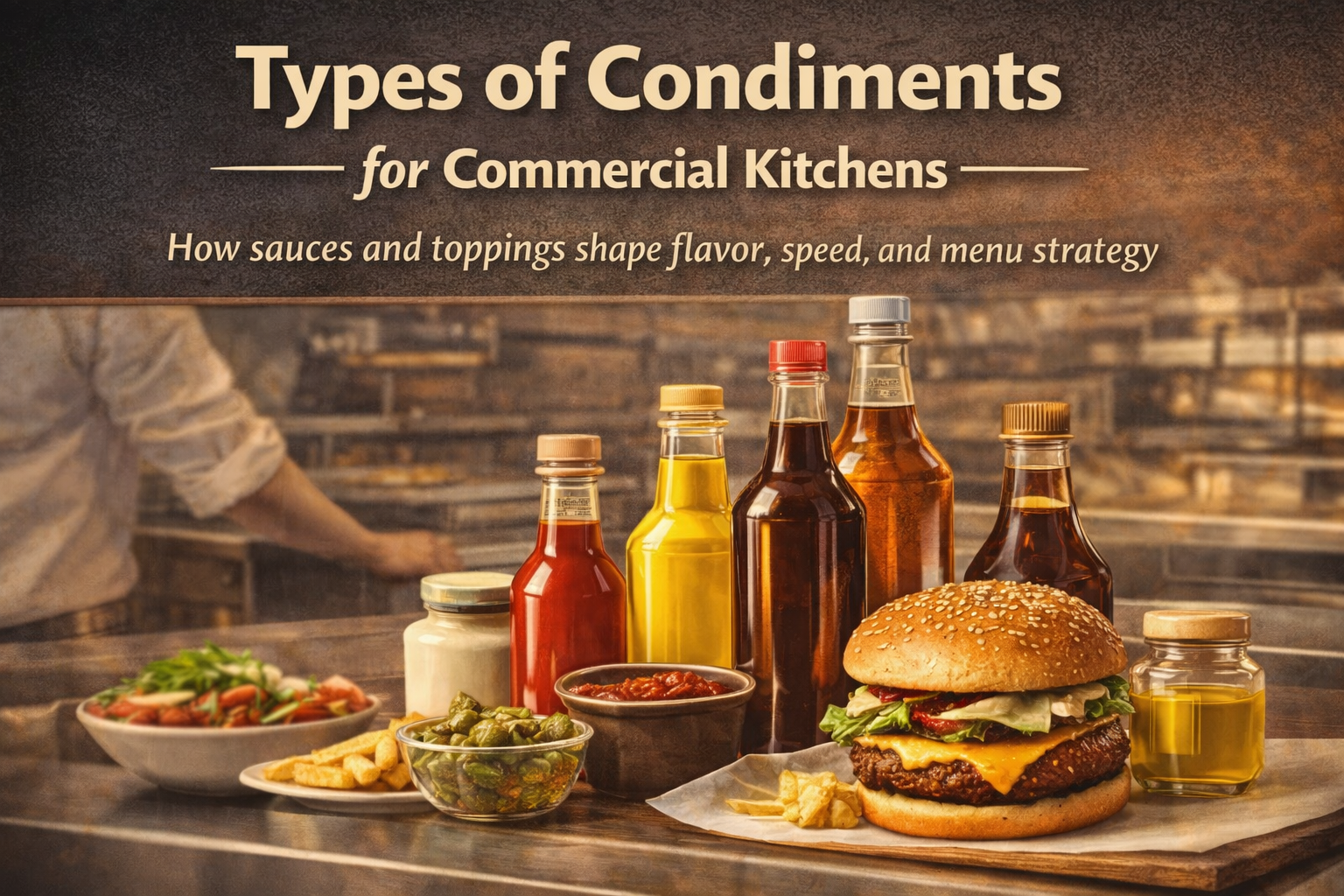
In modern foodservice operations, condiments work hand-in-hand with professional tools and systems found in commercial cooking equipment setups, helping kitchens maintain consistency at scale.
The difference between an average dish and a memorable one often comes down to how condiments are selected, combined, and applied. In high-volume foodservice environments, condiments also serve a second, equally important role: they act as efficiency multipliers, allowing kitchens to build complexity without increasing prep time.

This guide breaks down the essential types of condiments used in commercial kitchens, not just from a culinary perspective, but from an operational and strategic standpoint.
Why Condiments Matter More Than You Think
Most operators think in terms of proteins, sides, and equipment. But condiments sit at the intersection of all three.
A well-structured condiment system allows a kitchen to:
- Standardize flavor across multiple locations
- Reduce prep complexity
- Increase perceived menu variety
- Improve speed of service
In many cases, the same base ingredient can be transformed into multiple menu items simply by changing the condiment profile. This is why high-performing kitchens treat condiments not as accessories, but as modular flavor tools.
Classic Table Condiments
Every commercial kitchen needs a baseline of universally recognized condiments. These are the products customers expect to see without asking.
Ketchup
Ketchup is one of the most scalable condiments in foodservice. Its balance of sweetness, acidity, and viscosity makes it highly adaptable — not only as a topping, but as a base ingredient in more complex sauces.
From an operational perspective, ketchup serves three roles:
- Direct application (fries, burgers)
- Base for sauces (BBQ blends, cocktail sauce)
- Flavor stabilizer in recipes
Its consistency and shelf stability make it a low-risk, high-impact staple.
Mustard
Mustard is often underestimated in commercial kitchens. Beyond being a sandwich condiment, it functions as a technical ingredient.
Its acidity helps cut through fat, while its emulsifying properties make it essential for vinaigrettes and sauces. Different types of mustard allow for layered flavor development:
- Yellow mustard for familiarity
- Dijon for depth and emulsification
- Whole grain for texture
In menu engineering, mustard is a powerful way to balance richness without adding cost.
Mayonnaise
Mayonnaise is not just a condiment — it is a base system.
Because it is an emulsion of fat and acid, it creates structure and mouthfeel in a wide range of applications:
- Sandwich spreads
- Salad binders
- Sauce bases (aioli, remoulade, flavored mayo blends)
From a business standpoint, mayonnaise is one of the most efficient ways to add richness and perceived value to a dish without increasing ingredient complexity.
Heat & Acidity: High-Impact Flavor Drivers
If classic condiments create familiarity, heat and acid-based condiments create differentiation.
Hot Sauce
Hot sauce operates as both a customer-facing condiment and a back-of-house ingredient.
Its real value lies in its ability to:
- Add immediate flavor impact
- Customize spice levels
- Enhance perceived boldness of a dish
Different styles serve different purposes:
- Vinegar-forward sauces for brightness
- Fermented sauces for depth
- Fruit-based sauces for complexity
For operators, hot sauce is a low-cost way to expand flavor range without adding SKUs.
BBQ and Steak Sauces
These sauces are essentially pre-built flavor systems.
Instead of building layers from scratch, they deliver:
- Sweetness
- Acidity
- Smoke
- Umami
in a single application.
BBQ sauce is particularly powerful in defining brand identity. Regional styles alone can create entirely different menu positioning:
- Kansas City (sweet, thick)
- Carolina (vinegar-forward)
- Texas (smoky, peppery)
Steak sauces, on the other hand, are more concentrated and umami-driven, making them ideal for enhancing proteins without overpowering them.
Texture & Contrast: The Missing Dimension
Flavor is only part of the equation. Texture plays a critical role in how customers experience food.
Pickles and Relish
Pickled products bring something that most kitchens struggle to create efficiently: contrast.
They add:
- Acidity
- Crunch
- Brightness
to otherwise heavy dishes.
From a menu perspective, pickles are one of the fastest ways to improve balance. A burger, sandwich, or fried dish instantly feels more refined when acidity is introduced.
Relish takes this further by integrating directly into sauces, making it a hybrid between ingredient and condiment. Condiments like ketchup, hot sauce, and BBQ sauce are especially critical in high-volume fried food environments where consistency from the deep fryer directly impacts final flavor delivery.
Umami Builders: Depth Without Complexity
Soy Sauce
Soy sauce is one of the most efficient ways to introduce umami into a dish.
Its versatility extends far beyond Asian cuisine. In commercial kitchens, it is used for:
- Marinades
- Glazes
- Sauces
- Broths
The key advantage is its ability to enhance flavor without requiring additional ingredients.
Different types allow for control:
- Light soy for seasoning
- Dark soy for color and richness
For operators, soy sauce is a shortcut to depth.
Fresh & Vibrant Condiments
Salsa and Mexican Sauces
Unlike shelf-stable condiments, salsa brings freshness and immediacy.
It functions as both:
- A topping
- A core flavor component
Its flexibility allows it to work across multiple dayparts:
- Breakfast (eggs, burritos)
- Lunch (bowls, tacos)
- Dinner (proteins, sides)
For commercial kitchens, salsa offers high perceived freshness with relatively simple ingredients.
Creamy & Structured Condiments
Salad Dressings
Dressings are often treated as secondary, but in reality they define the entire dish.
A well-balanced dressing controls:
- Acidity
- Fat
- Seasoning
This balance determines whether a dish feels heavy, fresh, or premium.
In many operations, signature dressings become brand assets. They are one of the easiest ways to differentiate a menu without changing core ingredients.
Sweet Condiments and Cross-Utilization
Jam, Jelly, and Fruit Spreads
These are not just breakfast items. In modern kitchens, they are used for:
- Glazing proteins
- Pairing with cheese
- Adding contrast to savory dishes
They provide controlled sweetness and visual appeal, making them highly versatile.
Specialized Condiments for Targeted Use
Seafood Sauces
Seafood sauces are designed to solve a specific challenge: enhancing delicate proteins without overwhelming them.
They typically rely on:
- Creaminess (mayonnaise base)
- Acidity (lemon, vinegar)
- Sharpness (horseradish, capers)
Their role is precision, not dominance.
Asian Sauces
This category includes high-impact, concentrated condiments like:
- Hoisin
- Oyster sauce
- Chili crisp
- Fish sauce
These are not general-use condiments. They are flavor accelerators.
A small amount can completely transform a dish, making them extremely efficient in high-volume kitchens.
Cheese Sauce
Cheese sauce is about consistency and scalability.
In commercial environments, it provides:
- Visual appeal
- Richness
- Holding stability
Its biggest advantage is that it performs well under heat lamps and high-volume service conditions.
Horseradish
Horseradish is a niche but powerful condiment.
It delivers sharp, aggressive heat that cuts through:
- Fatty meats
- Cream-based dishes
It is rarely used as a base, but as a finishing accent that elevates the entire dish.
Building a Smart Condiment System
The best kitchens don’t just stock condiments — they design systems around them.
A strong condiment strategy includes:
- Core staples (ketchup, mustard, mayo)
- Flavor drivers (hot sauce, BBQ, soy sauce)
- Texture elements (pickles, relish)
- Specialty enhancers (horseradish, seafood sauces)
This layered approach allows a kitchen to:
- Expand menu variety without expanding inventory
- Maintain consistency across dishes
- Increase perceived value
Condiments are one of the most underutilized tools in commercial kitchens.
They sit at the intersection of flavor, efficiency, and brand identity. When used strategically, they allow operators to do more with less — fewer ingredients, less prep time, and more impactful dishes.
The difference between a standard menu and a memorable one is often not the protein, the equipment, or even the technique.
It’s the condiments.