
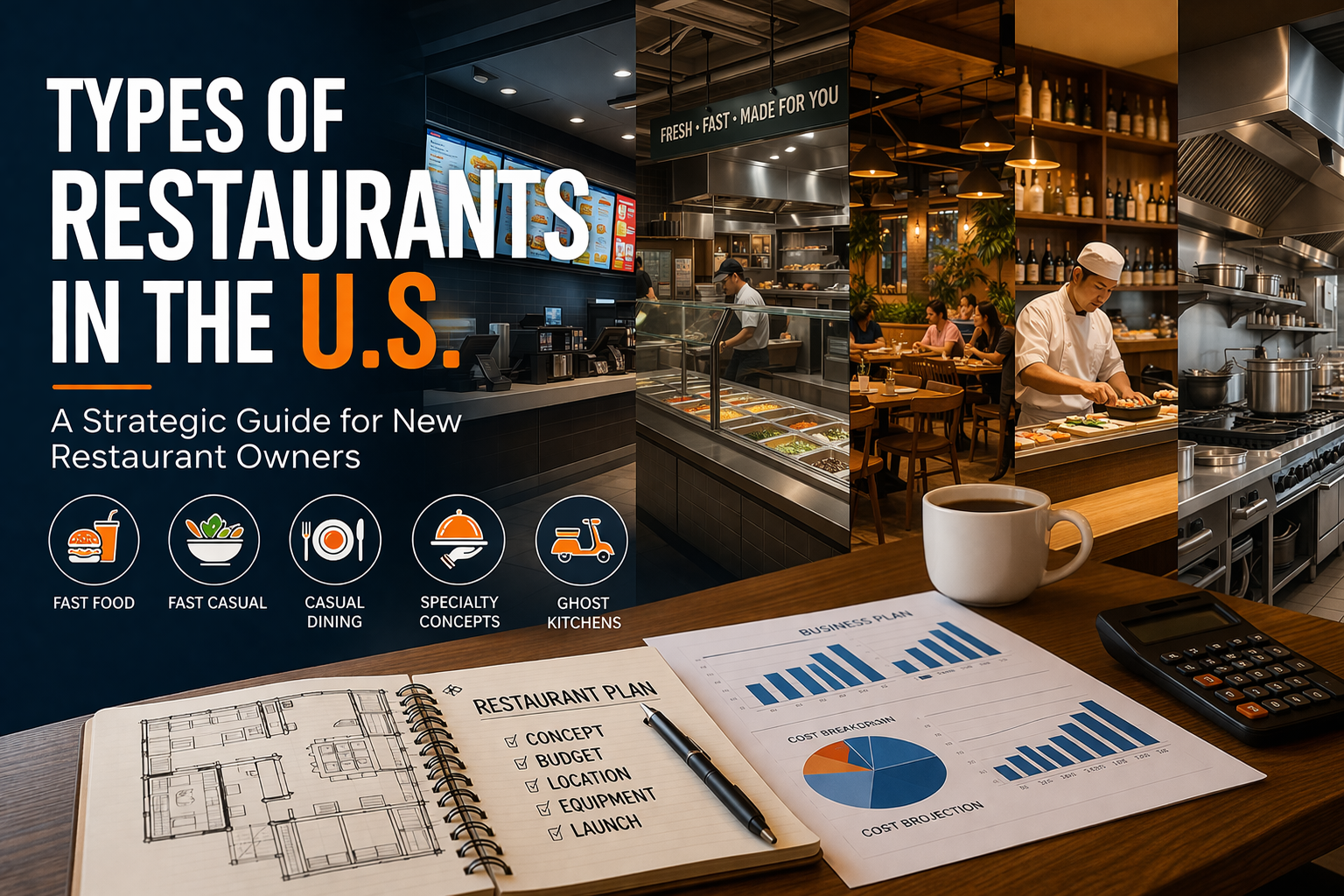
If you’re planning to open a restaurant in the United States, the first decision you make will quietly determine almost everything that follows.
Not your menu.
Not your branding.
Not even your location.
Your restaurant type.
Most first-time owners underestimate this decision. They start with an idea like “I want to open a burger place” or “I want a nice restaurant,” without realizing that what they’re actually choosing is a full operational model. And that model dictates your costs, your kitchen design, your staffing structure, your equipment investment, and ultimately your chances of survival.
The reality is simple: in today’s market, the difference between a profitable restaurant and a failing one is rarely food quality. It’s structure.
This guide is not another generic list of restaurant types. It’s a strategic breakdown designed to help you understand which model fits your situation, what it actually requires behind the scenes, and how to make a decision that aligns with both your budget and your long-term goals.

Understanding Restaurant Types from a Business Perspective
The industry likes to categorize restaurants into dozens of subtypes. But from an operational and financial standpoint, almost all successful restaurants fall into a handful of core models. Before you even finalize your concept, it’s critical to understand how your decision will impact your kitchen setup and overall restaurant equipment needs, as these factors directly determine your startup costs and operational efficiency.
Each model represents a different way of making money.
Some rely on speed and volume.
Some rely on experience and pricing power.
Others rely on niche positioning or operational efficiency.
If you don’t understand which game you’re playing, you can’t win it.
Fast Food (QSR)
Fast food, or Quick Service Restaurants, are built around one idea: speed.
Everything in this model is optimized for throughput. The menu is simplified, the kitchen is engineered for repetition, and the customer journey is reduced to its fastest possible form. This is not a culinary model; it is an operational system.
The reason this model continues to dominate globally is because it solves a very real consumer need: predictable, affordable, and fast food.
From a business perspective, the advantages are clear. Lower labor requirements, high order volume, and a tightly controlled cost structure create a relatively stable operation when executed correctly. However, this stability comes with a trade-off: intense competition and very little room for differentiation unless you invest heavily in branding.
What most new owners fail to anticipate is that success in this model is less about the food and more about execution. Your kitchen layout, equipment selection, and workflow design matter far more than your recipe.
Fast Casual
If there is one model that defines the current restaurant landscape, it is fast casual.
This model sits in the space between fast food and traditional dining. It delivers higher perceived quality without sacrificing speed, and it aligns perfectly with how modern consumers behave—especially in urban markets.
Customers today want food that feels fresh, customizable, and slightly elevated, but they still expect convenience. Fast casual delivers exactly that.
From an operator’s standpoint, this model offers one of the best balances between margin and scalability. You can charge more than a typical fast food restaurant, while still maintaining a relatively lean operation.
More importantly, this model integrates seamlessly with digital ordering, delivery platforms, and brand-driven marketing. Many of the fastest-growing restaurant brands in the U.S. today are built on this structure.
For a new entrepreneur, fast casual is often the most rational starting point. It allows you to build a brand, test a concept, and scale without taking on the full complexity of a traditional restaurant.
Casual Dining
Casual dining is what most people picture when they think of opening a restaurant. Table service, a full menu, a designed interior, and an experience that goes beyond just eating.
On the surface, it feels like a natural choice. In reality, it is one of the most complex models to execute.
Unlike fast food or fast casual, casual dining requires you to manage both a kitchen operation and a front-of-house experience simultaneously. You are not just serving food; you are orchestrating an environment.
This introduces layers of cost and complexity that many first-time owners underestimate. Staffing becomes more expensive, service quality becomes a variable, and your success becomes partially dependent on factors like ambiance, customer perception, and consistency.
However, when done correctly, casual dining offers something powerful: higher average ticket size. Customers are not just paying for food. They are paying for time, comfort, and experience. This opens the door to additional revenue streams such as beverages, desserts, and upselling.
The key insight here is that casual dining is not simply a bigger version of fast casual. It is a fundamentally different business with different risks.
Specialty Concepts
Some of the most successful restaurants are not broad. They are narrow.
A pizzeria that does one thing exceptionally well.
A BBQ concept built entirely around smoked meats.
A sushi bar focused on craftsmanship and presentation.
These are specialty restaurants.
The advantage of this model is clarity. When you focus on a specific category, your brand becomes easier to communicate, your operations become more streamlined, and your customers know exactly why they are choosing you.
But specialization comes with its own requirements. Your equipment is no longer generic—it becomes central to your identity. A BBQ restaurant without proper smokers or a pizzeria without the right oven is not just inefficient; it undermines the entire concept.
This is where many new operators make critical mistakes. They try to enter a specialized category with a general-purpose setup, and the result is a diluted experience.
When executed correctly, specialty concepts can generate strong margins and loyal customer bases. But they demand precision.
Ghost Kitchens
In recent years, ghost kitchens have fundamentally changed how restaurants can be launched.
By removing the dining space entirely, this model eliminates one of the largest cost drivers in the business. There is no need for front-of-house staff, expensive interior design, or prime real estate.
Instead, the focus shifts entirely to production and delivery.
For new entrepreneurs, this creates an opportunity that did not exist a decade ago. You can test a concept, build a brand, and generate revenue with significantly lower upfront investment.
However, ghost kitchens are not “easy.” They shift the challenge from operations to marketing. Without foot traffic or physical presence, your success depends heavily on digital visibility, platform optimization, and brand positioning.
Still, as an entry point into the industry, this is one of the most efficient models available today.
How to Actually Choose the Right Model
At this point, the question is no longer “which restaurant types exist.” The real question is:
Which one fits you?
The answer comes down to alignment.
Your budget determines your starting point. Your location defines your opportunity. Your experience level dictates how much complexity you can handle. And your long-term goal shapes the model you should choose.
If your priority is speed and cash flow, you lean toward efficiency-driven models like QSR.
If you want to build a brand, fast casual becomes more attractive.
If your vision is experience and atmosphere, casual dining or a specialty concept may make sense.
If you want to minimize risk, ghost kitchens offer a strategic entry.
The mistake is trying to force a model that doesn’t match your reality.
The Part Most People Get Wrong: Equipment Planning
There is one final point that rarely gets discussed early enough, yet impacts everything: equipment.
Your commercial kitchen equipment is not just a cost. It is the infrastructure of your business.
The type of restaurant you choose directly determines:
- Your kitchen layout
- Your workflow
- Your service speed
- Your labor efficiency
- Your long-term scalability
A poorly planned kitchen creates bottlenecks, slows down service, increases labor costs, and ultimately limits your growth.
This is why experienced operators think about equipment early—not after signing a lease, not after designing the menu, but at the concept stage.
Because once your kitchen is built, your flexibility is gone.
Opening a restaurant is not about chasing trends. It is about making structured decisions.
The type of restaurant you choose is the foundation. Everything else—menu, branding, marketing—sits on top of that foundation.
If you get the foundation right, you give yourself a real chance.
If you get it wrong, no amount of marketing can fix it.
And in a market as competitive as the United States, clarity is your biggest advantage.
Before you move forward, take the time to define your model, understand its requirements, and build your plan around it.
Because in this business, success is rarely accidental.