
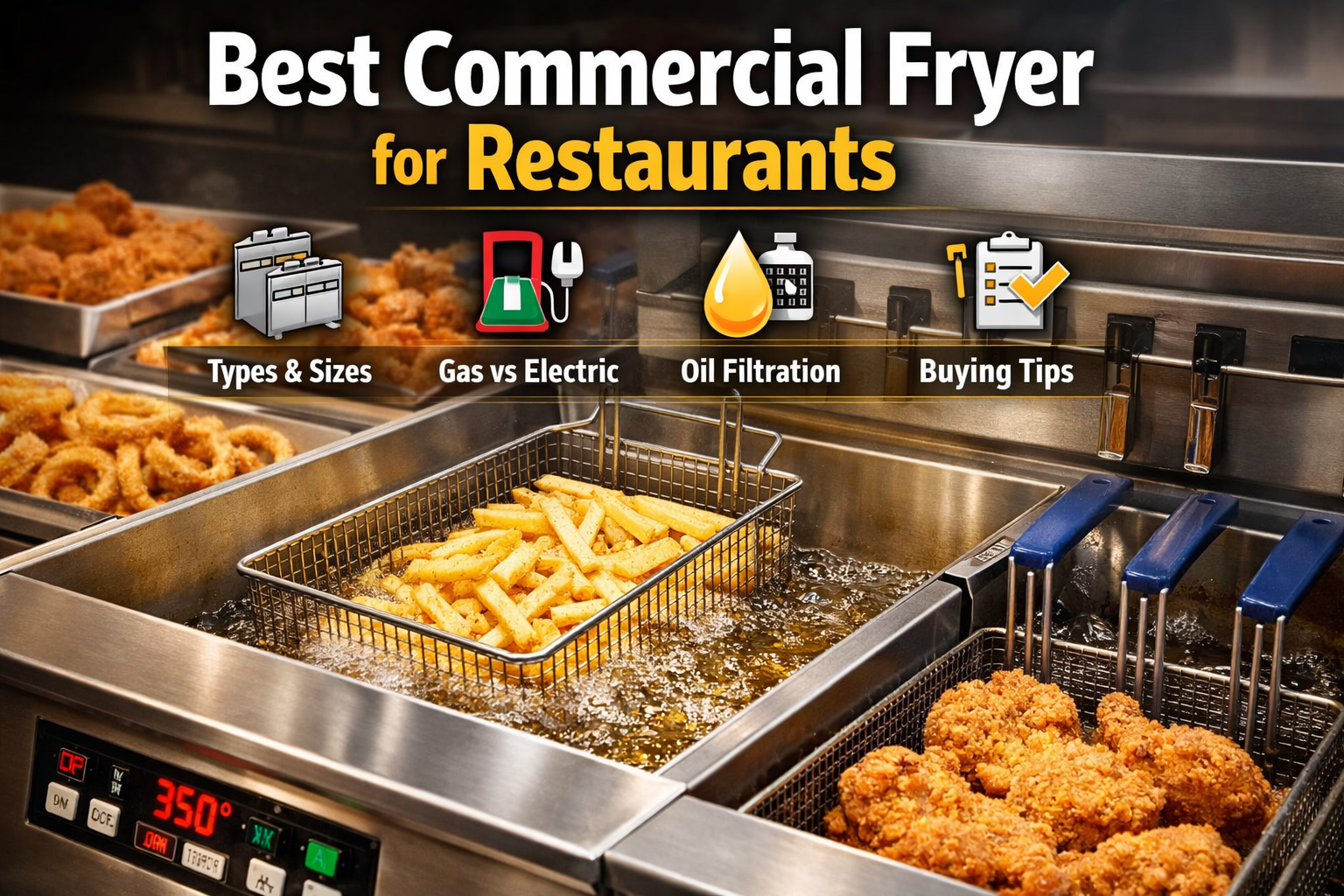
n many foodservice operations, the fryer is not just another cooking appliance. It is one of the most important profit drivers in the kitchen. French fries, chicken tenders, wings, onion rings, mozzarella sticks, seafood, and many high-demand comfort foods depend on speed, consistency, and crisp results. When the fryer is matched correctly to the menu and production level, it helps service move faster, supports food quality, and protects margins. When it is chosen poorly, the problems show up quickly in the form of slow recovery, greasy food, excessive oil consumption, wasted labor, and customer complaints.
That is why the question is not simply “what is the best commercial fryer?” The better question is: what is the best commercial fryer for your restaurant’s menu, volume, kitchen layout, and operating costs? A small café serving occasional fries does not need the same fryer as a busy burger concept, a fried chicken store, a pizzeria with appetizers, or a deli with a rush-heavy lunch business. The best fryer is the one that fits your production reality, not the one with the most features on paper.
A strong fryer buying decision starts with understanding a few technical and operational factors. Capacity matters because oil volume and batch load directly affect product consistency. Recovery time matters because the fryer must return to target temperature quickly during peak periods. Oil filtration matters because oil is one of the biggest hidden costs in a frying program. Power source matters because gas and electric models differ in installation, efficiency, and performance profile. ENERGY STAR notes that certified commercial fryers can reduce utility costs and improve efficiency, while current fryer guidance from manufacturers and equipment sources continues to emphasize sizing, oil management, and menu alignment as the real decision points.
The best commercial fryer for restaurants is usually not defined by brand name alone. It is defined by how well the unit supports the menu you actually sell, the rushes you actually experience, and the labor model you actually operate with. A high-volume kitchen often benefits from a floor fryer with solid recovery and built-in filtration. A lower-volume concept may be better served by a compact countertop model that saves space and keeps investment under control. A chicken-focused operation may need a different fryer setup than a bar serving fries and frozen appetizers. In other words, the “best” fryer is a strategic fit.
Start with the Menu, Not the Machine
The most common mistake in fryer selection is beginning with equipment specs instead of the menu. Restaurant owners often compare price, size, or fuel type before they define what the fryer will need to do every day. That creates risk because different foods behave differently in hot oil. Light frozen products, breaded appetizers, hand-cut fries, battered fish, and bone-in chicken all place different demands on a fryer.
If your menu is centered around fries, wings, frozen appetizers, and similar fast-turn items, an open-pot fryer may be a practical choice. If your concept is built around fried chicken, especially bone-in chicken, pressure frying may enter the conversation. If the fryer is only handling occasional side items, then a smaller and simpler model may be more efficient. The right starting point is always the mix of foods, batch frequency, and peak-hour output your kitchen must handle.
This is also where product separation becomes important. If you are frying fish, chicken, fries, and allergen-sensitive items in the same oil, flavor transfer and quality issues can become a serious problem. Recent fryer guidance emphasizes that correct capacity and oil volume help reduce contamination, preserve product quality, and maintain crisp, consistent results. In practical terms, that means the “best commercial fryer” may actually be two smaller fryers instead of one larger unit if menu separation is operationally critical.
Floor Fryer vs Countertop Fryer
One of the first decisions most buyers face is whether to choose a countertop fryer or a floor model. This is not just a space decision. It is a volume, workflow, and performance decision.
Countertop fryers are often best for lower-volume operations, concession environments, food trucks, cafés, or kitchens where fried food is an add-on rather than the core of the business. They are compact, easier to place, and usually more accessible from a budget standpoint. They can make sense when fried items represent a smaller percentage of sales or when available line space is limited.
Floor fryers are typically the better choice for restaurants with heavier frying demand. They are built for more oil capacity, higher throughput, and stronger production during rush periods. In a busy restaurant, a floor model usually delivers better long-term value because it supports faster cycles, larger batches, and more stable operation under pressure. If lunch and dinner rushes depend on the fryer line moving without delays, a floor fryer is usually the more appropriate answer.
This is where many operators underbuy. They choose a compact unit because it costs less upfront, then discover the fryer cannot keep up when tickets pile up. That leads to soggy food, delayed orders, and staff frustration. When a fryer is central to your line, it should be sized for your busiest hour, not your average afternoon.
Gas vs Electric: Which Is Better?
Gas vs electric is one of the most searched fryer questions, and for good reason. Both can be excellent choices, but they serve different operational priorities.
Gas fryers are often favored in high-volume restaurant environments because they are widely associated with strong recovery and heavy-duty production. In many kitchens, gas is the default choice when the fryer will be under serious daily load. If you are serving large quantities of fries, chicken, or fast-moving appetizers, a gas floor fryer is often a logical fit.
Electric fryers, however, deserve much more attention than they sometimes get. ENERGY STAR states that certified commercial standard vat electric fryers are around 17 percent more energy efficient than standard models, while certified gas fryers are about 30 percent more energy efficient than standard gas models. ENERGY STAR also notes that certified standard vat electric fryers can save about 3,000 kWh and around $400 annually on utility bills over standard models.
In practical terms, electric fryers can be very attractive where energy efficiency, utility rebates, installation conditions, or local infrastructure make them the smarter choice. Some operators also prefer electric models for specific installation environments or for consistency in certain applications. The correct decision depends on your building setup, utility rates, service capacity, and production goals.
So which is better? For many traditional high-volume restaurant lines, gas remains a strong candidate. For efficiency-minded operations, certain layouts, or sites where gas is less practical, electric can be the better long-term investment. The best commercial fryer is the one that fits the economics and infrastructure of the location, not the one that wins a generic argument online.
Size and Capacity Matter More Than Most Buyers Think
A fryer that is too small creates more problems than a fryer that is slightly oversized. Capacity affects more than how much food fits in the basket. It influences oil temperature stability, throughput, food quality, labor pace, and oil life.
According to current fryer guidance, proper oil volume helps stabilize temperature, maintain freshness, reduce flavor transfer, and improve cost efficiency by minimizing uneven cooking and waste. That sounds technical, but the operational meaning is simple: when the fryer is correctly sized, the food cooks more consistently and the line works more smoothly.
Think about your busiest 60 minutes. How many fried orders come through? How many baskets need to drop back-to-back? Are staff members waiting on the fryer, or is the fryer waiting on staff? If your menu includes high-demand fried items, the fryer needs enough oil capacity and thermal performance to absorb repeated loads without collapsing in temperature.
The right way to size a fryer is to work backward from production. Estimate peak-hour fried item volume, identify the most demanding products, and account for future growth. If your current setup is already near its limit, buying another borderline-capacity fryer will only delay the problem. In most professional kitchens, it is smarter to buy for the rush than to buy for the slow period.
Recovery Time Is a Real Profit Factor
A fryer’s recovery time is one of the most important specifications that buyers often overlook. Recovery time refers to how quickly the fryer returns to the target cooking temperature after cold or frozen product is dropped into the oil.
Why does this matter so much? Because a fryer with poor recovery turns crisp food into oily food. When the oil temperature drops too far and stays down too long, the product absorbs more oil, cooks less consistently, and slows the entire service line. That hurts both guest experience and food cost.
The best commercial fryer for restaurants is usually one that holds temperature well during repeated batch cooking. This is especially important for concepts with fast-moving fried items, lunch rushes, game-day traffic, or late-night volume. A fryer may look good in a spec sheet, but if it struggles under actual service conditions, it becomes a bottleneck.
For this reason, “best commercial fryer” should never be reduced to price alone. Recovery performance often makes the difference between a fryer that looks affordable and one that actually performs like a professional tool.
Oil Filtration and Oil Management Are Not Optional Details
If there is one area restaurant operators should take more seriously when buying a fryer, it is oil management. Fryer oil is expensive, and poor oil practices quietly damage profit every week. Modern fryer guidance increasingly treats oil filtration as a core business issue, not a secondary maintenance topic. Pitco’s recent materials emphasize that better oil management can reduce waste, extend oil life, improve food quality, and simplify daily operation.
This means that a fryer with good filtration support is often worth paying more for. In a real restaurant environment, the labor savings and oil savings can justify the investment far more than operators expect. Filtration helps remove debris, maintain cleaner oil, support more consistent flavor, and protect the fryer’s overall performance. It also helps reduce the tendency to dump oil too early.
Oil type matters too. Current fryer oil guidance notes that smoke point, flavor neutrality, and application fit all affect results. Oils such as canola, peanut, and blended vegetable oils serve different operational goals depending on heat tolerance, flavor preference, and cost structure.
When evaluating fryers, ask practical questions: Is filtration built in? How easy is it for staff to use? Does the design support disciplined oil management, or will the team avoid the process because it is cumbersome? The best fryer for a restaurant is not just one that cooks well when new. It is one that helps the team maintain performance over time.
Energy Efficiency and Long-Term Operating Cost
Restaurants often focus too heavily on purchase price and not enough on lifetime cost. That is a mistake, especially with fryers. A cheaper unit can become more expensive if it burns more energy, wastes more oil, slows down service, or creates more maintenance headaches.
ENERGY STAR states that certified commercial deep fryers can deliver meaningful savings and, depending on model type, may also support faster recovery, lower idle energy use, and extended oil life. Those benefits matter because utility cost, oil usage, and labor friction all compound over the life of the equipment.
For operators comparing two fryers, the better financial question is not “which unit costs less today?” but “which unit costs less to own?” If one fryer saves energy, supports longer oil life, and reduces service disruption, it can create stronger value even at a higher upfront price.
This is especially important for category-page SEO content because real buyers are searching for more than generic definitions. They want help making expensive decisions. A high-quality article should reflect that by focusing on ownership economics, not just product features.
The Best Commercial Fryer for Different Restaurant Types
There is no single fryer that is best for every restaurant, but there is usually a best type for each style of operation.
For burger restaurants, diners, and delis, a dependable floor fryer with strong recovery is often the best fit because fries, appetizers, and sides move constantly during rush periods. For pizzerias and casual restaurants where fried items are important but not the only production focus, a medium-duty fryer with reliable recovery and easy cleaning may be the ideal balance. For bars and sports-focused concepts, basket throughput and speed often matter most because wings, fries, and shareables create intense rushes. For food trucks or tight kitchens, compact countertop models may make the most sense if electrical capacity, layout, and menu volume align.
For chicken-heavy concepts, the decision becomes more specialized. In those cases, operators may need to evaluate whether an open fryer or pressure fryer is better suited to the menu, product style, and throughput targets. The point is not that one fryer is universally best. The point is that the fryer must match the menu architecture of the business.
What Smart Buyers Check Before They Buy
Experienced buyers tend to evaluate fryers with a more operational lens. They look beyond dimensions and BTUs or kilowatts and focus on what will matter six months after installation.
They think about how easy the fryer is to clean at closing. They think about whether staff will realistically use the filtration system. They think about whether the fryer footprint works with baskets, dump stations, holding, and traffic flow on the line. They think about local service support, replacement part availability, and whether the unit can scale with the concept.
They also think about what happens on the busiest day of the month. If the fryer fails, slows, or causes quality drift under pressure, the cost is much bigger than a utility bill. It affects ticket times, online reviews, re-fire rates, and staff stress. The best commercial fryer is the one that protects production when the kitchen is under real demand.
Final Verdict: What Is the Best Commercial Fryer for Restaurants?
The best commercial fryer for restaurants is the one that aligns with four things at the same time: menu fit, peak-hour volume, oil management strategy, and long-term operating cost.
If your restaurant has heavy fried-food demand, a professional floor fryer with strong recovery, appropriate capacity, and practical filtration will usually be the right answer. If your operation is more compact or lower volume, a well-chosen countertop fryer may be the smarter and more efficient choice. If utility savings and lifecycle cost are major priorities, ENERGY STAR certified options deserve serious consideration.
The key takeaway is simple: do not buy a fryer based only on sticker price, broad online rankings, or brand familiarity. Buy based on how the fryer will perform in your actual kitchen, with your actual menu, during your actual rush. That is the difference between owning a fryer and owning the right fryer.
A restaurant fryer should do more than heat oil. It should help your kitchen move faster, protect food quality, reduce waste, and support profitability over the long run. When you evaluate fryers through that lens, the buying decision becomes much clearer. And that is how you identify the best commercial fryer for your restaurant.