
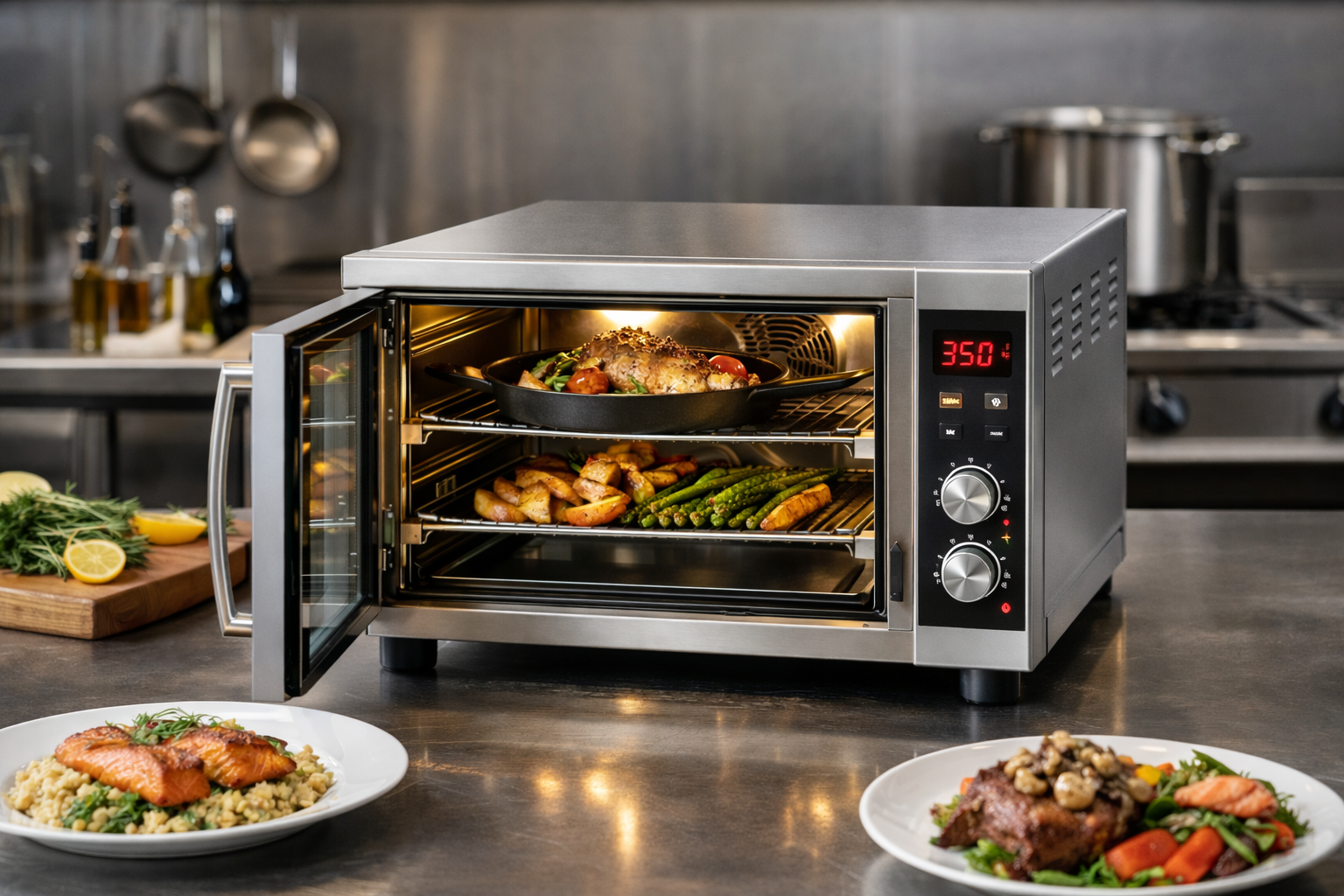
If you are shopping for a countertop convection oven, the biggest mistake is assuming all compact ovens do roughly the same job. On paper, many models look similar. They are electric, space-saving, and designed for commercial use. But in a real kitchen, the difference between the right unit and the wrong one becomes obvious very quickly. One oven supports service, improves consistency, and saves space. Another turns into a daily bottleneck because it cannot keep up with production, does not fit your pans, or creates installation problems you did not plan for.
That is why choosing the right countertop convection oven should never be based on price alone. For bakeries, cafés, delis, restaurants, concession setups, and smaller commercial kitchens, the right oven is the one that fits your menu, your daily workload, your available power, and your physical space at the same time. A well-chosen model can give you the benefits of even cooking, faster heat circulation, and flexible production without taking up the footprint of a larger floor oven. A poorly chosen one can cost you time every single day.
In this guide, we will break down exactly what matters before you buy a countertop convection oven for commercial use, from cooking volume and pan capacity to electrical requirements, build quality, and workflow fit.
Why Countertop Convection Ovens Are So Popular in Commercial Kitchens
There is a reason countertop convection ovens continue to perform well across so many different search terms. Buyers are actively looking for compact cooking equipment that still delivers professional output. Whether they search for countertop convection oven, countertop ovens, tabletop oven, portable electric oven, or electric convection oven, they are usually trying to solve the same business problem: they need reliable cooking performance in a limited amount of space.
This is exactly where countertop convection ovens shine. They are especially useful for operations that need extra cooking capacity but do not have room for a full-size floor model. In smaller kitchens, they can function as a primary oven for lighter-duty use. In busier operations, they often serve as a support oven for reheating, finishing, baking, or overflow production during peak hours.
The format is appealing because it combines three things commercial kitchens care about: efficiency, footprint, and flexibility. But those advantages only matter if the oven is properly matched to the operation.
Start With Your Menu, Not the Spec Sheet
One of the most practical ways to choose a countertop convection oven is to begin with the menu. Too many buyers start by comparing exterior dimensions, price points, or brand names before they have defined what the oven actually needs to do.
That approach usually leads to the wrong decision.
Instead, ask a more useful question: what will this oven be doing most of the time?
If you are running a café, the answer may be pastries, cookies, breakfast sandwiches, and light reheating. In a deli, it may be hot holding support, sandwich finishing, or warming prepared foods. In a bakery, it may be tray-based baking in repeated batches throughout the day. In a compact restaurant kitchen, it may function as supplemental cooking capacity during service.
Once you understand the oven’s real role, the buying process becomes much easier. You are no longer shopping for a generic countertop oven. You are shopping for a specific production tool.
Capacity Is More Important Than Most Buyers Realize
One of the most common buying mistakes is focusing too much on external size and not enough on internal working capacity. Yes, the oven needs to fit on the counter. But that is only the beginning. What really matters is how much food it can handle during your busiest periods.
This is where professional buyers think differently. They do not ask whether the unit physically fits in the kitchen. They ask whether it can keep up with the kitchen.
That means looking closely at:
- interior cavity size
- number of racks
- pan compatibility
- spacing between trays
- expected batch size
- recovery time during repeated use
A countertop convection oven may look large enough from the outside but still fall short if the interior does not support your actual production. This becomes especially important if your team uses sheet pans, bakes in batches, or needs repeatable output throughout the day.
The right oven is not simply the smallest one that saves space. It is the smallest one that still handles your workload comfortably.
Think About Peak Hours, Not Quiet Hours
This is one of the clearest differences between amateur buying and professional buying.
A quiet kitchen can make almost any oven look good. The real test is what happens during peak demand.
Can the oven recover fast enough when the door opens repeatedly? Can it maintain consistency from one batch to the next? Can it support the output your team needs when service gets busy?
If the answer is no, the oven will quickly become a frustration. That is why commercial kitchen equipment should always be selected around the busiest part of the day, not the easiest part of the day.
If your oven is going to be used heavily during breakfast rushes, lunch production, bakery prep, or high-traffic service periods, choose accordingly. A unit that feels “good enough” in theory may feel undersized in practice.
Power Requirements Can Make or Break the Purchase
A surprising number of buyers choose an oven first and think about electrical compatibility later. That is backwards.
Before ordering a countertop convection oven, confirm the electrical setup where the unit will actually be installed. Not every commercial electric oven is the same. Voltage, amperage, plug type, and circuit capacity all matter. Even if the oven fits your production needs perfectly, it can still become a problem if your kitchen is not prepared for it.
This is especially important in older buildings, smaller food businesses, and locations where counter space is available but electrical infrastructure is limited.
Before you buy, make sure you know:
- the required voltage
- the amp draw
- the plug configuration
- whether a dedicated circuit is needed
- where the oven will be placed in relation to the power source
A good buying decision includes installation reality, not just product appeal.
Do Not Ignore Clearance and Ventilation
Countertop ovens are compact, but that does not mean they can be placed anywhere. This is another area where buyers get into trouble.
In many kitchens, the most convenient counter is not always the best installation point. Maybe there is shelving above it. Maybe the wall clearance is too tight. Maybe the oven door swing affects workflow. Maybe there is not enough surrounding airflow.
These details sound minor when you are shopping online, but they become very important once the oven arrives.
Always measure the full installation area, not just the unit footprint. That includes side clearance, rear clearance, top clearance, and working room in front of the oven. A professional setup is not just about whether the oven fits physically. It is about whether it can operate safely, efficiently, and comfortably in the space you have.
Countertop Does Not Mean Light-Duty
Another mistake buyers make is assuming countertop format automatically means casual or low-performance use. In commercial settings, that is not always true.
Many countertop convection ovens are serious production tools. The better models are built for repeated daily use, reliable airflow, and consistent commercial performance. The key is understanding which models are suited for occasional baking or reheating and which are built for heavier daily workloads.
This is where build quality matters.
When you compare commercial countertop ovens, look beyond the headline specs and pay attention to the details that affect long-term use:
- door construction
- hinge strength
- rack support durability
- ease of cleaning
- control simplicity
- overall feel of daily operation
In busy kitchens, the long-term value of an oven comes from how well it performs over time, not how impressive it looks on day one.
Ease of Cleaning Matters More Than Buyers Expect
In commercial kitchens, small annoyances become expensive habits. An oven that is difficult to wipe down, awkward to load, or inconvenient to access will create friction every day.
This is why usability matters just as much as technical specs.
A good countertop convection oven should feel easy to work with. Staff should be able to load and unload it smoothly, clean it without unnecessary effort, and use the controls without confusion. If the oven slows people down, makes cleaning harder, or interrupts the natural flow of prep and service, it is not a good fit no matter how attractive the price is.
This is one of the reasons experienced buyers think in terms of workflow rather than features. The right oven supports the rhythm of the kitchen. The wrong one forces the kitchen to adapt to the equipment.
Manual Controls or More Advanced Controls?
For many operations, control style is not the first thing they think about, but it has a direct effect on usability.
If your menu is narrow and repetitive, simple manual controls may be exactly what you need. They are straightforward, practical, and easy to train around. For operations with a small team and repeatable cooking patterns, that simplicity can be a real advantage.
On the other hand, if multiple staff members use the oven across shifts, or if you rely on more precise timing and repeatability, more advanced controls may be worth considering.
The question is not which control style looks better. The real question is which one reduces errors and improves consistency in your kitchen.
The Best Oven for a Bakery Is Not Always the Best Oven for a Deli
This is where generic buying advice often fails. Different food businesses use countertop convection ovens in very different ways.
A bakery may care most about batch consistency, tray compatibility, and even browning. A café may focus on flexibility, speed, and mixed-use production. A deli may care more about reheating, finishing, and supporting a fast-moving prep line. A compact restaurant kitchen may need the oven as overflow support during busy hours.
That is why there is no single “best countertop convection oven” for every commercial kitchen. The best choice always depends on the specific operation.
This is also why category pages and blog content should work together. The category page helps users compare products. The blog article helps them think more clearly about what they actually need before they compare those products.
How to Know You Are Buying the Right Size
If you are unsure between two sizes or capacity levels, think about the oven in terms of pressure, not possibility.
Do not ask, “Can I make this work?”
Ask, “Will this still feel right when the kitchen is busy?”
That small shift in thinking leads to much better decisions.
A slightly larger or better-matched oven often saves more money over time than a cheaper unit that constantly limits production. The cost of outgrowing an oven too quickly is not just financial. It affects speed, labor flow, customer wait times, and consistency.
In commercial foodservice, equipment should remove friction, not create it.
What Buyers Should Check Before Ordering
Before placing an order, review the following points carefully:
1. Production volume
Know how much food the oven needs to handle during your busiest hours, not just during normal use.
2. Interior capacity
Confirm pan size compatibility, rack count, and usable cooking space.
3. Electrical setup
Double-check voltage, amperage, plug type, and circuit requirements before buying.
4. Physical footprint
Measure width, depth, height, and surrounding clearance, not just the counter surface.
5. Workflow fit
Think about loading, unloading, door swing, cleaning, and how the unit fits into daily kitchen movement.
6. Menu alignment
Choose the oven based on what you cook most often, not based on a generic product description.
Choosing the right countertop convection oven for your commercial kitchen is really about making the oven fit the operation, not forcing the operation to fit the oven.
The strongest buying decisions come from understanding your kitchen clearly. What do you cook? How often do you cook it? How busy does your service get? How much space do you really have? Can your electrical setup support the unit properly? Will the oven make the kitchen smoother, or will it introduce new friction?
Those are the questions professionals ask first.
A well-chosen countertop convection oven can become one of the most useful pieces of equipment in a bakery, café, deli, or commercial kitchen. It can expand production, improve consistency, and give you valuable extra cooking capacity in a compact footprint. But that only happens when the buying decision is based on real kitchen needs rather than surface-level specs.
If you are comparing models now, start with workload, menu, capacity, and installation requirements. Once those are clear, the right choice usually becomes much easier to see.