
Commercial Display Guide for Retail, Grocery, and Convenience Stores
Commercial display refrigerators are one of the most strategic pieces of equipment in any retail food environment. Unlike standard refrigeration units that focus purely on storage, display refrigerators are designed to influence customer behavior, increase product visibility, and drive impulse purchases. In many cases, the right display refrigeration setup can significantly impact sales performance without changing the product itself.
From convenience stores and supermarkets to delis and specialty food shops, different business types require different display refrigeration solutions. Understanding these variations is critical when building an efficient and profitable store layout.
In this guide, we break down the most important types of commercial display refrigerators, how they are used, and how to choose the right one for your business.

Glass Door Merchandiser Refrigerators
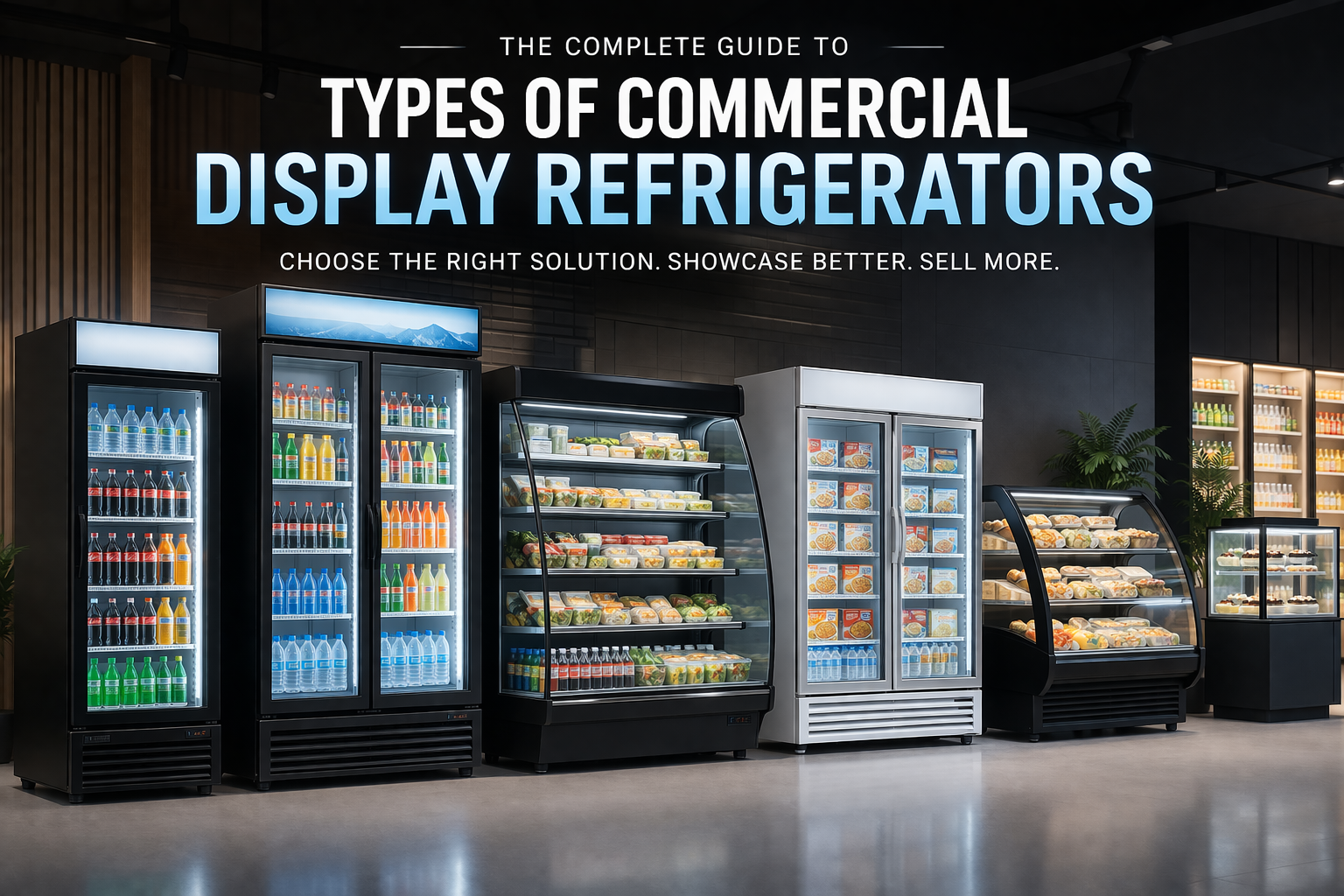
Glass door merchandiser refrigerators are the most common type of commercial display refrigeration. These units are typically used for beverages, packaged foods, and grab-and-go items where visibility is key.
Their primary advantage lies in product presentation. Customers can quickly scan the contents without opening the door, which improves convenience and reduces cold air loss. This makes them one of the most energy-efficient display refrigeration options compared to open units.
These refrigerators are widely used in convenience stores, gas stations, supermarkets, and retail shops. They are available in single, double, and multi-door configurations, allowing businesses to scale based on available space and product variety.
Another important feature is internal LED lighting, which enhances product appearance and makes items more visually appealing. When properly stocked and organized, a glass door merchandiser can act as a silent salesperson, increasing impulse purchases throughout the day.
Open-Air Display Refrigerators
Open-air display refrigerators are designed for maximum accessibility. Unlike glass door units, these refrigerators do not have doors, allowing customers to quickly grab items without any barrier.
They are commonly used in grocery stores, delis, and high-traffic retail environments where speed and convenience are more important than energy efficiency. You will often see these units in grab-and-go sections featuring salads, sandwiches, dairy products, and ready-to-eat meals.
The biggest advantage of open-air units is customer flow. They reduce friction in the buying process, which can lead to higher sales volume, especially during peak hours.
However, this convenience comes with trade-offs. Open display refrigerators consume more energy and require stronger airflow systems to maintain consistent temperatures. They are also more sensitive to ambient conditions such as store temperature and layout.
Because of this, they are best used in controlled environments and strategically placed areas where product turnover is high.
Display Freezers
Display freezers are specifically designed for frozen products such as ice cream, frozen meals, and packaged frozen goods. These units combine low-temperature performance with strong visual merchandising.
They are commonly found in grocery stores, convenience stores, and supermarkets, often positioned near checkout areas to encourage impulse purchases.
Display freezers come in multiple formats, including glass door upright freezers and horizontal chest-style units with sliding glass lids. Upright models provide better visibility and organization, while chest freezers are often used for bulk storage and promotional items.
Maintaining consistent low temperatures is critical in these units. High-quality insulation, powerful compressors, and proper sealing are essential to prevent temperature fluctuations that could compromise product quality.
For businesses that rely heavily on frozen goods, choosing the right display freezer is just as important as selecting a refrigerator.
Countertop Display Refrigerators
Countertop display refrigerators are compact units designed for limited space environments. They are commonly used in cafes, bakeries, and small retail locations where floor space is restricted.
These units are ideal for displaying beverages, desserts, and small packaged items near the point of sale. Because they are placed at eye level, they are highly effective for upselling and impulse purchases.
Despite their smaller size, countertop display refrigerators still need to maintain consistent temperatures and provide clear visibility. Many models include glass panels on multiple sides to maximize exposure.
They are especially useful for businesses that want to increase average order value without making major changes to their store layout.
Deli Display Cases
Deli display refrigerators are designed specifically for fresh food presentation. These units are commonly used in delis, butcher shops, and grocery stores to display meats, cheeses, and prepared foods.
Unlike standard display refrigerators, deli cases are built with angled glass fronts that allow customers to clearly see products while maintaining proper food safety conditions.
These units often include specialized temperature zones and humidity control to preserve product freshness. Proper airflow and internal design are critical to prevent drying out or spoilage.
Deli display cases are not just functional equipment. They are a key part of the customer experience, especially in businesses where product appearance directly influences purchasing decisions.
Vertical vs Horizontal Display Refrigerators
Display refrigerators can also be categorized based on their orientation. Vertical units are tall and space-efficient, making them ideal for convenience stores and smaller retail environments. They maximize product visibility while using minimal floor space.
Horizontal units, on the other hand, are wider and often used for bulk display or promotional setups. These are more common in supermarkets where space is less limited and product variety is higher.
Choosing between vertical and horizontal units depends on your store layout, traffic flow, and merchandising strategy.
Remote vs Self-Contained Display Refrigeration
Another important distinction is between remote and self-contained refrigeration systems.
Self-contained units have built-in compressors, making them easier to install and more flexible in terms of placement. They are commonly used in small to medium-sized stores.
Remote systems, on the other hand, connect to an external refrigeration system. These are typically used in large supermarkets where multiple units are connected to a centralized cooling system. They offer better heat management and reduced noise inside the store but require more complex installation.
Choosing the Right Type for Your Business
Selecting the right type of commercial display refrigerator is not just about product storage. It is about aligning your equipment with your business model, customer behavior, and store layout.
A convenience store may prioritize vertical glass door refrigerators for quick access to beverages, while a grocery store may rely on a combination of open-air units, display freezers, and deli cases to cover different product categories.
The most effective setups often combine multiple types of display refrigeration to create a seamless shopping experience. By placing the right units in the right locations, businesses can guide customer movement, increase visibility, and ultimately drive higher sales.
Commercial display refrigerators are more than just cooling equipment. They are a core part of your merchandising strategy. The right combination of units can transform how customers interact with your products and significantly improve your store’s performance.
Understanding the different types available and how they function allows you to make smarter investment decisions. Whether you are opening a new store or upgrading your existing setup, choosing the right display refrigeration system is a critical step toward long-term success.