
If you’ve ever run a restaurant, bar, or foodservice operation, you already know this:
Ice is not just ice.
It directly affects drink quality, customer perception, speed of service, and even your margins. Yet most businesses treat it like a commodity decision instead of an operational one.
That’s a mistake.
Because the type of ice you use—and the machine that produces it—changes how your entire beverage system performs.
And once you start paying attention to it, you realize very quickly:
different ice shapes are not interchangeable.

Why Ice Type Matters More Than Most Operators Think
At first glance, ice looks simple. Freeze water, drop it in a drink, done.
But in real service conditions, three things start to matter immediately:
How fast the ice melts.
How it interacts with the drink.
How it behaves in high-volume environments.
A large, solid cube cools slowly and preserves the drink. A small, porous piece cools faster but melts quickly. Some ice types are designed for chewing, others for presentation, others for display—not drinking at all.
So the real question isn’t “what’s the best ice?”
It’s:
what’s the right ice for your operation?
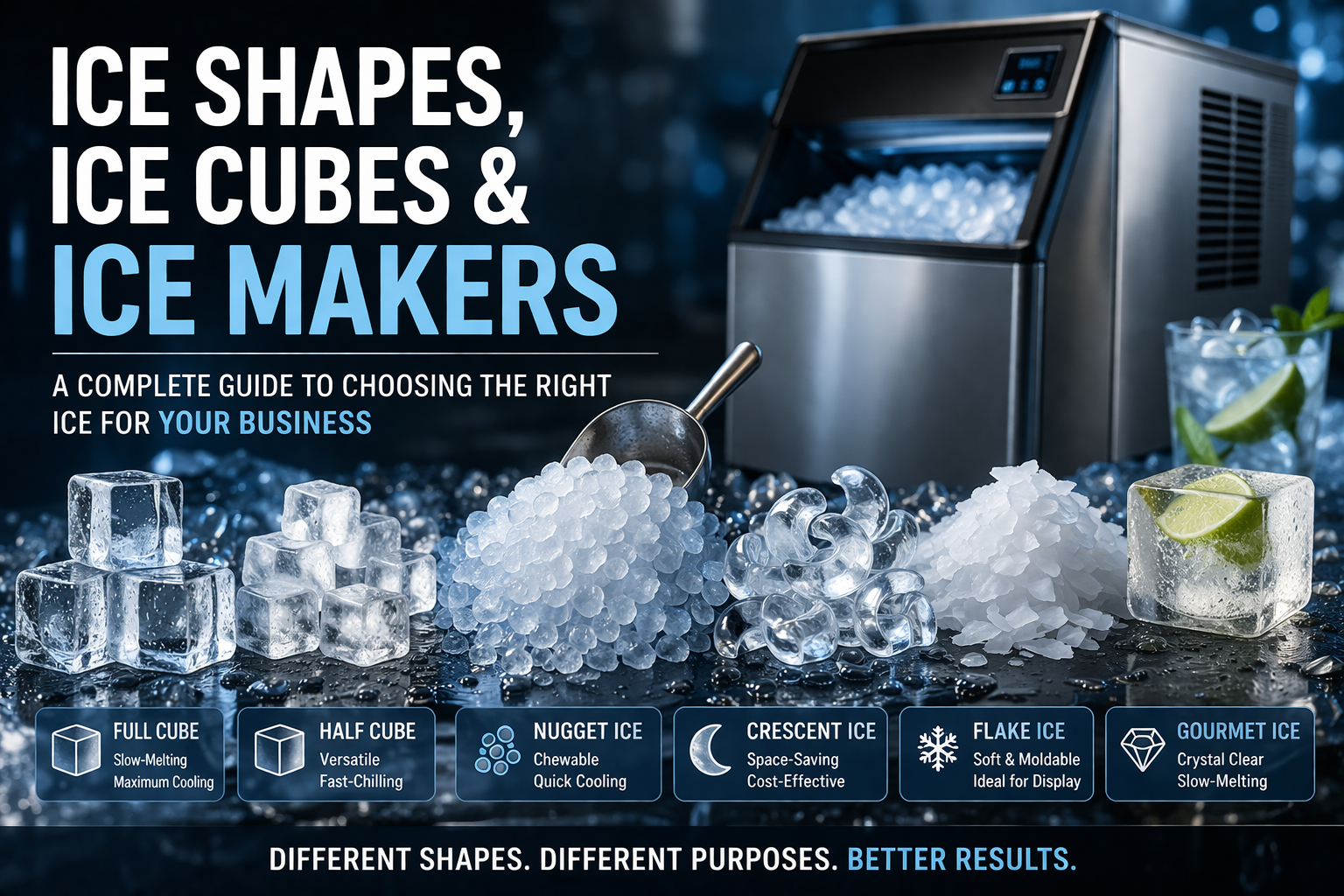
Cube Ice: The Standard That Still Works
Full cube ice is what most people think of when they picture a classic drink. It’s clean, structured, and performs exactly the way you expect.
In a commercial setting, its biggest advantage is stability.
Because the cubes are solid and dense, they melt slowly. That means drinks stay cold longer without getting watered down, which is critical in restaurants where beverages might sit for a few minutes before being served.
It’s also one of the most efficient ice types in terms of production. You need less ice per drink, and it holds up well in bulk storage, bagging, and high-volume use.
This is why you still see full cube ice in:
- Restaurants
- Bars
- Beverage stations
- Ice bagging operations
It’s not flashy, but it’s reliable.
Half Cube Ice: The Workhorse of Commercial Kitchens
If there’s one ice type that quietly dominates commercial kitchens, it’s half cube.
Not because it’s the best at everything, but because it’s good at almost everything.
Its smaller size allows it to pack tighter into a glass, which improves cooling efficiency. It also works well in dispensers, which is why you’ll see it everywhere from fast-casual restaurants to convenience stores.
Operationally, it solves a lot of problems:
- Faster cooling than full cube
- Better glass fill ratio
- Works seamlessly with ice dispensers
This is why many operators default to half cube when they don’t want to overthink the decision.
It’s the safest “all-around” choice.
Nugget Ice: The Ice That Sells Drinks
Nugget ice changed the game.
Not because of performance alone, but because of customer behavior.
This is the ice people chew. The one people specifically ask for. The one brands like Sonic and Chick-fil-A built part of their identity around .
From an operational perspective, nugget ice behaves very differently.
It’s soft, airy, and highly porous. That means it absorbs the flavor of the drink and cools quickly. It also packs tightly, which creates a perception of “more ice” in the cup.
That combination makes it extremely effective in:
- Fountain drinks
- Coffee shops
- High-margin beverage programs
But there’s a trade-off.
Because of its structure, nugget ice melts faster. That means higher consumption, more production demand, and potentially higher operating costs if not managed properly.
Still, for businesses where drinks drive revenue, nugget ice is often a strategic decision—not just a functional one.
Crescent Ice: The Underrated Efficiency Play
Crescent ice doesn’t get talked about much, but it solves a very specific problem: space efficiency inside the glass.
Its curved shape allows pieces to stack in a way that reduces gaps. That means more ice per glass and less liquid volume.
From a business perspective, that matters.
More ice = less beverage poured
Less beverage = lower cost per serving
That’s why crescent ice quietly shows up in:
- High-volume restaurants
- Beverage dispensers
- Cost-sensitive operations
It’s not about aesthetics. It’s about control.
Flake Ice: Not for Drinks, but Critical for Display
Flake ice is where most operators misunderstand the category completely.
This is not drink ice.
It’s soft, moldable, and designed for temperature control and presentation, not beverage service.
You see it in:
- Seafood displays
- Butcher counters
- Salad bars
- Medical environments
Its biggest advantage is how it wraps around products. It creates full surface contact, which improves cooling efficiency and keeps food visually fresh.
The downside is obvious.
It melts fast.
But in the environments where it’s used, that’s not a problem—it’s part of the design.
In many foodservice operations, ice is only one part of the cooling system, and businesses that rely on proper temperature control often pair ice solutions with a reliable commercial refrigerator to maintain product quality and food safety throughout the day.
Gourmet Ice: Where Presentation Becomes Part of the Product
Gourmet ice sits at the opposite end of the spectrum.
This is not about function first. It’s about perception.
Large, clear, slow-melting ice cubes elevate a drink visually and psychologically. They signal quality. They justify higher pricing.
You’ll find this type of ice in:
- Cocktail bars
- Upscale restaurants
- Hotels and lounges
Because the pieces are larger and denser, they melt slower than most other ice types. That makes them ideal for whiskey, cocktails, and premium beverages where dilution needs to be controlled.
This isn’t just ice.
It’s part of the customer experience.
Choosing the Right Ice Machine
When buying commercial ice machines ost buyers focus on production capacity first.
That’s important, but it’s not the starting point.
The first decision should always be:
what type of ice do you actually need?
Because every machine is built around a specific ice form.
Once that’s clear, then you look at:
- Daily production rate
- Storage capacity
- Space constraints
- Air-cooled vs water-cooled systems
And here’s where experience matters.
An underpowered machine creates bottlenecks.
An oversized one wastes energy and money.
But the real issue is mismatch.
The wrong ice type, even with the right machine, still leads to a poor result.
The Real Decision Framework
If you strip everything down, choosing the right ice setup comes down to this:
If your focus is consistency → cube ice
If your focus is versatility → half cube
If your focus is beverage sales → nugget
If your focus is cost control → crescent
If your focus is display → flake
If your focus is premium experience → gourmet
Everything else is secondary.
What Actually Moves the Needle
Most operators spend time optimizing menus, pricing, and marketing.
Very few optimize something as basic as ice.
But the ones who do usually notice something interesting:
Drinks taste better.
Service becomes smoother.
Costs become more predictable.
And customers don’t know why—but they feel the difference.
Because at scale, small details aren’t small anymore.