
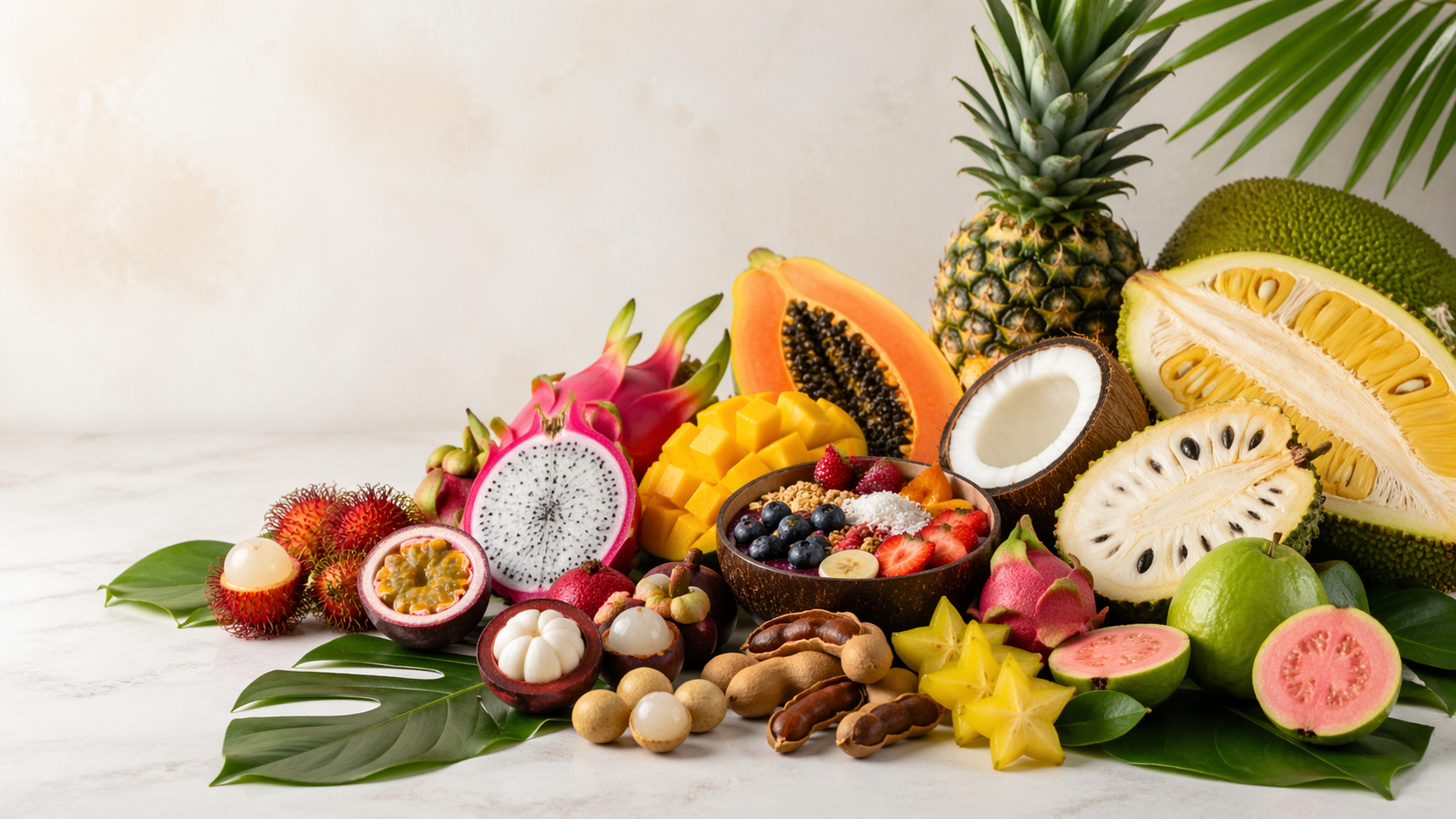
If you run a restaurant, bakery, café, smoothie shop, dessert concept, or specialty grocery business, tropical fruit is one of the easiest ways to make a menu feel more vibrant, premium, and memorable. Tropical fruits bring bold color, unusual texture, floral aroma, and strong seasonal storytelling to drinks, desserts, breakfast bowls, sauces, and plated dishes. In practical terms, they also help operators build limited-time specials, differentiate signature beverages, and create menu photography that performs better on social media. Tropical fruits are generally associated with warm climates and plants that do not tolerate freezing well.

The original article you shared focuses on dragon fruit, passion fruit, rambutan, acai, jackfruit, mangosteen, lychee, papaya, and guava. That is a solid starting point, but it leaves out several fruits people actively search for, including mango, pineapple, star fruit, durian, longan, tamarind, and soursop. Expanding the list helps the article rank for a wider set of queries while making it more useful for foodservice operators trying to build real menus instead of just browsing produce trivia.
What Makes a Fruit “Tropical”?
In menu language, “tropical fruit” usually refers to fruits associated with equatorial or near-equatorial growing regions, often valued for sweetness, perfume, acidity, color, or dense texture. In operational terms, these fruits matter because they create high-impact flavor combinations with relatively little effort. Mango instantly lifts a smoothie program. Passion fruit can sharpen desserts and cocktails. Guava can transform a glaze or syrup. Jackfruit can function as either fruit or savory plant-based ingredient depending on ripeness.
1. Dragon Fruit
Dragon fruit, also called pitaya, is one of the easiest tropical fruits to merchandise because it looks premium before a customer even tastes it. It typically has bright pink or yellow skin and white or magenta flesh dotted with tiny black seeds. Flavor-wise, it is usually mild and refreshing rather than aggressively sweet, which makes it especially useful in smoothie bowls, yogurt parfaits, fruit cups, mocktails, and plated breakfast items. UC Davis notes that dragon fruit is handled as a specialty fruit with specific postharvest guidance, and University of Hawai‘i guidance highlights that it stores better around 50°F than at colder temperatures that can trigger chilling injury.
Best menu uses: smoothie bowls, fruit salads, breakfast plating, colorful beverage garnishes.
2. Passion Fruit
Passion fruit is one of the best “small amount, big impact” ingredients in foodservice. The fruit contains an aromatic pulp with edible seeds, and the flavor is tart, acidic, and intensely fragrant. That makes it extremely useful for curds, syrups, dessert toppings, cocktail programs, lemonades, and premium smoothie blends. UC Davis notes that passion fruit is a very high ethylene producer, which is relevant for ripening and handling in produce operations.
Best menu uses: pavlovas, cheesecakes, glazes, specialty sodas, cocktails, smoothie bases.
3. Rambutan
Rambutan is a strong visual fruit with red skin and soft hair-like spines, making it ideal for social-first menu presentation. Inside, the flesh is translucent and juicy. For operators, rambutan works best when used as a garnish fruit, specialty fruit cup ingredient, or premium addition to tropical fruit platters. It is less common than lychee in mainstream U.S. foodservice, which can actually help make a menu feel more distinctive. The Webstaurant article correctly frames rambutan as a sweet tropical fruit with good smoothie and fruit salad potential.
Best menu uses: garnishes, fruit platters, sorbets, smoothie blends.
4. Acai
Acai remains one of the most commercially important tropical fruits in modern beverage and breakfast menus. In the U.S. market it is usually sold frozen as purée rather than fresh, because the fruit is highly perishable after processing. The original article notes that acai is commonly sold frozen in packets in U.S. retail and foodservice contexts, which aligns with how operators typically source it.
Best menu uses: acai bowls, smoothie blends, frozen desserts, layered breakfast concepts.
5. Jackfruit
Jackfruit deserves much more attention in search-driven content because it serves two very different use cases. When unripe, it is widely used as a savory meat alternative because of its fibrous texture. UC Davis notes that unripe jackfruit is used as a starchy vegetable while ripe fruit is eaten as a dessert fruit, which makes it uniquely versatile for foodservice. It is also notable as the largest tree-borne fruit, a fact often referenced in encyclopedic sources.
Best menu uses: vegan sandwiches, tacos, curries, fruit desserts, jams, fritters.
6. Mangosteen
Mangosteen is one of the most elegant tropical fruits in both taste and presentation. It has a thick purple rind and segmented white flesh inside. On menus, it works best in raw fruit service, fruit salads, sorbets, and premium dessert applications. UC Davis includes mangosteen among its specialty produce fact sheets, reinforcing its relevance in professional produce handling.
Best menu uses: raw fruit cups, plated desserts, tasting menus, upscale smoothie add-ins.
7. Lychee
Lychee is already familiar to many consumers because of canned products, syrups, bubble tea, and cocktail use, but fresh lychee still feels premium. The fruit has a brittle pink-red shell and translucent flesh around a seed. UC Davis notes that temperature and relative humidity are critical to postharvest life and that well-handled lychees can maintain quality for several weeks under optimal cold-chain conditions.
Best menu uses: cocktails, lemonades, fruit teas, sorbets, fruit salads, sauces.
8. Papaya
Papaya is one of the most operator-friendly tropical fruits because it is easy to cut, easy to portion, and broadly compatible with breakfast, smoothie, and dessert menus. UC Davis notes that papayas are commonly harvested at color break to partially yellow stages depending on market destination, which helps explain why restaurants often receive fruit that continues ripening after delivery. Papaya’s mild sweetness and soft texture also make it useful as a smoothie base rather than just a topping.
Best menu uses: breakfast bowls, smoothies, fruit cups, salsas, chilled desserts.
9. Guava
Guava is one of the most underused tropical fruits in restaurant content marketing. It has a floral aroma, juicy texture, and strong versatility across sweet and savory applications. UC Davis identifies guava as a climacteric fruit and provides specific storage ranges for different ripeness stages, which is useful for operators managing back-of-house shrink and prep timing.
Best menu uses: syrups, glazes, cocktails, pastries, smoothie bases, barbecue sauces.
10. Mango
Any article trying to dominate this topic should absolutely include mango. It is one of the most commercially important tropical fruits in foodservice and one of the most searched. Mango works in smoothies, lassis, chutneys, fruit cups, desserts, salads, frozen bars, and sauces. UC Davis notes that mangoes are generally harvested at the mature-green or breaker stage to achieve good flavor after ripening, which is highly relevant for buyers and kitchen managers receiving firm fruit.
Best menu uses: smoothies, salsas, chutneys, desserts, salads, frozen drinks.
11. Pineapple
Pineapple may feel too common to count as “exotic,” but excluding it would weaken the article’s usefulness and SEO reach. It remains one of the most commercially important tropical fruits in restaurants, bars, and hospitality. UC Davis notes that pineapple is considered nonclimacteric, which matters because it will not continue ripening the same way fruits like mango or guava do after harvest.
Best menu uses: cocktails, grilling, upside-down cakes, fruit bowls, salsa, juice blends.
12. Star Fruit (Carambola)
Star fruit is a strong click driver because its shape is instantly recognizable in search results and social imagery. Sliced crosswise, it forms star-shaped pieces that work beautifully in beverage garnishes, dessert plating, buffet displays, and fruit platters. It is more about presentation and mild acidity than concentrated sweetness. UC Davis includes carambola in its produce fact sheet ecosystem, which supports its relevance as a specialty produce item.
Best menu uses: cocktail garnishes, fruit platters, plated desserts, hotel brunch displays.
13. Durian
Durian deserves inclusion because people search for it constantly, even if not every operator wants to serve it. The fruit is famous for its intense aroma and custardy interior. For SEO purposes, it is a high-interest term. For restaurant purposes, it works best in highly specific dessert contexts, frozen applications, and cuisine-authentic menus where customers expect it. UC Davis maintains a durian produce fact sheet, and Britannica notes durian’s distinctive reputation for strong odor.
Best menu uses: niche dessert menus, frozen desserts, Southeast Asian specialty offerings.
14. Longan
Longan is closely related to lychee but has a more subdued sweetness and a brown shell. Specialty Produce describes it as a prized Asian fruit and notes its long history in Southeast Asian culinary use. Because it is still less familiar than lychee to many U.S. customers, it can help a beverage or dessert menu feel more exploratory without becoming too intimidating.
Best menu uses: fruit teas, cocktails, syrup infusions, dessert cups.
15. Soursop
Soursop, sometimes associated with a creamy sweet-tart profile, is one of those fruits that performs well in search because consumers are curious about flavor and health associations. Its pulp is especially attractive for smoothies, frozen desserts, nectars, and tropical purées. While it is less mainstream than mango or pineapple, that is exactly why it can broaden the article’s organic reach.
Best menu uses: smoothies, frozen beverages, ice cream, tropical sauces.
16. Tamarind
Tamarind is essential in any serious tropical fruit roundup because it bridges fruit, sauce, and savory cuisine. It brings a tangy, dark, sweet-sour profile that works in beverages, marinades, chutneys, glazes, and global sauce programs. It also gives the article a stronger crossover into savory restaurant search intent.
Best menu uses: sauces, marinades, cocktails, aguas frescas, glazes.
17. Breadfruit
Breadfruit is not as commonly searched as mango or dragon fruit, but it adds depth and authority to the article. It is important because it broadens the topic beyond smoothie-bar fruit and into global culinary produce. Operators exploring Caribbean, Pacific, or plant-based menus may find it especially relevant. UC Davis includes breadfruit within its produce information system.
Best menu uses: roasted applications, savory sides, starch replacements, global cuisine menus.
How Restaurants and Cafés Can Actually Use Tropical Fruits
The biggest weakness of many fruit-list articles is that they stop at identification. That is not enough. A high-performing article should help the reader make menu decisions.
For smoothie and juice businesses, the most commercially useful fruits are mango, acai, dragon fruit, papaya, pineapple, guava, and passion fruit. These fruits blend well, photograph well, and are easy to position as premium add-ons. For dessert programs, passion fruit, lychee, mangosteen, guava, pineapple, and star fruit create the strongest balance of flavor and visual appeal. For savory menus, jackfruit, tamarind, pineapple, mango, and green papaya open up the most practical possibilities.
For smoothie shops and cafés, high-performance commercial blenders make it much easier to turn tropical fruits like mango, papaya, guava, and dragon fruit into consistent, premium drinks.
Tropical Fruit Handling and Storage Tips
Any operator article should also address handling, because that is where real value lives. The FDA recommends washing produce thoroughly under running water before eating or preparation and specifically advises against washing with soap, detergent, or commercial produce washes. It also recommends rinsing produce before peeling so contaminants are not transferred by the knife.
Because many tropical fruits are highly perishable once cut, a dependable commercial refrigerator is essential for maintaining freshness, food safety, and prep efficiency in busy kitchens.
Cold storage also matters, but tropical fruit is not a one-rule category. USDA guidance emphasizes that produce storage must be commodity-specific, and several tropical fruits are sensitive to chilling injury if stored too cold. UC Davis and University of Hawai‘i sources show this clearly: dragon fruit performs better around 50°F, passion fruit storage depends on type and maturity, guava storage range changes by ripeness, and lychee quality is heavily influenced by tight temperature and humidity control.
If the goal is to build an article that can attract more traffic than a simpler competitor roundup, the key is not just adding more fruits. It is covering more search intent. This means identifying fruits, explaining flavor, suggesting menu applications, including commercially important staples like mango and pineapple, expanding into curiosity-driven fruits like durian and soursop, and giving operators real handling guidance. The original Webstaurant piece is a useful base, but a broader and more operationally useful version has a better chance of earning links, satisfying searchers, and holding rankings over time.
FAQ
What are the most popular tropical fruits for restaurant menus?
For most foodservice operators, mango, pineapple, passion fruit, dragon fruit, papaya, guava, and acai are the most practical because they are versatile, visually appealing, and familiar enough to sell easily.
Which tropical fruit is best for smoothies?
Mango, acai, papaya, pineapple, guava, and dragon fruit are among the strongest smoothie fruits because they balance flavor, texture, and color well.
Which tropical fruits work well in desserts?
Passion fruit, lychee, mangosteen, guava, mango, and pineapple are all strong dessert fruits because they bring acidity, fragrance, sweetness, or visual appeal.
Can tropical fruits be stored the same way as other fruits?
Not always. USDA and university postharvest sources make clear that tropical fruits often require commodity-specific handling and that some are sensitive to chilling injury at very low temperatures.
Should you wash tropical fruits with soap?
No. The FDA advises washing produce under running water and says soap, detergent, and commercial produce washes are not recommended.
What tropical fruit is best for plant-based savory dishes?
Jackfruit is the standout because unripe fruit is widely used as a savory ingredient and meat alternative. Tamarind and pineapple are also excellent for sauces and marinades.