
Choosing a commercial oven sounds straightforward until you realize how many expensive mistakes are hidden behind that decision. Two ovens can look similar on a spec sheet and still perform very differently once they are placed in a real kitchen. One may help a restaurant move through service smoothly, while another may create bottlenecks, uneven results, higher utility costs, and workflow problems that show up every day. That is why the best way to choose a commercial oven is not to start with brand names or price alone. It is to start with your menu, your production volume, your space, and the way your kitchen actually works. Industry buying guides consistently emphasize that oven selection should be driven first by what you cook, how much you cook, and how the unit fits your utilities, layout, and service demands.
A commercial oven is not just a heating appliance. In a restaurant, bakery, café, commissary, or catering operation, it is a production tool. It affects ticket times, product consistency, labor flow, and even menu flexibility. Webstaurant’s category guidance frames commercial ovens as essential equipment across restaurants, bakeries, smokehouses, sandwich shops, and convenience-focused foodservice operations, while KaTom’s buyer resources make the same point from a purchasing angle: the right unit depends on the foods being cooked and the final result the operator wants to achieve.
The most important principle is this: the “right” oven is not the one with the most features. It is the one that most closely matches your business model. A bakery producing artisan loaves all day does not need to think like a fast-casual restaurant finishing proteins and sides. A pizzeria focused on crust quality should not buy as if it were a hotel banquet kitchen. A small café with limited floor space should not choose equipment the same way as a high-volume commissary. Good oven buying guides return to this same idea again and again: match the oven type to the menu, the batch size, the available footprint, the utility setup, and the rate of production you expect during peak periods.
Start with what your business actually needs to produce
The first question is not “Which oven is best?” but “What do we need this oven to do every day?” If you are shopping for a commercial oven without a clear answer to that question, you are already at risk of overbuying or underbuying. Restaurants usually need versatility. They may roast proteins, finish casseroles, bake sides, reheat prepared items, or support prep production throughout the day. Bakeries, on the other hand, often need repeatable baking performance, consistent browning, reliable recovery between batches, and in some cases features such as steam support or specialized heat delivery depending on the product. KaTom’s bakery oven buying guidance explicitly recommends choosing oven type based on how products need to cook, then matching that choice to volume, footprint, ventilation, and future expansion.
This is why commercial oven shopping should begin with a simple production audit. Think about your core products, your busiest hour, the number of pans or trays you need to process at once, and how often the oven door will be opened during service. Think about whether the oven is mainly for all-purpose kitchen support or whether it needs to be central to your production output. A kitchen that bakes bread continuously and a kitchen that occasionally finishes baked pasta may both search for “commercial oven,” but they should not land on the same purchasing logic. That distinction is one of the clearest themes across current commercial oven and bakery oven guides.
Understand the main types of commercial ovens
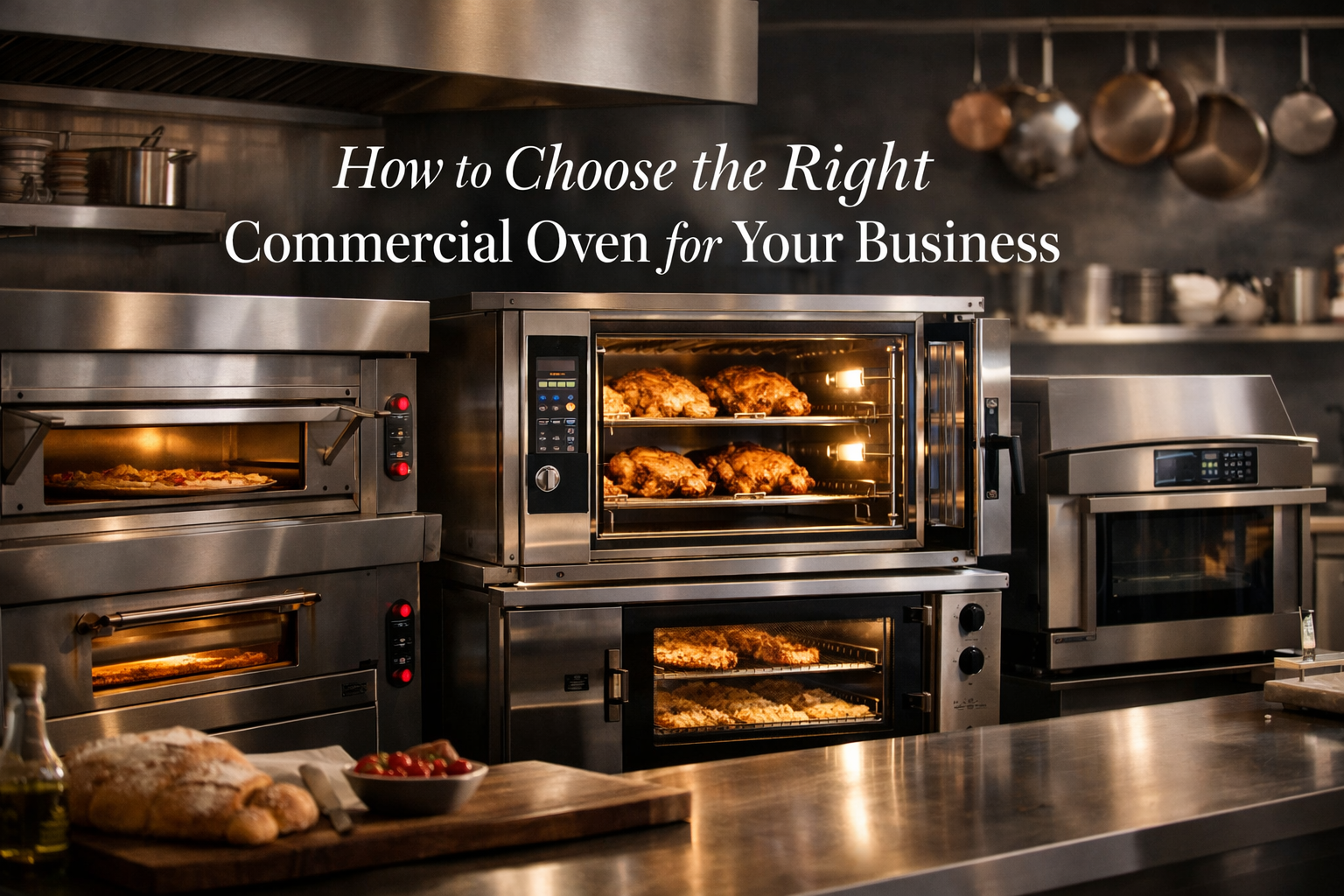
The next step is understanding oven categories in practical terms. The market includes several major formats, but four tend to matter most for broad commercial buying decisions: convection ovens, deck ovens, combi ovens, and rapid cook or high-speed ovens. These are also the oven types most often highlighted in current foodservice buying guides.
A commercial convection oven is often the most versatile starting point for a restaurant or general foodservice business. Convection ovens use fans to circulate hot air, which can support more even cooking and strong day-to-day utility in busy kitchens. Current convection buying guidance stresses that the best fit depends on practical realities such as throughput, kitchen layout, utility compatibility, and service-life value rather than on headline specs alone. For many restaurants, cafés, schools, and institutional kitchens, a convection oven is the safest all-around choice because it can cover a wide range of applications without forcing the operator into a highly specialized setup.
A deck oven is more specialized and often makes the most sense where crust, texture, and hearth-style results matter. KaTom’s deck oven guidance notes that pizzerias and artisanal bakeries commonly rely on deck ovens because stone or metal deck surfaces help produce crisp, flavorful crusts in a way that other oven types usually do not replicate. That does not mean every bakery needs one, but it does mean that operators focused on bread character, artisan baking, or certain pizza styles should take deck ovens seriously rather than defaulting to convection.
A combi oven sits at a higher level of flexibility. Webstaurant describes a combi oven as equipment that uses convection, steam, and a combined steam-convection mode in one appliance. That versatility allows it to steam, poach, roast, bake, braise, and perform other tasks that might otherwise require multiple pieces of equipment. For operations with the budget, menu complexity, and training discipline to take advantage of it, a combi oven can do much more than a traditional oven. For some smaller businesses, though, it can be more equipment than they realistically need.
Rapid cook ovens occupy a different niche. Webstaurant’s current high-speed guide emphasizes matching the oven to the speed and simplicity your menu requires, warning that underpowered models can become peak-hour bottlenecks while overly complex units can strain budget and training. These are not universal replacements for full-size ovens, but they can be extremely valuable in operations where speed, footprint, and repeatability are more important than traditional baking volume.
Match the oven to your type of business
For a general restaurant, a commercial convection oven is usually the most logical place to start. It offers flexibility, familiar workflow, and broad menu support. If you run a full-service restaurant, diner, catering business, or multi-use kitchen, you are often better served by reliable versatility than by hyper-specialization. That is one reason convection ovens remain central in current commercial oven guidance.
For a bakery, the equation changes. A bakery should think less about broad versatility and more about product quality at scale. If your output revolves around bread, pastries, cakes, or repeated tray production, the oven type should be selected according to how those products need to bake. KaTom’s bakery oven guide explicitly frames the decision this way and also highlights the importance of throughput, footprint, ventilation, and future growth. In other words, a bakery should not buy an oven merely because it is called “commercial.” It should buy an oven that supports the specific style of baking the business depends on.
For artisan bread and hearth-style products, a deck oven deserves serious attention because of the crust and bake characteristics it can support. For broader tray baking across cookies, pastries, cakes, and standard bakery output, convection may be more practical. For operations that need a blend of roasting, steaming, baking, and menu flexibility, a combi oven may create real value if the staff can use its capabilities properly. For small-footprint or speed-oriented environments, rapid cook units may fill an important role. The main point is that “best” only exists in context. Buying guides that rank ovens without reference to operation type are usually less helpful than those that connect oven choice directly to products, volume, and workflow.
Capacity matters more than many buyers realize
One of the most common commercial oven mistakes is focusing on oven type without thinking deeply enough about capacity. KaTom’s sizing guidance recommends that buyers match oven size to menu, production volume, available kitchen space, pan capacity, electrical or power requirements, and budget. That sounds simple, but in practice many buyers underestimate how quickly a too-small oven becomes a problem once the kitchen is under pressure.
The issue is not just internal oven dimensions. Real capacity is about output during peak demand. How many pans can you load at once without compromising results? How often will the door open? How quickly does the oven recover between batches? Will the unit support current demand only, or does it leave room for growth? KaTom’s recent sizing overview points out that commercial ovens are available in quarter-size, half-size, and full-size formats, each suited to different operational needs, but the real decision should be driven by daily workload rather than by the temptation to save floor space at all costs.
This is where many businesses either overspend or create long-term bottlenecks. If you buy a unit that is too small, service slows down and staff begin working around the oven rather than with it. If you buy a unit far beyond your actual needs, you may spend more upfront, use more space than necessary, and complicate utility planning. The goal is not maximum capacity. It is appropriate capacity with enough room for realistic growth. Both commercial and bakery buying resources stress this balance.
Think about footprint, utilities, and ventilation before you shop too far
Another costly mistake is falling in love with an oven before confirming that your space and utilities can support it. Current guidance on both convection and bakery ovens repeatedly highlights footprint, ventilation, and utility compatibility as practical buying constraints, not minor technical details. A good oven on paper is the wrong oven if it disrupts movement, does not match the available power source, or creates installation complications that were never priced into the purchase.
Before you commit, measure the available footprint carefully. Think beyond width and depth. Consider door swing, loading and unloading space, service access, nearby prep tables, racks, and the path staff take during prep and service. A cramped kitchen can be harmed as much by the wrong oven placement as by the wrong oven itself. Then look at utilities. KaTom’s sizing overview specifically calls out the need to match BTU or kW and electrical requirements to your kitchen’s capabilities. If the oven demands more than your site can realistically support, the real cost of ownership changes immediately.
Ventilation matters as well. Bakery and oven buyer guides increasingly mention it early because it affects both installation planning and long-term usability. Some buyers think only about the purchase price, but installation constraints can delay deployment, add expense, or force compromises elsewhere in the kitchen. That is why the smartest oven buyers validate physical and utility fit before comparing finer feature details.
Decide how much specialization your business really needs
Many buyers assume that more advanced equals better. In reality, the right level of sophistication depends on how consistently your staff will use the equipment’s full capabilities. A combi oven can be transformative in the right hands because it combines steam, convection, and mixed-mode cooking equipment in one unit. But if the kitchen only needs straightforward baking and roasting, that flexibility may not translate into real operational value. Webstaurant’s description of combi ovens makes clear how broad their capabilities are; the buying question is whether your menu and team will actually benefit from that breadth.
The same applies to rapid cook ovens. They can be excellent in compact, speed-sensitive operations, but Webstaurant’s current high-speed guidance notes that the best choice is often the simplest oven that can consistently execute the core menu at the speed required. That is a useful principle for all commercial oven purchases. Complexity is justified only when it solves a real production problem.
In other words, do not buy technology for its own sake. Buy capability that your business will use repeatedly and profitably.
Budget the oven as a system, not just a product
Price matters, but it should be viewed as part of a wider cost structure. Webstaurant’s commercial oven guide recommends considering not only the purchase budget, but also installation, maintenance, and energy expenses. That is exactly the right mindset. A cheaper oven that creates utility complications, delivers poor recovery, or wears down faster can cost more over time than a better-matched unit with a higher upfront price.
This does not mean every business should buy premium equipment. It means every business should think in terms of total fit and total ownership. A modestly priced convection oven that matches a restaurant’s real output and layout can be a smarter investment than a specialized oven the team does not fully need. On the other hand, a bakery trying to save money with an undersized or inappropriate unit may pay for that decision every day in slower throughput and less consistent product quality. Good equipment buying is rarely about finding the cheapest option. It is about avoiding expensive mismatch.
The most common commercial oven buying mistakes
The biggest mistake is buying based on category labels instead of production reality. “Commercial oven” is too broad to be a decision by itself. Another mistake is underestimating volume and buying for an average day instead of for peak periods. A third is ignoring installation realities such as utilities, ventilation, and footprint until too late. A fourth is choosing high feature complexity without considering whether the team will use and maintain those features well. Current buying guides across commercial, bakery, convection, and rapid-cook categories all point in different ways to these same operational truths: fit, throughput, layout, and practical use determine success.
The other mistake is thinking too narrowly about the present. If your menu is likely to expand, or if your order volume is trending upward, the oven should support that near-term growth. KaTom’s bakery buying guide specifically calls out future expansion as a consideration, and that advice applies well beyond bakery settings.
What kind of oven should most buyers choose?
If your business is a general restaurant or multi-purpose foodservice kitchen, a commercial convection oven is often the best starting point because of its flexibility and broad suitability. If your business depends on artisan bread, deck-style results, or distinct crust development, a deck oven may be the more intelligent choice. If your kitchen benefits from steam, precision, and multi-mode cooking, a combi oven may create the most value. If speed and compact execution matter more than traditional batch baking, rapid cook may deserve a closer look. These are not marketing categories; they reflect real differences in how ovens support specific operations.
The best commercial oven for your business is the one that matches your menu, your production peaks, your kitchen footprint, your utility setup, and your staff’s day-to-day reality. That may sound less exciting than buying the most advanced model on the market, but it is how good operators make smart equipment decisions. When you choose from that perspective, the oven stops being just another equipment purchase and becomes a dependable part of the system that keeps your kitchen moving.