


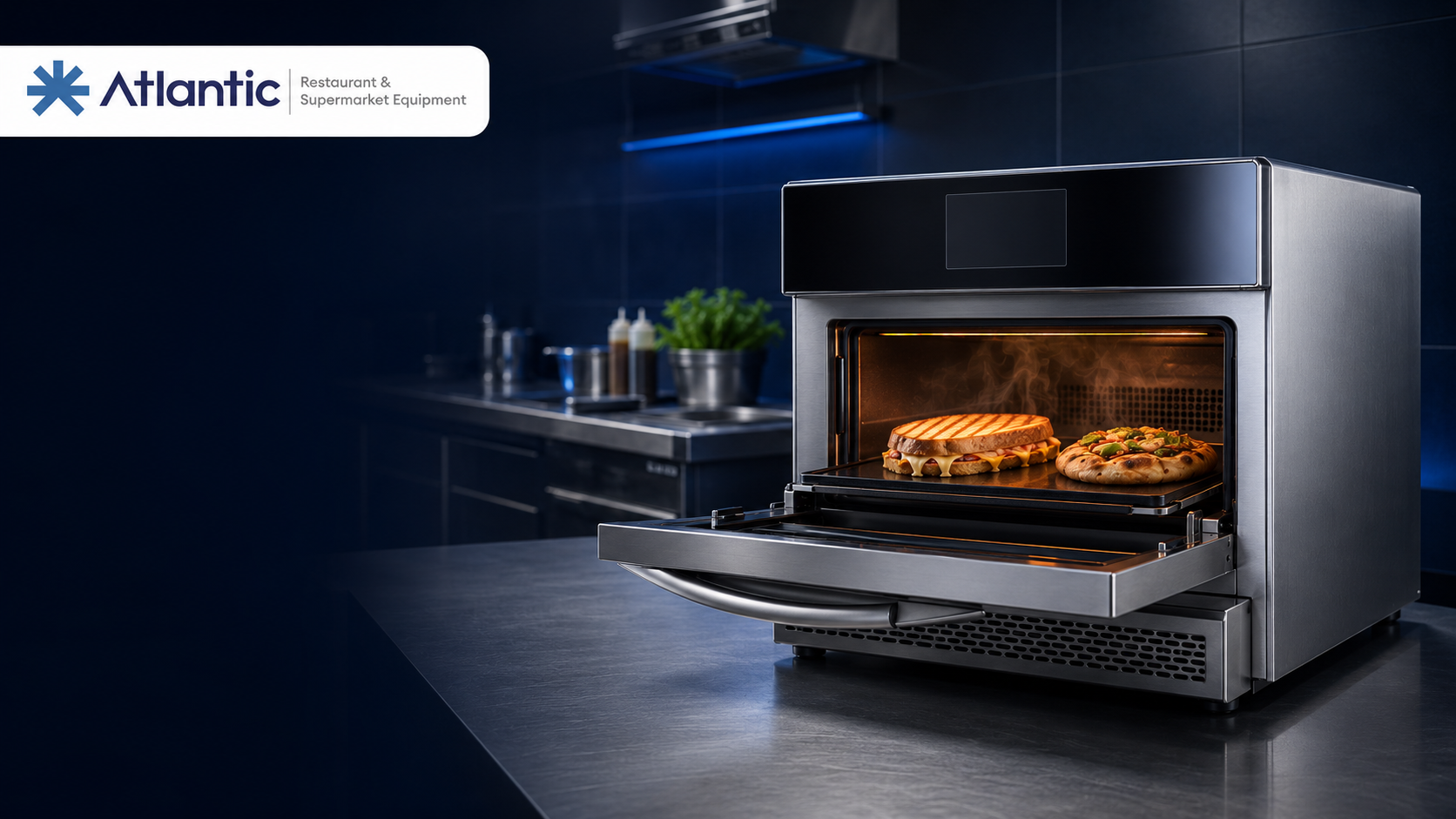
A commercial high-speed oven is an electric foodservice oven engineered to cook, reheat, toast, brown, or crisp menu items very quickly by combining two or more heat-transfer methods. Depending on the model, those methods may include microwave or radio-frequency energy, convection, high-velocity impingement air, radiant heat, infrared energy, or direct contact heat.
Unlike a standard commercial microwave, a high-speed oven is designed to do more than heat food rapidly. It can also create the surface color, texture, and crispness customers expect from toasted sandwiches, pizzas, breakfast items, appetizers, and other made-to-order foods.
This combination of speed and finishing quality has made high-speed ovens valuable in coffee shops, convenience stores, quick-service restaurants, delis, bakeries, hotels, healthcare facilities, stadium concessions, ghost kitchens, and other operations where ticket time and counter space matter.
If you are ready to compare models, explore Atlantic's commercial high-speed and rapid cook ovens. If you are still determining which cooking platform fits your menu, this guide explains the technology, terminology, installation questions, throughput calculations, and purchasing criteria that matter most.
Commercial High-Speed Ovens at a Glance
- Primary purpose: Fast cooking with better browning and crisping than a standard microwave can usually provide
- Typical format: Compact electric countertop oven, although larger and specialty configurations exist
- Common technologies: Microwave assist, convection, impingement, radiant heat, infrared heat, and conductive cooking surfaces
- Common applications: Sandwiches, pizza, flatbreads, breakfast items, appetizers, baked goods, reheated entrées, and grab-and-go foods
- Main operational advantage: Faster made-to-order production from a relatively small footprint
- Critical purchasing checks: Menu fit, tested cook time, batch capacity, cavity dimensions, voltage, amperage, phase, plug, ventilation status, clearances, and cleanability
- Important ventless note: A ventless label does not automatically eliminate every hood, HVAC, fire-code, or local approval requirement
How Does a Commercial High-Speed Oven Work?

A high-speed oven uses several forms of energy at the same time—or in programmed stages—to heat both the inside and surface of food efficiently.
The oven may use microwave or RF energy to raise the internal temperature quickly while moving hot air across the surface to remove moisture, brown cheese, toast bread, and create a crisp exterior. Radiant or infrared elements may add top heat, while an impingement system directs focused jets of hot air at the food. Some designs also use a heated cooking plate or pan to brown the bottom surface.
This matters because the fastest way to heat the center of a food is not always the best way to finish its surface. A standard microwave can heat moisture inside food rapidly, but it may leave bread soft and fail to produce the toasted exterior expected from an oven. Convection and radiant heat can create that exterior, but they generally need more time to move heat from the outside toward the center.
A high-speed oven coordinates these cooking methods through a stored recipe. A program may specify:
- Total cooking time
- Cavity temperature
- Microwave or RF power level
- Fan or impingement intensity
- Top and bottom heat balance
- Multiple stages within one cooking cycle
The operator selects the menu item, loads the food in the approved tray or basket, and starts the program. This makes a properly developed recipe easier to reproduce across shifts and locations.
The Main Cooking Technologies
| Technology | What it does | Why it is used |
|---|---|---|
| Microwave or RF energy | Excites molecules within the food to generate heat quickly | Raises internal temperature and shortens the overall cook cycle |
| Convection | Circulates heated air throughout the cavity | Promotes even heating, baking, and surface drying |
| Impingement | Directs high-velocity jets of hot air at the food | Accelerates heat transfer and improves browning and crisping |
| Radiant or infrared heat | Transfers intense heat from an element toward the food surface | Adds color, toasting, broiling, and top-surface finishing |
| Conductive heat | Transfers heat through a hot tray, plate, stone, or press | Browns and crisps the bottom or contact surface |
Not every oven includes every technology. Two models sold as commercial high-speed ovens may perform very differently because of their energy mix, cavity geometry, fan design, power output, software, and approved accessories.
Is a Rapid Cook Oven the Same as a High-Speed Oven?
The terms rapid cook oven, high-speed oven, speed oven, and accelerated cooking oven frequently overlap in foodservice marketing. In most purchasing conversations, they refer to compact commercial ovens that combine cooking methods to reduce preparation time.
There is no single feature shared by every product carrying these names. One rapid cook oven may combine microwave energy and impingement air, while another high-speed oven may rely on impingement, convection, and radiant heat without microwave assist.
For that reason, buyers should compare the actual cooking technology and performance rather than relying only on the category name.
Ask these questions:
- Which cooking energies does the oven use?
- Can it produce the texture required by your menu?
- How many items fit in the usable cavity?
- What is the tested cycle time for your actual food?
- Is the selected configuration listed or approved for the intended installation?
Types of Commercial High-Speed Ovens
Understanding the main product families makes it easier to narrow the field.
Microwave-Assisted Rapid Cook Ovens
These ovens combine microwave or RF energy with hot-air cooking. Convection, impingement, radiant heat, or some combination of the three handles exterior browning while microwave energy accelerates internal heating.
They are often selected for:
- Toasted sandwiches and panini
- Breakfast sandwiches
- Pizza and flatbreads
- Frozen snacks and appetizers
- Reheated entrées
- Grab-and-go menu items
Microwave-assisted rapid cook ovens are especially useful when an operation needs short ticket times and a crisp or browned finish from a small countertop appliance.
High-Speed Impingement Ovens
Impingement ovens force concentrated streams of hot air toward the food. This disrupts the cooler layer of air that naturally surrounds the product and speeds heat transfer.
Some commercial high-speed impingement ovens use microwave assist; others do not. Batch models use a cavity and door, while high-speed conveyor models move food through a heated chamber on a belt.
Impingement is well suited to foods that benefit from strong surface heating, including pizza, flatbreads, toasted sandwiches, and certain baked or roasted products.
High-Speed Convection or Multicook Ovens
These units use high-powered air movement and programmable controls to handle a broad range of tasks. Some support simultaneous or zoned cooking; others combine convection with additional heat sources.
They may be appropriate for operations that value menu flexibility more than the shortest possible microwave-assisted cycle.
Specialty High-Speed Pizza Ovens
High-speed pizza ovens are optimized for crust browning, cheese melting, and rapid service. Depending on the design, they may use impingement, radiant heat, a heated stone or plate, microwave assist, or multiple technologies.
Before selecting one, verify the largest pizza diameter, required pan or screen, fresh-versus-frozen performance, recovery between cycles, and whether different pizza styles have been tested.
What Can You Cook in a Commercial High-Speed Oven?
The best menu depends on the oven's technology, cavity, accessories, and recipe-development capabilities. Common applications include:
- Breakfast sandwiches, burritos, and egg-based items
- Panini, subs, melts, and toasted wraps
- Personal pizzas, flatbreads, and quesadillas
- Chicken tenders, wings, fries, and other prepared appetizers
- Cookies, pastries, croissants, and selected baked goods
- Reheated pasta, rice dishes, casseroles, and plated entrées
- Roasted vegetables and selected proteins
- Frozen snacks and convenience foods
- Grab-and-go products finished to order
High-speed ovens are particularly effective when the food needs both fast internal heating and a browned exterior. However, an oven should be evaluated with the exact food, portion, starting temperature, packaging, pan, and service standard used in the operation.
A cook time demonstrated with one frozen sandwich does not predict performance for a thicker refrigerated sandwich, raw protein, or high-moisture entrée.
Can a High-Speed Oven Cook Raw Food?
Some models and recipes can cook raw products, but capability should never be assumed. The selected oven must bring the exact food to the required time-and-temperature standard while also delivering acceptable quality and repeatable results.
Use a calibrated food thermometer during recipe validation and follow the applicable local health code. The FDA Food Code serves as a model used by many jurisdictions when developing foodservice safety rules, but state and local requirements can differ.
Cooking faster does not reduce the obligation to reach a safe internal temperature.
Benefits of a Commercial High-Speed Oven
Faster Ticket Times
The main advantage is speed. Combining internal and surface heating can reduce the time between order and service, particularly for foods that would otherwise require separate microwave heating and oven finishing.
Faster cooking can help an operation handle rush periods, but advertised speed should not replace a menu test. Cycle time varies by product weight, thickness, moisture, starting temperature, load size, desired finish, and oven program.
Better Texture Than Standard Microwave-Only Heating
Convection, impingement, radiant heat, and conductive surfaces can remove moisture and brown food. This enables results that are difficult to obtain in a conventional microwave, such as toasted bread, crisp crust, browned cheese, and a drier exterior.
Compact Production Capacity
Many high-speed ovens are designed for the countertop. They can add a meaningful cooking station to a café counter, convenience store, kiosk, concession area, or small kitchen where a full-size oven would not fit.
The footprint alone does not determine installation suitability. Door swing, side and rear clearances, air intake, hot-air discharge, service access, and the strength and depth of the supporting counter all matter.
Consistency Through Programmable Recipes
Programmable menus allow an operator to recall a validated time, temperature, fan, and energy sequence. Icons and touchscreen controls can reduce the number of decisions required during service.
Programs improve repeatability, but they do not replace portion control. Changes in food weight, construction, temperature, or loading pattern can still change the outcome.
Menu Expansion Without Multiple Cooking Appliances
One oven may toast, reheat, roast, bake, brown, and finish several menu categories. This can be useful for an operation adding hot food without building a large traditional cookline.
No single appliance is universally capable of replacing a fryer, griddle, conveyor oven, microwave, convection oven, and combi oven. Replacement decisions must be based on tested food quality and peak-hour capacity.
Potential Labor and Workflow Benefits
Short, stored programs can reduce active cooking steps. A team member may be able to load an item, select the program, and perform another task while the oven runs.
The real labor benefit depends on the entire workflow: cold storage, assembly, loading, unloading, garnishing, packaging, cleaning, and order handoff. A fast oven placed in a poorly designed station can still create a bottleneck.
Limitations to Consider
High-speed ovens solve specific operational problems, but they also involve tradeoffs.
Limited Batch Size
A compact cavity may hold only one or two large items at a time. An extremely short cycle does not guarantee adequate peak-hour capacity if the oven cannot accommodate the required batch.
Electrical Demand
Many models require more power than an ordinary countertop receptacle can provide. Depending on the oven, installation may require 208 or 240 volts, a dedicated branch circuit, a particular amperage, a specific NEMA plug, or single- or three-phase power.
Never choose an oven before confirming the data plate and specification sheet against the available electrical service. OSHA's electrical rules state that listed or labeled equipment must be installed and used according to the instructions included with its listing or labeling. They also require ventilation openings to remain unobstructed where equipment depends on airflow for cooling. See OSHA 29 CFR 1910.303.
Recipe Development Is Essential
The factory library may provide a starting point, but successful results usually require testing the operation's exact ingredients, portions, pans, and desired finish. Recipe creation should include both quality evaluation and verified internal temperatures where applicable.
Cleaning Cannot Be Deferred
Food debris and grease can affect airflow, odor, smoke, performance, and component life. Filters, jet plates, catalytic components, cooking surfaces, and cavity liners may require different cleaning procedures.
Follow the model-specific daily and periodic cleaning instructions. Do not spray water or chemicals into controls, fan openings, electrical components, or catalytic assemblies unless the manual specifically permits it.
A High-Speed Oven Does Not Fit Every Menu
Large roasts, delicate multi-pan baking, high-volume conveyor production, heavily grease-producing foods, and menus requiring steam control may be better served by other equipment. Compare commercial convection ovens, combi ovens, and pizza ovens when the menu requires larger batches or a different cooking environment.
What Does Ventless Mean on a High-Speed Oven?
A ventless high-speed oven is designed and tested to manage specified cooking emissions internally, commonly through a combination of airflow management, filtration, and catalytic treatment. This may allow an approved model to operate without a traditional externally ducted hood in certain applications.
But ventless does not mean unrestricted installation.
The approval may depend on:
- The exact oven model and configuration
- The product's safety and emissions listings
- The foods being cooked
- The amount and type of grease produced
- Required filters or catalytic components
- Clearances and surrounding construction
- Room ventilation and heat load
- Fire, mechanical, building, and health codes
- Acceptance by the local authority having jurisdiction
Codes are adopted and amended locally. For example, New York City publishes separate mechanical-code chapters covering ventilation, exhaust systems, and specific appliances and equipment. Operators in the New York market should review the current NYC Construction Codes and obtain project-specific confirmation rather than relying on a product page alone.
Before purchasing a ventless oven, send the model's specification sheet, listing documentation, intended menu, and proposed location to the relevant building, fire, mechanical, and health authorities or qualified project professionals.
Questions to Ask Before Buying a Ventless Model
- Is this exact model listed for ventless operation?
- Does the approval cover the foods on our intended menu?
- Is a Type I or Type II hood still required locally?
- Does the room need additional HVAC capacity or general ventilation?
- What filters or catalytic components require cleaning or replacement?
- Are there restrictions on raw proteins, fatty foods, smoke, or grease production?
- What side, rear, top, and service clearances are required?
- Has the local authority having jurisdiction approved the proposed installation?
High-Speed Oven vs. Microwave vs. Convection vs. Combi Oven
| Feature | High-speed oven | Commercial microwave | Convection oven | Combi oven |
|---|---|---|---|---|
| Primary strength | Rapid heating plus browning or crisping | Very fast heating and reheating | Baking and roasting with circulating hot air | Flexible cooking with convection and controlled steam |
| Typical batch size | Small to medium | Small | Medium to large | Medium to large |
| Surface browning | Strong on suitable models and recipes | Limited | Strong | Strong |
| Internal heating speed | Very fast when microwave/RF assisted | Very fast | Moderate | Varies by mode and product |
| Moisture control | Model dependent | Limited | Dry heat | Strong humidity and steam control |
| Water connection | Usually not required, but verify | Usually not required | Usually not required | Commonly required |
| Typical footprint | Countertop or compact | Countertop | Countertop or floor | Countertop or floor |
| Best fit | Fast made-to-order items requiring finished texture | Reheating, defrosting, and rapid heating | Baking, roasting, and larger batches | Broad menus requiring steam, humidity control, and production flexibility |
High-Speed Oven vs. Commercial Microwave
A commercial microwave prioritizes rapid internal heating. A high-speed oven may use microwave energy too, but adds other heat sources to toast, brown, dry, or crisp the exterior.
Choose a commercial microwave when rapid reheating is the primary goal and exterior browning is not essential. Choose a high-speed oven when the customer expects an oven-finished texture.
High-Speed Oven vs. Convection Oven
A convection oven uses a fan to circulate hot air. It is well suited to baking and roasting and generally offers more batch capacity than a compact rapid cook oven. A microwave-assisted high-speed oven can heat the center of food more quickly, making it better suited to short made-to-order cycles.
High-Speed Oven vs. Combi Oven
A combi oven combines convection heat and controlled steam. It offers exceptional flexibility for roasting, steaming, baking, reheating, and production cooking. A rapid cook oven is typically smaller and optimized for individual orders or small batches rather than large-scale production.
How to Size a Commercial High-Speed Oven
Do not size the oven by advertised cook time alone. The correct size depends on the busiest sustained service period, usable batch capacity, handling time, recipe mix, and acceptable utilization.
Step 1: Define Peak-Hour Demand
Count the number of high-speed-oven menu items expected during the busiest sustained hour—not the daily average.
Separate the demand by item because different recipes can have different cook times and may not be compatible in the same batch.
Step 2: Test the Real Cycle
Time the complete station cycle:
- Retrieve and assemble the product
- Load the oven
- Select the recipe
- Cook
- Unload safely
- Garnish, cut, or package
- Reset the station for the next order
An advertised 60-second cooking program does not create a 60-second order cycle if loading and unloading add another 30 seconds.
Step 3: Calculate Theoretical Throughput
Use this formula for a single menu item:
Items per batch × 3,600 ÷ complete cycle time in seconds = theoretical items per hour
Example:
- Two sandwiches per batch
- 100 seconds for cooking, loading, and unloading
2 × 3,600 ÷ 100 = 72 theoretical sandwiches per hour
Step 4: Apply a Practical Utilization Factor
An oven rarely runs at perfect theoretical capacity for an entire hour. Orders arrive unevenly, items vary, employees switch programs, and the station must be cleaned and reset.
For preliminary planning, apply a utilization factor based on the operation's testing and workflow. At 75% utilization:
72 × 0.75 = 54 planned sandwiches per hour
This is a planning estimate, not a performance guarantee. A live menu test during realistic operating conditions is more reliable.
Step 5: Check Mixed-Menu Capacity
If pizza takes three minutes while a breakfast sandwich takes one minute, a simple average may hide a bottleneck. Model the expected peak-hour mix and determine whether incompatible products will compete for the same oven.
Two smaller ovens can sometimes provide better redundancy and menu separation than one larger cavity. One oven can handle breakfast while the other handles allergen-sensitive, vegetarian, or longer-cycle products—provided the operation's food-safety and allergen procedures support that workflow.
Installation Checklist
Complete these checks before placing the order:
- Confirm exterior dimensions and door swing
- Measure the usable cavity, not only total cubic volume
- Confirm the largest approved pan, tray, basket, or pizza size
- Verify counter depth, strength, height, and heat resistance
- Maintain all required air-intake and exhaust clearances
- Confirm voltage, phase, amperage, wattage, plug, and receptacle
- Determine whether a dedicated circuit or electrical work is required
- Verify cord length and receptacle location
- Review HVAC heat load and room comfort
- Confirm hood, ventilation, fire-code, and health-department requirements
- Check water and drain requirements, if any
- Plan service access and filter removal space
- Confirm stacking approval before placing one oven on another
- Review delivery path, doorway, elevator, and final placement dimensions
- Obtain required permits and local approvals
Do not use an adapter, extension cord, field-modified plug, or improvised ventilation arrangement unless expressly permitted by the equipment documentation and applicable code.
How to Choose the Best Commercial High-Speed Oven
Start With the Menu
Create a test list representing the full challenge of the menu:
- Thickest product
- Highest-moisture product
- Product requiring the crispest finish
- Largest item
- Frozen and refrigerated starting conditions
- Highest-volume item
- Raw item, if applicable
- Product most likely to create grease, smoke, or odor
An oven that performs well on the easiest item may fail on the product that actually drives customer satisfaction.
Compare Usable Cavity Dimensions
Cubic feet can be misleading. Measure the width and depth needed for the approved cooking vessel and allow enough height for the food. Check whether the cavity can hold two items without blocking critical airflow.
Evaluate Cooking Technology
Microwave assist is valuable for fast internal heating. Impingement is effective for rapid surface heat transfer. Radiant heat can improve top browning. A conductive plate or stone can strengthen bottom crisping.
The best combination is the one that produces your desired food, not the one with the longest feature list.
Verify Electrical Compatibility
Compare the complete model number, voltage, phase, amperage, wattage, and plug. The same oven family may be sold in multiple electrical configurations that are not interchangeable.
Have a qualified electrician evaluate available capacity before purchase, especially when adding multiple ovens to an existing location.
Test the User Interface
During a rush, the interface should make the correct program easy to find and the wrong program difficult to select. Consider:
- Touchscreen visibility
- Menu icons and naming
- Number of stored recipes
- Recipe locking and manager access
- USB, Wi-Fi, or network updates
- Multi-location menu distribution
- On-screen cleaning prompts
- Language options
Review Cleaning and Service Access
Ask staff to simulate daily cleaning. Determine which components are removable, which chemicals are approved, how long cooldown takes, and whether filters can be accessed without moving the oven.
Also review warranty terms, authorized service coverage, parts availability, and expected response in your market.
Compare Total Installed Cost
The purchase price is only one part of the investment. Include:
- Electrical upgrades
- Ventilation or HVAC work
- Permits and professional review
- Delivery and installation
- Oven stand or reinforced counter
- Approved trays, baskets, stones, or liners
- Cleaning chemicals and replacement filters
- Recipe development and employee training
- Planned maintenance
- Downtime coverage or a backup cooking method
For model selection and project pricing, Atlantic's team can help you request an equipment quote.
Daily Cleaning and Maintenance
A high-speed oven depends on controlled airflow and clean cooking surfaces. A practical maintenance program usually includes:
Every Day
- Allow the oven to cool according to the manual
- Remove loose crumbs and food debris
- Clean approved removable trays, racks, baskets, plates, and shields
- Wipe the cavity with the specified cleaner and nonabrasive tools
- Clean the door, gasket, and contact surfaces
- Inspect and clean accessible air filters as directed
- Leave the oven in the manufacturer-recommended overnight condition
On a Scheduled Basis
- Inspect air intakes and exhaust paths
- Deep-clean removable jet plates or liners if permitted
- Check door alignment, seals, and latches
- Inspect approved catalytic or filtration components
- Review fault logs and recipe performance
- Replace filters and consumable components at the specified interval
- Arrange qualified service for unusual noise, smoke, odor, arcing, or heating problems
Never place foil, metal pans, or accessories in a microwave-assisted oven unless they are specifically approved for that model and recipe.
Final Buying Checklist
Before selecting a commercial high-speed oven, confirm all of the following:
- The exact menu has been tested
- Food quality is acceptable at the target cycle time
- Peak-hour throughput has been calculated
- The usable cavity fits the required products and accessories
- Electrical service matches the complete model number
- Counter space and required clearances are available
- Ventless or hood requirements have been approved locally
- HVAC can handle the equipment heat load
- Cleaning can be completed by the operating team
- Programs can be managed across shifts or locations
- Warranty and authorized service are available
- Installed cost fits the project budget
- A backup plan exists for maintenance or downtime
Find the Right Commercial High-Speed Oven for Your Operation
A commercial high-speed oven can be a powerful production tool when its technology, cavity, capacity, electrical configuration, and ventilation status match the operation. The best oven is not automatically the model with the shortest advertised cook time. It is the model that can reproduce your menu quality during the busiest hour, fit the available utilities and space, and remain practical to clean and service.
Explore Atlantic's commercial high-speed and rapid cook ovens, compare the broader selection of commercial ovens, or request a quote for help reviewing menu needs, electrical requirements, capacity, and installation considerations.
This article provides general equipment-planning information and is not legal, engineering, fire-code, electrical, or food-safety advice. Always follow the equipment listing and manual and consult the applicable local authorities and qualified professionals.

