

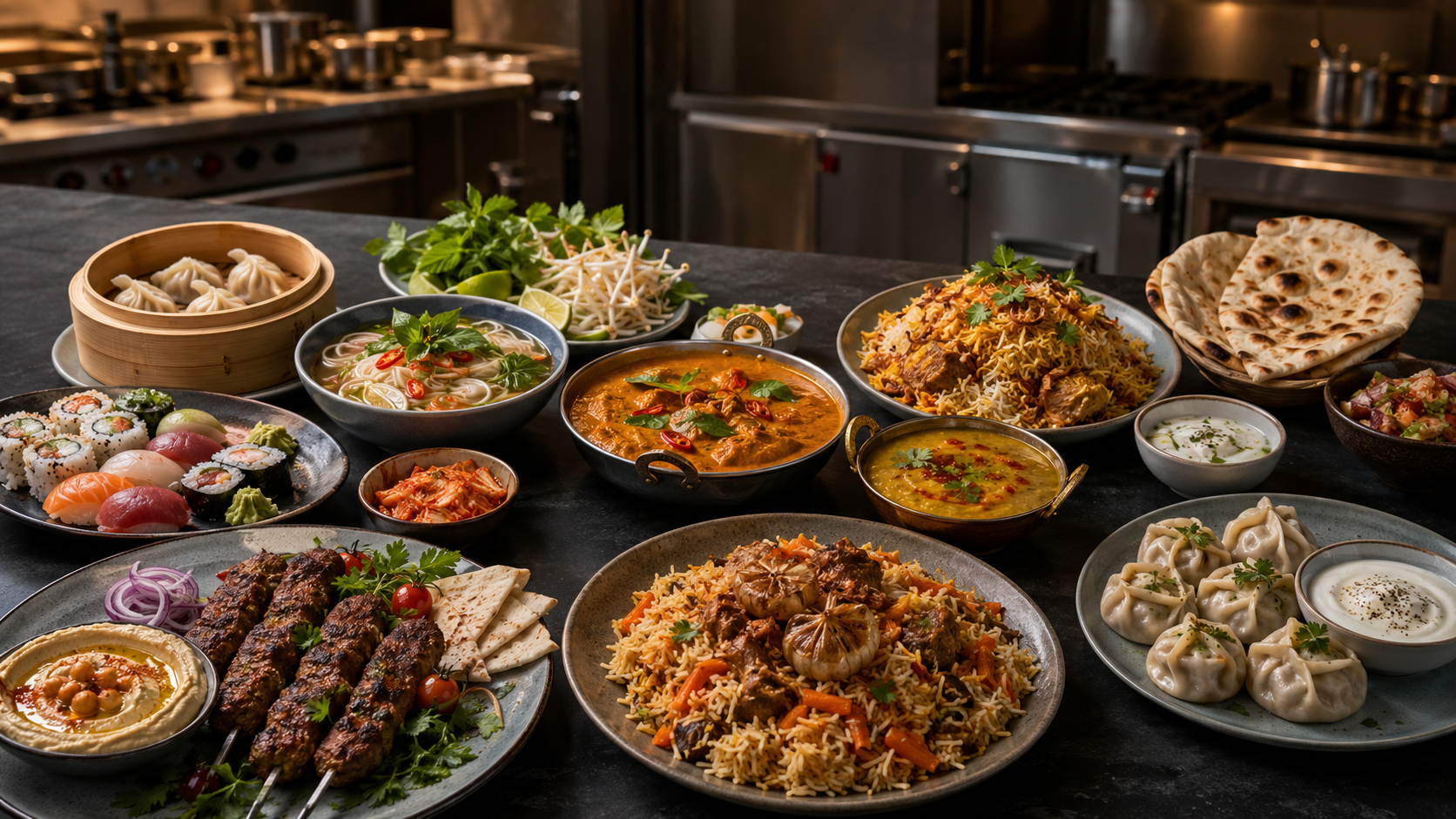
Asian cuisine is not a single style of cooking. It is an enormous collection of culinary traditions shaped by geography, climate, religion, trade, migration and generations of local knowledge.
Chinese stir-fries, Japanese sushi, Korean barbecue, Vietnamese pho, Indian biryani and Uzbek plov may all be described as “Asian food,” yet they use different ingredients, cooking techniques and approaches to flavor. Even within one country, regional food traditions can vary dramatically.
To see how these traditions fit into the broader culinary world, explore our complete guide to the different types of cuisine found around the globe.
For restaurant owners, chefs and food lovers, understanding the main types of Asian cuisine provides a useful starting point for menu development, ingredient selection and commercial kitchen planning.
What Are the Main Types of Asian Cuisine?

Asian cuisines are commonly grouped into five broad culinary regions:
- East Asian cuisine
- Southeast Asian cuisine
- South Asian cuisine
- Central Asian cuisine
- West Asian cuisine
These classifications are helpful, but they should not be treated as rigid boundaries. Trade routes, migration, shared religions and neighboring cultures have carried ingredients and techniques across Asia for centuries.
| Region | Examples | Common characteristics | Representative dishes |
|---|---|---|---|
| East Asia | China, Japan, Korea, Taiwan | Soy products, rice, wheat noodles, fermentation, steaming and stir-frying | Dumplings, sushi, ramen, bibimbap, bulgogi |
| Southeast Asia | Thailand, Vietnam, Malaysia, Indonesia, Philippines | Fresh herbs, rice, coconut, chiles, fish sauce, sweet-sour balance | Pad Thai, pho, nasi goreng, adobo, laksa |
| South Asia | India, Pakistan, Bangladesh, Sri Lanka, Nepal | Layered spices, legumes, rice, flatbreads, grilling and slow cooking | Biryani, dosa, dal, kebabs, hoppers |
| Central Asia | Uzbekistan, Kazakhstan, Kyrgyzstan, Tajikistan, Turkmenistan | Meat, wheat, rice, dairy, dumplings and hearty one-pot dishes | Plov, manti, lagman, beshbarmak |
| West Asia | Türkiye, Iran, the Levant, Arabian Peninsula, Caucasus | Grains, legumes, grilled meats, yogurt, herbs, nuts and olive oil | Kebabs, mezze, pilaf, hummus, dolma |
East Asian Cuisine
East Asian cuisine includes the cooking traditions of China, Japan, Korea, Taiwan and neighboring areas. Rice, wheat, soybeans, vegetables, seafood and preserved ingredients appear throughout the region, but their importance changes significantly from one country—and sometimes one province—to another.
Common cooking techniques include:
- Stir-frying
- Steaming
- Braising
- Grilling
- Simmering
- Pickling
- Fermentation
Soy sauce, rice vinegar, sesame oil, fermented soybean products, ginger, garlic and scallions are widely used, but East Asian cuisine cannot be reduced to one shared flavor profile.
Chinese Cuisine
China contains dozens of regional cooking traditions rather than one uniform national cuisine. Cantonese, Sichuan, Hunan, Shandong, Jiangsu, Zhejiang, Fujian and Anhui are often identified among the country’s major culinary traditions.
Geography plays an important role. Rice and rice-based foods are more prominent in much of southern China, while wheat noodles, dumplings, pancakes and steamed buns are common staples in the north.
Regional Chinese cuisines also differ in flavor and technique:
- Cantonese cuisine often highlights fresh ingredients through steaming, roasting and light seasoning.
- Sichuan cuisine is known for complex combinations of chile heat, fragrance and the numbing sensation of Sichuan peppercorn.
- Hunan cuisine frequently uses fresh and preserved chiles, smoked ingredients and bold sour-spicy flavors.
- Shandong cuisine is associated with seafood, soups, wheat-based foods and precise knife work.
- Fujian cuisine is noted for seafood, broths, fermented ingredients and an emphasis on umami.
Commercial Chinese kitchens frequently require high-output burners, wok stations, steamers, stockpot ranges and efficient ventilation. A standard restaurant range may not deliver the same concentrated heat as a purpose-built wok range, so equipment selection should reflect the actual menu.

Cookline SP-1W Commercial 13" Wok Range - 95,000 BTU
Japanese Cuisine
Japanese cuisine emphasizes seasonality, ingredient quality, careful preparation and presentation. Rice, seafood, vegetables, seaweed, tofu, noodles and fermented seasonings such as miso and soy sauce form important parts of the cuisine.
Dashi—a stock traditionally made with ingredients such as kombu and dried bonito—creates the umami foundation of many soups, sauces and simmered dishes. Regional climates and local products have also produced many different styles of miso, pickles, noodles and seafood preparations.
Popular Japanese foods include:
- Sushi and sashimi
- Ramen
- Udon and soba
- Tempura
- Yakitori
- Tonkatsu
- Donburi
- Okonomiyaki
The Japanese concept of washoku represents more than a collection of recipes. It includes the knowledge, traditions and social practices surrounding the preparation and sharing of food. UNESCO added washoku to its Representative List of the Intangible Cultural Heritage of Humanity in 2013.
A Japanese restaurant may need precise cold storage for seafood, dedicated rice preparation, noodle cookers, fryers, grills and refrigerated prep stations. Sushi concepts in particular must plan refrigeration and preparation areas around safe handling and efficient service.
Korean Cuisine
Korean cuisine is distinguished by fermentation, grilling, braising and the combination of a main dish with multiple small accompaniments known as banchan.
Common ingredients include:
- Gochujang, a fermented red chile paste
- Doenjang, a fermented soybean paste
- Ganjang, or soy sauce
- Sesame oil
- Garlic
- Ginger
- Scallions
- Korean chile flakes
- Fermented vegetables
Kimchi is not one specific recipe. The term covers many preserved vegetable preparations whose ingredients and seasonings vary by region, season and household. The communal tradition of preparing and sharing kimchi, known as kimjang, is also recognized by UNESCO.
Other popular Korean dishes include bibimbap, japchae, tteokbokki, samgyeopsal and bulgogi—the correct spelling of the marinated grilled meat sometimes written incorrectly as “pulgoki.”
Korean barbecue restaurants require careful planning for tabletop cooking, gas or electric connections, grease management, ventilation and fire safety. Concepts without tabletop grilling may rely on charbroilers, griddles, rice cookers and refrigerated prep equipment.
Southeast Asian Cuisine
Southeast Asian cuisine includes the traditions of Thailand, Vietnam, Cambodia, Laos, Myanmar, Malaysia, Singapore, Indonesia, Brunei, Timor-Leste and the Philippines.
The region’s cuisines frequently combine aromatic herbs, tropical produce, rice, noodles, seafood, coconut and fermented sauces. Sweet, sour, salty, bitter, spicy and savory elements may appear in the same meal, but their balance differs across countries.
Thai Cuisine
Thai cooking is known for balancing contrasting flavors rather than relying on heat alone. Fish sauce, lime, tamarind, palm sugar, coconut milk, chiles, lemongrass, galangal and makrut lime leaves are common ingredients.
Popular dishes include:
- Pad Thai
- Tom yum
- Green curry
- Massaman curry
- Som tam
- Pad kra pao
- Khao soi
Authentic Pad Thai typically receives its sour-sweet character from tamarind and palm sugar—not turmeric, as some simplified descriptions suggest.
Woks are important for noodle and rice dishes, while stockpots, rice cookers, fryers and refrigeration support curries, soups, appetizers and fresh herb preparation.
Vietnamese Cuisine
Vietnamese cuisine is often characterized by fresh herbs, broths, rice, rice noodles, fish sauce and a careful balance between richness and freshness.
Regional differences are substantial. Northern Vietnamese food is often more restrained in sweetness and spice, central Vietnamese cuisine can feature intense seasoning and elaborate preparations, while southern cooking makes greater use of tropical produce, coconut and sweeter flavor profiles.
Well-known Vietnamese dishes include:
- Pho
- Banh mi
- Bun cha
- Goi cuon
- Bun bo Hue
- Com tam
- Banh xeo
A pho-focused kitchen needs substantial stockpot capacity and reliable burners for long-simmered broths. Refrigerated prep tables can organize herbs, vegetables and garnishes for quick assembly during service.
Malaysian, Singaporean and Indonesian Cuisines
Maritime trade helped make Malaysia, Singapore and Indonesia some of the world’s most culturally layered food regions. Indigenous traditions developed alongside Chinese, Indian, Arab, Malay and European influences.
Common ingredients include coconut milk, sambal, shrimp paste, tamarind, turmeric, lemongrass, peanuts and aromatic spice pastes.
Representative dishes include:
- Nasi goreng
- Satay
- Rendang
- Laksa
- Hainanese chicken rice
- Char kway teow
- Nasi lemak
Menus in this category often involve several production methods, including grilling, wok cooking, simmering, frying and rice preparation. Kitchen layouts should provide enough separation between high-heat cooking, cold preparation and bulk sauce production.
Filipino Cuisine
Filipino food combines Indigenous, Chinese, Spanish, American and regional Southeast Asian influences. Vinegar, soy sauce, garlic, coconut, calamansi, seafood and fermented condiments are widely used.
Instead of fitting a single sweet-spicy profile, Filipino cuisine often explores contrasts between sour, salty, savory and rich flavors.
Popular dishes include:
- Adobo
- Sinigang
- Lechon
- Pancit
- Kare-kare
- Sisig
- Lumpia
Large-batch braising, roasting and frying are common in Filipino restaurant kitchens. Depending on the menu, operators may require commercial ranges, fryers, charbroilers, rice cookers and hot holding equipment.
South Asian Cuisine
South Asian cuisine encompasses India, Pakistan, Bangladesh, Sri Lanka, Nepal, Bhutan and the Maldives. Religion, climate, agriculture and regional history have produced a vast range of vegetarian and meat-based food traditions.
There is no single “Indian curry powder” that defines the region. In South Asian cooking, spices may be used whole, ground, toasted, fried in fat or added at different stages to create layers of aroma and flavor. “Curry” is an umbrella term applied to many unrelated dishes rather than one universal spice blend.
Frequently used ingredients include:
- Cumin
- Coriander
- Turmeric
- Cardamom
- Mustard seeds
- Fenugreek
- Black pepper
- Chiles
- Ginger and garlic
- Lentils and chickpeas
- Yogurt and ghee
Indian Cuisine
India contains numerous regional cuisines with different staple foods, cooking fats, spice combinations and religious traditions.
Northern Indian cooking frequently features wheat breads, dairy, grilled meats, legumes and tandoor cooking. Southern India has extensive rice, lentil and coconut traditions, including dosa, idli, sambar and regional seafood dishes. Western India includes the seafood and coconut-based cooking of Goa as well as the vegetarian traditions of Gujarat. Eastern India is known for rice, fish, mustard, sweets and varied methods such as steaming and smoking.
Popular Indian foods include:
- Biryani
- Dal
- Tandoori chicken
- Dosa
- Chaat
- Butter chicken
- Rogan josh
- Palak paneer
Commercial Indian kitchens may need tandoor ovens, stockpot ranges, griddles for breads and dosa, fryers, rice cookers and powerful ventilation.
Pakistani and Bangladeshi Cuisines
Pakistani cuisine includes rich meat dishes, kebabs, slow-cooked stews, breads and rice dishes. Regional traditions range from the foods of Punjab and Sindh to Pashtun and Balochi cooking.
Bangladeshi cuisine places strong emphasis on rice, river fish, lentils, mustard and vegetables. Although it shares ingredients with neighboring regions, it has its own culinary identity and should not be treated as simply an extension of Indian cuisine.
Sri Lankan and Nepalese Cuisines
Sri Lankan food frequently uses coconut, rice, curry leaves, chiles and seafood. Hoppers, kottu roti, sambols and rice-and-curry meals demonstrate the country’s range of textures and flavors.
Nepalese cuisine reflects Himalayan geography and cultural connections with both South and Central Asia. Dal bhat, momos and thukpa are among its best-known foods.
Central Asian Cuisine
Central Asian cuisines remain underrepresented on many “types of Asian food” lists despite their enormous historical importance. Uzbekistan, Kazakhstan, Kyrgyzstan, Tajikistan and Turkmenistan were connected by Silk Road trade and pastoral traditions.
Common characteristics include:
- Lamb, beef and other meats
- Rice and wheat
- Flatbreads
- Dumplings
- Noodles
- Yogurt and fermented dairy
- Onions, carrots and warming spices
Plov—rice cooked with meat, carrots, onions and seasonings—is one of the region’s most recognizable dishes, particularly in Uzbekistan. Other important foods include manti, lagman noodles, shashlik, samsa and beshbarmak.
Central Asian restaurants often depend on large kettles or stockpots, charbroilers, commercial ranges, dough preparation equipment and ovens capable of producing flatbreads and filled pastries.
West Asian Cuisine
West Asian cuisine includes the food traditions of Türkiye, Iran, Iraq, the Levant, the Arabian Peninsula and parts of the Caucasus. “Middle Eastern cuisine” is the more familiar commercial term, but much of the area is geographically located in Western Asia.
Shared ingredients may include:
- Wheat and rice
- Lentils and chickpeas
- Olive oil
- Yogurt
- Tahini
- Eggplant
- Parsley and mint
- Sumac and za’atar
- Saffron
- Nuts and dried fruits
Yet Turkish, Persian, Lebanese, Syrian, Iraqi, Yemeni and Georgian food traditions remain distinct.
Common dishes include kebabs, pilaf, mezze, hummus, falafel, dolma, flatbreads and slow-cooked meat preparations. Persian cuisine is especially known for fragrant rice, herbs, saffron, fruits and long-simmered stews, while the cuisines of the Levant feature extensive mezze, grilled meats, vegetables and legumes.
Restaurants serving West Asian food may require vertical broilers for döner or shawarma, charbroilers for kebabs, deck ovens for bread, commercial ranges, food processors and refrigerated prep tables.
What Do Asian Cuisines Have in Common?
Because Asia is so large, no ingredient or cooking method appears everywhere. However, several recurring themes connect many of its culinary traditions:
Rice and Wheat as Major Staples
Rice is essential across large parts of East, Southeast and South Asia. Wheat dominates many northern, inland and Central Asian food traditions, appearing as noodles, dumplings, steamed buns and flatbreads.

Winco RC-S301 30 Cup Electric Rice Cooker/Warmer
Fermentation and Preservation
Soy sauce, miso, kimchi, fish sauce, shrimp paste, pickles, yogurt and fermented doughs demonstrate the importance of preservation throughout the continent.
Flavor-Building Aromatics
Garlic, ginger, onions, scallions, chiles, herbs and spices are often used to create a flavor base before the main ingredients are added.
Shared Dishes and Communal Dining
Many Asian meals are designed around several dishes shared at the table. This affects portioning, presentation, plate selection and the timing of restaurant service.
Strong Regional Identity
National labels rarely tell the entire story. Climate, agriculture, migration and religious practices can create major culinary differences within the same country.
Essential Equipment for an Asian Restaurant
An Asian restaurant equipment list should be developed from the menu, expected volume and cooking methods—not from the broad label “Asian restaurant.”
| Menu or cooking style | Common equipment needs |
|---|---|
| Stir-fries and wok noodles | Wok range, high-output burners, ventilation and refrigeration |
| Rice-based menus | Commercial rice cookers, rice warmers and bulk storage |
| Dumplings and steamed foods | Commercial steamers, prep tables and dough equipment |
| Broths and noodle soups | Stockpot ranges, kettles, noodle cookers and refrigerated prep tables |
| Tempura and fried appetizers | Commercial fryers, oil filtration and hot holding equipment |
| Korean barbecue and kebabs | Charbroilers, tabletop grills or griddles and strong ventilation |
| Sushi and raw seafood | Reliable refrigeration, refrigerated prep stations and safe cold storage |
| Curries and stews | Commercial ranges, stockpots, kettles and hot holding equipment |
| Tandoori and flatbread menus | Tandoor, deck oven, dough mixer and prep tables |
| High-volume ingredient storage | Reach-in refrigerators, freezers or walk-in coolers |
Atlantic offers a broad selection of commercial cooking equipment , including commercial ranges, charbroilers, commercial fryers and commercial steamers.
Restaurants can also explore commercial rice cookers, food preparation equipment, commercial refrigerators and walk-in coolers for high-volume cold storage.
Before purchasing equipment, confirm utility requirements, ventilation capacity, local fire and health codes, production volume and available kitchen space.
Sources
This article was informed by the Japanese Ministry of Agriculture, Forestry and Fisheries’ resources on regional washoku traditions, as well as UNESCO’s documentation on washoku and kimjang. These authoritative sources provide valuable cultural and historical context for understanding regional Asian cuisines.
