

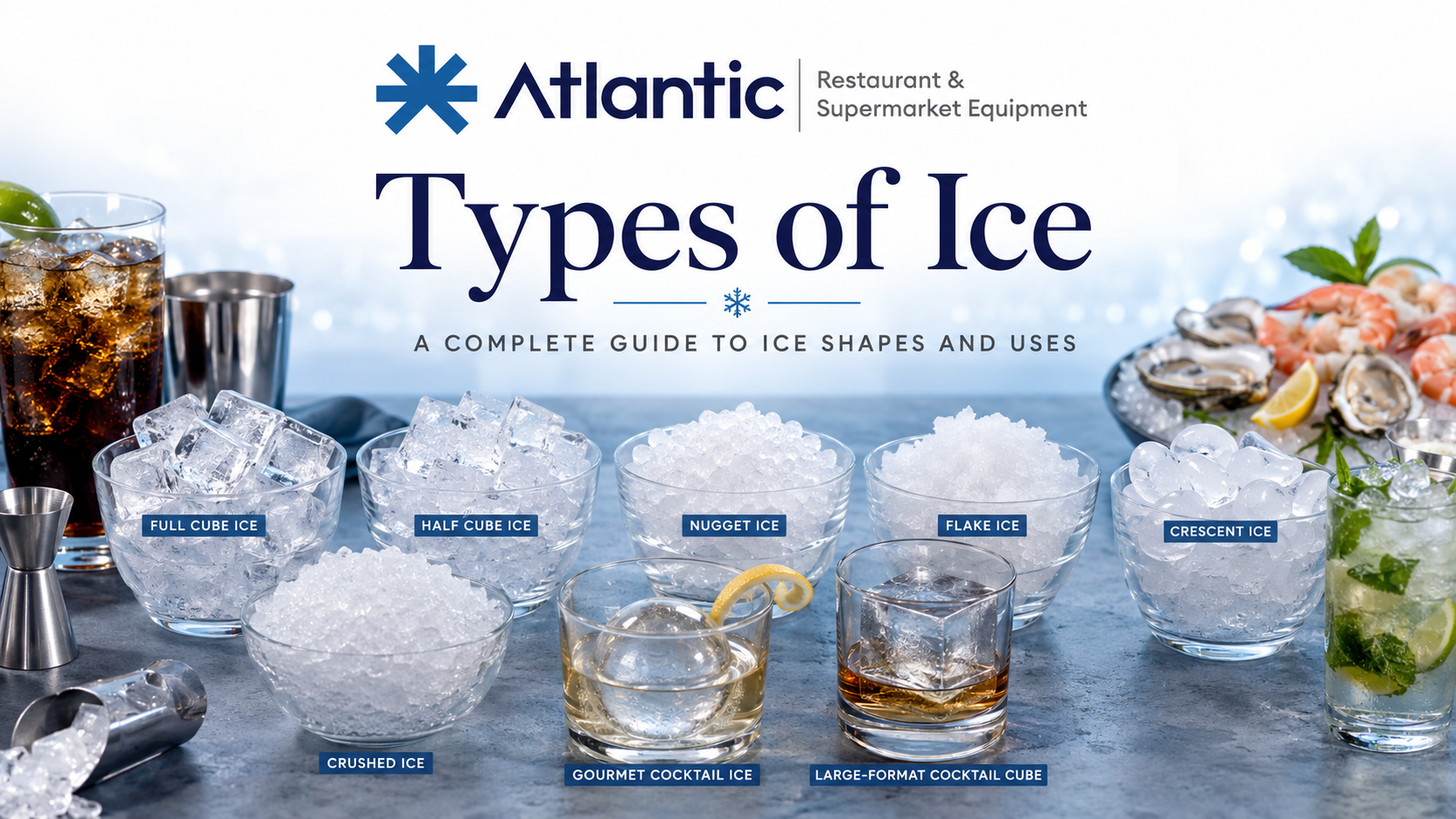
Ice may seem simple, but in restaurants, bars, hotels, convenience stores, cafés, supermarkets, and healthcare facilities, the type of ice you choose can directly affect beverage quality, food presentation, service speed, equipment performance, and customer experience.
A cocktail bar does not need the same ice as a seafood display. A hospital does not use ice the same way a convenience store does. A high-volume restaurant may need fast-dispensing half-cube ice, while an upscale lounge may prefer slow-melting gourmet cubes for whiskey and premium cocktails.
Understanding the different types of ice helps foodservice operators choose the right commercial ice machine, reduce waste, improve drink quality, and create a better presentation. This guide explains the most common ice types, how they differ, where they are used, and what kind of businesses should choose each one.
What Are the Main Types of Ice?
The most common types of ice used in commercial foodservice are:
- Full cube ice
- Half cube ice
- Regular cube ice
- Nugget ice
- Flake ice
- Crescent ice
- Gourmet ice
- Cubelet ice
- Crushed ice
- Large format cocktail ice
- Ice spheres
- Shaved ice
Each ice type has a different shape, density, melt rate, texture, and application. Some are designed for beverages, some for food display, some for healthcare use, and others for premium presentation.
Quick Ice Type Comparison Chart
| Ice Type | Texture | Melt Rate | Best Uses |
|---|---|---|---|
| Full Cube Ice | Hard, solid, square | Slow | Soft drinks, cocktails, ice bagging, dispensing |
| Half Cube Ice | Hard, smaller cube | Moderate | Restaurants, bars, fountain drinks, iced coffee |
| Regular Cube Ice | Hard, large cube | Slow | Mixed drinks, bagged ice, beverage service |
| Nugget Ice | Soft, chewable | Fast | Soft drinks, healthcare, convenience stores, smoothies |
| Flake Ice | Soft, moldable | Fast | Seafood displays, produce, buffets, medical use |
| Crescent Ice | Hard, half-moon shape | Slow | Restaurants, bars, convenience stores, dispensers |
| Gourmet Ice | Hard, clear, elegant | Slow | Whiskey, cocktails, premium drinks |
| Cubelet Ice | Soft, compact nugget | Fast to moderate | Healthcare, beverage stations, self-serve drinks |
| Crushed Ice | Small broken ice pieces | Fast | Cocktails, juleps, mojitos, blended drinks |
| Large Format Ice | Large solid cube | Very slow | Craft cocktails, whiskey, premium spirits |
| Ice Sphere | Round, solid ice | Very slow | Whiskey, bourbon, high-end cocktails |
| Shaved Ice | Fine, snow-like | Very fast | Desserts, snow cones, frozen treats |
Why Ice Type Matters
Choosing the right ice is not only about appearance. Ice shape affects how quickly a drink cools, how fast it melts, how much it dilutes beverages, how it feels in the mouth, how it moves through dispensers, and how well it supports food products.

For example, a slow-melting cube is ideal for cocktails because it chills the drink without watering it down too quickly. Nugget ice is popular in fountain drinks because it absorbs flavor and is easy to chew. Flake ice is preferred for seafood displays because it is soft and moldable, helping keep delicate products cold without damaging them.
For foodservice businesses, ice is part of the customer experience. The wrong ice can create watery drinks, poor presentation, slow service, clogged dispensers, or inconsistent product quality.
1. Full Cube Ice
Full cube ice is one of the most common commercial ice types. It is usually square, solid, and dense. Because of its larger size and high ice-to-water ratio, full cube ice melts more slowly than smaller ice pieces.

Coldline ICE550M-FA 30” 550 lb. Ice Machine Air Cooled Full Cube Modular with Bin
This makes it a good choice for beverage service where dilution needs to be controlled. Full cube ice works well in soft drinks, mixed drinks, iced tea, water service, and ice bagging. It also performs well in dispensers because the cube shape is consistent and durable.
Best Uses for Full Cube Ice
Full cube ice is commonly used in:
- Restaurants
- Bars
- Hotels
- Convenience stores
- Catering businesses
- Ice bagging operations
- Beverage stations
Advantages of Full Cube Ice
Full cube ice provides strong cooling power, a clean appearance, and a slower melt rate. Since it melts more slowly, it can help reduce ice consumption and keep drinks from becoming diluted too quickly.
When to Choose Full Cube Ice
Choose full cube ice if your business serves a high volume of beverages and needs a reliable, versatile ice type that works in many settings. It is especially useful for drinks that should stay cold without becoming watery too fast.
2. Half Cube Ice
Half cube ice is smaller than full cube ice and is one of the most versatile ice types for commercial foodservice. It cools drinks quickly, fits easily into glasses, works well in dispensers, and is commonly used in restaurants, bars, cafés, and convenience stores.
Because half cube ice has more surface area than full cube ice, it cools beverages faster. However, it may also melt a bit faster than larger cubes. This balance makes it a practical choice for busy beverage programs.
Best Uses for Half Cube Ice
Half cube ice is ideal for:
- Fountain drinks
- Iced coffee
- Iced tea
- Soft drinks
- Mixed drinks
- Smoothies
- Frozen cocktails
- Self-service beverage stations
Advantages of Half Cube Ice
Half cube ice is easy to dispense, easy to scoop, and compatible with many commercial beverage applications. It is often a smart default choice for restaurants because it handles a wide range of drink service needs.
When to Choose Half Cube Ice
Choose half cube ice if your operation needs a universal ice type for everyday beverage service. It is one of the best options for restaurants, quick-service businesses, cafés, bars, and convenience stores.
3. Regular Cube Ice
Regular cube ice is a larger, solid cube used in restaurants, bars, and commercial beverage programs. It is usually larger than half cube ice and often has a slower melt rate.
Because regular cubes are dense and durable, they work well in mixed drinks, soft drinks, ice bagging, and dispensing applications. They provide good cooling while helping control dilution.
Best Uses for Regular Cube Ice
Regular cube ice works well for:
- Mixed drinks
- Soft drinks
- Ice water
- Bagged ice
- Catering
- General beverage service
Advantages of Regular Cube Ice
Regular cube ice offers reliable cooling, good presentation, and a slower melt rate. It is a strong choice for businesses that want one ice style for multiple uses.
When to Choose Regular Cube Ice
Choose regular cube ice if your business needs a solid, slower-melting ice type for beverage service, dispensing, and general foodservice use.
4. Nugget Ice
Nugget ice is one of the most popular ice types because of its soft, chewable texture. It is sometimes called pebble ice, pellet ice, chewable ice, or “Sonic-style” ice. Unlike solid cubes, nugget ice is made from compressed ice flakes, which gives it a softer texture and a porous structure.
This structure allows nugget ice to absorb beverage flavors. That is one reason customers love it in soft drinks, lemonades, iced teas, and fountain beverages.
Best Uses for Nugget Ice
Nugget ice is commonly used in:
- Convenience stores
- Healthcare facilities
- Hospitals
- Nursing homes
- Beverage stations
- Smoothie shops
- Fast casual restaurants
- Self-serve drink areas
Advantages of Nugget Ice
Nugget ice is easy to chew, cools drinks quickly, and creates a satisfying texture. It works well in drinks where customers enjoy chewing the ice after finishing the beverage.
It is also popular in healthcare because it is softer than hard cubes and easier for many patients to consume.
Disadvantages of Nugget Ice
Nugget ice melts faster than solid cube ice. It may not be the best choice for premium cocktails, whiskey, or drinks where dilution control is important. Because it is softer, it can also clump if not stored or dispensed properly.
When to Choose Nugget Ice
Choose nugget ice if customer experience, chewability, and quick cooling are priorities. It is one of the best choices for convenience stores, healthcare environments, beverage stations, and casual dining operations.
5. Flake Ice
Flake ice is soft, thin, and moldable. It looks more like small ice flakes or snow than solid cubes. Because it can be packed around products, it is widely used in food displays, seafood counters, produce displays, buffets, and healthcare settings.
Flake ice cools quickly and conforms to the shape of the product. This makes it useful for keeping fish, shellfish, meat, and produce cold while maintaining visual presentation.
Best Uses for Flake Ice
Flake ice is ideal for:
- Seafood displays
- Fish markets
- Grocery stores
- Meat displays
- Produce displays
- Buffets
- Salad bars
- Medical compresses
- Healthcare applications
Advantages of Flake Ice
Flake ice is soft and gentle. It helps prevent bruising or damage to delicate products. It is also easy to shape, which makes it excellent for display cases and presentation areas.
Disadvantages of Flake Ice
Flake ice melts faster than solid cube ice and is not usually the best choice for standard beverage service. It can make drinks watery quickly and does not provide the same clean look as cubes.
When to Choose Flake Ice
Choose flake ice if your business displays seafood, produce, meats, or chilled prepared foods. It is also a strong choice for supermarkets, fish markets, healthcare facilities, and buffet operations.
6. Crescent Ice
Crescent ice has a half-moon shape. It is hard, clear, and designed to move easily in a glass without packing tightly together. The curved shape allows liquid to flow around the ice, making it popular in beverage service and commercial dispensing.
Crescent ice is commonly associated with restaurants, bars, convenience stores, and self-service drink programs.
Best Uses for Crescent Ice
Crescent ice is commonly used for:
- Soft drinks
- Mixed drinks
- Ice water
- Self-service beverage stations
- Ice bagging
- Restaurants
- Convenience stores
Advantages of Crescent Ice
Crescent ice is durable, attractive, and slow-melting. It works well in dispensers and glasses because it does not compact as tightly as some smaller ice types.
When to Choose Crescent Ice
Choose crescent ice if your operation needs dependable beverage ice that performs well in glasses, dispensers, and general service applications.
7. Gourmet Ice
Gourmet ice is a premium ice type used for upscale beverage presentation. It is often clear, hard, and shaped like a cylinder, octagon, top hat, or specialty cube. Because gourmet ice is dense and slow-melting, it is excellent for high-end cocktails and spirits.
This type of ice is often used in bars, hotels, lounges, banquet halls, and fine dining restaurants.
Best Uses for Gourmet Ice
Gourmet ice is best for:
- Whiskey
- Bourbon
- Scotch
- Old Fashioneds
- Negronis
- Premium cocktails
- Upscale bars
- Fine dining beverage service
Advantages of Gourmet Ice
Gourmet ice creates a luxury presentation. It melts slowly, helps preserve drink flavor, and looks more refined than standard cube ice.
Disadvantages of Gourmet Ice
Gourmet ice machines are usually more specialized. They may produce less ice per day than standard cube machines and may not be the best choice for high-volume fountain drinks or general kitchen use.
When to Choose Gourmet Ice
Choose gourmet ice if presentation and drink quality are priorities. It is ideal for craft cocktail bars, upscale restaurants, hotels, and lounges.
8. Cubelet Ice
Cubelet ice is similar to nugget ice but may have a more compact or defined shape depending on the machine. It is soft, chewable, and often used in healthcare, beverage stations, and self-service environments.
Some cubelet ice is softer and more chewable, while other types are firmer and better suited for dispensing.
Best Uses for Cubelet Ice
Cubelet ice is used in:
- Hospitals
- Nursing homes
- Convenience stores
- Self-service dispensers
- Beverage stations
- Offices
- Schools
- Breakrooms
Advantages of Cubelet Ice
Cubelet ice is easy to chew, pleasant in soft drinks, and often works well in ice and water dispensers. It is useful where customer or patient comfort matters.
When to Choose Cubelet Ice
Choose cubelet ice if you need soft, chewable ice for drinks, healthcare use, or customer-facing dispensers.
9. Crushed Ice
Crushed ice is made by breaking larger ice into small, irregular pieces. It chills drinks quickly and creates a textured, refreshing presentation. It is common in cocktail bars and dessert applications.
Unlike nugget ice, crushed ice is not formed as a soft pellet. It is simply broken ice, so the texture can be sharper and more irregular.
Best Uses for Crushed Ice
Crushed ice is popular for:
- Mojitos
- Mint juleps
- Tiki drinks
- Frozen cocktails
- Slush-style drinks
- Seafood platters
- Dessert displays
Advantages of Crushed Ice
Crushed ice chills quickly and creates an attractive texture in specialty drinks. It is useful for cocktails that are designed to be served very cold and slightly diluted.
Disadvantages of Crushed Ice
It melts quickly and can water down drinks fast. It is usually not ideal for standard fountain drinks or long holding times.
When to Choose Crushed Ice
Choose crushed ice for cocktail programs, specialty beverages, and certain display applications where quick chilling and texture are important.
10. Large Format Cocktail Ice
Large format ice includes oversized cubes or blocks designed for craft cocktails. These large pieces have less surface area relative to their volume, which means they melt more slowly than small cubes.
Large format ice is commonly used in whiskey, bourbon, tequila, rum, and spirit-forward cocktails.
Best Uses for Large Format Ice
Large format ice is best for:
- Old Fashioneds
- Whiskey on the rocks
- Negronis
- Premium cocktails
- Bourbon and Scotch service
- High-end bar programs
Advantages of Large Format Ice
Large format ice gives drinks a premium look and slows dilution. It also signals quality and attention to detail.
When to Choose Large Format Ice
Choose large format ice if your bar focuses on craft cocktails, premium spirits, and presentation-driven beverage service.
11. Ice Spheres
Ice spheres are round pieces of large-format ice. Their shape reduces surface area, allowing them to melt slowly. Ice spheres are often used for whiskey, bourbon, and premium cocktails.
They are especially popular in upscale bars because they create a strong visual impression.
Best Uses for Ice Spheres
Ice spheres are used for:
- Whiskey
- Bourbon
- Scotch
- Premium cocktails
- Luxury hotel bars
- Cocktail lounges
Advantages of Ice Spheres
Ice spheres melt slowly and look elegant. They help preserve the flavor of spirit-forward drinks.
Disadvantages of Ice Spheres
They are not practical for high-volume beverage service and usually require specialty molds or equipment.
When to Choose Ice Spheres
Choose ice spheres for premium presentation, not for everyday restaurant beverage service.
12. Shaved Ice
Shaved ice is very fine, snow-like ice used mostly for desserts and frozen treats. It absorbs syrups quickly and creates a soft texture.
It is common in snow cones, Hawaiian shave ice, Asian shaved ice desserts, and frozen dessert shops.
Best Uses for Shaved Ice
Shaved ice is ideal for:
- Snow cones
- Hawaiian shave ice
- Frozen desserts
- Dessert shops
- Summer concessions
- Specialty beverage shops
Advantages of Shaved Ice
Shaved ice holds syrup well, creates a light texture, and works beautifully for dessert presentation.
When to Choose Shaved Ice
Choose shaved ice if your business sells frozen desserts, snow cones, or syrup-based ice treats.
Ice Type by Business Type

Different businesses need different ice types. The best choice depends on menu, service style, volume, and customer expectations.
Restaurants
Most restaurants benefit from half cube, full cube, or crescent ice. These types are versatile enough for water service, soft drinks, iced tea, cocktails, and general beverage use.
For restaurants with a seafood display or buffet, flake ice may also be needed.
Bars
Bars often need more than one ice type. Half cube or full cube ice works well for standard drinks, while gourmet ice, large cubes, or ice spheres are better for premium cocktails and whiskey service.
Cocktail bars may also use crushed ice for tiki drinks, juleps, and mojitos.
Cafés and Coffee Shops
Cafés usually need half cube ice or nugget ice for iced coffee, cold brew, lemonades, and specialty drinks. Nugget ice can be especially appealing for customers who enjoy chewable ice.
Convenience Stores
Convenience stores often use nugget ice, cubelet ice, or half cube ice for fountain drinks and self-service beverage stations. They may also use full cube or regular cube ice for bagged ice programs.
Hotels
Hotels may need several ice solutions: cube ice for guest ice machines, half cube or full cube ice for restaurants, gourmet ice for bars, and flake ice for banquet or display needs.
Healthcare Facilities
Healthcare facilities often prefer nugget, cubelet, or flake ice because these types are softer and easier to use for patients, hydration, and therapeutic applications.
Supermarkets and Seafood Markets
Supermarkets, fish markets, and grocery stores often use flake ice for seafood, meat, and produce displays. Flake ice molds around products and helps maintain cold temperatures while improving presentation.
Catering Businesses
Caterers may need full cube, half cube, or regular cube ice for beverages, transport, and ice bins. For upscale events, gourmet ice or large format cocktail ice can help improve presentation.
How Melt Rate Affects Drink Quality
Melt rate is one of the most important differences between ice types. Smaller or softer ice melts faster because it has more surface area. Larger and denser ice melts more slowly.
Fast-melting ice is useful when you need quick cooling or a soft texture. Slow-melting ice is better when you want to reduce dilution.
For example:
- Nugget ice cools quickly but melts faster.
- Flake ice cools and molds quickly but is not ideal for most drinks.
- Full cube ice melts more slowly than half cube ice.
- Gourmet ice and large format cubes are best for slow dilution.
- Crushed ice melts fast but is perfect for certain cocktail styles.
A drink program should match the ice type to the beverage. Using the wrong ice can make drinks watery, inconsistent, or less appealing.
Ice Clarity and Presentation
Ice clarity matters most in premium beverage service. Clear ice looks cleaner, more elegant, and more professional. Cloudy ice may be acceptable for standard beverage service, but it may not be ideal for cocktails, spirits, or high-end presentation.
Gourmet ice, large cocktail cubes, and ice spheres are often selected because they look more refined. In upscale restaurants and bars, ice becomes part of the presentation, not just a cooling method.
For casual restaurants, quick-service businesses, and convenience stores, clarity may be less important than production capacity, dispensing reliability, and cost efficiency.
Ice Density and Chewability
Ice density affects how ice feels and how quickly it melts. Dense cube ice is hard and slow-melting. Nugget and cubelet ice are softer and easier to chew. Flake ice is soft and moldable.
If your business serves customers who enjoy chewable ice, nugget or cubelet ice may be a strong choice. If your business serves cocktails or premium drinks, harder and denser ice is usually better.
For healthcare use, soft ice can be important because it is easier for patients to consume.
Ice for Food Display
Food display ice must do more than chill products. It must support presentation, protect delicate foods, and maintain a clean appearance.
Flake ice is the most common choice for seafood displays because it forms a soft, cold bed that supports fish and shellfish. It can also be used for produce, buffets, salad bars, and chilled prepared foods.
For retail environments, ice is often used alongside display refrigeration equipment. Businesses that sell seafood, prepared foods, or cold desserts should plan their ice machine and refrigeration setup together.
Ice for Beverages
For beverage service, the most important factors are cooling speed, melt rate, glass fill, and customer experience.
Half cube ice is one of the best all-purpose choices for restaurants and cafés. Full cube ice is better when slower melting is needed. Nugget ice is excellent for soft drinks and chewable texture. Gourmet ice is ideal for premium cocktails.
Bars and restaurants should avoid using one ice type for every application if the menu requires different drink experiences. A high-volume restaurant may be fine with half cube ice, but a cocktail-focused bar may need a separate premium ice solution.
Ice for Cocktails
Cocktail ice has a major effect on dilution, texture, and presentation. The best ice for cocktails depends on the drink.
For spirit-forward drinks such as Old Fashioneds, Negronis, whiskey, and bourbon, large format ice or gourmet ice is often best. These ice types melt slowly and help preserve flavor.
For cocktails such as mojitos, juleps, swizzles, and tiki drinks, crushed ice works well because fast dilution is part of the drink style.
For high-volume bar service, full cube or half cube ice may be the most practical choice.
Ice for Smoothies and Blended Drinks
For smoothies, frozen cocktails, and blended beverages, smaller ice types are usually easier to blend. Half cube ice and nugget ice are commonly used because they break down more easily than large cubes.
Nugget ice can be especially useful because of its softer structure. However, businesses should confirm that the ice type works properly with their blender and drink recipes.
How to Choose the Right Ice Machine for Your Ice Type
Choosing the right ice type also means choosing the right commercial ice machine. Not every ice machine makes every type of ice. A cube ice machine will not produce nugget ice. A flake ice machine will not produce gourmet cocktail cubes.
Before buying a commercial ice machine, consider:
- What type of ice do you need?
- How much ice do you use per day?
- Do you need built-in storage or a separate ice bin?
- Will the machine be undercounter or modular?
- Is your space properly ventilated?
- Do you have the correct drain, water line, and electrical connection?
- Will customers see or serve themselves from the ice machine?
- Do you need filtration for water quality?
Atlantic Restaurant & Supermarket Equipment offers a wide selection of commercial ice machines for restaurants, bars, hotels, cafés, convenience stores, supermarkets, and foodservice operations. The right machine should match your ice type, daily production needs, available space, and service style.
Undercounter vs Modular Ice Machines
The type of machine you choose matters as much as the ice type.
Undercounter Ice Machines
Undercounter ice machines are compact units that usually include built-in storage. They are a good choice for cafés, offices, small bars, breakrooms, and low-to-medium volume operations.
They save space and can be installed near the point of service. However, they may not produce enough ice for large restaurants, hotels, or high-volume bars.
Modular Ice Machines
Modular ice machines, sometimes called ice machine heads, are designed for higher production. They usually need to be paired with a separate ice storage bin or dispenser.
They are ideal for restaurants, hotels, supermarkets, convenience stores, and businesses that need a large daily ice supply.
Ice Storage Bins
If a machine is listed as “head only,” “modular,” or “no bin,” it usually requires a compatible ice storage bin. Ice bins help store produced ice until staff need it during service.
A properly sized bin is important because even a high-production machine can create operational problems if storage capacity is too small.
Air-Cooled vs Water-Cooled Ice Machines
Commercial ice machines are commonly available in air-cooled and water-cooled models.
Air-Cooled Ice Machines
Air-cooled machines use surrounding air to remove heat. They are the most common choice for restaurants and foodservice businesses because they are generally easier to install and use less water.
However, they need proper clearance and ventilation. If placed near ovens, fryers, dish machines, or hot kitchen areas, performance can drop.
Water-Cooled Ice Machines
Water-cooled machines use water to help remove heat from the system. They may perform better in certain hot or low-ventilation environments, but they usually use more water.
For most foodservice businesses, air-cooled models are the standard choice unless the installation environment requires another solution.
Ice Machine Installation Considerations
Before buying an ice machine, confirm that your location can support the equipment.
Most commercial ice machines need:
- A water line
- A drain
- Correct voltage
- Enough airflow clearance
- Level flooring
- Access for cleaning and service
- Water filtration
- Proper ambient temperature conditions
Some undercounter units may need a drain pump depending on the installation location. Modular machines may need a separate bin, dispenser, or stand.
For safety, sanitation, and performance, many businesses should use a qualified technician, plumber, electrician, or refrigeration professional for installation.
Ice Machine Cleaning and Sanitation
Ice is used in drinks and foodservice, so it must be handled safely. Ice machines, bins, scoops, and dispensers should be cleaned and sanitized on a proper schedule.
Dirty ice machines can lead to poor ice quality, odors, slime, scale buildup, reduced production, and health code concerns.
Basic ice handling best practices include:
- Use a clean ice scoop, not hands or glasses.
- Store the scoop safely between uses.
- Keep the ice bin covered when possible.
- Clean and sanitize the bin regularly.
- Replace water filters as recommended.
- Follow the manufacturer’s cleaning schedule.
- Inspect for mold, slime, scale, or unusual odors.
- Do not store bottles, food, or containers inside the ice bin.
A well-maintained machine produces better ice, lasts longer, and performs more consistently.
Common Ice Machine Problems Related to Ice Type
Different ice types can create different operational challenges.
Nugget or Cubelet Ice Clumping
Soft ice can clump if storage conditions are poor or if the dispenser is not used frequently. Proper bin design and maintenance help reduce this issue.
Flake Ice Melting Too Quickly
Flake ice is designed for fast cooling and display, not long holding in drinks. If used incorrectly, it can melt quickly and create excess water.
Cube Ice Production Drops
Cube ice machines may produce less ice if the condenser is dirty, airflow is restricted, water pressure is low, filters are clogged, or the room is too hot.
Cloudy Ice
Cloudy ice can be caused by water quality, trapped air, mineral content, or machine conditions. Filtration can help improve appearance and taste.
Bad Taste or Odor
Bad-tasting ice is often related to water quality, dirty bins, old filters, or poor cleaning practices.
Which Type of Ice Is Best?
There is no single best type of ice for every business. The best choice depends on the application.
Choose full cube or regular cube ice for slower melting and general beverage service.
Choose half cube ice for high-volume restaurants, cafés, fountain drinks, and all-purpose beverage use.
Choose nugget or cubelet ice for chewable texture, soft drinks, healthcare, and convenience stores.
Choose flake ice for seafood, produce, buffets, and food displays.
Choose crescent ice for beverage service, dispensers, and restaurants that want a durable, slow-melting ice shape.
Choose gourmet ice, large cubes, or ice spheres for premium cocktails and upscale drink presentation.
Choose shaved ice for frozen desserts and specialty treats.
Ice is more than frozen water. In a commercial foodservice operation, ice affects beverage quality, food presentation, customer satisfaction, sanitation, and equipment planning.
The right ice type can improve drink consistency, reduce dilution, support food display, create a better customer experience, and help your staff work more efficiently. The wrong ice type can lead to watery drinks, poor presentation, dispensing problems, and unnecessary waste.
Before choosing a commercial ice machine, start with the ice type your business needs. Then consider daily production, storage capacity, installation requirements, water filtration, and maintenance. Whether you run a restaurant, bar, hotel, café, convenience store, supermarket, or healthcare facility, matching the right ice type with the right ice machine is the best way to keep your operation running smoothly.
