
Choosing the right refrigeration system for a walk-in cooler or freezer is one of the most important decisions in a commercial kitchen, grocery store, deli, bakery, butcher shop, convenience store, or food production facility.
If the refrigeration system is too small, your walk-in may struggle to reach temperature, recover slowly after deliveries, overwork the compressor, and put stored product at risk. If the system is too large, you may spend more than necessary upfront and create short cycling issues that can affect performance and efficiency.
That is why we created this walk-in cooler BTU calculator.
Use this guide to understand how walk-in refrigeration sizing works, what information you need before requesting a quote, and how to use the calculator to get a practical first estimate for your project.
Use Our Walk-In Cooler and Freezer BTU Calculator
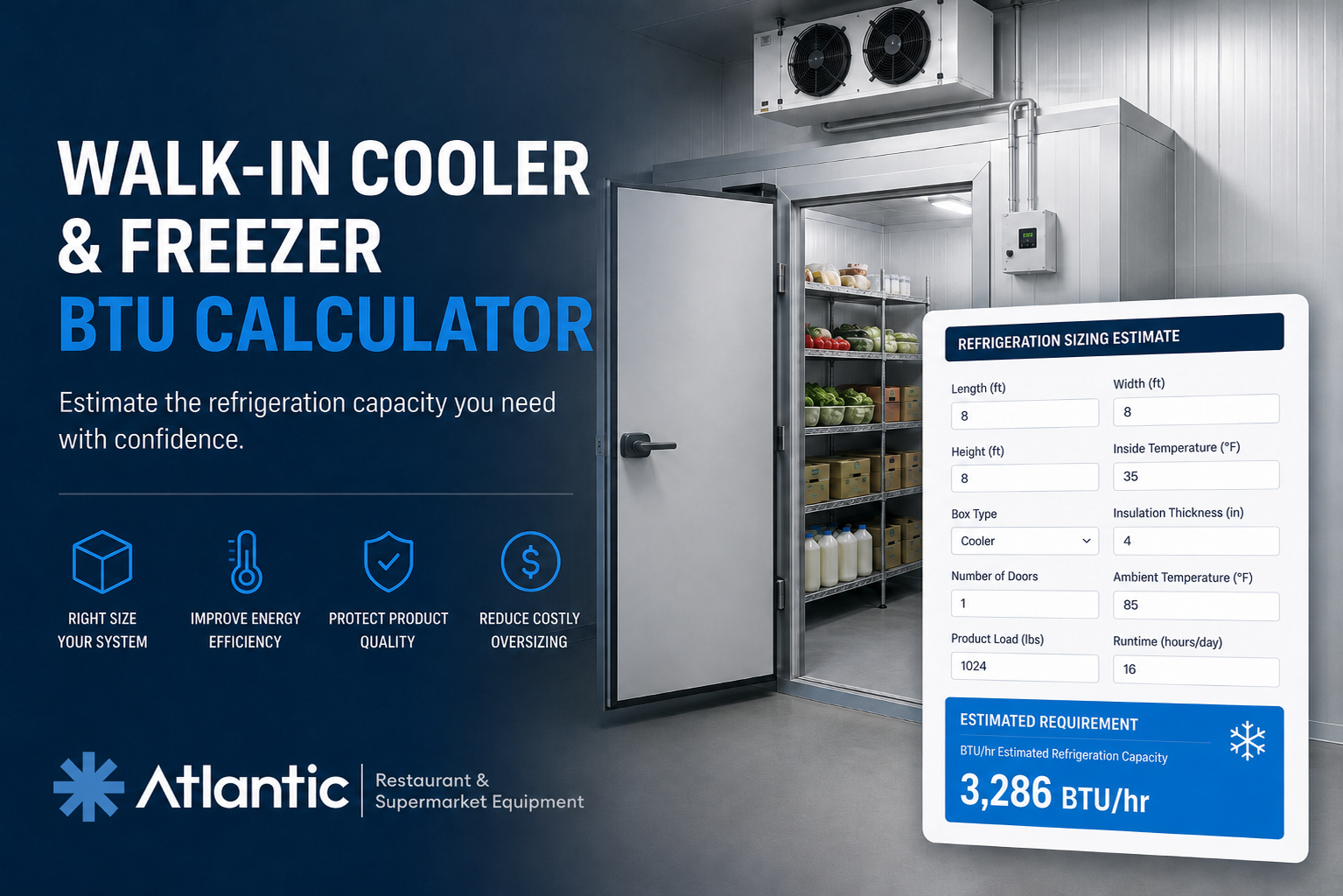
Use the calculator below to estimate the refrigeration capacity your walk-in cooler or freezer may need.
The calculator considers several important sizing factors, including:
- Walk-in box length, width, and height
- Cooler or freezer application
- Holding temperature
- Ambient temperature
- Incoming product weight
- Incoming product temperature
- Wall and ceiling insulation
- Floor insulation
- Number of people entering the box
- Light, normal, or heavy usage
This calculator is designed to provide a first-pass BTU/hr estimate. It is not a final engineering selection. Actual refrigeration sizing may vary depending on product type, door openings, outdoor conditions, installation location, panel insulation, refrigeration type, defrost requirements, and local code requirements.
For a final recommendation, contact Atlantic Restaurant & Supermarket Equipment and our team can help you choose the right walk-in box and refrigeration package.
What Does BTU Mean in Walk-In Cooler Sizing?
BTU stands for British Thermal Unit. In refrigeration, BTU/hr is used to describe how much heat the refrigeration system can remove from a space per hour.
A walk-in cooler or freezer does not “create cold.” It removes heat from inside the box and rejects that heat outside the refrigerated space. The more heat entering the box, the more refrigeration capacity you need.
For walk-in coolers and freezers, BTU/hr demand usually comes from four major sources:
- Heat passing through the walls, ceiling, and floor
- Warm air entering when the door opens
- Warm product being loaded into the box
- Internal heat from people, lights, fans, and equipment
A good BTU estimate should consider all of these factors, not just the size of the box.
Why Walk-In Cooler Size Alone Is Not Enough
Many buyers start with a simple question:
“How many BTUs do I need for an 8x8 walk-in cooler?”
That is a useful starting point, but it is not enough.
An 8x8 walk-in cooler used for packaged beverages in a climate-controlled indoor space may need a different refrigeration system than an 8x8 cooler used for frequent food deliveries in a hot kitchen. The box size may be the same, but the heat load can be very different.
For example, these two walk-ins may have different BTU requirements:
- A 6x8 cooler in an air-conditioned storage room with light door traffic
- A 6x8 cooler next to a hot kitchen with frequent door openings and warm incoming product
Both boxes have the same dimensions, but the second installation has a higher heat load.
That is why our calculator asks for more than length, width, and height.
Main Factors That Affect Walk-In Cooler BTU Requirements

1. Box Dimensions
The larger the walk-in, the more surface area it has. More surface area means more heat can transfer through the panels.
The calculator uses:
-
Length
-
Width
-
Height
These measurements help estimate the internal volume and the surface area of the box.
Common restaurant walk-in cooler sizes include:
-
5x6 walk-in cooler
-
6x6 walk-in cooler
-
6x8 walk-in cooler
-
6x10 walk-in cooler
-
8x8 walk-in cooler
-
8x10 walk-in cooler
-
10x10 walk-in cooler
-
Custom walk-in cooler sizes
A larger box does not always mean the refrigeration load increases in a perfectly straight line, but box size is still one of the most important starting points.
2. Cooler vs. Freezer Application
A walk-in cooler and a walk-in freezer are not sized the same way.
A walk-in cooler usually operates above 32°F. Typical foodservice cooler temperatures are often around 35°F to 38°F.
A walk-in freezer operates at or below 32°F. Many commercial freezer applications operate around 0°F or lower.
Freezers generally require more refrigeration capacity because the system must maintain a much larger temperature difference between the inside of the box and the surrounding environment. Freezers also require different design considerations, including insulated floors, defrost cycles, and freezer-rated refrigeration equipment.
If you are storing frozen food, ice cream, meat, seafood, or other frozen products, do not size the project like a standard cooler.
3. Holding Temperature
Holding temperature is the target temperature inside the walk-in.
Typical examples:
-
Fresh food cooler: 35°F to 38°F
-
Beverage cooler: 35°F to 40°F
-
Floral cooler: often higher than foodservice temperatures
-
Freezer: 0°F or below, depending on product
-
Ice cream freezer: may require lower temperatures than a standard frozen food box
The lower the holding temperature, the more refrigeration capacity you may need.
4. Ambient Temperature
Ambient temperature is the temperature around the walk-in box or around the walk in refrigeration unit, depending on the installation.
This matters because refrigeration systems work harder when the surrounding air is warmer.
A walk-in installed inside an air-conditioned building may have a much lower ambient load than a walk-in installed in a hot back room, warehouse, garage, or outdoor environment.
Examples of ambient conditions:
-
Indoor, air-conditioned space
-
Hot commercial kitchen
-
Basement or storage room
-
Warehouse
-
Outdoor installation
-
Rooftop or remote condensing unit location
If the walk-in will be installed outdoors, you may also need an outdoor roof kit, proper weather protection, and a refrigeration system selected for the actual outdoor design conditions.
5. Incoming Product Load
Product load is one of the most overlooked parts of walk-in refrigeration sizing.
If you load warm product into the walk-in, the refrigeration system must remove heat from that product until it reaches the holding temperature.
A cooler that only stores already-chilled product has a much lighter load than a cooler receiving warm deliveries every day.
Product load depends on:
-
How many pounds of product enter the walk-in
-
The temperature of the product when it enters
-
The target holding temperature
-
How quickly the product needs to pull down
-
The type of product being stored
For example, 800 pounds of product entering at 50°F creates more load than 100 pounds of product entering at 38°F.
This is why our calculator asks for incoming product weight and incoming product temperature.
6. Door Openings and Usage Level
Every time the door opens, warm air enters the box and cold air escapes. This is called infiltration load.
Door traffic can make a major difference in real-world performance.
A walk-in used once or twice per hour is very different from a walk-in in a busy restaurant where staff enters constantly during service.
Usage level may be affected by:
-
Number of employees using the box
-
Delivery schedule
-
Kitchen volume
-
Door location
-
Whether the door is left open during stocking
-
Strip curtains or air curtains
-
Self-closing door hardware
-
Whether the walk-in is used during peak service
Heavy door traffic usually increases BTU requirements.
7. Insulation Type and Panel Thickness
Walk-in panels slow down heat transfer. Better insulation helps reduce refrigeration load and can improve long-term performance.
Most commercial walk-in boxes use insulated wall and ceiling panels. Freezers typically require insulated floors as well.
Important insulation questions include:
-
What is the panel thickness?
-
What is the insulation type?
-
Is the box cooler-rated or freezer-rated?
-
Does the freezer include an insulated floor?
-
Is the box installed indoors or outdoors?
-
Are the panels properly sealed?
If the insulation is weak, damaged, wet, or poorly sealed, the refrigeration system must work harder.
8. Floor Insulation
Floor insulation is especially important for freezers.
A walk-in cooler may be installed with or without an insulated floor depending on the application, site conditions, and local requirements. A walk-in freezer normally requires an insulated floor to help prevent heat transfer from below and reduce the risk of floor-related issues.
If you are buying a freezer, do not assume that a no-floor cooler box can be used as a freezer. Freezer applications require freezer-rated construction and refrigeration.
9. Internal Heat Load
Internal heat comes from sources inside the walk-in, including:
-
People entering the box
-
Lights
-
Evaporator fan motors
-
Equipment inside the box
-
Door heaters or frame heaters on freezer applications
These loads may seem small compared with product load or infiltration load, but they still matter in a complete estimate.
How to Use the Walk-In Cooler BTU Calculator
To use the calculator, enter the basic information about your project.
Step 1: Enter the Walk-In Dimensions
Start with length, width, and height.
If you already know the size you need, enter those dimensions. If you are still planning, use your best estimate and compare multiple sizes.
For example, you can compare:
-
6x6 vs. 6x8
-
6x8 vs. 8x8
-
8x10 vs. 10x10
This can help you understand how box size affects refrigeration demand.
Step 2: Choose Cooler or Freezer
Select whether the walk-in will be used as a cooler or freezer.
Choose cooler if the box will store refrigerated products above freezing.
Choose freezer if the box will store frozen products at or below 32°F.
Step 3: Enter Holding Temperature
Enter the temperature you want the box to maintain.
For many foodservice coolers, 35°F to 38°F is common. For many frozen food applications, 0°F is common. Your exact target may depend on the product being stored.
Step 4: Enter Ambient Temperature
Enter the temperature around the box or the expected environment.
If the walk-in is installed in a hot kitchen, warehouse, or outdoor space, use a higher ambient temperature. If it is installed in a climate-controlled indoor space, use a lower ambient temperature.
Step 5: Add Incoming Product Information
Enter how much product will be loaded and the temperature of that product when it enters the walk-in.
This is important for restaurants, delis, supermarkets, bakeries, butcher shops, seafood markets, and food production businesses that receive frequent deliveries.
Step 6: Select Insulation and Floor Conditions
Choose the insulation condition that best matches your project.
If you are using a new commercial walk-in box, your insulation performance should be much better than an old or damaged box. If the freezer has no insulated floor, the estimate may not reflect a proper freezer installation.
Step 7: Add Personnel and Usage Level
Enter the number of people who regularly enter the box and choose the usage level.
If your staff will enter the walk-in frequently during service, select a heavier usage level.
Step 8: Review the Estimated BTU/hr
The calculator will generate an estimated BTU/hr requirement.
Use this number as a starting point when discussing refrigeration options with our team.
Example: Estimating BTU for a Restaurant Walk-In Cooler
Let’s say a restaurant is planning a 6x8 walk-in cooler.
Basic project details:
-
Box size: 6 ft x 8 ft x 8 ft
-
Application: Cooler
-
Holding temperature: 35°F
-
Ambient temperature: 85°F
-
Incoming product: 400 lb per day
-
Incoming product temperature: 45°F
-
Usage: Normal restaurant use
-
Personnel: 2 to 3 people
-
Insulation: Standard commercial walk-in panels
In this case, the final BTU/hr estimate will depend not only on the 6x8 box size, but also on the daily product load and how often the door opens.
A light-use beverage cooler may require less capacity. A busy restaurant cooler with warm deliveries and frequent door traffic may require more.
Example: Estimating BTU for a Walk-In Freezer
Now let’s compare a freezer application.
Basic project details:
-
Box size: 6 ft x 8 ft x 8 ft
-
Application: Freezer
-
Holding temperature: 0°F
-
Ambient temperature: 90°F
-
Incoming product: 300 lb
-
Incoming product temperature: 20°F
-
Usage: Normal to heavy
-
Floor: Insulated freezer floor
This freezer will usually require more refrigeration capacity than a cooler of the same size because the temperature difference is much greater.
A freezer also requires freezer-rated equipment, proper defrost, insulated floor construction, and careful door sealing.
Common Walk-In Cooler Sizing Mistakes
Mistake 1: Sizing Only by Box Dimensions
Box dimensions matter, but they are not the whole story.
A walk-in refrigeration system should account for product load, door traffic, ambient temperature, insulation, and usage.
Mistake 2: Ignoring Incoming Product Temperature
If you load warm product into the box, your system has to remove that heat.
This is especially important for:
-
Restaurants
-
Bakeries
-
Meat markets
-
Seafood markets
-
Grocery stores
-
Commissary kitchens
-
Food prep operations
Mistake 3: Underestimating Door Traffic
A walk-in that is opened constantly needs more recovery capacity than a box that stays closed most of the day.
If your staff frequently enters the walk-in during peak hours, choose a realistic usage level in the calculator.
Mistake 4: Treating Coolers and Freezers the Same
Coolers and freezers have different design requirements.
A freezer is not just a colder cooler. It may require different panels, insulated floors, defrost systems, door heaters, and refrigeration components.
Mistake 5: Forgetting About Ambient Conditions
A walk-in in a hot kitchen or outdoor environment may need more capacity than the same box in an air-conditioned room.
Always size based on the real installation environment.
Mistake 6: Choosing Equipment Without Professional Review
A calculator is useful, but final selection should be reviewed before purchase.
The wrong refrigeration system can lead to temperature problems, energy waste, compressor stress, or product loss.
Walk-In Cooler BTU Calculator vs. Refrigeration Sizing Chart
A sizing chart can be helpful for quick reference, but it usually assumes standard conditions.
A calculator is more flexible because it lets you adjust the inputs.
A typical chart may not fully account for:
-
Heavy door traffic
-
Hot ambient conditions
-
Large product deliveries
-
Freezer applications
-
Outdoor installations
-
Poor insulation
-
Unusual box dimensions
-
Special product storage requirements
That is why a calculator is often a better first step than a simple chart.
How Much Refrigeration Capacity Do I Need for a Walk-In Cooler?
There is no single answer that works for every walk-in cooler.
The refrigeration capacity depends on the total heat load.
Important questions include:
-
What size is the box?
-
What temperature do you need to maintain?
-
Is it a cooler or freezer?
-
Where will the box be installed?
-
How hot is the surrounding area?
-
How much product will be loaded?
-
What temperature is the product when it enters?
-
How often will the door open?
-
How many people will use the walk-in?
-
Is the box indoor or outdoor?
-
Is the insulation new, old, damaged, or upgraded?
Use the calculator to get a starting estimate, then contact Atlantic for a more specific recommendation.
Do You Need a Top-Mount or Remote Refrigeration System?
After estimating BTU/hr, the next question is usually refrigeration type.
Two common options are top-mount refrigeration and remote refrigeration.
Top-Mount Refrigeration
A top-mount system is installed directly on top of the walk-in box.
It can be a practical choice for many restaurants, delis, cafés, bakeries, and small foodservice operations.
Benefits may include:
-
Compact installation
-
Easier package selection
-
No separate remote condensing location
-
Common choice for many indoor walk-in coolers
However, top-mount systems may release heat into the surrounding space. If the walk-in is located in a small or hot room, this may not be ideal.
Remote Refrigeration
A remote refrigeration system places the condensing unit away from the box, often outside, on a roof, or in a mechanical area.
Benefits may include:
-
Less heat rejected into the kitchen or storage room
-
More flexibility for larger projects
-
Better option for certain high-load applications
-
Potentially quieter operation near the walk-in
Remote systems usually require professional installation by a qualified refrigeration contractor.
Atlantic can help you compare box-only, top-mount, and remote refrigeration options based on your space and budget.
Walk-In Cooler Applications That Need Careful BTU Sizing
Some businesses have more demanding refrigeration needs than others.
Restaurants
Restaurants often have frequent door openings, daily deliveries, and changing product loads. A restaurant walk-in cooler should be sized for real daily use, not just empty-box conditions.
Delis and Sandwich Shops
Delis often store meats, cheeses, produce, beverages, and prepared foods. Door traffic can be high during busy hours.
Bakeries
Bakeries may store dough, dairy, fillings, toppings, and finished products. Incoming product temperatures and humidity needs may affect the final recommendation.
Butcher Shops and Meat Markets
Meat storage requires consistent temperature control. Product load can be significant, especially after deliveries.
Seafood Markets
Seafood applications may require careful temperature management, high sanitation standards, and consistent recovery.
Grocery Stores and Supermarkets
Grocery and supermarket walk-ins may have larger product loads, frequent stocking, and more demanding refrigeration requirements.
Convenience Stores
Convenience stores may use walk-ins for beverages, packaged foods, and backstock. Door traffic and product rotation can vary widely.
Why Correct Refrigeration Sizing Matters
Correct sizing can help with:
-
Maintaining safe product temperatures
-
Improving recovery after door openings
-
Reducing compressor stress
-
Avoiding unnecessary energy waste
-
Protecting food inventory
-
Improving long-term system performance
-
Matching the walk-in box to the right refrigeration package
A walk-in cooler or freezer is a major investment. Proper sizing helps protect that investment.
When Should You Contact Atlantic for Help?
You should contact our team if:
-
You are not sure what size walk-in you need
-
You need help choosing cooler vs. freezer
-
You are comparing top-mount and remote refrigeration
-
You need a box-only walk-in
-
You need a walk-in with refrigeration included
-
You are installing the box outdoors
-
You need a freezer with insulated floor
-
You have heavy product loading
-
Your space has unusual dimensions
-
You need nationwide shipping
-
You want help matching a walk-in box to your business
Atlantic Restaurant & Supermarket Equipment supplies commercial walk-in coolers, walk-in freezers, and restaurant equipment for businesses across the United States.
We can help you compare sizes, choose the right box configuration, and understand your refrigeration options before you buy.
Frequently Asked Questions
What is a walk-in cooler BTU calculator?
A walk-in cooler BTU calculator is a tool that estimates how much refrigeration capacity a walk-in cooler or freezer may need. It uses inputs such as box size, holding temperature, ambient temperature, product load, insulation, door traffic, and usage level.
How many BTUs do I need for a walk-in cooler?
The BTU requirement depends on the size of the box, target temperature, ambient temperature, product load, insulation, and door openings. A small cooler with light use may need far less capacity than the same size cooler in a hot kitchen with heavy traffic.
How do I calculate refrigeration load for a walk-in cooler?
A basic refrigeration load estimate considers heat transfer through the panels, warm air entering through door openings, heat from incoming product, and internal heat from people, lights, fans, and equipment. A calculator helps estimate these loads based on your project details.
Is a walk-in freezer sized differently than a walk-in cooler?
Yes. A walk-in freezer usually requires more refrigeration capacity than a cooler of the same size because it must maintain a much lower temperature. Freezers also require freezer-rated construction, insulated floors, defrost systems, and proper door sealing.
What temperature should a walk-in cooler be?
Many foodservice walk-in coolers operate around 35°F to 38°F, depending on the products being stored. Always follow food safety requirements and product-specific storage guidelines.
What temperature should a walk-in freezer be?
Many commercial freezers operate around 0°F or below. Some products, such as ice cream, may require lower temperatures.
Does ambient temperature affect BTU requirements?
Yes. The hotter the surrounding area, the harder the refrigeration system must work. A walk-in installed in a hot kitchen, warehouse, or outdoor location may require more capacity than one installed in an air-conditioned room.
Why does incoming product weight matter?
Warm product adds heat to the box. The refrigeration system must remove that heat to bring the product down to the target holding temperature. More product or warmer product usually means more refrigeration load.
Does door traffic affect walk-in cooler sizing?
Yes. Every door opening allows warm air to enter and cold air to escape. Busy restaurants, grocery stores, and production kitchens may need more recovery capacity because of frequent door openings.
Can I use a walk-in cooler without a floor?
Some walk-in coolers can be installed without an insulated floor, depending on the application and site conditions. Walk-in freezers usually require insulated floors. Always confirm the correct configuration before ordering.
Can I install a walk-in cooler outdoors?
Yes, but outdoor installations require additional planning. You may need a weather-resistant roof kit, proper panel protection, outdoor-rated refrigeration, and site-specific installation review.
Is this calculator a final refrigeration selection?
No. This calculator provides an estimate. Final refrigeration sizing should be reviewed based on your exact box, product load, installation location, usage, and refrigeration type.
Get Help Choosing the Right Walk-In Cooler or Freezer
Use the calculator above to estimate your refrigeration capacity, then contact Atlantic Restaurant & Supermarket Equipment for help choosing the right walk-in cooler, walk-in freezer, or refrigeration package.
Whether you need a small restaurant walk-in, a freezer box, a combo cooler/freezer, or a custom walk-in solution, our team can help you find the right option for your space, budget, and business needs.
Call Atlantic today or request a quote online to get started.