
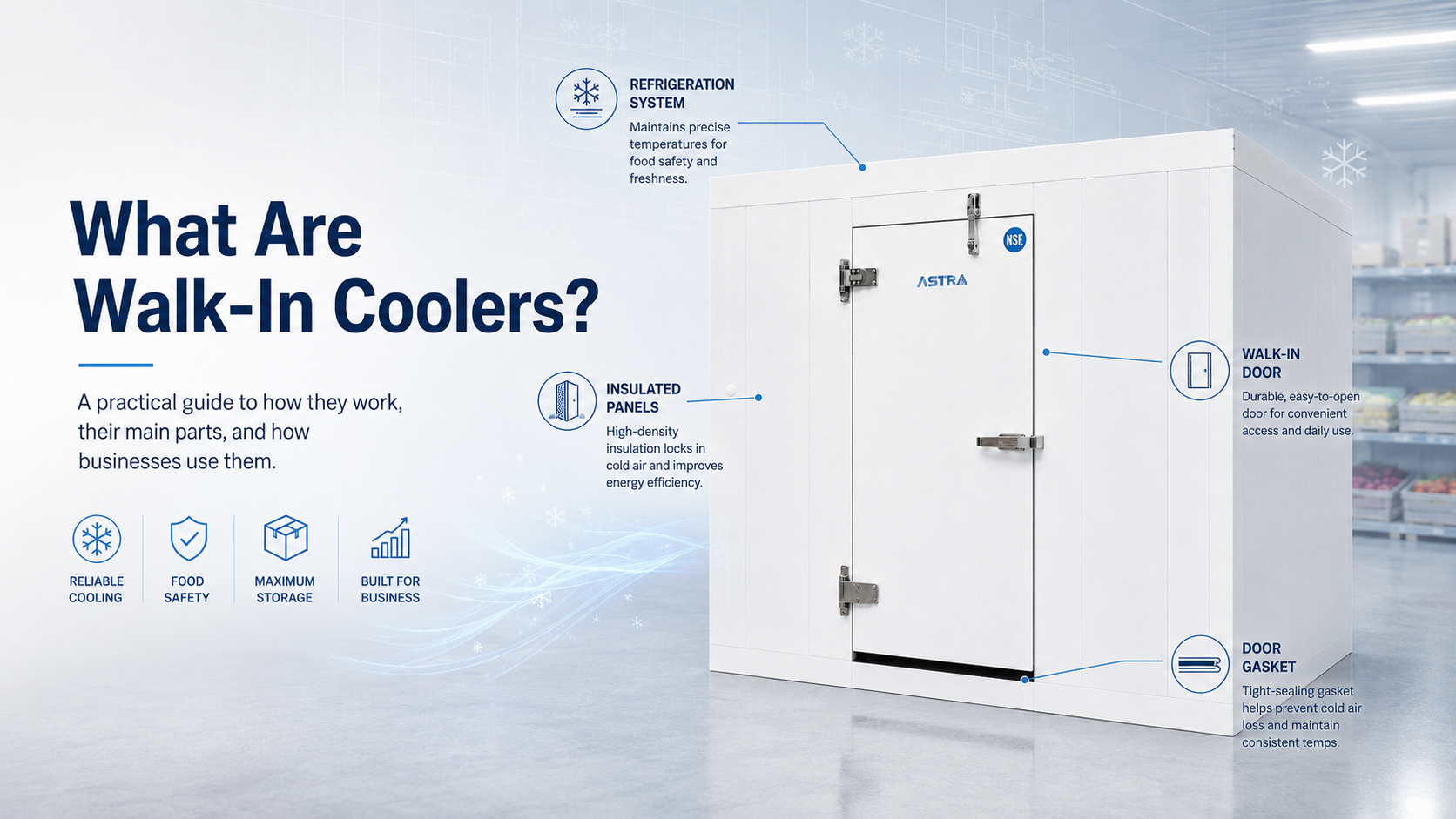
Walk-in coolers are one of the most important pieces of cold storage equipment in the foodservice industry. For restaurants, supermarkets, delis, bakeries, butcher shops, convenience stores, catering companies, and food production businesses, a walk-in cooler is more than a large refrigerator. It is part of the daily operation.
A well-planned walk in cooler helps protect perishable inventory, support food safety, organize back-of-house storage, and make daily prep work easier. If a business stores large quantities of meat, produce, dairy, beverages, prepared foods, flowers, or other temperature-sensitive products, a walk-in cooler can provide the space and temperature control that standard reach-in refrigerators cannot.
This guide explains what walk-in coolers are, why they matter, how they work, what parts they include, which types are available, and what businesses should understand before choosing one.
What Are Walk-In Coolers?
A walk-in cooler is a large refrigerated storage room designed to keep products cold at a controlled temperature. Unlike a reach-in refrigerator, which is opened from the outside and has limited internal space, a walk-in cooler is large enough for a person to walk inside, organize inventory, and store products on commercial shelving.
Walk-in coolers are commonly used in businesses that need more refrigerated storage than standard commercial refrigerators can provide. A restaurant may use a walk-in cooler to store meat, vegetables, dairy, sauces, beverages, and prepared ingredients. A supermarket may use one for backroom inventory. A deli or butcher shop may need one for meat storage. A bakery may use a cooler for dairy products, dough, fillings, or finished items. A florist may use a walk-in cooler to extend the life of fresh flowers.
The main purpose is simple: keep perishable products cold, organized, and accessible.
Most commercial walk-in coolers are built with insulated panels, a commercial door, refrigeration equipment, and a temperature control system. The insulated panels form the walls, ceiling, and sometimes the floor of the box. The refrigeration system removes heat from inside the cooler and releases it outside the refrigerated space. Together, these components create a controlled cold storage environment for daily business use.
In many foodservice operations, walk-in coolers work together with reach-in refrigerators. Reach-in refrigerators are useful for fast access during service, while walk-in coolers are better for larger inventory storage. A busy kitchen may keep daily-use items in reach-ins and bulk storage in the walk-in cooler.
Why Walk-In Coolers Matter for Foodservice Businesses
For many businesses, cold storage is not just a convenience. It directly affects food safety, purchasing, labor flow, and profitability.
A restaurant without enough cold storage may be forced to order smaller quantities more often. That can increase delivery pressure and make inventory planning harder. With a properly sized walk-in cooler, a business can store more products, receive larger deliveries, and organize inventory more efficiently.
Walk-in coolers also help reduce clutter in the kitchen. When products are packed into small refrigerators, it becomes harder for staff to find what they need. Items may be forgotten, blocked, damaged, or stored in the wrong place. A walk-in cooler gives the team more space to separate categories, label products, rotate stock, and follow a first-in, first-out system.
Food safety is another major reason walk-in coolers matter. Perishable products need to stay within safe temperature ranges. If cold storage is unreliable or overloaded, products can warm up, spoil faster, or become unsafe. A walk-in cooler gives businesses a more stable environment for refrigerated inventory, especially during busy service periods when reach-in doors are constantly opened.
For supermarkets and markets, walk-in coolers support backroom inventory before products are moved to display cases. For delis and butcher shops, they help keep meat and prepared foods organized. For bakeries, they protect ingredients and finished goods. For catering companies, they make it easier to stage large quantities of food before delivery or events.
In short, a walk-in cooler supports the entire cold side of the operation. It helps a business buy better, store better, prep better, and operate with fewer interruptions.
How Does a Walk-In Cooler Work?

A walk-in cooler works by removing heat from the inside of the refrigerated room and moving that heat outside the space. The goal is not to “create cold” as much as it is to continuously remove unwanted heat.
The refrigeration system usually includes an evaporator coil, condensing unit, compressor, refrigerant, fans, and a temperature controller. These parts work together to keep the interior of the cooler at the desired temperature.
Inside the walk-in cooler, the evaporator coil absorbs heat from the air. Fans move warm interior air across the coil, where the refrigerant absorbs that heat. The refrigerant then carries the heat to the condensing side of the system. The condensing unit releases the heat outside the refrigerated space, allowing the system to continue cooling the box.
The compressor plays a major role in this cycle. It moves refrigerant through the system and helps maintain the pressure needed for the refrigeration process. The thermostat or digital controller monitors the temperature inside the cooler and signals the system when cooling is needed.
There are different refrigeration layouts. Some walk-in coolers use top-mounted refrigeration systems, where the refrigeration equipment is installed on top of the box. Others use remote refrigeration systems, where the condensing unit is installed away from the cooler, often outdoors or in a mechanical area. The right setup depends on the space, heat load, building layout, noise considerations, and installation requirements.
A walk-in cooler also depends on good airflow. Products should not be stacked directly against the evaporator fans or packed so tightly that cold air cannot circulate. Even the best refrigeration system can struggle if the cooler is overloaded or poorly organized.
Main Parts of a Walk-In Cooler

A walk-in cooler may look like a simple cold room from the outside, but it is made up of several important components. Understanding these parts helps buyers make better decisions and helps operators take better care of the equipment.
The insulated panels form the structure of the walk-in cooler. These panels are designed to reduce heat transfer and help the cooler maintain a stable internal temperature. Panels are used for the walls and ceiling, and some walk-in coolers also include insulated floor panels.
Many commercial walk-in coolers use cam-lock panel connections. This type of system allows the panels to lock together securely during assembly. A good panel connection helps create a tight structure and reduces air leaks.
The door is another critical part of the walk-in cooler. A commercial walk-in cooler door usually includes heavy-duty hinges, a latch, a handle, a gasket, and an interior safety release. The gasket helps seal the door and prevent warm air from entering. If the gasket is damaged, loose, or dirty, the cooler may lose efficiency and the refrigeration system may need to work harder.
Some walk-in coolers include a floor, while others are no-floor models. A no-floor walk-in cooler is installed over an existing floor, often using a U-channel around the base of the panels. This can make sense for certain indoor cooler applications, depending on the condition and suitability of the existing floor. Walk-in freezers usually require insulated floors because they operate at much lower temperatures.
The refrigeration system includes the evaporator, condensing unit, compressor, refrigerant lines, fans, and controller. These parts are responsible for removing heat and maintaining temperature. The evaporator is typically located inside the cooler, while the condensing unit may be mounted on top, nearby, outdoors, or in another designated location.
Other important components may include shelving, LED lighting, a ramp, strip curtains, a digital thermometer, an alarm, a drain line, and an outdoor roof kit for exterior installations. These accessories can make the cooler easier to use, safer, and more efficient.
Types of Walk-In Coolers

Walk-in coolers come in different configurations. The right type depends on the business, space, storage needs, and installation environment.
An indoor walk-in cooler is installed inside a building, usually in a kitchen, backroom, storage area, or warehouse space. Indoor units are common in restaurants, delis, bakeries, cafés, and markets. They are protected from weather and can often be easier to access during daily operations.
An outdoor walk-in cooler is installed outside the building. Outdoor units may be useful when interior space is limited, but they require more planning. Weather protection, drainage, electrical access, refrigeration placement, roof kits, and local code requirements must be considered.
A walk-in cooler with floor includes insulated floor panels as part of the box. This can be useful when the existing floor is not suitable or when the project requires a fully insulated structure. A no-floor walk-in cooler uses the existing floor of the building and is often selected for indoor refrigerated storage applications where the floor is level, durable, cleanable, and appropriate for the installation.
A top-mount walk-in cooler has the refrigeration equipment mounted on top of the unit. This is a common option for many standard commercial applications because it can simplify the overall footprint. A remote refrigeration system places the condensing unit away from the box. This may help reduce heat and noise near the cooler, but it usually requires more planning and professional installation.
There are also cooler/freezer combo boxes. These combine refrigerated and frozen storage in one system, usually with separate compartments. A combo unit can be useful for businesses that need both cooler and freezer storage but want to use space efficiently.
Some businesses choose standard walk-in cooler sizes, while others need custom dimensions. A standard box can be faster and more cost-effective, while a custom walk-in cooler may be better for unusual spaces, larger storage needs, or specific operational requirements.
Walk-In Cooler Sizes: Which Size Do You Need?
Walk-in cooler size depends on the type of business, available space, delivery schedule, menu size, inventory volume, and how the team uses refrigerated storage day to day.
A small café or limited-service restaurant may only need a compact walk-in cooler, such as a 6' x 6' or 6' x 8' unit. This may be enough for basic produce, dairy, beverages, and prep items. A small to mid-sized restaurant may need something larger, such as a 6' x 10' or 6' x 12' walk-in cooler, especially if it stores more ingredients or receives larger deliveries.
A busy restaurant, deli, butcher shop, or bakery may need a larger cooler because product categories must be separated and organized. A supermarket, grocery store, or food distributor may require a much larger walk-in cooler or even multiple cold storage areas for different inventory categories.
When choosing a size, it is important to think beyond today’s inventory. A cooler that is barely large enough at the time of opening may become too small as the business grows. At the same time, buying a cooler that is much larger than necessary can increase cost and use valuable space.
The layout inside the cooler also matters. Shelving, aisle space, door swing, product rotation, and staff access should all be considered. A walk-in cooler should not be packed wall to wall. Cold air needs space to circulate, and staff need enough room to safely enter, move, and organize products.
A good starting point is to ask these questions: How often do you receive deliveries? How much refrigerated inventory do you keep at one time? What types of products do you store? Do you need space for rolling racks, sheet pans, meat lugs, beverage cases, or produce boxes? Do you expect the business to grow in the next few years?
The best walk-in cooler size is not just the one that fits the room. It is the one that fits the workflow.
Energy Efficiency and Operating Costs
A walk-in cooler operates every day, so energy efficiency matters. The purchase price is only one part of the total cost. Over time, energy use, maintenance, door condition, insulation quality, and refrigeration performance can all affect operating costs.
Insulation is one of the most important factors. Well-insulated panels help reduce heat transfer and make it easier for the refrigeration system to maintain temperature. If panels are damaged, poorly sealed, or not properly installed, the system may work harder than necessary.
The door also has a major impact on efficiency. Every time the door opens, warm air enters the cooler. If the door is opened frequently, left open too long, or not sealed properly, the refrigeration system must remove more heat. Door gaskets should be checked regularly, and staff should be trained to close the door properly.
Strip curtains can help reduce cold air loss in busy operations. They are especially useful when staff enter and exit the cooler frequently. LED lighting can also help reduce heat inside the cooler compared with older lighting systems.
The refrigeration system must be correctly sized. An undersized system may struggle to maintain temperature. An oversized or poorly matched system may create other performance issues. Proper system selection should consider box size, product load, door openings, ambient temperature, indoor or outdoor placement, and business use.
Maintenance also affects energy cost. Dirty condenser coils, blocked airflow, damaged gaskets, malfunctioning fans, and poor organization can all make the cooler less efficient. A walk-in cooler that is clean, organized, and properly maintained is usually easier to operate and less likely to create emergency problems.
NSF, Codes, and Compliance
Walk-in coolers used in commercial foodservice environments should be selected with sanitation, food safety, and local code requirements in mind. Restaurants, markets, delis, bakeries, and other food businesses may be inspected by local health departments, and cold storage equipment is part of that inspection environment.
NSF certification is often discussed in the commercial food equipment industry because it relates to sanitation and food protection standards. For foodservice buyers, NSF-listed or commercially suitable equipment can be important when planning a kitchen or food storage area. However, requirements can vary depending on the location, type of business, and local authority having jurisdiction.
Local building, electrical, mechanical, fire, and health codes may also affect the installation. Outdoor walk-in coolers may require additional planning for weather protection, drainage, roofing, structural support, and permits. Electrical work and refrigeration installation may need to be performed by qualified professionals.
This is why buyers should avoid treating a walk-in cooler as a simple plug-and-play purchase. The cooler box, refrigeration system, electrical requirements, installation environment, and local regulations all need to work together.
Before buying a walk-in cooler, it is smart to confirm the following: Is the unit suitable for commercial use? Does it meet the requirements of your local health department? Is the installation indoor or outdoor? Does the project require a floor? Is refrigeration included or separate? Who is responsible for electrical and refrigeration work? Are permits needed?
A little planning before purchase can prevent costly problems later.
Need Help Choosing a Walk-In Cooler?

A walk-in cooler is one of the most important cold storage decisions a foodservice business can make. The right unit can support your operation for years. The wrong size, wrong configuration, or wrong refrigeration setup can create daily problems.
Before choosing a walk-in cooler, think about your space, inventory, business type, delivery schedule, and long-term plans. A small restaurant may need a compact and practical cooler. A supermarket may need a larger box with more specific storage planning. A bakery, deli, butcher shop, or catering company may need a layout that supports the way products are received, stored, and prepared.
At Atlantic Restaurant & Supermarket Equipment, we help restaurants, markets, delis, bakeries, cafés, and foodservice businesses compare walk-in cooler options based on real operational needs. Whether you are opening a new location, replacing an older cooler, expanding your cold storage, or trying to understand which size and configuration fits your space, our team can help you review your options and choose a walk-in cooler that makes sense for your business.