
In any commercial kitchen, the range is not just another piece of equipment. It is the operational core. Every service, every ticket, and every plate depends on how efficiently your range performs under pressure. Yet, one of the most common mistakes operators make is choosing a range size based purely on space availability rather than output demand, workflow, and long-term growth.
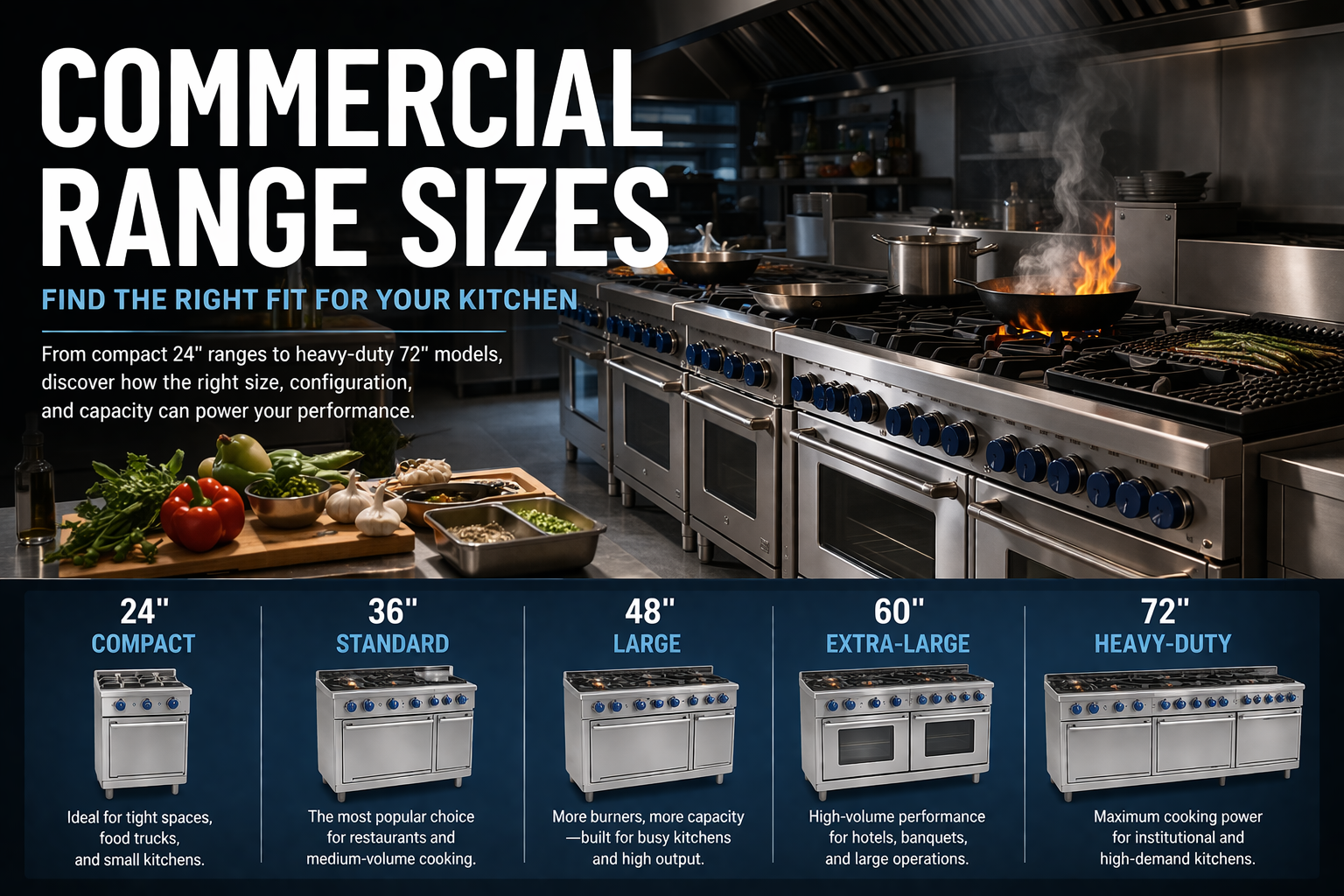
Commercial range sizes typically span from compact 24-inch units to heavy-duty 72-inch configurations. While a 36-inch range is often considered the industry standard, the “right” size is never universal. It is a strategic decision that directly impacts speed of service, kitchen efficiency, labor flow, and ultimately revenue.
This guide goes beyond basic size charts. It explains how range sizes function in real kitchen environments, how to align them with your menu and volume, and how to avoid costly sizing mistakes. Choosing the right commercial cooking equipment is not just about specifications, but about building a kitchen that performs efficiently under real service conditions.

Why Range Size Matters More Than You Think
Choosing the right range size is not about fitting equipment into a kitchen. It is about designing a system that supports your output without creating bottlenecks.
An undersized range will slow down service, force staff to wait for burner space, and reduce ticket turnover. On the other hand, an oversized range can waste energy, take up valuable floor space, and disrupt kitchen flow.
The correct range size achieves balance in four critical areas:
First, it matches your cooking volume during peak hours.
Second, it aligns with your menu complexity and cooking methods.
Third, it integrates smoothly into your kitchen workflow.
Fourth, it supports future growth without requiring immediate upgrades.
When these four variables are aligned, the range becomes a performance multiplier rather than a limitation.
Standard Commercial Range Sizes Explained
Commercial ranges are manufactured in standardized widths to fit professional kitchen layouts. Each size increase represents a significant jump in cooking capacity.
24-Inch Ranges: Compact Efficiency
24-inch ranges are designed for tight spaces where every inch matters. They typically feature four burners and a single small oven.
These units are ideal for:
- Food trucks
- Coffee shops
- Small cafes
- Low-volume kitchens
While compact, they are not designed for high-output environments. Attempting to run a full-service menu on a 24-inch range often results in operational friction.
36-Inch Ranges: The Industry Standard
The 36-inch range is the most widely used configuration in commercial kitchens. It typically includes six burners and a full-size oven.
This size works best for:
- Small to mid-sized restaurants
- Catering operations
- Growing kitchens with moderate volume
The reason 36-inch models dominate the market is simple. They offer a strong balance between capacity and footprint. For many operators, this is the first “serious” commercial range investment.
48-Inch Ranges: Expanding Capacity
48-inch ranges mark the transition into high-volume cooking. These units often feature eight burners or a combination of burners and griddle space, along with dual ovens.
Best suited for:
- Busy restaurants
- Pizzerias
- Multi-station kitchens
At this level, the range starts to support simultaneous cooking processes. This is where efficiency gains become noticeable during peak service.
60-Inch Ranges: High-Output Performance
60-inch ranges are built for kitchens that operate at scale. With up to 10 burners and dual ovens, they provide the flexibility required for diverse menus.
Common in:
- Full-service restaurants
- Hotels
- Banquet kitchens
These ranges often include mixed configurations such as griddles, charbroilers, or French tops. They are designed not just for volume, but for versatility.
72-Inch Ranges: Maximum Capacity
72-inch ranges represent the highest standard size in commercial kitchens. These units can feature up to 12 burners, multiple cooking zones, and dual large ovens.
They are typically found in:
- Institutional kitchens
- High-volume production environments
- Large-scale restaurants
At this scale, the range becomes a central production hub capable of handling continuous, high-demand service.
Modular Ranges: Custom Configuration
Unlike fixed-width ranges, modular systems allow operators to build a cooking line tailored to their menu.
You can combine:
- Open burners
- Griddles
- Charbroilers
- Induction tops
- Storage or oven bases
Modular ranges are ideal for chef-driven kitchens where flexibility and customization are essential.
Range Configurations: Beyond Size
Range size alone does not define performance. The configuration of the cooktop is equally important.
Common configurations include:
Burners, which provide direct heat for pots and pans.
Griddles, which offer flat surfaces for high-volume cooking.
Charbroilers, which create flame-based grilling flavor.
French tops, which allow multiple heat zones on a single surface.
Plancha tops, which deliver consistent high heat across a large surface.
The right combination depends on your menu. A breakfast-focused kitchen will prioritize griddle space, while a steakhouse will rely heavily on charbroilers.
Range Base Options
The base of your range is not just structural. It adds functionality.
Standard oven bases are the most common and provide baking or roasting capability.
Convection ovens improve airflow and reduce cooking times.
Storage bases offer space for pans and tools.
Refrigerated bases keep ingredients within reach.
Choosing the right base can significantly improve workflow efficiency and reduce unnecessary movement in the kitchen.
How to Choose the Right Range Size
Selecting a range should follow a structured decision-making process.
1. Analyze Your Menu
Your menu determines everything. If your kitchen relies heavily on sautéing, you need more burners. If you produce high volumes of grilled items, you may need integrated charbroilers.
2. Calculate Peak Volume
Do not size your range based on average service. Always plan for peak hours. A range that performs well during slow periods may fail during rush hours.
3. Measure Your Kitchen Space
Account for:
- Hood size and ventilation
- Clearance requirements
- Workflow pathways
Improper spacing can create congestion and safety issues.
4. Consider Utility Requirements
Gas and electric ranges have different installation needs. Gas models typically offer higher BTU output, while electric and induction models provide precision and efficiency.
5. Plan for Future Growth
One of the biggest mistakes is sizing equipment only for current demand. A slightly larger or modular system can prevent costly upgrades within a year.
BTU Output and Real Performance
Range size is only one part of the equation. BTU output per burner determines actual cooking power.
A smaller range with high BTU burners can outperform a larger range with lower output.
For example:
- Standard burners: 20,000–30,000 BTU
- High-performance burners: 30,000–60,000 BTU
Understanding this distinction allows you to make smarter purchasing decisions.
Common Mistakes When Choosing Range Size
Many operators repeat the same errors:
Choosing based only on kitchen size rather than output
Ignoring workflow and creating bottlenecks
Overlooking future growth
Selecting too many burners without considering actual usage
Not matching range configuration to menu needs
Avoiding these mistakes can save thousands of dollars and prevent operational inefficiencies.
Range Size and Kitchen Workflow
A well-sized range improves workflow by reducing unnecessary movement.
In efficient kitchens:
- Prep stations are positioned near cooking zones
- Cooking stations are organized by method
- Staff can access burners without crossing paths
Poor range sizing disrupts this flow and slows down service.
Commercial range sizing is not a simple decision. It is a foundational choice that affects every aspect of kitchen performance.
The right range size:
- Increases efficiency
- Improves food quality
- Supports faster service
- Reduces long-term costs
The wrong size does the opposite.
If you approach range selection strategically—based on menu, volume, workflow, and growth—you will build a kitchen that performs consistently under pressure.