


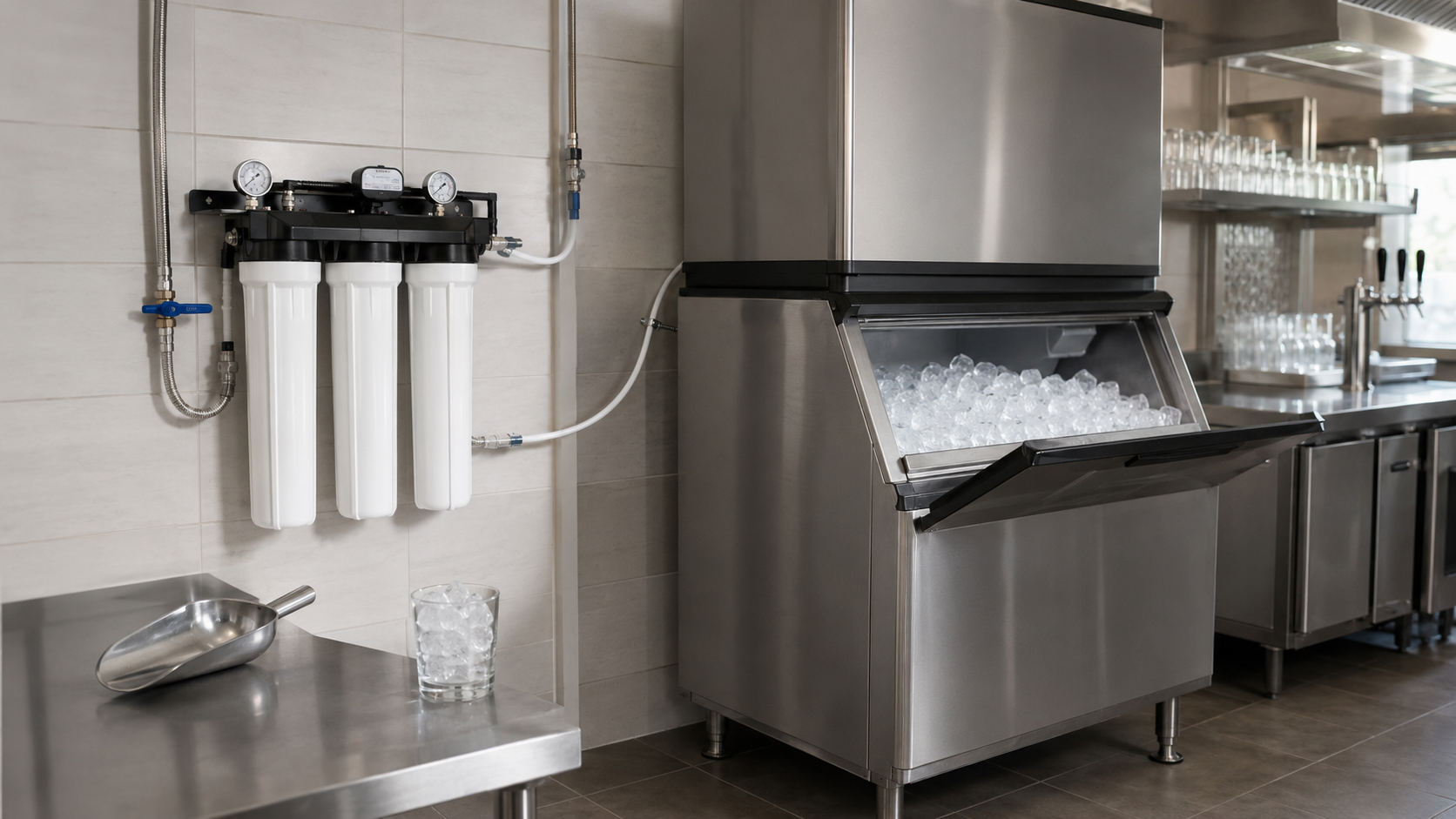
Water is the only ingredient in ice. Its quality is also one of the biggest variables affecting the output, reliability, cleaning frequency, and operating cost of a commercial ice machine.
The wrong water treatment can allow scale to coat an evaporator, sediment to restrict a valve, or chlorine and other compounds to affect the taste and odor of every drink. An undersized filter can create a different problem by restricting flow and slowing the machine’s fill cycle. Even an expensive filtration system may fail to solve the issue if it was selected without testing the water first.
This guide explains how to choose a commercial ice machine water filter based on the machine, local water conditions, and actual operating demand—not a one-size-fits-all recommendation.
The Short Answer: What Filter Does a Commercial Ice Machine Need?
For many businesses using treated municipal water, a properly sized commercial filtration system that reduces sediment, controls scale, and addresses chlorine-related taste and odor is a strong starting point. However, the correct solution depends on five factors:
- The contaminants or conditions present in the incoming water
- The ice machine manufacturer and model
- The type of ice machine (cuber, nugget, flake, or dispenser)
- The required service flow rate and filter capacity
- The facility’s water pressure, plumbing, and daily ice demand

Hard water may require more than a standard carbon filter. A water supply treated with chloramine needs media specifically rated for chloramine reduction. High sediment may justify a separate prefilter. Very high dissolved mineral content may call for reverse osmosis, but only when the machine manufacturer permits it and the system is designed to maintain adequate pressure and mineral balance.
The safest rule is simple: test the water, check the ice machine manual, and size the filtration system to the manufacturer’s requirements.
Why Water Filtration Matters for Commercial Ice Machines
Commercial ice machines repeatedly freeze water and reject some of its impurities. As ice forms, dissolved minerals become more concentrated in the remaining water. Depending on the machine design, part of that concentrated water is purged and replaced, but minerals can still accumulate on the evaporator, water distribution components, sensors, pumps, and valves.
A correctly selected water filtration or treatment system can help:
- Reduce dirt, rust, sand, and suspended particles
- Control mineral scale
- Improve ice taste and odor
- Protect valves, pumps, distribution tubes, and evaporator surfaces
- Maintain water flow and consistent freeze cycles
- Reduce avoidable cleaning and service
- Support better ice clarity, depending on the machine and water chemistry
Filtration does not replace cleaning and sanitizing. A filter treats incoming water; descaling removes mineral deposits already inside the machine; sanitizing controls microorganisms on food-contact surfaces. A complete maintenance program needs all three.
Start With a Water Test
Do not select a commercial ice machine filter by ice production alone. First determine what needs to be treated.
Your municipal water supplier’s annual water-quality report is a useful starting point, but conditions can change between the water main and the equipment. Older plumbing, construction, private wells, and building-specific treatment can all affect the water at the ice machine. For a new installation or a location with recurring ice problems, test a sample from the supply line that will feed the machine.
At minimum, evaluate:
| Water condition | Why it matters to an ice machine | Common treatment approach |
|---|---|---|
| Hardness | Calcium and magnesium can form scale on internal surfaces | Scale inhibitor, softening, or RO depending on severity and manufacturer guidance |
| Sediment or turbidity | Can restrict valves, clog distribution holes, and shorten primary filter life | Sediment prefilter plus appropriate primary filtration |
| Chlorine | May affect taste and odor; treatment needs vary by machine and sanitation strategy | Activated carbon when chlorine reduction is desired and approved |
| Chloramine | Is harder to reduce than free chlorine | Catalytic carbon or a cartridge with a specific chloramine-reduction claim |
| Total dissolved solids (TDS) | High levels may contribute to scale, cloudy ice, purge demand, or taste issues | RO or another engineered treatment when appropriate |
| pH and alkalinity | Influence scale formation and corrosion potential | Treatment selected by a water professional based on full chemistry |
| Iron and manganese | Can stain components, discolor ice, and foul filters | Dedicated iron/manganese treatment, often before the ice machine filter |
| Chloride | Elevated levels may increase corrosion risk for some materials | Manufacturer review and specialized treatment where necessary |
Water hardness is commonly reported in milligrams per liter as calcium carbonate (mg/L as CaCO3) or grains per gallon (gpg). To convert mg/L to gpg, divide by approximately 17.1. The U.S. Geological Survey’s water-hardness guide provides the following widely used classifications.
As a general reference:
| Hardness as CaCO3 | Classification |
|---|---|
| 0–60 mg/L | Soft |
| 61–120 mg/L | Moderately hard |
| 121–180 mg/L | Hard |
| More than 180 mg/L | Very hard |
These classifications describe the water; they do not prescribe a universal treatment. Scale potential also depends on alkalinity, pH, temperature, machine design, purge settings, and usage. Follow the water-quality limits in the manual for the specific ice machine.
If the building uses a private well or the water is microbiologically unsafe or of unknown quality, a normal foodservice cartridge is not enough to make it safe. Have the source evaluated and treated by a qualified water professional before using it to make ice.
Understand the Main Types of Ice Machine Water Treatment
1. Sediment Filtration
Sediment filters mechanically capture suspended material such as sand, rust, silt, and pipe debris. They protect small water passages and can prevent larger particles from prematurely loading a more expensive carbon cartridge.
A separate prefilter is especially useful in older buildings, well-water applications, or locations where cartridges plug long before reaching their rated gallon capacity. A prefilter does not remove dissolved hardness minerals and usually does not correct chlorine taste, odor, or high TDS.
2. Activated Carbon Filtration
Carbon filtration is commonly used to reduce chlorine-related taste and odor and to capture fine particulate matter. This can improve the sensory quality of ice and the beverages it cools.
Free chlorine and chloramine are not the same. Standard carbon may reduce free chlorine effectively, while meaningful chloramine reduction generally requires more contact time or specialized catalytic carbon. If the local utility uses chloramine, look for a specific chloramine performance claim—not only the words “carbon filter.”
Some ice-machine filtration strategies intentionally leave a disinfectant residual in the water to help manage slime inside the equipment, while others are designed to reduce chlorine. Follow the ice machine and filter manufacturers’ recommendations rather than assuming maximum chlorine removal is always the best choice.
3. Scale Inhibition
Scale-inhibiting cartridges commonly use food-grade polyphosphate or another scale-control technology to reduce the ability of hardness minerals to attach to equipment surfaces. This approach can work well in many moderate-scale applications.
A scale inhibitor does not remove calcium and magnesium from the water. It changes how readily they form deposits. Its effectiveness depends on water chemistry, temperature, flow, and timely cartridge replacement. In very hard water or a location with persistent scale, inhibition alone may not be sufficient. Pentair’s technical overview of scale formation in commercial water-using equipment explains why freezing can leave concentrated mineral residue inside a cuber.
4. Water Softening
An ion-exchange softener removes much of the calcium and magnesium responsible for hardness and exchanges them for sodium or potassium ions. It can be an effective scale-control solution in high-hardness locations.
Softening is not automatically right for every ice machine. Extremely soft water can affect ice formation or increase corrosion concerns in some systems, and certain machines may require a specific hardness range. A softener also requires correct sizing, salt or potassium replenishment, regeneration, and periodic service. Verify compatibility with the ice machine manufacturer before installation.
5. Reverse Osmosis
Reverse osmosis (RO) removes a high percentage of dissolved minerals and many other substances. It can be useful when high TDS, severe scale, salinity, or inconsistent water quality cannot be managed effectively with standard filtration.
RO requires careful engineering for a commercial ice machine. The system must produce enough treated water, store it if necessary, and deliver the required flow and pressure during fill cycles. Water that is too low in minerals may be corrosive or may not freeze and release as the manufacturer intended. Many commercial systems use blending or remineralization to create the correct finished-water chemistry.
Do not connect an ice machine to RO based on TDS alone. Review the model’s water specifications and work with a qualified treatment professional.
6. Microbial-Control Technologies
Fine filtration, ultraviolet treatment, ozone systems, and other technologies may be used in specialized applications. Each solves a different problem. A fine micron rating does not make a filter a sanitizer, and bacteriostatic media only inhibits growth within the filter or under the conditions stated in its certification—it does not sterilize the ice machine.
The FDA considers ice a food, regardless of its shape or source. The machine and bin therefore still need routine cleaning and sanitizing according to the manufacturer’s instructions and local health requirements.
How to Read a Commercial Ice Machine Filter Specification
The best filter is not simply the cartridge with the lowest micron number. Compare the complete performance specification.
Service Flow Rate
Service flow rate, stated in gallons per minute (GPM), is the amount of water the filtration system can deliver while performing as rated. It must meet or exceed the ice machine’s required instantaneous flow—not merely its average daily water consumption.
If the filter is undersized, pressure after the filter may fall during a fill cycle. The result can be slow fills, long harvest or freeze cycles, low production, small or malformed ice, and water-related error codes.
High-capacity machines may need twin, triple, or quad parallel-cartridge systems to provide the necessary flow without excessive pressure loss. Manufacturer specifications illustrate why model-level sizing matters: Hoshizaki lists a 2 GPM system for many cubers producing less than 900 lb. per day, while Ice-O-Matic lists a 1.5 GPM system for ice makers producing up to 800 lb. per day.
Rated Capacity
Capacity is the number of gallons a cartridge is rated to treat under specified test conditions. The cartridge should be replaced when it reaches its rated capacity or its maximum time in service, whichever comes first.
Capacity is not the same as pounds of ice production. To estimate filtration demand, use the potable-water consumption listed on the ice machine’s specification sheet:
Estimated daily filtered water = daily ice production ÷ 100 × potable gallons per 100 lb. of ice
For example, if a machine actually produces 500 lb. per day and its specification lists 18 potable gallons per 100 lb., estimated filtration demand is:
500 ÷ 100 × 18 = 90 gallons per day
A 15,000-gallon cartridge would reach its nominal gallon capacity in about 167 operating days at that demand, before allowing for seasonal peaks or other water use. This is why a high-volume operation may exhaust a cartridge before a calendar-based replacement date.
Use actual production where possible, not only the machine’s maximum rated output. Remember that published production and water-consumption figures are tied to stated air- and water-temperature test conditions.
Micron Rating
A micron rating describes the particle size a filter is designed to reduce. “Nominal” and “absolute” are not interchangeable, and a micron number alone does not show performance against chlorine, chloramine, hardness, scale, cysts, or dissolved solids.
Finer filtration can provide valuable protection, but it can also create faster pressure loss in sediment-heavy water. The correct solution may be a larger system or staged filtration rather than simply choosing the finest cartridge available.
Contaminant-Reduction Claims
Read the cartridge performance data sheet for the exact claims. Do not assume that every product certified to the same standard removes the same substances. NSF’s official water-treatment standards guide makes an important distinction between certification to a standard and certification for a particular contaminant-reduction claim.
- NSF/ANSI 42 covers aesthetic or non-health-related effects such as specific claims for chlorine, taste and odor, and particulate reduction.
- NSF/ANSI 53 covers specific contaminants with health effects, such as cyst or lead reduction when those claims are listed.
- NSF/ANSI 58 applies to reverse-osmosis systems.
The standard number is not a quality ranking. A certification is meaningful only together with the specific reduction claim, rated flow, capacity, pressure range, and operating conditions.
Inlet Pressure and Pressure Drop
Check the ice machine’s acceptable inlet-pressure range and the filter’s operating range. Measure static pressure when no water is flowing and dynamic pressure while the machine is filling. Static pressure can appear normal even when clogged cartridges, undersized tubing, or an inadequate filter causes pressure to collapse under flow.
Pressure gauges before and after the filter make it easier to identify cartridge loading and plumbing restrictions. If building pressure is too high, use an approved regulator. If it is too low, do not assume a larger pipe or coarser cartridge will solve the entire problem; the supply may need professional correction.
Connection Size and Installation Space
Confirm inlet and outlet size, mounting orientation, cartridge-change clearance, bypass or shutoff requirements, and access for service. Reducing a large commercial machine to undersized tubing can negate the advantage of a high-flow filter.
Match the Filtration System to the Ice Machine
Filtration requirements can change with the machine design and the ice-making process. If you are still deciding between full cube, half cube, nugget, flake, and crescent ice, start with our guide to the types of ice for restaurant and bar use, then verify the water requirements for the exact model that produces your preferred ice.
Undercounter Ice Machines
Compact machines typically use less water and may pair with a single-cartridge system, but the filter still needs to meet the model’s flow, pressure, and treatment requirements. Limited cabinet space is not a reason to install an inaccessible cartridge. Mount it where staff can inspect and replace it without moving the ice machine.
Modular Cube Ice Machines
High-output cubers may need multi-cartridge filtration to support peak fill demand. Scale control is especially important because mineral deposits on the evaporator and water distribution system can affect cube formation and harvest. Size the system using both daily production and required GPM.
Nugget and Flake Ice Machines
Auger-style nugget and flake machines concentrate minerals and operate differently from cubers. They may have distinct requirements for hardness, chlorine, filtration media, and cleaning. A filter approved for a manufacturer’s cube machine may not be recommended for its flaker. Always verify the exact model and ice type.
Water-Cooled Ice Machines
A water-cooled machine normally has separate potable ice-making water and condenser-water connections. The filtration system discussed in this guide belongs on the potable water line that becomes ice.
Do not automatically feed expensive carbon-filtered or RO water to the condenser circuit. Doing so can consume filter capacity rapidly, restrict condenser flow, or waste treated water. Pipe and treat the condenser line only as directed by the equipment manufacturer and local requirements.
Multiple Machines on One Filtration System
A shared system can work when it is engineered for the combined peak flow and total gallon demand. Add the simultaneous flow requirements of all connected equipment and allow for pressure loss as cartridges load. If one system also supplies coffee, fountain beverages, or steam equipment, each application’s water chemistry may conflict. Dedicated treatment is often easier to size and maintain.
A Five-Step Filter Selection Process
Step 1: Identify the Exact Machine
Record the manufacturer, model, ice type, rated production, potable-water consumption, required flow, connection size, water pressure range, and manufacturer water-quality limits.
Step 2: Test the Incoming Water
At minimum, identify hardness, sediment, free chlorine or chloramine, TDS, pH, alkalinity, iron, manganese, and any known local concerns. For a private well, include microbiological testing and professional evaluation.
Step 3: Select the Treatment
Match the problem to the technology:
- Sediment: mechanical prefiltration
- Chlorine taste or odor: carbon with the relevant claim
- Chloramine: chloramine-rated media
- Moderate scale: approved scale inhibition
- Severe hardness: softening, RO, or an engineered combination
- High TDS or salinity: manufacturer-approved RO, often with blending
- Iron or manganese: dedicated pretreatment
Step 4: Size for Flow and Capacity
Confirm that the system can supply the machine’s peak GPM at acceptable dynamic pressure. Estimate monthly gallon demand from the machine’s potable-water specification, then select a capacity that fits the planned replacement interval with a reasonable operating margin.
Step 5: Verify Compatibility and Serviceability
Confirm the filter with the ice machine manufacturer, authorized service company, or a knowledgeable equipment specialist. Check local plumbing and backflow requirements, make space for cartridge replacement, and document the correct replacement part number.
Installation Best Practices
A good filter installed badly can still cause poor performance. For most commercial installations:
- Use a dedicated cold, potable water supply
- Install a reachable manual shutoff valve
- Follow the required inlet tubing or pipe size
- Mount the system in the manufacturer-approved orientation
- Provide enough clearance to remove cartridges
- Install pressure gauges when practical
- Flush new cartridges for the specified time or volume before connecting the machine
- Check all fittings under static and flowing conditions for leaks
- Record the installation date, pressure readings, and cartridge model
- Follow local plumbing, sanitation, and backflow-prevention codes
Commercial equipment should be installed by qualified professionals. Improper plumbing can contaminate the water supply, restrict production, cause leaks, or affect warranty coverage.
How Often Should an Ice Machine Water Filter Be Changed?
Many commercial cartridges call for replacement every six months, while some systems permit six to twelve months. The correct interval is the manufacturer’s stated time or gallon capacity—whichever comes first. Poor water quality and high usage can require earlier replacement.
Change or investigate the cartridge when you notice:
- Falling dynamic water pressure
- Longer fill cycles or reduced ice production
- Small, incomplete, or inconsistent ice
- Chlorine taste or odor returning
- Visible sediment or scale increasing
- A filter alarm or service indicator
- The rated gallon capacity or time limit has been reached
After replacement, flush the cartridge as directed and check the system for leaks. Never leave a saturated cartridge in service simply because water still passes through it.
Maintain a filter log with:
- Installation and replacement dates
- Cartridge part number
- Meter reading or estimated gallons
- Inlet and outlet pressure
- Water-test results
- Observed scale during cleaning
- Next scheduled replacement
If your operation has multiple locations, this log makes it possible to compare cartridge life and adjust treatment by location instead of using the same schedule everywhere.
Filtration Does Not Replace Ice Machine Cleaning
These maintenance tasks solve different problems:
- Filter replacement restores incoming-water treatment and flow.
- Descaling removes mineral deposits from the machine’s water circuit and evaporator.
- Sanitizing reduces microorganisms on internal surfaces and in the bin.
- Condenser and air-filter cleaning maintains heat rejection on air-cooled equipment.
Follow the ice machine manual for approved cleaner, sanitizer, concentration, sequence, and frequency. Never mix chemicals or substitute household products unless the manufacturer expressly allows them.
During a boil-water advisory, stop making and serving affected ice. Discard ice produced with unsafe water and follow the manufacturer’s and local health authority’s procedures for replacing cartridges, flushing lines, and cleaning and sanitizing the machine before returning it to service. An ordinary carbon or sediment cartridge is not a substitute for a safe water supply.
Signs Your Current Filtration System Is Wrong or Undersized
Recurring problems often indicate a mismatch between the water, filter, and machine:
| Symptom | Possible filtration-related cause |
|---|---|
| White scale returns soon after cleaning | Insufficient scale control, expired cartridge, or untreated hardness |
| Ice tastes or smells like disinfectant | Wrong carbon media, exhausted capacity, or chloramine not addressed |
| Production falls after a filter change | Cartridge flow too low, inadequate flushing, installation restriction, or low pressure |
| Filters clog unusually fast | High sediment, old plumbing, or missing prefiltration |
| Cloudy or fragile ice | Water chemistry, restricted flow, machine settings, or dirty internal components |
| Rust-colored staining | Iron, manganese, or pipe corrosion requiring pretreatment |
| Slime or biofilm returns quickly | Sanitation, environment, disinfectant strategy, or maintenance issue—not simply micron rating |
| Water leaks around the filter head | Incorrect cartridge, damaged O-ring, excessive pressure, or improper installation |
Do not diagnose every ice problem as a filtration problem. High ambient temperature, warm inlet water, dirty condensers, poor ventilation, refrigeration faults, and incorrect purge settings can also reduce production or ice quality.
Common Water Filtration Mistakes
Buying by Micron Rating Alone
A 0.5-micron filter is not automatically better than a 1-micron filter. It may offer finer particle reduction, but treatment claims, flow, capacity, pressure loss, scale control, and machine compatibility are equally important.
Treating Hardness With Carbon
Standard activated carbon improves taste and odor but does not remove dissolved calcium and magnesium. Choose a filter with scale-control capability or a separate treatment designed for the measured hardness.
Confusing Chlorine and Chloramine
A cartridge that reduces chlorine may have limited chloramine capacity. Confirm which disinfectant the utility uses and select media with the exact claim you need.
Sizing by Maximum Ice Production Only
Pounds of ice per day can help narrow the choices, but GPM and dynamic pressure determine whether the filter can feed the machine during a fill cycle. Rated gallon capacity determines how long the cartridge may last.
Filtering the Condenser Line by Accident
On a water-cooled machine, the condenser circuit can use far more water than the ice-making circuit. Connecting both to a small potable-water filter can exhaust the cartridge quickly and restrict performance.
Installing a Filter and Forgetting It
Expired or loaded cartridges can lose treatment capacity and restrict flow. Make cartridge changes part of preventive maintenance, with a named employee or service provider responsible for the schedule.
Assuming Filtration Eliminates Cleaning
No water filter keeps the evaporator, distribution system, chute, dispenser, and bin permanently clean. Continue descaling and sanitizing at the interval required by the manufacturer and the conditions at your location.
Choosing a Commercial Ice Machine and Filtration System Together
Water treatment should be part of the ice machine purchase—not an accessory considered after installation. If you have not selected a manufacturer yet, our comparison of the best commercial ice machine brands explains how Hoshizaki, Manitowoc, Ice-O-Matic, Atosa, Serv-Ware, Dukers, and Coldline differ in positioning and typical applications.
Before ordering, compare the complete system:
- Ice type and real-world daily demand
- Potable-water consumption
- Incoming water temperature and room temperature
- Available pressure and plumbing size
- Water chemistry
- Filter flow and gallon capacity
- Cartridge cost and local availability
- Cleaning requirements
- Installation and service access
- Manufacturer warranty conditions
At Atlantic Restaurant & Supermarket Equipment, we help businesses compare ice machines by production, ice type, configuration, utilities, and installation requirements. If you are opening a new location or replacing an existing machine, speak with our team before ordering. We can help you review the equipment specifications and identify the questions your plumber, installer, or water-treatment provider should answer.
Request a quote or call 201-467-8222 for help selecting the right commercial ice machine for your operation.

