

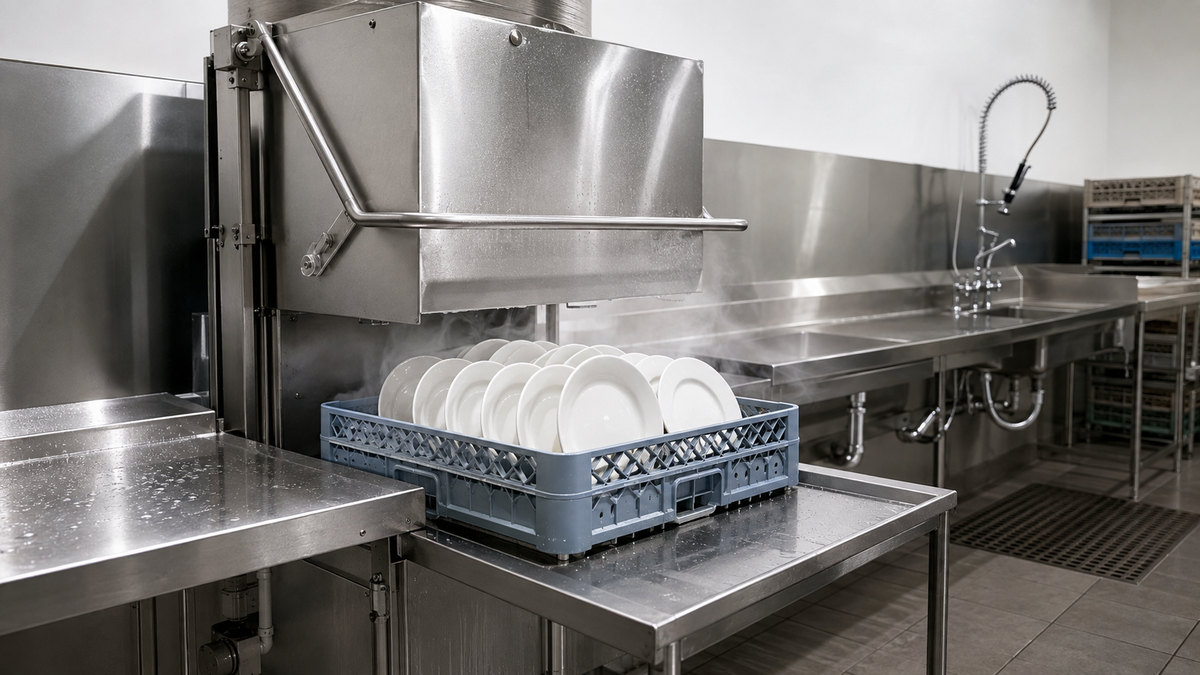
A commercial dishwasher is a high-capacity warewashing machine designed to clean and sanitize plates, glasses, utensils, cookware, and foodservice equipment quickly and repeatedly. Unlike a residential dishwasher, which may run for an hour or longer, a commercial unit is built around short cycles, continuous workflow, measurable hourly capacity, and food-safety requirements.
Commercial dishwashers are used in restaurants, bars, cafés, hotels, schools, hospitals, catering kitchens, cafeterias, bakeries, and other facilities that must process large quantities of soiled wares throughout the day.
The right machine can reduce labor, prevent dirty dishes from slowing service, and help an establishment maintain a consistent sanitation process. However, commercial dishwashers vary considerably in size, output, utility requirements, and sanitizing method. Understanding those differences is essential before selecting a machine.
How Does a Commercial Dishwasher Work?
A commercial dishwasher generally completes three main functions: washing, rinsing, and sanitizing.
Before loading the machine, employees scrape or spray away large food particles. Plates, glasses, or utensils are then arranged in the appropriate rack so water can reach every surface. During the cycle, powerful spray arms circulate detergent solution over the wares to remove grease and food residue.
The machine then rinses and sanitizes the load using either high-temperature water or an approved chemical sanitizer. Clean items must be allowed to air-dry before they are stacked or returned to service.
Because food removal and sanitization are different processes, a machine cannot sanitize a plate that has not first been properly cleaned. Spray arms, nozzles, filters, chemical dispensers, water temperature, pressure, and cycle timing must all function correctly.
The FDA Food Code states that warewashing machines must be operated according to their data plates and manufacturer instructions. It also requires wash, rinse, and sanitizing solutions to be maintained in clean condition.
Commercial vs. Residential Dishwashers
Although both machines wash dishes, they are designed for very different environments.
| Feature | Commercial dishwasher | Residential dishwasher |
|---|---|---|
| Primary purpose | Repeated foodservice use | Household use |
| Cycle design | Short, continuous cycles | Longer, less frequent cycles |
| Capacity measurement | Racks or dishes per hour | Place settings or load capacity |
| Construction | Heavy-duty, serviceable components | Light-duty domestic construction |
| Sanitization | High-temperature or chemical process | Usually available through a special sanitize cycle |
| Loading system | Standard racks and dishroom workflow | Pull-out household baskets |
| Utilities | May require special voltage, booster heating, ventilation, or floor drainage | Standard residential connections |
| Drying | Commonly air-dried after sanitization | Often includes an extended drying cycle |
The most important difference is not simply speed. A commercial dishwasher is designed to support a documented foodservice sanitation process throughout repeated cycles.
NSF explains that commercial machines certified under NSF/ANSI 3 must demonstrate a 5-log—or 99.999%—reduction of bacteria. Residential machines are evaluated under a different standard, NSF/ANSI 184, and their sanitizing performance applies only when the designated sanitizing cycle is used. (NSF dishwasher certification)
A residential machine may therefore be unsuitable for a restaurant even if it fits under the counter. It may not provide the required throughput, commercial certification, monitoring features, durability, or sanitation method required by the local authority.
Types of Commercial Dishwashers
Undercounter Dishwashers
A commercial undercounter dishwasher is a compact machine that fits beneath a counter or worktable. It resembles a residential dishwasher in size, but it is engineered for faster cycles and repeated commercial use.
Undercounter models work well in coffee shops, small restaurants, bars, daycare kitchens, and operations with limited space. They are also useful as secondary machines dedicated to glassware or utensils.
Their compact footprint is an advantage, but capacity can become a problem if the operation generates several racks of dishes at once.
Door-Type Dishwashers
A door-type dishwasher—sometimes called a pass-through or hood-type machine—accepts a full rack of dishes through a lift-up door. Clean and dirty dish tables can be positioned on opposite sides to create an efficient workflow.
Door-type machines are common in full-service restaurants because they provide greater output than most undercounter models without requiring the space of a conveyor system. Straight-through and corner configurations are available for different dishroom layouts.
Conveyor Dishwashers
A conveyor dishwasher moves loaded racks automatically through one or more washing, rinsing, and sanitizing sections. It is designed for medium- and high-volume facilities such as hotels, hospitals, universities, banquet operations, and large restaurants.
Capacity varies substantially by model. For example, commercial rack-conveyor machines can process hundreds of racks per hour, making the hourly rating and real peak demand more useful than the machine’s physical size alone.
Flight-Type Dishwashers
Flight-type machines use a continuous conveyor belt rather than individual dish racks. Employees place wares directly onto the belt, allowing extremely high-volume operations to maintain a continuous loading process.
These systems require considerable space, carefully planned dishroom flow, and substantial utility capacity. They are generally used in institutional kitchens, convention centers, large hotels, and high-volume cafeterias.
Glasswashers and Pot-and-Pan Washers
Glasswashers are designed to clean beverage glasses while reducing breakage and supporting bar service. Pot-and-pan washers have larger openings, stronger washing action, or specialized racks for cookware, sheet pans, mixing bowls, and kitchen utensils.
A specialized machine may be more efficient than forcing unusually delicate or oversized wares through a standard dishwasher.
High-Temperature vs. Low-Temperature Dishwashers
Commercial dishwashers are commonly classified by how they sanitize.
High-Temperature Machines
High-temperature dishwashers use hot water for sanitization. Under the FDA Food Code, fresh hot-water sanitizing rinse entering the manifold must generally be at least 180°F for most mechanical warewashing machines. A stationary-rack, single-temperature machine has a specified minimum of 165°F. Operators must follow the machine’s data plate and applicable local code rather than relying on one universal setting.
High-temperature machines can support faster air-drying and do not depend on a chemical sanitizer for the final sanitation step. However, they may require a booster heater, greater electrical or gas capacity, and appropriate management of heat and steam.
Low-Temperature Machines
Low-temperature machines use an EPA-registered chemical solution to sanitize the wares. Depending on the machine and product, this may involve chlorine or another approved sanitizer.
These models generally place less demand on water heating, but the chemical concentration, temperature, pH, contact time, and—in some cases—water hardness must remain within the required range. The FDA requires chemical sanitizers to be used according to their registered label instructions. Current Food Code guidance also requires sanitizer concentration to be verified with an appropriate test kit or device.
Low-temperature equipment can reduce certain utility demands, but owners must account for ongoing chemical costs, storage, dispenser maintenance, and routine testing.
How to Choose the Right Commercial Dishwasher
Begin by measuring demand during your busiest period—not by using the restaurant’s total number of seats alone.
Consider:
- The number of racks or dishes produced during peak hours
- The largest wares the machine must accommodate
- Available floor, counter, and dish-table space
- Straight-through or corner-loading workflow
- Incoming water temperature and pressure
- Electrical voltage and phase
- Drain location and drain-pump requirements
- Booster-heater needs
- Ventilation, steam, and heat-recovery options
- High-temperature versus chemical sanitization
- Water hardness and filtration or softening needs
- Local health, plumbing, electrical, and building requirements
- Availability of local parts and qualified service
ENERGY STAR-certified commercial dishwashers must meet limits for final-rinse water consumption and idle energy use, with requirements based on machine type and sanitizing method. Comparing water per rack and idle energy can therefore reveal operating-cost differences that are not visible in the purchase price. (ENERGY STAR commercial dishwashers)
Cleaning and Maintaining a Commercial Dishwasher
At the end of service, remove and clean the scrap screens, empty debris, inspect the spray arms, clear blocked nozzles, and clean the interior according to the manufacturer’s instructions. Leave doors open when recommended so the chamber can dry.
Employees should also verify operating temperatures or chemical concentration throughout the day, watch for scale accumulation, and confirm that detergent and rinse-aid dispensers are working. Hard water can reduce cleaning performance and create scale on heating elements and spray components, so water treatment may be an important part of the installation.
Find the Right Dishwasher for Your Operation
A commercial dishwasher should be selected as part of the entire dishroom—not as an isolated appliance. The machine, tables, pre-rinse station, racks, drainage, utilities, ventilation, and employee movement must work together.
You can compare commercial dishwashers available from Atlantic by machine type, capacity, sanitizing method, brand, and installation requirements. Businesses planning a complete kitchen can also use Atlantic’s restaurant opening guide to review other major equipment and project considerations.
