


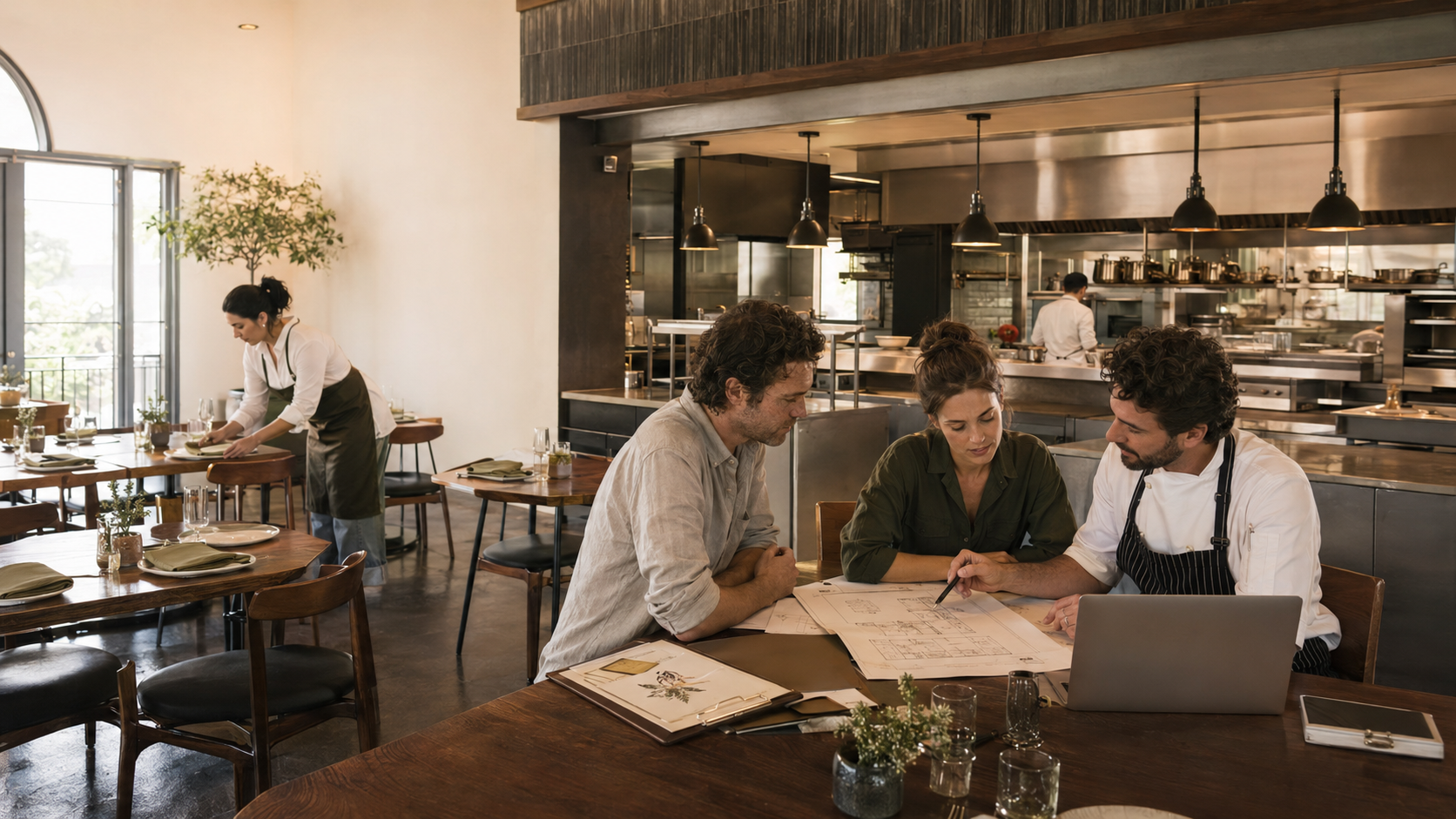
Opening a restaurant starts with a concept, but it succeeds or fails through planning, numbers, location, execution, and cash control. Before signing a lease or ordering equipment, you need to confirm that your menu, target customer, pricing, space, kitchen capacity, permits, and startup budget can work together as one viable business.
The process generally includes developing the concept, researching the market, writing a business plan, securing funding, choosing a location, obtaining permits, designing the kitchen, purchasing equipment, hiring and training employees, and testing the entire operation before opening.
This guide explains each step in the order it should be addressed and highlights the decisions that should be made before you commit significant capital.
Requirements vary by state, county, and municipality. Use this guide as a planning resource and confirm legal, tax, zoning, building, employment, and food-safety requirements with the appropriate authorities and qualified professionals.
Restaurant Opening Checklist: Quick Overview
The major steps to opening a restaurant are:
- Define your restaurant concept
- Research and validate the market
- Write a restaurant business plan
- Calculate startup costs and financial projections
- Secure restaurant financing
- Build and cost the menu
- Choose a location and evaluate the lease
- Register the business and obtain permits
- Design the restaurant and kitchen layout
- Select and purchase restaurant equipment
- Set up suppliers, inventory, and technology
- Hire and train restaurant employees
- Build food-safety and operating systems
- Market the restaurant before opening
- Conduct a soft opening and prepare for launch
Some steps will overlap. Permitting, construction, equipment procurement, hiring, and marketing frequently happen at the same time. However, the concept, menu, budget, and location feasibility should be established before major irreversible commitments are made.
How Long Does It Take to Open a Restaurant?
A restaurant may take approximately six months to more than a year to open. A second-generation space that was previously approved and equipped as a restaurant may open faster. Converting an unrelated retail space into a commercial restaurant can require extensive construction, utility upgrades, ventilation, accessibility work, plan review, and inspections.
A planning timeline might look like this:
| Time before opening | Primary work |
|---|---|
| 12 months or more | Concept, market research, financial model, funding strategy |
| 9–12 months | Site search, lease negotiation, architect and contractor evaluation |
| 6–9 months | Design, plan review, permits, construction and equipment specifications |
| 3–6 months | Buildout, equipment orders, supplier selection, technology setup |
| 1–3 months | Management hiring, marketing, menu testing and operating procedures |
| 2–6 weeks | Employee hiring, training, equipment commissioning and mock service |
| Opening week | Soft opening, corrections and controlled public launch |
This is an illustrative timeline, not a guaranteed schedule. Alcohol licensing, major construction, zoning changes, utility upgrades, or delayed equipment can significantly extend the project.
1. Define Your Restaurant Concept
Your concept connects the food, customer, service model, pricing, location, design, and operating structure.
A useful concept statement should answer:
- Who is the restaurant for?
- What type of food will it serve?
- What service style will it use?
- What will the typical guest spend?
- Why will customers choose it over nearby alternatives?
- Which occasions will it serve?
- Will the business depend on dine-in, takeout, delivery, catering, or a combination?
Instead of describing the idea as “an Italian restaurant,” define it more precisely:
A neighborhood counter-service Italian restaurant serving house-made pasta and sandwiches to nearby office workers and residents, with an average lunch check of $18 and dinner check of $30.
That statement provides a foundation for evaluating rent, labor, production capacity, service speed, kitchen equipment, and sales potential.
Choose an operating format
Possible formats include:
- Full-service restaurant
- Quick-service restaurant
- Fast-casual restaurant
- Café or bakery
- Pizzeria
- Deli or sandwich shop
- Bar or taproom
- Food truck
- Ghost kitchen
- Takeout-only restaurant
- Pop-up or shared-kitchen concept
- Franchise
- Existing restaurant acquisition
The least expensive format is not automatically the safest. A ghost kitchen may require less front-of-house investment but depend heavily on delivery platforms and digital advertising. A high-rent storefront may be expensive but generate visibility and walk-in traffic.
Evaluate the entire business model rather than choosing by startup cost alone.
2. Research and Validate the Market
Market research should determine whether enough of the right customers exist to support the concept at the required price and volume.
Analyze:
- Neighborhood population and demographics
- Daytime and nighttime activity
- Nearby offices, schools, hospitals, housing, and entertainment
- Pedestrian and vehicle traffic
- Parking and public transportation
- Direct and indirect competitors
- Competitor menu prices
- Customer reviews of competing restaurants
- Delivery demand and delivery radius
- Seasonal changes
- Planned neighborhood development
- Local labor availability
- Area rent and occupancy costs
The U.S. Small Business Administration recommends combining market research with competitive analysis to identify customers and establish a competitive advantage.
Test the concept before signing a lease
Possible low-risk tests include:
- Pop-up dinners
- Catering events
- Farmers’ markets
- Food festivals
- Shared-kitchen delivery
- Limited takeout programs
- Preorders
- Menu tastings
- Paid digital campaigns testing local interest
Compliments from friends do not validate a restaurant concept. A stronger test shows that target customers will pay the proposed price, return, and recommend the product.
3. Write a Restaurant Business Plan
A restaurant business plan turns the concept into a financial and operational model. It is also commonly required by lenders, investors, landlords, and potential partners.
Include the following sections:
Executive summary
Summarize the concept, location strategy, target market, funding requirement, management team, and financial opportunity.
Restaurant description
Explain the format, cuisine, service style, hours, price level, seating capacity, takeout strategy, and customer experience.
Market analysis
Document customer demand, competitors, pricing, traffic patterns, local development, and the opportunity your restaurant will address.
Sample menu
Include menu categories, representative dishes, proposed prices, ingredient requirements, and service format.
Marketing plan
Explain how customers will discover the restaurant before and after opening. Cover local search, social media, public relations, email, community partnerships, promotions, delivery platforms, and loyalty programs.
Operations plan
Describe:
- Management responsibilities
- Staffing levels
- Operating hours
- Purchasing
- Receiving
- Food preparation
- Service
- Cleaning
- Inventory
- Cash handling
- Maintenance
- Food safety
Financial plan
Include:
- Startup budget
- Sources and uses of funding
- Monthly operating budget
- Sales forecast
- Profit-and-loss projection
- Cash-flow projection
- Break-even analysis
- Best-, expected-, and worst-case scenarios
- Working-capital requirement
The SBA provides business-plan guidance, startup cost resources, and access to free counseling through SCORE and Small Business Development Centers.
4. Calculate Restaurant Startup Costs
There is no reliable universal answer to how much it costs to open a restaurant. A small takeout operation in an existing foodservice space and a full-service restaurant built from an empty retail shell are fundamentally different projects.
Many brick-and-mortar restaurant openings require six figures, while complex buildouts can exceed $1 million. Build the budget from actual quotes and project requirements instead of starting with a national average.
Restaurant startup cost categories
| Category | Expenses to include |
|---|---|
| Business formation | Registration, legal work, accounting and professional fees |
| Location | Deposit, first rent payments, broker costs and due diligence |
| Design | Architect, engineer, kitchen designer and expeditor |
| Construction | Demolition, plumbing, electrical, gas, HVAC, walls and finishes |
| Ventilation | Hood, exhaust, make-up air and fire-suppression system |
| Kitchen equipment | Refrigeration, prep, cooking, holding and warewashing |
| Front of house | Furniture, counters, service stations and décor |
| Technology | POS, KDS, ordering, reservations, internet and security |
| Permits | Health, building, fire, signage, occupancy and liquor applications |
| Opening inventory | Food, beverages, disposables, chemicals and smallwares |
| Labor | Recruiting, training, uniforms and pre-opening payroll |
| Marketing | Branding, website, signage, photography and opening campaign |
| Insurance | Property, liability, workers’ compensation and other coverage |
| Contingency | Construction changes, delays and unexpected conditions |
| Working capital | Rent, payroll, utilities, purchasing and debt service after opening |
Do not treat the contingency and working-capital reserve as the same fund. Construction overruns should not consume the cash needed to operate after opening.
Expenses commonly missed
New operators frequently forget to budget for:
- Utility deposits
- Permit revisions
- Freight and unloading
- Equipment installation
- Water filtration
- Gas regulators and connectors
- Electrical receptacles and disconnects
- Booster heaters
- Refrigerant line work
- Fire-suppression modifications
- Hood balancing
- Grease interception
- Internet installation
- Pest control
- Trash and recycling
- Linen service
- Music licensing
- Smallwares
- Cleaning chemicals
- Employee training payroll
- Food used during testing and soft opening
- Repairs to used equipment
Collect written estimates and document what each quote excludes.
5. Build the Financial Model and Break-Even Point
A sales forecast should be based on operational capacity and demand—not the amount of revenue required to make the plan appear profitable.
Seat-based sales forecast
For a dine-in restaurant:
Seats × table turns × occupancy rate × average check × operating days
Example:
- 60 seats
- 1.5 dinner turns
- 75% average occupancy
- $32 average dinner check
- 26 dinner services per month
60 × 1.5 × 0.75 × $32 × 26 = $56,160 projected monthly dinner sales
Lunch, takeout, delivery, bar, and catering sales should be modeled separately.
Transaction-based sales forecast
For counter service:
Transactions per hour × average check × productive hours × operating days
Use realistic throughput. If the kitchen, ordering counter, fryer, oven, or pickup station cannot process the projected transactions, the sales forecast is not operationally possible.
Break-even sales formula
Monthly break-even sales = Fixed monthly costs ÷ Contribution margin ratio
If fixed costs are $65,000 and variable costs represent 34% of sales:
Contribution margin ratio = 1 − 0.34 = 0.66
Break-even sales = $65,000 ÷ 0.66 = approximately $98,485 per month
This calculation is only as reliable as the assumptions underneath it. Separate truly variable costs from fixed and semi-variable expenses, and have the model reviewed by an accountant familiar with restaurants.
6. Secure Restaurant Financing
Restaurant funding may come from:
- Personal savings
- Business partners
- Private investors
- Traditional bank loans
- Credit unions
- SBA-backed loans
- Equipment financing
- Business lines of credit
- Landlord improvement allowances
- Seller financing when purchasing an existing restaurant
- Crowdfunding or community investment where appropriate
The SBA explains that its guaranteed loans can support working capital, equipment, real estate, construction, and remodeling, subject to the applicable loan program and lender requirements.
Keep long-life investments and short-term expenses separate. Financing a durable piece of equipment may be reasonable; relying on expensive short-term debt for ongoing payroll can create a serious cash-flow problem.
Before accepting funding, understand:
- Interest rate
- Repayment term
- Personal guarantee
- Collateral
- Origination fees
- Prepayment terms
- Payment frequency
- Investor control rights
- Ownership dilution
- Cash required at closing
7. Create and Cost the Menu
The menu should be developed before the final kitchen design and equipment list.
Each item affects:
- Ingredient storage
- Refrigeration capacity
- Prep labor
- Cooking equipment
- Ventilation
- Cook time
- Holding time
- Plating
- Packaging
- Dishwashing
- Waste
- Employee training
Create standardized recipes
For every menu item, document:
- Ingredient quantities
- Yield
- Portion size
- Preparation procedure
- Cook time and temperature
- Plating or packaging
- Allergen information
- Direct food cost
- Selling price
- Required equipment and station
Calculate contribution, not just food cost
A low food-cost percentage does not automatically make an item profitable. Consider selling price, packaging, waste, preparation labor, cook time, station capacity, and popularity.
A dish that generates a high dollar contribution and moves quickly through the kitchen may be more valuable than a low-cost item that creates a bottleneck.
Simplify before opening
A focused menu can:
- Reduce inventory
- Limit waste
- Simplify training
- Improve consistency
- Reduce equipment requirements
- Speed up service
- Make purchasing easier
Add items after the operation becomes stable rather than opening with every possible idea.
8. Choose the Right Restaurant Location

Do not evaluate a space only by rent, square footage, and appearance. A low-cost location can become extremely expensive if it needs new ventilation, drainage, electrical service, gas capacity, accessibility work, or a change of use.
Second-generation restaurant space
A second-generation space was previously operated as a restaurant. It may already have:
- A hood and exhaust path
- Fire suppression
- Grease interception
- Commercial plumbing
- Gas service
- Adequate electrical capacity
- Walk-in refrigeration
- Floor drains
- Approved restrooms
- Foodservice use or occupancy
These features can reduce cost and time, but never assume they are operational, code-compliant, transferable, or properly sized for your menu.
Location due-diligence checklist
Before signing a lease, investigate:
- Zoning and permitted use
- Certificate of occupancy
- Building violations
- Previous health or fire issues
- Hood condition and capacity
- Fire-suppression inspection status
- Make-up air
- HVAC capacity
- Gas availability
- Electrical voltage, phase, amperage and panel capacity
- Water pressure and hot-water capacity
- Drainage and floor drains
- Grease interceptor requirements
- Restroom and accessibility requirements
- Roof penetrations and exhaust route
- Trash, recycling and grease storage
- Loading and delivery access
- Pest-control conditions
- Signage restrictions
- Outdoor dining rules
- Alcohol eligibility
- Noise restrictions
- Required construction
- Equipment delivery path
Have the location reviewed by appropriate professionals, potentially including an architect, engineer, contractor, attorney, accountant, kitchen designer, and local authorities.
Review the lease carefully
Depending on the transaction, important lease provisions may include:
- Permitted use
- Permit and financing contingencies
- Construction period
- Rent commencement date
- Tenant improvement allowance
- Exclusivity
- Assignment and transfer
- Personal guarantee
- Common-area charges
- Property taxes
- Utility responsibilities
- HVAC and roof responsibility
- Signage rights
- Renewal options
- Delivery access
- Trash and grease areas
- Restoration obligations
Obtain qualified legal advice before signing. A lease can remain binding even when the restaurant concept later proves difficult or impossible to approve.
9. Register the Business and Obtain Permits
Business and restaurant requirements vary by location and activity. The SBA advises businesses to check federal, state, county, and city requirements because restaurants are commonly regulated locally.
Potential requirements include:
- Business entity registration
- Assumed-name or DBA filing
- Employer Identification Number
- State and local tax registration
- Sales-tax or seller’s permit
- Food service establishment permit
- Food-safety plan review
- Food manager certification
- Certificate of occupancy
- Building permits
- Plumbing permits
- Electrical permits
- Mechanical permits
- Fire department approval
- Hood and suppression approval
- Sign permit
- Liquor license
- Outdoor dining permit
- Grease or wastewater approval
- Music licensing
- Workers’ compensation coverage
- Unemployment and payroll registration
Form the legal entity before applying for an EIN. The IRS provides EINs directly and without charge.
Do not purchase an EIN from an unofficial website.
NYC restaurant requirements
Last verified: July 18, 2026.
New York City restaurants generally need a Food Service Establishment Permit from the Department of Health and Mental Hygiene.
The NYC Food Service Establishment Permit page currently states that:
- The standard permit fee for most establishments is $280 annually
- An additional fee applies when manufacturing frozen desserts
- A supervising manager with a Food Protection Certificate must be on-site during operating hours
- Proof of a Certificate of Authority to collect sales tax is required
- Workers’ compensation and disability documentation may be required
- The location cannot be used without the required Certificate of Occupancy
- Additional city and state permits may still be necessary
The page also explains a 22-day rule related to operating after submitting a permit application. This does not eliminate other zoning, occupancy, construction, tax, insurance, fire, or licensing requirements. Confirm eligibility directly with NYC authorities before relying on that provision.
New York businesses making taxable sales must obtain a Certificate of Authority. The New York State Department of Taxation and Finance says applicants generally must apply at least 20 days before beginning taxable sales.
Restaurants serving alcohol must separately work with the New York State Liquor Authority. License type, cost, restrictions, and processing time depend on the location and beverages served.
10. Design an Efficient Restaurant Layout

Restaurant design must balance customer experience, employee movement, production capacity, food safety, accessibility, and code requirements.
The back-of-house flow should generally move through:
- Receiving
- Dry, refrigerated, and frozen storage
- Preparation
- Cooking
- Holding or plating
- Service or pickup
- Warewashing
- Waste removal
Avoid layouts that require raw ingredients, finished food, dirty dishes, employees, and customers to cross the same narrow path.
Plan accessibility early
The ADA guidance for small businesses explains that restaurants must provide access to dining areas, service counters, food service lines, self-service areas, and public restrooms as applicable.
Accessibility should be incorporated into the initial layout rather than treated as a late construction correction.
Design for the busiest hour
Evaluate:
- Peak tickets per hour
- Prep volume
- Cooking capacity
- Refrigerator access
- Landing space
- Plating positions
- Expo capacity
- Pickup shelving
- Dirty-dish volume
- Dishwasher capacity
- Employee circulation
- Delivery order staging
A kitchen that works when empty may fail when cooks, servers, delivery drivers, bussers, and dish staff occupy it simultaneously.
11. Select Restaurant Equipment
Start with the menu, volume, layout, utilities, and code requirements—not individual products.
Atlantic’s restaurant equipment checklist provides a detailed breakdown of refrigeration, cooking, preparation, warewashing, storage, beverage, service, and safety equipment.
Most restaurant projects require some combination of:
- Commercial refrigerators and freezers
- Walk-in refrigeration
- Refrigerated prep tables
- Ranges and ovens
- Fryers
- Griddles or charbroilers
- Specialty cooking equipment
- Food processors, mixers or slicers
- Stainless steel work tables
- Hot holding equipment
- Ice machines
- Beverage equipment
- Commercial dishwashers
- Sinks and pre-rinse equipment
- Shelving and storage
- Pots, pans, utensils and smallwares
- Thermometers and sanitation supplies
Create an equipment schedule
For each unit, document:
- Manufacturer and model
- Quantity
- Exterior dimensions
- Required clearances
- Door or drawer movement
- Capacity
- Voltage
- Phase
- Amperage
- Plug or hardwire requirement
- Gas type and BTU load
- Water connection
- Drain requirement
- Filtration
- Ventilation
- Installation responsibility
- Lead time
- Warranty
- Service access
Confirm the schedule with the appropriate design and construction professionals before rough plumbing, gas, electrical, and ventilation work is finalized.
Size equipment for peak demand
Average daily sales do not determine equipment capacity. Estimate what each station must produce during the busiest 15, 30, and 60 minutes.
A fryer, oven, prep table, ice machine, refrigerator, or dishwasher that handles the average day may still fail during the dinner rush.
New, used, or financed equipment?
| Option | Advantages | Risks |
|---|---|---|
| New | Warranty, known condition, current specifications | Higher initial cost |
| Used | Lower purchase price, possible immediate availability | Limited warranty, unknown wear and service history |
| Financing | Preserves opening cash, spreads payments | Interest, approval requirements and ongoing obligation |
| Leasing | Lower upfront commitment for some equipment | Total cost and contract restrictions may be higher |
A mixed approach is often practical. Equipment critical to food safety, production, and revenue may deserve more reliability, while simpler non-powered items may be reasonable used purchases.
Atlantic offers commercial cooking equipment, commercial refrigeration, food preparation equipment, ice machines, and commercial dishwashers for new restaurant projects.
12. Set Up Suppliers, Inventory, and Technology
Choose primary and backup suppliers for:
- Food
- Beverages
- Disposables
- Cleaning chemicals
- Linens
- Smallwares
- Gas or fuel
- Pest control
- Waste and recycling
- Used cooking oil
- Equipment maintenance
- Hood cleaning
- Fire-system inspection
Document order days, delivery windows, minimum orders, payment terms, emergency contacts, and product substitutions.
Restaurant technology
Depending on the concept, you may need:
- POS system
- Kitchen display system
- Online ordering
- Delivery integration
- Reservation platform
- Inventory software
- Recipe costing
- Scheduling and payroll
- Accounting integration
- Loyalty and gift cards
- Security cameras
- Music system
- Business internet
- Backup connectivity
Test technology under realistic load. Send multiple orders to every station, process refunds and voids, print checks, split payments, test online orders, and confirm what happens if the internet fails.
13. Hire and Train Restaurant Staff
Estimate staffing needs by station, daypart, and projected transaction volume.
Possible positions include:
- General manager
- Kitchen manager or executive chef
- Sous chef
- Line cooks
- Prep cooks
- Bakers
- Dishwashers
- Servers
- Bartenders
- Hosts
- Bussers and runners
- Cashiers
- Baristas
- Delivery and catering coordinators
Hire management early enough to participate in recruiting, menu testing, supplier setup, procedure development, and training.
Build a training system
Training should cover:
- Restaurant culture and service standards
- Job responsibilities
- Standardized recipes
- Portion control
- POS and KDS
- Food allergies
- Food safety
- Cleaning and sanitation
- Equipment operation
- Opening and closing duties
- Cash handling
- Incident reporting
- Emergency procedures
The OSHA restaurant safety resources address hazards such as burns, cuts, slips, electrical risks, lifting, chemicals, and powered equipment. Child-labor restrictions may also limit which cooking and powered-equipment tasks younger employees can perform.
14. Build Food-Safety and Operating Systems
The FDA Food Code is a model used by jurisdictions when developing retail food regulations; it is not a single nationwide restaurant permit. Operators must follow the code adopted by their own authority.
Review the current FDA Food Code alongside state and local requirements.
Create written procedures for:
- Approved suppliers
- Receiving
- Temperature checks
- Refrigerated storage
- Date marking
- Cooling
- Reheating
- Hot and cold holding
- Cross-contamination prevention
- Allergen communication
- Employee illness
- Handwashing
- Cleaning and sanitizing
- Chemical storage
- Pest prevention
- Waste handling
- Equipment maintenance
- Emergency power or water interruption
- Product recalls
Assign responsibility for each procedure. A checklist without a named owner is easily ignored.
15. Market the Restaurant Before Opening
Marketing should begin before construction is finished.
Establish the digital foundation
Set up:
- Restaurant name and visual identity
- Domain and website
- Google Business Profile
- Accurate address and contact information
- Menu page
- Reservation or ordering links
- Social media profiles
- Email signup
- Professional photography
- Local directory listings
Before investing heavily in branding and signage, confirm that the business name is legally available and review trademark concerns with an appropriate professional.
Build a local audience
Possible pre-opening content includes:
- Construction progress
- Menu testing
- Chef and team introductions
- Ingredient sourcing
- Equipment installation
- Neighborhood stories
- Behind-the-scenes training
- Opening-date announcements
- Email-only previews
- Community tastings
Marketing cannot repair a weak concept or impossible unit economics, but opening without an audience makes the initial ramp-up harder.
16. Conduct a Soft Opening
A soft opening is a controlled rehearsal, not merely a discounted opening night.
Invite a limited number of guests and restrict the menu or reservation volume if necessary.
Test:
- Ordering
- Ticket routing
- Cook times
- Table turns
- Portions
- Plating
- Packaging
- Beverage service
- Payment processing
- Dishwashing
- Cleaning
- Guest recovery
- Closing procedures
Record every problem and assign an owner and deadline.
Possible issues include:
- Dishes taking too long
- Stations running out of ingredients
- Incorrect POS modifiers
- Refrigerator capacity problems
- Excessive noise
- Pickup congestion
- Weak Wi-Fi
- Missing smallwares
- Inconsistent portions
- Dishwashing bottlenecks
Do not increase opening volume until the operation can handle the current level consistently.
Restaurant Opening-Day Readiness Checklist
Before opening, confirm:
- All required permits and approvals are in place
- Insurance is active
- Utilities are operational
- Equipment has been installed and commissioned
- Refrigeration temperatures are stable
- Hood and fire-suppression systems are approved
- Water heating and warewashing are operational
- Food-safety procedures are documented
- Managers and employees are trained
- POS, KDS and online ordering are tested
- Suppliers and delivery schedules are confirmed
- Opening inventory has been received
- Recipes and portions are standardized
- Cleaning supplies and smallwares are available
- Payroll and timekeeping are active
- Emergency contacts are posted
- Soft-opening problems have been corrected
- Working capital remains available
Start Your Restaurant Project With the Right Equipment Plan
A successful restaurant opening depends on aligning the concept, menu, space, utilities, workflow, budget, and equipment before construction and purchasing decisions become difficult to change.
Atlantic Restaurant & Supermarket Equipment helps restaurant owners compare commercial refrigeration, cooking, preparation, ice, warewashing, and storage equipment for new foodservice projects.
To discuss a project, send Atlantic:
- Your proposed menu
- Kitchen dimensions or floor plan
- Estimated order volume
- Delivery location
- Available utilities
- Target opening date
- Equipment budget
Call 201-467-8222 or request a restaurant equipment quote to begin planning your kitchen.

