
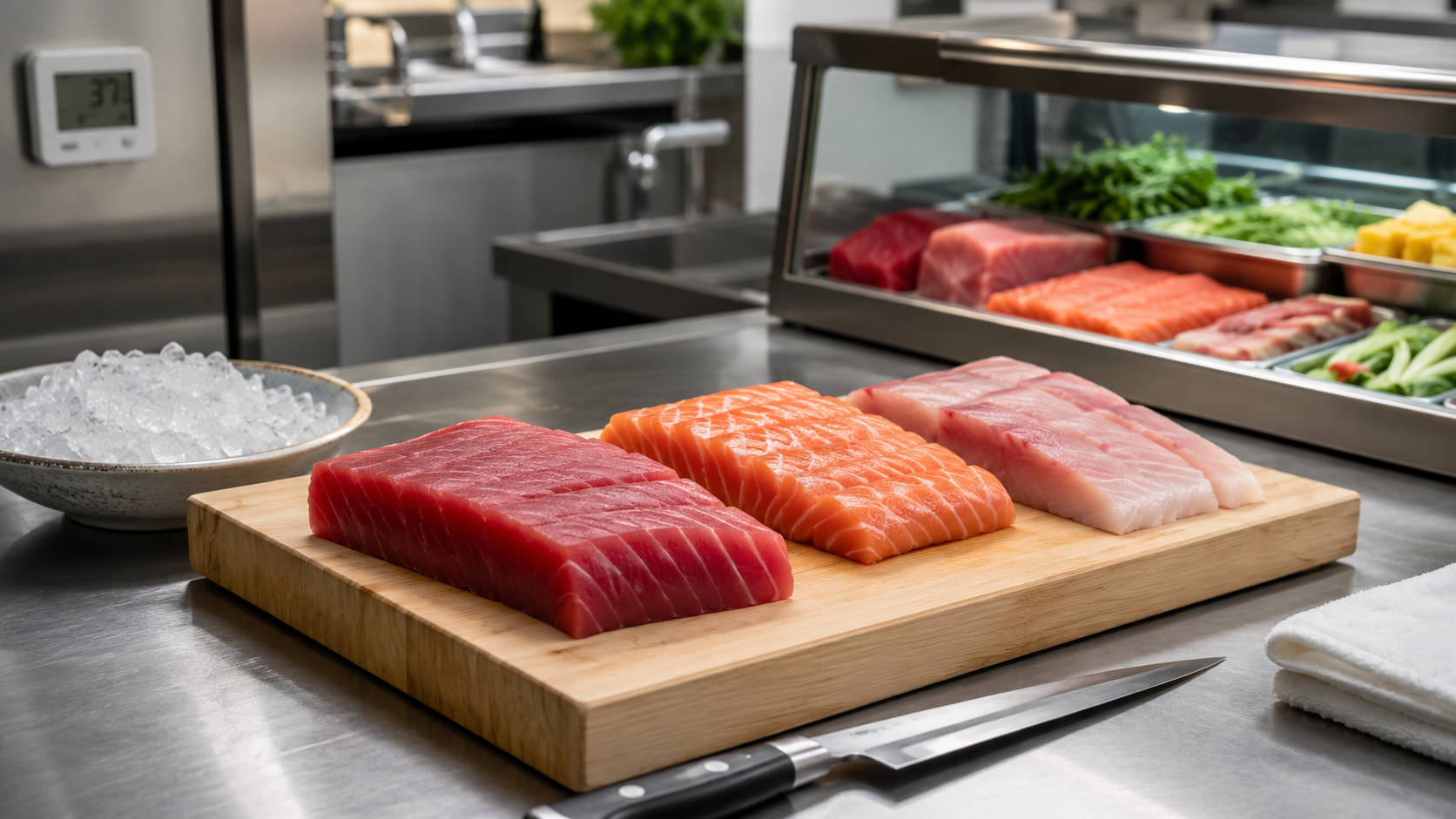
Raw seafood is one of the most delicate ingredients a restaurant can serve. A perfectly sliced piece of tuna, salmon, yellowtail, or fluke can make a sushi bar feel premium, but the same ingredient can also create food safety risk if it is sourced, frozen, transported, stored, and prepared incorrectly.
That is why the phrase “sushi grade fish” gets so much attention. Customers see it as a sign of quality. Restaurant owners often see it as a shortcut for safety. Fishmongers may use it to describe their best seafood. But the truth is more complicated: “sushi grade” is not an official government grade, and the label alone does not guarantee that fish is safe to eat raw.

For restaurants, sushi bars, seafood markets, grocery stores, catering kitchens, and foodservice operators, the real question is not simply “Is this fish sushi grade?” The better question is: “Can my supplier prove that this fish was handled correctly for raw consumption, and can my kitchen maintain that safety until service?”
This guide explains what sushi grade fish really means, how raw fish safety works, which fish are commonly used for sushi, what questions to ask suppliers, and how to protect seafood quality inside a commercial kitchen.
What Does Sushi Grade Fish Mean?
“Sushi grade fish” usually refers to fish that a seller believes is suitable for raw consumption. You may also see similar phrases such as “sashimi grade,” “raw grade,” or “safe for sushi.” These terms generally suggest that the fish is high quality, fresh, carefully handled, and often frozen according to parasite destruction procedures.
However, sushi grade is not a legally defined seafood grade in the United States. There is no single national inspection stamp that automatically makes fish “sushi grade.” A vendor may use the term responsibly, but another seller may use it mainly as a marketing phrase.
That does not mean the label is useless. In many cases, reputable seafood suppliers use “sushi grade” to identify fish that has been selected and handled with extra care. But restaurants should never rely on the label alone. The phrase should start a conversation with the supplier, not end it.
A responsible buyer should ask how the supplier defines sushi grade, whether the fish was frozen for parasite destruction when required, how it was transported, how long it has been held, and whether documentation is available.
Sushi Grade vs Sashimi Grade
The terms sushi grade and sashimi grade are often used interchangeably. In everyday foodservice language, both usually mean fish intended to be eaten raw.
The difference is more about use than regulation. Sushi often includes vinegared rice, seaweed, vegetables, sauces, and other ingredients. Sashimi is usually sliced raw fish or seafood served without rice. Because sashimi is served in a very clean, exposed format, texture, aroma, knife work, and visual quality matter even more.
If your restaurant serves sushi or sashimi, the seafood should meet strict internal standards for sourcing, freezing history, temperature control, freshness, and preparation hygiene.
Is Sushi Grade Fish 100% Safe?
No raw seafood can be called 100% risk free. Freezing can kill parasites when time and temperature standards are met, but it does not eliminate every possible food safety hazard. Bacteria, viruses, cross-contamination, temperature abuse, and toxins can still be concerns.
This is why raw fish service requires multiple layers of control:
- The fish must come from a reputable supplier.
- The species must be appropriate for raw service.
- Parasite destruction must be verified when required.
- The fish must stay cold during receiving, storage, prep, and service.
Cutting boards, knives, gloves, towels, and prep surfaces must be clean and separated from raw meat, poultry, and other contamination sources.
Staff must understand time and temperature control.
Menus must include consumer advisories when required by local code.
In other words, “sushi grade” is not a magic safety category. It is only one part of a larger food safety system.
FDA Parasite Destruction Guidelines for Raw Fish

One of the most important safety issues for raw fish is parasite control. Some fish can contain parasites that may be harmful if the fish is eaten raw or undercooked. Proper freezing can destroy parasites when done under controlled conditions.
FDA guidance commonly references these parasite destruction methods for fish intended to be consumed raw or undercooked:
Freezing and storing at -4°F (-20°C) or below for 7 days total time.
Freezing at -31°F (-35°C) or below until solid, then storing at -4°F (-20°C) or below for 24 hours.
Freezing at -31°F (-35°C) or below until solid, then storing at -31°F (-35°C) or below for 15 hours.
Restaurants should not guess whether this happened. The safest approach is to buy from suppliers who can provide parasite destruction documentation, often called a parasite destruction letter or guarantee. This documentation helps show that the seafood was treated according to recognized time and temperature controls before it reached your kitchen.
Local health departments may also have specific requirements, so restaurants should always check local food code rules before serving raw or undercooked seafood.
Fish That Are Commonly Used for Sushi and Sashimi
Different fish carry different quality expectations and food safety considerations. Here are common seafood options used in sushi restaurants and raw fish programs.
Tuna
Tuna is one of the most popular fish for sushi and sashimi. Common types include yellowfin, bigeye, albacore, skipjack, and bluefin. Tuna is prized for its clean flavor, firm texture, and rich color.
Tuna is often considered lower risk for parasites compared with many other species, but it still requires careful sourcing and temperature control. Tuna is also one of the fish categories associated with histamine risk if time and temperature abuse occurs. Once histamine forms, it cannot be reliably removed by cooking or freezing.
For restaurants, tuna quality depends heavily on supplier reputation, cold chain management, receiving inspection, and fast rotation.
Salmon
Salmon is extremely popular in modern sushi, but it requires special attention. Wild salmon can be more likely to carry parasites because of its life cycle and exposure to natural feed sources. Farm-raised salmon from controlled aquaculture systems is often preferred for raw applications, but operators should still verify supplier handling and freezing practices.
Salmon should have a clean ocean-like smell, bright color, firm texture, and no sour or spoiled odor. Because salmon is fatty, it can develop quality issues quickly if it is not stored properly.
Yellowtail and Amberjack
Yellowtail, often listed as hamachi, is valued for its buttery texture and mild flavor. Amberjack and related species can be excellent for raw service, but buyers should be aware of freshness, sourcing, and mercury considerations depending on species and serving frequency.
Fluke, Halibut, and Other Flatfish
Flatfish such as fluke, hirame, and halibut are commonly used in sashimi and nigiri. These fish are appreciated for clean, lean, delicate flesh. Because lean white fish can show quality loss quickly, proper holding temperature and knife handling are especially important.
Mackerel
Mackerel, often called saba, is flavorful and oily. It is commonly cured with salt and vinegar before service. Because mackerel is associated with histamine risk, strict temperature control is essential from harvest through service.
Sea Bream and Sea Bass
Sea bream, sea bass, and similar white fish are often used in Japanese restaurants. They can have excellent texture when fresh and properly handled. Depending on species and preparation style, some restaurants use light curing or aging techniques, but these processes should be managed carefully and never treated as substitutes for required food safety controls.
Shellfish and Other Seafood
Scallops, shrimp, crab, squid, octopus, and shellfish appear on many sushi menus, but they are not all handled the same way. Some are served cooked. Some may be served raw. Molluscan shellfish have their own tagging, source, and safety rules. Restaurants should treat each seafood category separately instead of assuming one “sushi grade” standard applies to everything.
Fish to Avoid Serving Raw
Freshwater fish should generally not be served raw because of parasite risk. Fish that spend part or all of their life in freshwater environments can present higher raw-consumption hazards.
Restaurants should also be cautious with fish from unknown suppliers, fish without clear documentation, fish that smells sour or “fishy,” fish with soft flesh, fish with cloudy eyes or dull gills, and fish that has been temperature abused.
If your team cannot verify the source, freezing history, and handling conditions, do not serve the fish raw.
How to Buy Sushi Grade Fish for a Restaurant
The best sushi restaurants do not buy raw fish casually. They build supplier relationships, ask detailed questions, and create receiving standards.
Before purchasing fish for raw service, ask your supplier:
- How do you define sushi grade or sashimi grade?
- Was this fish frozen for parasite destruction?
- Can you provide a parasite destruction letter?
- What species is it exactly?
- Is it wild-caught or farm-raised?
- Where was it harvested or produced?
- When was it processed?
- How was it transported?
- How long has it been stored?
- At what temperature was it held?
- How often do you receive fresh shipments?
- Do you follow seafood HACCP controls?
- Can you provide traceability information?
A strong supplier should be able to answer these questions clearly. If the supplier cannot explain how the fish was handled, the restaurant should be cautious.
Receiving Checklist for Raw Fish
When seafood arrives at your restaurant, staff should inspect it before accepting delivery. Receiving is one of the most important control points because problems caught at the door are easier to fix than problems discovered during service.
- Check the delivery temperature.
- Confirm the product is cold and properly packed.
- Inspect the packaging for leaks, damage, or signs of thawing and refreezing.
- Check labels, harvest information, and supplier documentation.
- Confirm parasite destruction documentation when required.
- Look for clean, ocean-like aroma.
- Reject fish that smells sour, rotten, ammonia-like, or overly fishy.
- Check flesh texture. It should be firm, not mushy.
- Look for bright, natural color.
- For whole fish, check clear eyes, red gills, intact scales, and clean skin.
- Document receiving temperatures and any rejected product.
For sushi operations, receiving should be handled by trained employees, not treated as a routine back-door delivery.
How to Store Sushi Grade Fish
Once raw fish enters your kitchen, the restaurant becomes responsible for maintaining quality and safety. The fish should be refrigerated or frozen immediately after receiving.
Raw fish should be stored in clean, food-safe containers and protected from drips, odors, and cross-contamination. It should be kept separate from raw poultry, raw meat, chemicals, and ready-to-eat foods that are not part of the sushi station.
Temperature control is especially important. A reliable commercial refrigerator helps restaurants keep seafood cold, organized, and accessible during prep and service. For higher-volume sushi bars, seafood restaurants, and Asian restaurants, dedicated refrigeration for raw fish can improve workflow and reduce the risk of cross-contamination.
Fish should be rotated using FIFO, first in, first out. Date labels should be clear. Opened product should be used quickly according to your food safety plan and supplier guidance.
How to Thaw Fish for Sushi
Frozen fish should be thawed under refrigeration, not at room temperature. Thawing at room temperature can allow the outer surface of the fish to enter unsafe temperature ranges while the center is still frozen.
For best results:
Keep fish wrapped or protected during thawing.
Thaw in a refrigerator at safe holding temperatures.
Place fish in a container that prevents dripping.
Keep it separate from other foods.
Do not thaw fish in standing water unless your food safety procedure and local code allow a controlled method.
Use thawed fish quickly.
Never refreeze fish for raw service unless you have a validated process and supplier guidance.
Thawing should be planned around service volume. Sushi bars need enough thawed fish for smooth service, but not so much that expensive product sits too long.
Why Temperature Abuse Is Dangerous
Parasites are not the only concern with raw seafood. Some fish can develop histamine when exposed to unsafe temperatures. This is especially associated with tuna, mahi-mahi, mackerel, bonito, amberjack, and similar species.
Histamine is dangerous because it can form before the fish looks obviously spoiled. It is also heat-stable, meaning cooking does not reliably remove the risk once it has formed. This makes prevention critical.
The best prevention is strict time and temperature control from harvest to delivery, then from receiving to service. Restaurants should keep seafood cold, avoid leaving fish out during prep, and return unused portions to refrigeration quickly.
Sushi Rice, Prep Surfaces, and Cross-Contamination
Raw fish safety is not only about fish. Sushi rice, vegetables, sauces, gloves, cutting boards, knives, towels, and display cases can all affect food safety.
Sushi rice is often held at room temperature after acidification. Restaurants should follow a validated sushi rice procedure and local health department requirements. Rice pH, holding time, and written procedures may be checked during inspections.
Prep areas should be organized so raw fish does not contact dirty surfaces or unrelated foods. Knives and cutting boards should be washed, rinsed, and sanitized regularly. Towels should not be reused in ways that spread contamination. Employees should wash hands often and change gloves when moving between tasks.
A clean sushi station is part of the customer experience, but it is also a food safety requirement.
Menu Consumer Advisory for Raw Fish
Restaurants that serve raw or undercooked animal foods often need a consumer advisory on the menu. This usually includes a disclosure identifying which menu items are raw or undercooked and a reminder explaining that consuming raw or undercooked seafood may increase the risk of foodborne illness, especially for people with certain medical conditions.
A sushi menu should make raw items clear. This can be done with an asterisk, menu note, or item description, depending on local requirements.
Operators should check state and local food code rules because menu advisory expectations can vary by jurisdiction.
Is Farmed Fish Safer for Sushi?
Farmed fish can be safer for raw service in certain cases because aquaculture systems may use controlled feed and controlled environments that reduce parasite exposure. Farmed salmon is a common example.
However, farmed does not automatically mean safe. Restaurants still need supplier documentation, correct handling, clean processing, temperature control, and product traceability. The key is not simply wild versus farmed. The key is whether the fish was raised, harvested, processed, frozen, transported, and stored under controls appropriate for raw consumption.
Is Fresh Fish Better Than Frozen Fish for Sushi?
Many customers assume fresh fish is always better than frozen fish, but that is not always true for sushi. For raw service, properly frozen fish can be safer because freezing may be required for parasite destruction. High-quality frozen fish can also preserve texture and flavor when processed quickly and thawed correctly.
The problem is not freezing itself. The problem is poor freezing, slow freezing, bad thawing, temperature abuse, or refreezing after mishandling.
For sushi restaurants, the best fish is not simply “fresh.” It is properly sourced, properly frozen when required, properly transported, properly stored, and properly prepared.
Best Practices for Restaurants Serving Raw Fish
A restaurant that serves raw seafood should build a clear internal system. At minimum, that system should include:
Approved seafood suppliers.
Parasite destruction documentation.
Receiving temperature logs.
Product labeling and date marking.
Dedicated cold storage for raw seafood when possible.
Written thawing procedures.
Clean sushi prep station procedures.
Knife and cutting board sanitation schedule.
Employee handwashing and glove policies.
Menu consumer advisory.
Manager review of local health department requirements.
Staff training on spoilage signs and rejection standards.
These controls help protect customers, reduce waste, and support consistent quality.
Common Mistakes to Avoid
Do not buy fish for raw service from unknown or casual sources.
Do not assume “sushi grade” is a regulated guarantee.
Do not serve freshwater fish raw.
Do not thaw fish on a counter.
Do not store raw fish above ready-to-eat foods.
Do not use the same cutting board for raw fish and other foods without proper washing and sanitizing.
Do not ignore supplier documentation.
Do not leave tuna, mackerel, or other histamine-risk fish out during prep.
Do not use raw fish that smells sour, feels mushy, or looks dull.
Do not forget the menu consumer advisory.
Small mistakes can become expensive problems in a sushi operation.
Equipment Considerations for Sushi Restaurants
Sushi restaurants need more than sharp knives and fresh fish. They need the right cold storage and prep setup.
Important equipment may include:
Commercial refrigerators for daily seafood holding.
Reach-in refrigerators for prep stations.
Undercounter refrigerators near the sushi bar.
Walk-in coolers for larger operations.
Freezers for frozen fish storage.
Food-safe storage containers.
Accurate thermometers.
Prep tables with refrigerated bases.
Hand sinks and sanitation stations.
The goal is to reduce the time fish spends outside refrigeration, keep ingredients organized, and make safe workflow easy for staff.
Cold storage should be sized around menu volume, delivery schedule, seafood rotation, and prep style. A small sushi counter inside a restaurant may only need compact refrigerated storage, while a full sushi bar, seafood market, or buffet may need larger refrigeration capacity.
Sushi Grade Fish FAQ
Is sushi grade fish regulated?
No. The phrase “sushi grade” is not a formal government grade. It is usually a supplier or retailer term used to describe fish believed to be suitable for raw consumption. Restaurants should verify handling, freezing, and documentation instead of relying only on the label.
Can I use supermarket fish for sushi?
Restaurants should not use ordinary supermarket fish for raw service unless the supplier can confirm that it was handled for raw consumption and provide appropriate documentation. Retail fish may be fresh and safe when cooked, but that does not automatically make it suitable for sushi.
Does freezing fish make it safe to eat raw?
Freezing can kill parasites when proper time and temperature standards are met, but it does not kill every harmful germ or remove toxins that may form from temperature abuse. Safe raw fish service still requires careful sourcing, refrigeration, sanitation, and handling.
What fish is best for sushi?
Tuna, salmon, yellowtail, fluke, halibut, sea bream, and mackerel are common choices. The best option depends on supplier quality, documentation, flavor, texture, menu style, and food safety controls.
Can restaurants serve wild salmon raw?
Wild salmon can carry parasite risk, so restaurants should be very cautious. If salmon is served raw, operators should verify that it has been handled and frozen properly for raw consumption. Many sushi operations prefer farm-raised salmon from reputable suppliers.
Why does sushi fish need to stay so cold?
Cold storage slows bacterial growth, helps preserve texture, protects flavor, and reduces food safety risk. Some fish can also develop histamine if temperature abused, making cold chain control essential.
What should sushi grade fish smell like?
High-quality raw fish should smell clean, mild, and ocean-like. It should not smell sour, rotten, ammonia-like, or strongly fishy.
Do sushi restaurants need a menu warning?
In many jurisdictions, yes. Restaurants serving raw or undercooked seafood usually need a consumer advisory that identifies raw items and warns customers about increased foodborne illness risk. Local health department rules should always be checked.
Sushi grade fish is not just about buying premium seafood. It is about controlling risk from supplier to plate.
For restaurant operators, the phrase “sushi grade” should lead to deeper questions: What species is it? Who supplied it? Was it frozen for parasite destruction? Is documentation available? Was the cold chain maintained? Is the kitchen equipped to store and prepare it safely?
When these answers are clear, raw seafood service becomes more consistent, professional, and trustworthy.
Sushi is one of the most globally recognized Japanese foods, but it also belongs to a larger world of dining traditions and types of cuisine where ingredient handling, equipment, and technique all shape the guest experience. For restaurants that serve raw seafood, the best investment is not only better fish. It is a better system for keeping that fish safe, cold, clean, and ready for service.