

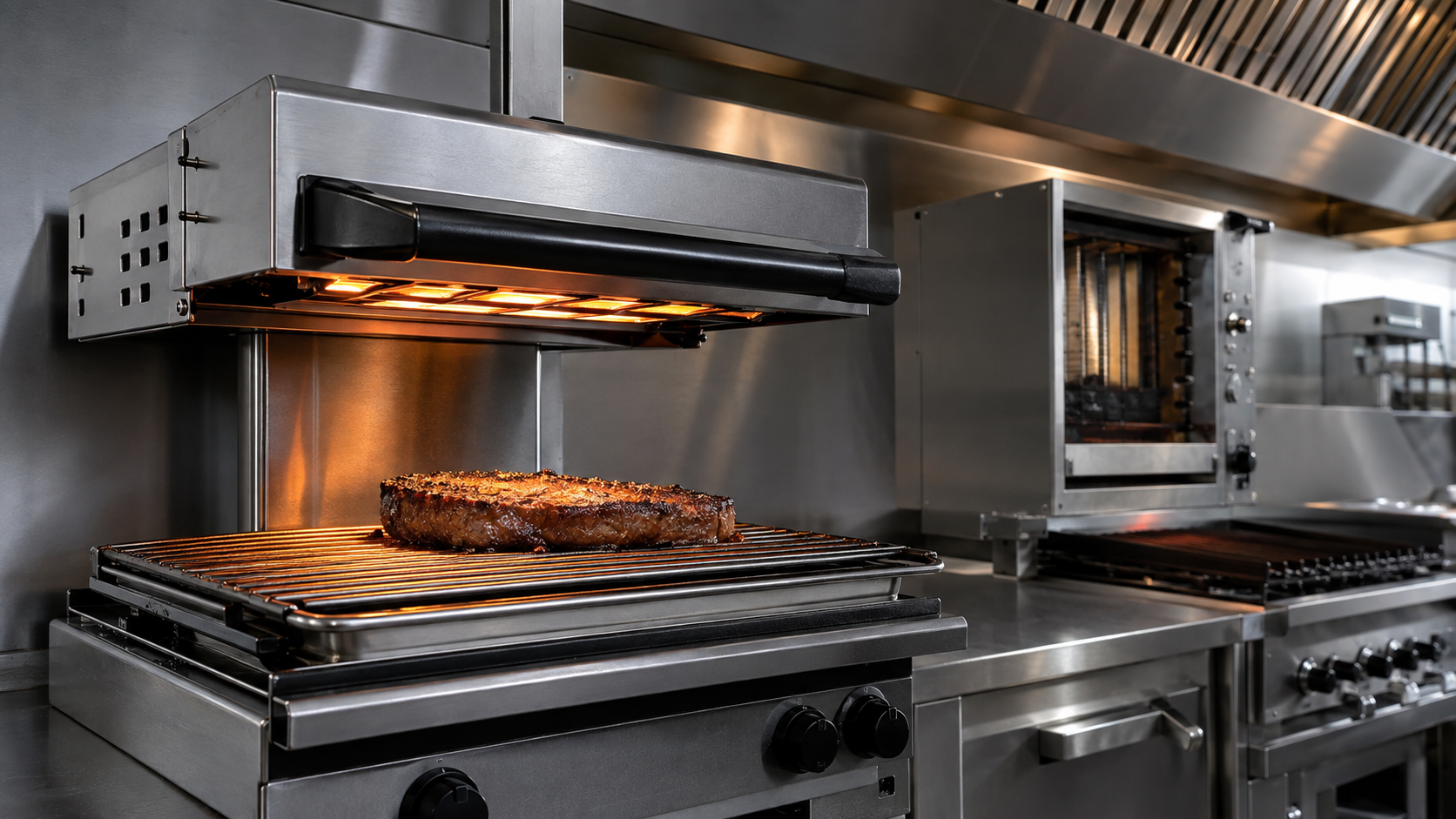
A broiler is a high-heat cooking appliance that exposes food to intense direct heat. In most oven and salamander broilers, the heat comes from above. This allows the surface of food to brown, caramelize, crisp, or sear much faster than it would in a conventional oven.
Commercial kitchens use broilers for everything from finishing French onion soup and melting cheese to cooking steaks, seafood, vegetables, and kebabs. However, “broiler” is a broad equipment category. A salamander, upright steakhouse broiler, charbroiler, and vertical gyro machine all apply powerful heat differently.
Understanding these differences will help you choose the right commercial broiler for your menu, production volume, utility connections, and available kitchen space.
What Does a Broiler Do?
A broiler transfers radiant heat directly toward the food rather than slowly heating the entire cooking chamber. Because the food is positioned close to the heat source, its exterior can brown rapidly while the interior retains moisture.
Broilers are commonly used to:
- Sear steaks, chops, seafood, and chicken
- Brown casseroles and gratins
- Melt cheese on sandwiches, nachos, and pasta
- Caramelize or char vegetables
- Toast bread
- Crisp the skin of fish or poultry
- Finish plated dishes before service
- Cook gyro, shawarma, or doner meat on a rotating spit
The exact applications depend on the equipment. A low-output cheesemelter is designed mainly for finishing, while a heavy-duty upright broiler can handle continuous steak production.
How Does a Broiler Work?
A broiler uses gas burners, electric elements, ceramic radiants, or infrared burners to generate concentrated heat. In an overhead broiler, that heat travels downward toward the food. A cook controls the result by changing the heat setting, adjusting the distance between the food and heat source, or both.
Moving food closer creates faster browning and a more aggressive sear. Increasing the distance provides gentler heat for melting, warming, or finishing delicate dishes.
Commercial models may use radiant or infrared heating. Ceramic radiant systems generally distribute heat across the cooking area, while infrared burners provide fast, concentrated energy and rapid recovery during busy service. Vulcan, for example, offers commercial broilers with radiant, ceramic, infrared, gas, and electric configurations.
Types of Commercial Broilers
Salamander Broiler
A salamander is a compact, high-intensity overhead broiler typically mounted above a commercial range, attached to a wall, or placed on a countertop.
Most models have an adjustable cooking grid that moves food closer to or farther from the heat. Salamanders can broil small cuts of meat, brown casseroles, glaze desserts, toast bread, and finish plated dishes.
A salamander is more powerful and versatile than a standard cheesemelter. It is a good choice for restaurants that need both finishing capability and limited high-heat cooking without using additional floor space.
Upright or Steakhouse Broiler
An upright broiler is a large, high-output unit designed for demanding meat production. It may use overfired infrared or ceramic heat and can reach extremely high searing temperatures. Some models include multiple decks or an oven, refrigerated cabinet, or storage base.
These broilers are best suited to steakhouses, hotels, clubs, and other high-volume kitchens. Selected heavy-duty models can produce searing temperatures around 1,000°F, although actual performance varies by model.
Charbroiler
A charbroiler cooks from below rather than above. Food sits on metal grates over gas burners, infrared elements, radiants, lava rock, or charcoal.
Because grease and juices drip toward the heat source, charbroilers can produce grill marks, smoke, and flame-kissed flavor. They are widely used for burgers, steaks, chicken, seafood, and vegetables.
Choose a charbroiler when grilled flavor and branded grate marks are priorities. Choose an overhead broiler when you need intense top heat, fast browning, or finishing.
Vertical Broiler
A vertical broiler—also called a gyro, shawarma, or doner machine—cooks stacked meat on an upright rotating spit. Burners positioned behind the meat brown its exterior as it rotates. The cooked outer layer is shaved away while the remaining meat continues cooking.
These machines are purpose-built for gyro, shawarma, tacos al pastor, and similar menu items. They should not be treated as substitutes for general-purpose salamanders or charbroilers.
Cheesemelter
A cheesemelter applies overhead heat but typically operates at a lower intensity than a salamander. It is intended primarily for melting cheese, browning toppings, toasting open-faced sandwiches, and warming plates.
If your menu only requires finishing, a cheesemelter may be the more economical choice. If you also want to broil proteins or need faster, more intense heat, select a salamander. Manufacturer guidance likewise distinguishes salamanders as higher-heat, more versatile appliances.
Broiling vs. Baking vs. Grilling
| Cooking method | Main heat pattern | Best for |
|---|---|---|
| Broiling | Intense direct heat, usually from above | Searing, browning, crisping and finishing |
| Baking | Moderate heat surrounding the food | Even, thorough cooking and baking |
| Grilling/charbroiling | Direct heat from below | Grill marks, smoky flavor and high-heat cooking |
Broiling is fast and surface-focused. Baking cooks food more gradually from multiple directions. Grilling resembles broiling in intensity, but its heat normally comes from below and creates direct contact between food and hot grates.
How to Use a Commercial Broiler
Always follow the operating instructions supplied with your specific model. As a general process:
- Preheat the broiler for the time recommended by the manufacturer.
- Use the appropriate broiler pan, grate, or heat-safe cookware.
- Set the rack height according to the food’s thickness and desired browning.
- Arrange food in a single, evenly spaced layer.
- Place fattier foods where grease can drain safely into the drip pan.
- Monitor the food continuously because high heat can burn it quickly.
- Turn proteins when necessary and verify doneness with a food thermometer.
- Remove grease and food residue after the unit has cooled.
Broiler location matters as well. Commercial cooking equipment may require an approved hood, exhaust system, fire suppression, and specific clearances. NFPA 96 addresses fire-safety requirements for commercial cooking operations, but installation must also comply with the manufacturer’s instructions and applicable local codes. (NFPA 96)
How to Choose the Right Commercial Broiler
Start with the food you intend to prepare—not simply the highest advertised temperature.
Consider:
- Menu: Finishing only, general broiling, steak production, grilling, or vertical roasting
- Volume: Occasional orders versus continuous high-volume cooking
- Heat source: Natural gas, propane, or electricity
- Recovery: How quickly the unit returns to cooking temperature between loads
- Cooking area: Rack dimensions, number of decks, and usable capacity
- Placement: Countertop, wall-mounted, range-mounted, or freestanding
- Controls: Independent heat zones and adjustable rack positions
- Cleaning: Removable grids, drip pans, and grease-management components
- Ventilation: Hood, exhaust, clearance, and fire-suppression requirements
- Certification: Appropriate sanitation and safety listings required in your jurisdiction
The right broiler should match your busiest service period while fitting the kitchen’s utility and ventilation capacity.
