


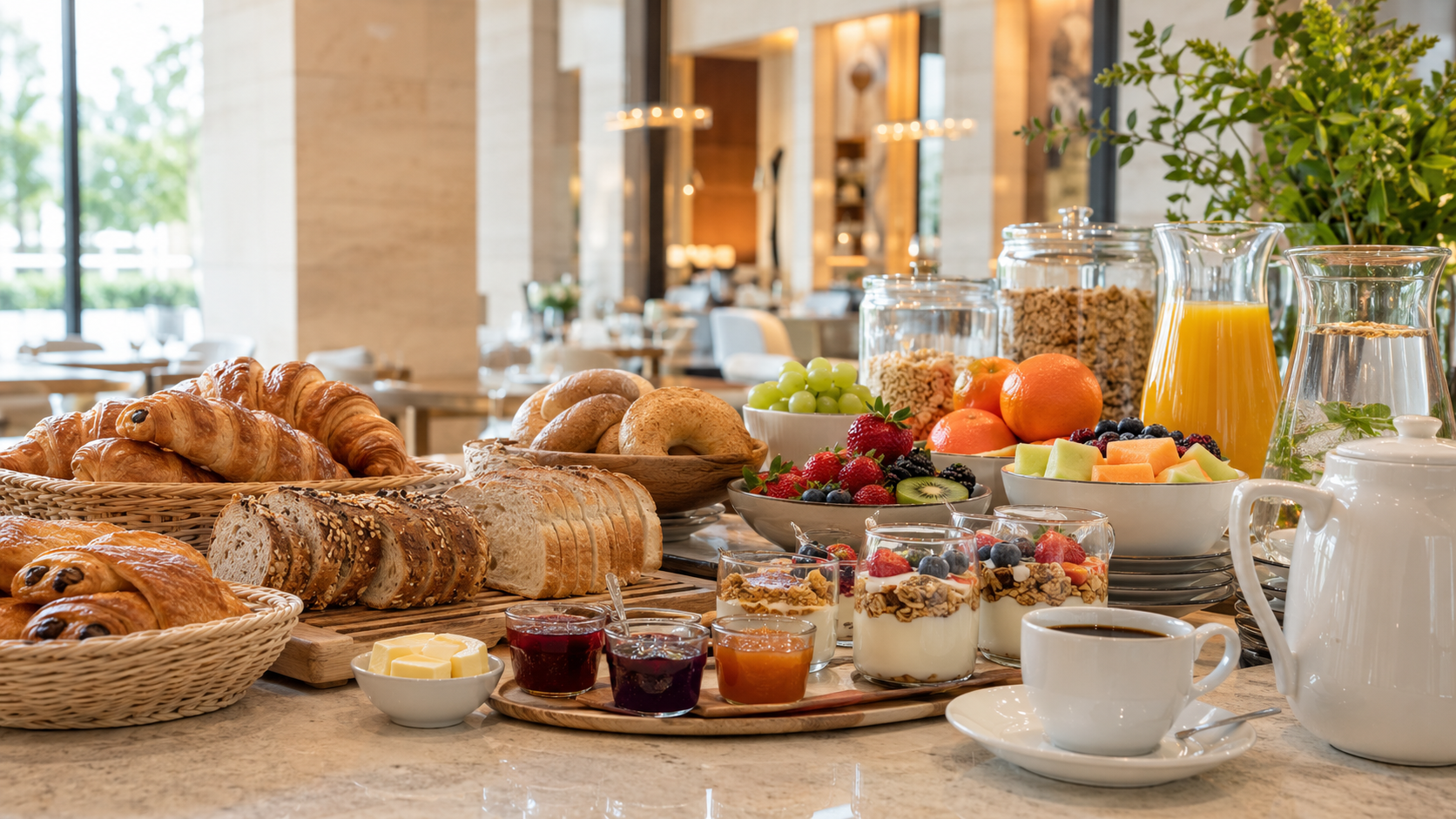
A continental breakfast is a light morning meal typically consisting of bread, pastries, fruit, cereal, coffee, tea, and juice. It is commonly served buffet-style in hotels, motels, conference centers, and other hospitality businesses because most items can be prepared or displayed with minimal cooking.
Unlike an American or full English breakfast, a traditional continental breakfast does not center on hot foods such as eggs, bacon, sausage, or breakfast potatoes. Modern hotels may add these items, but once several cooked dishes are included, the offering is more accurately described as a deluxe continental breakfast, hot breakfast, or breakfast buffet.
What Does “Continental Breakfast” Mean?
The word “continental” refers to continental Europe—mainland European countries rather than the British Isles.
The term developed from the contrast between the lighter breakfasts associated with countries such as France and Italy and the heavier cooked breakfasts traditionally served in Britain. A simple meal of bread or pastries with butter, preserves, and coffee was considered continental, while a British breakfast might include eggs, bacon, sausage, beans, tomatoes, and mushrooms.
The exact contents of breakfast vary considerably across Europe. German, Scandinavian, Mediterranean, and French breakfasts are not identical. The modern “continental breakfast” is therefore best understood as a hospitality format inspired by lighter European breakfast traditions, not as a precise representation of what everyone in Europe eats.
Published references to the phrase can be traced back to the late nineteenth century, when American hotels were adapting their service for changing urban lifestyles and international travelers.
What Does a Continental Breakfast Include?
A basic continental breakfast normally includes a selection from five main groups:
- Bread and baked goods
- Fruit
- Cereal and other cold items
- Spreads and accompaniments
- Hot and cold beverages
There is no mandatory universal menu. Hotels can adjust the selection based on their price point, available space, guest demographics, staffing, and kitchen capacity.
Bread and Baked Goods
Bread and pastries usually form the foundation of the buffet. Common options include:
- Croissants
- Muffins
- Bagels
- Toast
- Sliced bread
- English muffins
- Danish pastries
- Bread rolls
- Scones
- Breakfast loaves
Offering three or four different choices is generally more appealing than filling the display with a large quantity of one item. A toaster can also increase perceived variety without requiring additional recipes.
Fruit
Fruit adds color, freshness, and a naturally dairy-free and gluten-free choice. Options may include:
- Bananas
- Apples
- Oranges
- Grapes
- Berries
- Melon
- Fruit salad
- Individually packaged fruit cups
- Dried fruit
Whole fruit has a longer display life and requires less labor. Cut fruit provides a more premium presentation but requires refrigeration, careful handling, and more frequent replenishment.
Cereal and Grains
Common cereal options include:
- Cornflakes
- Bran cereal
- Granola
- Oatmeal
- Muesli
- Low-sugar cereal
- Gluten-free cereal
Dry cereal dispensers can create a cleaner display and reduce packaging waste. Single-serving packages are easier to track and may help limit cross-contact, but they generally create more waste and can cost more per serving.
Dairy and Protein Options
Protein is not always part of the most basic continental breakfast, but adding one or two choices makes the meal more satisfying. Suitable options include:
- Yogurt
- Greek yogurt
- Hard-boiled eggs
- Sliced cheese
- Cottage cheese
- Nut or seed butter
- Individually packaged protein bars
These products must be stored and displayed at safe temperatures when required.
Spreads and Condiments
Typical accompaniments include:
- Butter
- Cream cheese
- Fruit preserves
- Marmalade
- Honey
- Peanut butter
- Nut-free spreads
- Sugar and sugar substitutes
- Coffee creamer
Individual packets improve portion control and reduce shared handling. Bulk containers may reduce packaging but require dedicated utensils, frequent cleaning, and closer monitoring.
Beverages
A complete beverage station may offer:
- Regular coffee
- Decaffeinated coffee
- Hot tea
- Hot water
- Orange juice
- Apple juice
- Milk
- Non-dairy milk
- Still water
- Hot chocolate
Coffee is often one of the most important parts of the guest experience. A limited food selection can still feel thoughtful when coffee is fresh, hot, easy to find, and regularly replenished.
Sample Continental Breakfast Menu
A balanced standard menu might include:
Baked goods
- Croissants
- Blueberry muffins
- Plain and whole-wheat toast
- Bagels
Cold foods
- Plain and flavored yogurt
- Granola
- Two cereal varieties
- Bananas, apples, and seasonal cut fruit
Spreads
- Butter
- Cream cheese
- Strawberry preserves
- Honey
- Peanut butter
Beverages
- Regular and decaffeinated coffee
- Assorted tea
- Orange and apple juice
- Milk and oat milk
- Chilled water
This menu offers familiar choices while accommodating guests who want something quick, light, high in protein, or plant-based.
Continental Breakfast vs. American and English Breakfast
The difference is primarily the type and quantity of food—not whether it is served as a buffet.
| Breakfast type | Typical foods | Cooking required | Overall style |
|---|---|---|---|
| Continental breakfast | Pastries, bread, fruit, cereal, yogurt, coffee, and juice | Minimal | Light and convenient |
| Deluxe continental breakfast | Continental items plus eggs, waffles, or limited breakfast meat | Moderate | Expanded continental offering |
| American breakfast | Eggs, bacon or sausage, potatoes, pancakes, toast, coffee, and juice | Significant | Hot and filling |
| Full English breakfast | Eggs, bacon, sausage, baked beans, tomatoes, mushrooms, and toast | Significant | Large cooked meal |
| Breakfast buffet | Any combination of cold and hot items | Varies | A service format rather than a specific menu |
A buffet can be continental, American, English, or a mixture. “Buffet” describes how guests obtain the food; “continental” describes the general style of the meal.
Is a Continental Breakfast Free?
A continental breakfast is often included with a hotel stay, but the word “continental” does not mean complimentary.
Hotels may:
- Include breakfast in the room rate
- Offer it only with selected room packages
- Charge a separate breakfast fee
- Include it for loyalty program members
- Provide complimentary coffee but charge for food
Guests should check the hotel’s rate details rather than assuming that every continental breakfast is free.
What Is a Deluxe Continental Breakfast?
“Deluxe continental breakfast” is not a standardized menu classification. It generally describes an upgraded continental spread with more variety, higher-quality products, or a limited selection of hot foods.
It may include:
- Scrambled or hard-boiled eggs
- Bacon or sausage
- Waffles or pancakes
- Breakfast sandwiches
- Premium pastries
- Sliced meats and cheeses
- Smoked salmon
- Specialty coffee
- Freshly squeezed juice
If the menu relies heavily on cooked-to-order items, it is more helpful to guests to call it a hot breakfast or full breakfast buffet.
Why Do Hotels Offer Continental Breakfast?
Continental breakfast remains popular because it can benefit both the guest and the operator.
Convenience for Guests
Travelers can eat quickly without waiting for table service. Guests can also choose their portion size and take familiar foods when they have an early meeting, flight, or long drive ahead.
Lower Labor Requirements
Many items arrive ready to serve or require only basic preparation. A hotel may be able to operate the buffet with fewer employees than a made-to-order breakfast restaurant would require.
Flexible Menu Design
Operators can start with a basic selection and add items according to guest demand. The same station can support a small weekday service and a larger weekend buffet through changes in quantity and replenishment.
Broad Guest Appeal
Bread, fruit, cereal, yogurt, and coffee are familiar to many travelers. Hotels can also add regional products or dietary alternatives without redesigning the entire menu.
Easier Cost Control
Packaged products, measured dispensers, and batch replenishment make usage easier to track. However, continental breakfast is not automatically inexpensive. Premium pastries, fresh berries, individual packages, labor, utilities, and food waste can all raise the true cost per guest.
How to Set Up a Continental Breakfast Buffet

A successful buffet should help guests move in one direction, find what they need quickly, and avoid crowding around popular items.
1. Estimate the Number of Guests
Do not base production only on the number of occupied rooms. Estimate how many guests will actually use the buffet.
A practical starting formula is:
Expected servings = Number of eligible guests × expected participation rate × buffer
For example, if 100 guests are eligible, approximately 65% normally eat breakfast, and you want a 10% buffer:
100 × 0.65 × 1.10 = approximately 72 servings
Track actual participation by day of the week and season. After several weeks, the hotel’s own records will be more reliable than a general industry estimate.
2. Plan Portions Before Purchasing
The appropriate quantity depends on whether an item is the only choice or one of several alternatives. The following amounts can be used as initial planning ranges:
| Item | Starting quantity per expected guest |
|---|---|
| Pastries and baked goods | 1.25–1.5 pieces |
| Whole or cut fruit | 4–6 oz. |
| Yogurt | 0.5–0.75 container |
| Dry cereal | 1–1.5 oz. |
| Coffee | 12–16 fl. oz. |
| Juice | 6–8 fl. oz. |
| Milk | 4–6 fl. oz. |
These are starting points, not fixed rules. Adjust purchasing according to guest behavior and recorded waste.
3. Arrange the Buffet in Logical Zones
Instead of placing everything on one crowded table, divide the buffet into stations:
- Plates, bowls, and napkins
- Bread and pastries
- Toaster and spreads
- Cereal, yogurt, and fruit
- Hot foods, if offered
- Coffee and beverages
- Flatware and final condiments
Place the beverage station away from the main food line when possible. Coffee preparation tends to take longer than picking up food, and separating it prevents one guest from stopping the entire line.
4. Place High-Demand Items in More Than One Location
Popular items such as cups, napkins, butter, and sweeteners can be placed at multiple points. If space allows, use more than one coffee dispenser during peak periods.
The goal is not simply to fit every product on the counter. The layout should reduce repeated movements and prevent guests from crossing back through the line.
5. Replenish in Small Batches
A display does not have to be overflowing to look generous. Smaller, more frequent refills can:
- Keep food fresher
- Reduce waste
- Improve temperature control
- Prevent pastries from drying out
- Make the station easier to clean
- Give staff more accurate consumption data
Use shallow trays and smaller baskets near the end of service rather than leaving large quantities exposed.
6. Label the Food Clearly
Simple labels improve the guest experience and reduce repetitive questions. Identify:
- Product names
- Major allergens
- Dairy-free choices
- Gluten-free choices
- Vegan or vegetarian items
- Non-dairy milk
- Decaffeinated coffee
- Sugar-free products
Do not describe an item as allergen-free unless the ingredients, preparation process, storage, utensils, and risk of cross-contact have been properly evaluated.
Essential Continental Breakfast Equipment
The equipment required depends on the size of the buffet and whether hot food is offered.
| Equipment | Purpose |
|---|---|
| Commercial coffee brewer and dispenser | Produces and holds coffee for continuous service |
| Beverage or juice dispenser | Provides controlled, organized beverage service |
| Commercial toaster | Handles repeated use more reliably than residential equipment |
| Refrigerated display or cold well | Holds yogurt, milk, cut fruit, and other chilled foods |
| Reach-in or undercounter refrigerator | Stores backup products close to the service area |
| Cereal dispenser | Controls portions and keeps cereal organized |
| Pastry trays and baskets | Displays baked goods without overcrowding |
| Insulated milk dispenser | Keeps milk cold while reducing container handling |
| Ice machine | Supplies ice for beverages and chilled displays |
| Induction unit or food warmer | Maintains approved temperatures for hot foods |
| Sneeze guards and food shields | Help protect exposed self-service food |
| Serving utensils | Provide a dedicated utensil for each item |
| Waste and recycling stations | Keep the dining area organized |
Operators should choose commercial equipment rated for the expected volume. Residential coffee makers and toasters may not be designed for continuous hotel or foodservice use.
Atlantic offers commercial refrigeration, commercial ice machines, and food preparation equipment for hotels, cafes, and other foodservice operations.
Continental Breakfast Food Safety
A buffet with little cooking still requires careful food safety management. Milk, yogurt, cut fruit, cream cheese, eggs, and many other breakfast products need appropriate time and temperature control.
The FDA Food Code is a model code adopted or adapted by state and local jurisdictions. Operators should always follow the specific requirements enforced by their local health authority.
As a general FDA Food Code standard:
- Cold time/temperature control for safety food should generally be held at 41°F or below
- Hot food should generally be held at 135°F or above
- If time rather than temperature is used as a control, a written procedure and strict time marking may be required
Additional buffet practices include:
- Check and record food temperatures
- Use food shields where required
- Provide a separate utensil for each item
- Replace contaminated utensils immediately
- Never combine fresh food with an old batch without following an approved procedure
- Clean spills as soon as they occur
- Keep backup food refrigerated until needed
- Remove food according to the operation’s approved time-control policy
- Follow manufacturer instructions for dispensers and holding equipment
- Verify local rules before designing or changing the buffet
Managing Food Allergies and Dietary Needs
Breakfast buffets frequently contain several of the nine major U.S. food allergens: milk, eggs, wheat, soy, peanuts, tree nuts, fish, shellfish, and sesame.
Cross-contact can occur when guests share serving utensils, use the same toaster for different breads, or spill one food into another container. The CDC notes that food-allergy reactions frequently occur in restaurants, making staff training and accurate ingredient information especially important.
Helpful practices include:
- Keep original product labels and ingredient records accessible
- Use separate utensils for every item
- Place nut products in a controlled area
- Avoid placing allergen-containing toppings directly above other foods
- Train staff not to guess when answering ingredient questions
- Offer sealed alternatives when cross-contact cannot be prevented
- Consider a dedicated toaster for gluten-free products
- Clearly distinguish dairy milk from non-dairy alternatives
Offering dietary choices is valuable, but accurate communication is more important than placing a “gluten-free” or “allergy-friendly” label on an uncontrolled buffet item.
How to Make a Continental Breakfast Feel More Premium
A premium experience does not require dozens of products. Quality, organization, and consistency usually matter more than excessive variety.
Feature One Local Item
Offer bread from a neighborhood bakery, local preserves, regional fruit, or coffee from a nearby roaster. One distinctive product can make the breakfast more memorable.
Improve the Presentation
Use coordinated trays, clean labels, varied display heights, and appropriate lighting. Avoid piling unrelated products into the same basket.
Prioritize Coffee Quality
Serve fresh coffee in clean equipment and monitor it throughout service. Provide clearly labeled regular and decaffeinated options, along with milk and at least one non-dairy alternative.
Balance Carbohydrates with Protein
Pastries alone can make the breakfast feel incomplete. Yogurt, hard-boiled eggs, cheese, or seed-based products give guests more satisfying choices without requiring a full hot kitchen.
Keep the Station Consistently Stocked
A smaller buffet that remains clean and available throughout service creates a better impression than an oversized buffet that looks neglected after the first hour.
How to Reduce Continental Breakfast Waste
Breakfast waste is often caused by overproduction, large display containers, and poor consumption tracking.
Operators can reduce waste by:
- Recording daily guest participation
- Tracking waste by individual product
- Comparing weekday and weekend demand
- Using smaller trays near closing time
- Replenishing high-cost foods in limited batches
- Rotating seasonal fruit according to price and availability
- Reviewing whether every menu item adds real guest value
- Purchasing package sizes that match actual turnover
- Following safe storage and reuse rules
- Removing consistently unpopular items
Calculate the actual cost per participating guest rather than dividing breakfast expenses by total hotel occupancy.
Breakfast cost per participant = Total food and beverage cost ÷ Number of guests who used the buffet
Labor, disposable supplies, cleaning products, utilities, equipment maintenance, and waste should also be considered when evaluating the total program.

