


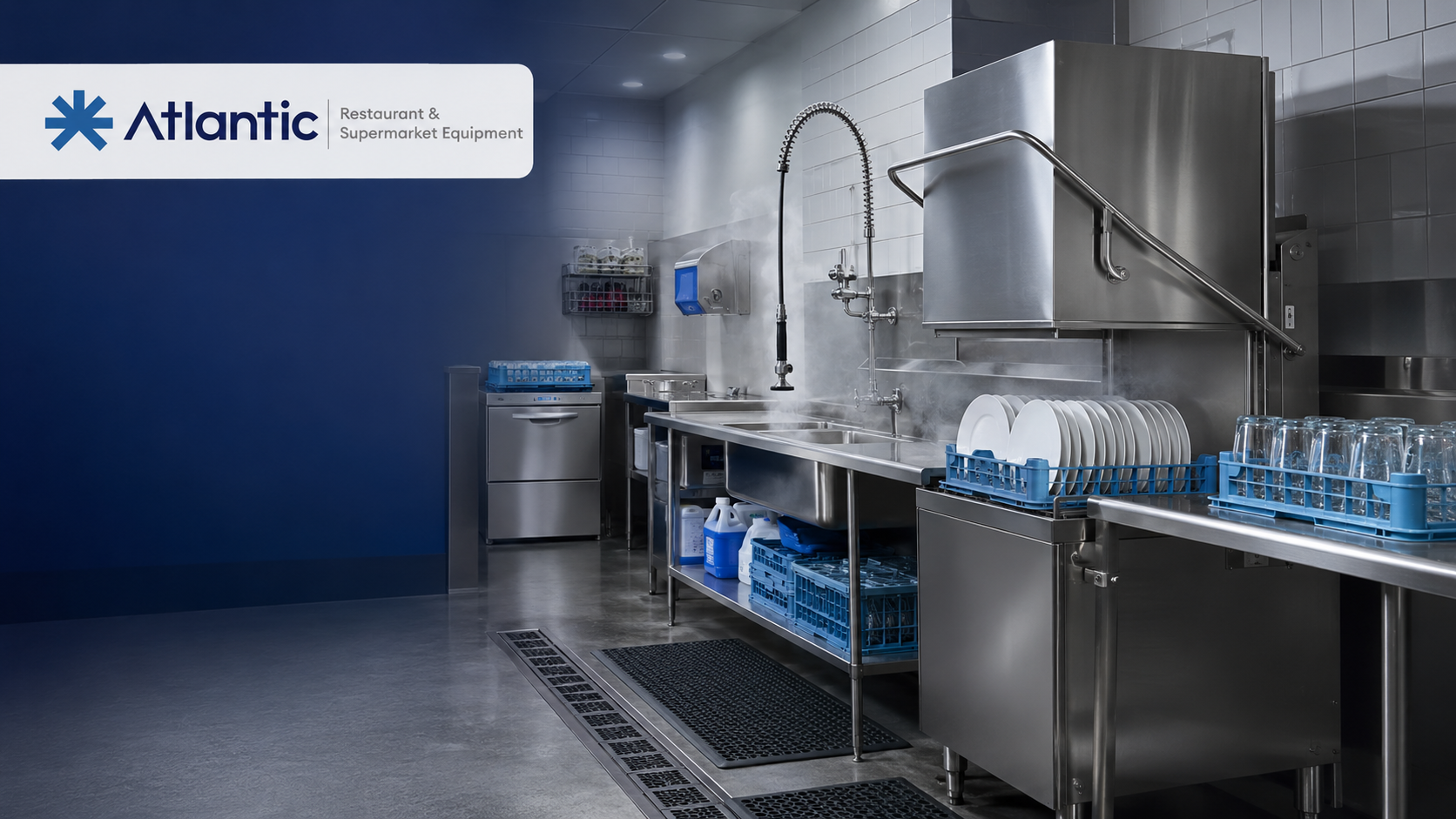
A commercial dishwasher is not simply a faster residential dishwasher. It is part of a complete warewashing system that includes scraping, pre-rinsing, loading, washing, rinsing, sanitizing, air-drying, chemical control, clean-dish storage, and employee workflow. Choosing the right machine means matching all of those functions to the busiest period your operation must handle.
The wrong machine can create a bottleneck that slows table turns, leaves the bar short of clean glassware, increases labor, or fails to deliver consistent sanitization. The right machine moves wares from dirty to clean at a predictable rate while fitting the operation's space, water, drain, electrical, ventilation, and chemical requirements.
This commercial dishwasher buying guide explains the major machine types, how to calculate racks per hour, the difference between high-temperature and low-temperature sanitizing, the utility and installation checks that must happen before ordering, and how to compare total operating cost—not just purchase price.
Quick answer: Choose a commercial dishwasher by measuring the number and type of wares that must be cleaned during your busiest hour. Convert that demand into required racks per hour, add a realistic operating reserve, and select a machine type that fits the load. Then verify sanitizing method, incoming water, drain, voltage, phase, booster heater, ventilation, chemical dispensing, rack opening, and clean/dirty workflow before purchasing.
Explore Atlantic's current selection of commercial dishwashers, including undercounter dishwashers, glasswashers, high-temperature machines, low-temperature machines, and door-type systems.
Key Takeaways
- Size for the busiest repeatable hour, not the daily average.
- Racks per hour is more useful than cycle time alone because loading, unloading, scraping, and employee movement affect real throughput.
- High-temperature machines sanitize with hot water; low-temperature machines use an approved chemical sanitizer under the required operating conditions.
- A 180°F final rinse is not a universal rule for every high-temperature machine configuration. Follow the machine data plate and applicable local code.
- Undercounter machines prioritize compactness and point-of-use washing; door-type and conveyor machines prioritize continuous throughput.
- A glasswasher is optimized around glasses and barware, not necessarily heavily soiled pots, pans, or mixed restaurant wares.
- Water use should be compared per rack for rack machines and per hour or square foot for appropriate flight-type equipment.
- Purchase price is only one part of cost. Include water heating, chemicals, labor, racks, plumbing, electrical work, ventilation, water treatment, maintenance, and downtime.
- Never order from a product title alone. Review the specification sheet, installation manual, data plate requirements, and local code before final selection.
What Is a Commercial Dishwasher?
A commercial dishwasher—also called a warewasher or dishmachine—is designed to wash and sanitize reusable foodservice wares through rapid, repeatable cycles. Depending on the model, those wares may include plates, bowls, cups, glasses, flatware, trays, utensils, food-preparation tools, or selected pots and pans.
Commercial machines are commonly categorized by:
- Physical design: countertop, undercounter, door-type, conveyor, or flight-type
- Primary application: dishwashing, glasswashing, pot and pan washing, or multipurpose warewashing
- Sanitizing method: hot-water sanitizing or chemical sanitizing
- Throughput: racks per hour, dishes or glasses per hour, or conveyor capacity
- Tank arrangement: dump-and-fill, recirculating single tank, or multiple tank
No single category tells the whole story. Two undercounter machines may have different sanitizing methods, cycle times, water use, clearances, rack sizes, drain arrangements, and electrical requirements.
How Does a Commercial Dishwasher Work?
A typical rack-type commercial warewashing process follows these stages:
- Scrape and sort: Staff remove food, paper, straws, and other debris.
- Pre-rinse: A pre-rinse spray removes loose soil before the rack enters the machine.
- Load: Wares are positioned so wash and rinse water can reach every food-contact surface.
- Wash: Pumped wash water and commercial detergent remove soil.
- Rinse and sanitize: The machine uses a hot-water sanitizing rinse or a properly controlled chemical sanitizer.
- Unload and air-dry: Clean wares move to a protected drainboard or storage area. Towel drying can recontaminate surfaces and should not replace proper air-drying.
The machine is only one part of this flow. A fast machine cannot achieve its advertised throughput if there are too few racks, no landing space, an undersized pre-rinse area, poor dishroom layout, or only one employee scraping, loading, unloading, and returning wares.
Types of Commercial Dishwashers
Countertop warewashers
Countertop machines are compact units for low-volume operations, specialty utensils, or locations with extremely limited space. Their small footprint can be useful in cafés, kiosks, tasting rooms, or support stations.
Choose a countertop warewasher when:
- Wash volume is low
- Counter space is available
- The ware dimensions fit the opening
- Utilities can be provided safely at the installation point
- It will not become the primary bottleneck during peak service
Do not confuse compact physical size with residential construction. A commercial countertop warewasher can still have substantial water, drain, heat, chemical, or electrical requirements.
Undercounter commercial dishwashers
An undercounter dishwasher fits beneath or near a work counter and typically processes one rack per cycle. It is commonly used in small restaurants, bars, cafés, coffee shops, bakeries, offices, and satellite service stations.
Advantages include:
- Compact footprint
- Convenient point-of-use placement
- Short cycles
- Simple one-rack workflow
- Availability in high- and low-temperature configurations
Limitations include:
- Lower practical throughput than larger door-type systems
- Frequent bending for loading and unloading
- Limited opening height
- Less space for large trays, pots, or tall wares
- Potential heat and steam near the counter for high-temperature models
An undercounter model can be an excellent main machine for a small operation or a secondary machine for glasses and server-station wares in a larger facility.
Commercial glasswashers
A glasswasher is designed around beverage glasses and barware. It may be countertop or undercounter and may use high-temperature or chemical sanitizing.
Glasswashers are best for:
- Bars and nightclubs
- Breweries and taprooms
- Wine bars
- Hotel lounges
- Restaurants with a dedicated glasswashing station
Before choosing one, confirm:
- Maximum glass height and rack dimensions
- Glasses per rack and racks per hour
- Stemware support
- Water treatment requirements
- Rinse-aid system
- Sanitizing method
- Whether lipstick, fruit pulp, dairy, beer foam, and specialty drink residue are handled effectively by the planned procedure
A glasswasher should not automatically be treated as a general-purpose pot and pan machine.
Door-type or hood-type dishwashers
A door-type machine accepts a rack on a pass-through or straight-through dish table. The operator raises the hood or door, slides in a rack, closes the machine, and starts the cycle. Corner configurations are also possible when supported by the machine and dishroom layout.
Door-type machines are often the best fit for:
- Full-service restaurants
- Busy cafés and bakeries
- Hotels
- Schools and cafeterias
- Catering kitchens
- Smaller institutions
- Operations that exceed comfortable undercounter capacity
Their elevated loading position can improve ergonomics, while compatible dirty and clean dish tables support continuous flow. However, the complete installed system needs more space than the machine footprint alone.
Conveyor dishwashers
A rack conveyor machine moves loaded racks through one or more washing and rinsing zones. It is designed for continuous high-volume production and is commonly used in large restaurants, hotels, hospitals, universities, commissaries, and banquet operations.
Conveyor systems require careful planning for:
- Direction of operation
- Sort and scrape stations
- Prewash and accumulation space
- Exhaust and heat management
- Clean-side landing and storage
- Multiple employees
- Electrical, water, and drain loads
- Rack return
- Preventive maintenance
Buying a conveyor machine without designing the complete dishroom can simply move the bottleneck from the washer to scraping, loading, unloading, or rack return.
Flight-type dishwashers
Flight-type machines use a continuously moving belt rather than individual racks. They are built for very high-volume institutional and production environments.
Typical applications include:
- Large hospitals
- Universities
- Correctional facilities
- Major commissaries
- Large employee cafeterias
- High-volume convention or banquet facilities
Flight machines require engineered layout, substantial space, coordinated utilities, ventilation, and a labor plan. They are rarely the right starting point for an independent restaurant or bar.
Undercounter vs. Door-Type vs. Conveyor Dishwasher
| Feature | Undercounter | Door-type / hood-type | Rack conveyor |
|---|---|---|---|
| Best fit | Small restaurant, café, bar, support station | Medium-volume restaurant, hotel, cafeteria | High-volume institutional or continuous service |
| Loading | One rack, low loading height | One rack, standing-height pass-through | Continuous racks |
| Space | Smallest footprint | Machine plus dish tables | Largest complete system |
| Throughput | Low to moderate | Moderate to high | High to very high |
| Labor pattern | One operator can manage light demand | Dedicated dish station during rush | Coordinated multi-person workflow |
| Large wares | Limited by opening | Better opening clearance | Depends on conveyor opening and rack |
| Installation complexity | Moderate | Moderate to high | High |
| Best selection metric | Racks/hour, cycle, opening, water/rack | Racks/hour, opening, recovery, water/rack | Racks/hour, conveyor speed, tanks, water/rack |
What Size Commercial Dishwasher Do You Need?

Size a dishwasher around the busiest repeatable hour. Daily totals can hide the moment when hundreds of plates, glasses, and utensils return within a short period.
The Atlantic rack-demand formula
Peak-hour ware pieces ÷ usable pieces per rack = base racks per hour
Base racks per hour × operating reserve = target racks per hour
The most accurate method is to build representative racks with the same plates, glasses, bowls, trays, and utensils the operation will use. Count the practical—not theoretical—number of items that can be loaded while still allowing spray to reach every surface.
Step 1: Count peak-hour wares
Estimate or measure all items returning during the busiest hour:
- Entrée plates
- Appetizer and dessert plates
- Bowls
- Cups and saucers
- Water, wine, beer, and cocktail glasses
- Flatware
- Trays
- Food-preparation utensils
- Smallwares
- Approved pots and pans
Seat count alone is insufficient. A 100-seat restaurant turning the dining room twice produces different demand from a 100-seat restaurant with one seating. Use peak-hour covers, beverage transactions, and actual ware pieces whenever possible.
Step 2: Determine usable rack capacity
Rack capacity depends on:
- Rack dimensions and peg layout
- Plate diameter and rim shape
- Bowl depth
- Glass diameter and height
- Stemware support
- Required spacing
- Soil level
- Whether mixed wares can be washed together under the operation's procedure
Avoid loading racks so tightly that spray and sanitizer cannot contact surfaces. The rack may physically hold more items than it can effectively wash.
Step 3: Add an operating reserve
A 15–25% capacity reserve is a useful planning range for many operations. Use the lower end when demand is stable and measured. Use the higher end for banquet peaks, seasonal patios, variable event schedules, rapid growth, or limited backup options.
This reserve is not a health-code requirement. It is an operational planning allowance.
Step 4: Compare practical throughput, not only theoretical cycles
A 60-second cycle suggests a theoretical maximum of 60 cycles per hour. Real production will be lower if the operator needs time to:
- Open the machine
- Remove the clean rack
- Insert the dirty rack
- Close and restart the machine
- Move racks to and from tables
- Wait for scraping or pre-rinsing
- Rewash incorrectly loaded or heavily soiled items
Published racks per hour may already account for a defined operating cycle, but your dishroom may not sustain that number continuously. Use a workflow factor when planning labor and rack inventory.
Worked sizing example
A restaurant expects the following during its busiest hour:
- 180 plates and bowls
- 140 glasses and cups
- 220 pieces of flatware
- 30 prep utensils
Representative rack tests show:
- 18 mixed plates and bowls per rack:
180 ÷ 18 = 10 racks - 25 glasses and cups per rack:
140 ÷ 25 = 5.6, rounded to 6 racks - Flatware and prep items:
4 racks
Base demand is 20 racks during the peak hour.
Applying a 20% operating reserve:
20 × 1.20 = 24 racks per hour
The operation should compare machines capable of at least 24 racks per hour under the intended cycle and site conditions. It must also have enough racks, pre-rinse capacity, dish tables, clean landing space, and labor to sustain that flow.
High-Temperature vs. Low-Temperature Commercial Dishwashers

“High temp” and “low temp” describe the sanitizing strategy, not simply whether the wash water feels hot.
High-temperature dishwashers
High-temperature machines use a hot-water sanitizing rinse. Depending on incoming water temperature and the machine, a booster heater may be built in, supplied separately, or unnecessary if the facility can already provide the required conditions.
Potential advantages:
- Hot-water sanitizing without a chemical sanitizer in the final sanitizing step
- Wares often leave hotter and may air-dry more quickly
- No ongoing chemical-sanitizer consumption for the final rinse
- Strong fit for mixed restaurant wares when properly specified
Considerations:
- Higher electrical or hot-water demand
- Booster heater and recovery requirements
- More heat and steam in the dishroom
- Possible ventilation implications
- Higher surface temperatures
- Greater sensitivity to scale when water quality is poor
Low-temperature dishwashers
Low-temperature machines use a chemical sanitizer delivered at the required concentration, temperature, pH, water-hardness conditions, and contact time specified by applicable requirements and the EPA-registered product label.
Potential advantages:
- Lower sanitizing-rinse temperature
- Reduced steam compared with many high-temperature machines
- May avoid a high-output booster heater
- Can be practical where electrical capacity is constrained
Considerations:
- Ongoing sanitizer cost
- Chemical storage and employee safety procedures
- Need to verify sanitizer concentration
- Potential spotting, odor, or material-compatibility considerations if chemistry is mismanaged
- Wares may air-dry more slowly because they leave cooler
- Results depend on correct chemical delivery and water conditions
High-temp vs. low-temp comparison
| Decision factor | High temperature | Low temperature |
|---|---|---|
| Sanitizing method | Hot water | Approved chemical sanitizer |
| Booster heater | Often required or integrated | Usually not used for a 180°F final rinse |
| Chemical sanitizer | Not normally used for the hot-water sanitizing rinse | Required and automatically dispensed when designed for it |
| Heat and steam | Generally higher | Generally lower |
| Drying | Wares often air-dry faster because they exit hotter | May require more landing and drying time |
| Ongoing cost focus | Energy and water heating | Sanitizer, detergent, rinse aid, and chemical control |
| Monitoring | Temperatures, pressure, surface-temperature verification | Temperature, sanitizer concentration, pH/hardness where applicable, label instructions |
| Best choice | Depends on utilities, wares, volume, labor, local rules, and operating cost | Depends on utilities, wares, volume, labor, local rules, and operating cost |
Neither system is automatically better. The correct answer comes from the facility, ware mix, local requirements, water quality, energy rates, chemical program, ventilation, and service workflow.
Commercial Dishwasher Temperature Requirements
Temperature information must be matched to the exact machine configuration. The FDA Food Code provides model requirements that jurisdictions can adopt or modify; it is not itself a universal local law.
Under the 2022 FDA Food Code:
- A stationary-rack, single-temperature hot-water sanitizing machine has a minimum wash-solution temperature of 165°F.
- A stationary-rack, dual-temperature machine has a minimum wash-solution temperature of 150°F.
- A single-tank conveyor dual-temperature machine has a minimum wash-solution temperature of 160°F.
- A multitank conveyor multitemperature machine has a minimum wash-solution temperature of 150°F.
- Spray-type machines using chemicals to sanitize have a minimum wash-solution temperature of 120°F.
- The fresh hot-water sanitizing rinse entering the manifold generally may not exceed 194°F.
- The minimum sanitizing-rinse temperature is 165°F for a stationary-rack single-temperature machine and 180°F for other machines covered by that provision.
- Hot-water mechanical warewashing should achieve a utensil surface temperature of 160°F, measured with an irreversible registering temperature indicator.
Always operate the machine according to its data plate and instructions and verify the rules adopted by the local regulatory authority. A display showing 180°F does not by itself prove that every utensil surface reached the required condition; loading, rinse pressure, cycle operation, and verification method also matter.
Chemical Sanitizer Requirements
Chemical sanitizing is not simply “adding bleach.” The sanitizer must be approved for the intended use and applied according to its registered label and applicable food-code requirements.
The FDA Food Code explains that chemical sanitizing effectiveness can be affected by concentration, temperature, pH, contact time, and—depending on the chemistry—water hardness. The U.S. EPA regulates antimicrobial pesticides, including products intended to sanitize inanimate surfaces.
For a low-temperature machine, plan for:
- Automatic chemical dispensing
- A visual means or alarm to identify delivery problems where required
- Correct detergent, rinse aid, and sanitizer
- Test strips or another appropriate concentration-testing device
- Safe chemical storage
- Staff training
- Label-compliant dilution and contact conditions
- Routine inspection of pickup tubes, pumps, and containers
Never use a household chemical or substitute product merely because the active ingredient sounds similar. Follow the registered label, equipment instructions, chemical supplier's program, and local authority.
Water and Energy Efficiency
Water use affects more than the water bill. Every additional gallon may also require heating, pumping, treatment, detergent, and disposal.
For rack machines, compare gallons per rack. Then estimate daily water use:
Gallons per rack × racks per day = dishwasher process water per day
Example:
- Machine A: 0.8 gal/rack
- 100 racks/day
0.8 × 100 = 80 gallons/day
At 360 operating days, that equals 28,800 gallons of process water before considering pre-rinse use and other dishroom water.
The ENERGY STAR commercial dishwasher product finder allows users to compare certified models using metrics such as water consumption, idle energy, washing energy, sanitation method, machine type, and heat-recovery features. Use normalized figures—such as gallons per rack and kWh per rack—when comparing machines of similar function and capacity.
Also consider:
- Pre-rinse spray valve water use
- Booster heater energy
- Tank heat and idle energy
- Heat recovery
- Standby or energy-saver modes
- Operating schedule
- Water and sewer rates
- Chemical concentration and replenishment
A machine with a higher purchase price may cost less to operate, but only when the efficiency improvement matches the operation's real rack volume and utility rates.
Commercial Dishwasher Installation Requirements
Do not order until every utility and layout condition has been checked against the exact model.
1. Incoming water
Confirm:
- Required incoming temperature
- Minimum and maximum flow pressure
- Connection size
- Hot, cold, or tempered connection requirement
- Flow rate and recovery during peak use
- Whether a booster heater is built in
- Water quality and treatment recommendations
The building's water heater must support simultaneous kitchen demand, not just the dishwasher in isolation.
2. Drainage
Verify:
- Gravity drain or pumped drain
- Drain height and connection size
- Floor sink or other approved receptor
- Air-gap or indirect-waste requirements
- Drain-water temperature limitations
- Local plumbing code
A pumped drain can increase placement flexibility, but it does not eliminate the need for a compliant drainage design.
3. Electrical service
Confirm:
- Voltage
- Phase
- Frequency
- Amperage
- Breaker and disconnect requirements
- Hardwire or plug configuration
- Booster-heater load
- Tank heater load
- Field-conversion options, if any
Many commercial warewashers require 208–240V service, and some configurations have significant electrical demand. Never assume that a nearby receptacle is suitable.
4. Ventilation and heat
High-temperature dishwashing can add moisture and sensible heat to the room. Whether a hood or other ventilation treatment is required depends on the machine, heat-recovery design, installation, and local mechanical and fire requirements.
Check:
- Steam and vapor output
- Heat recovery
- Hood requirements
- Room HVAC capacity
- Ceiling clearance
- Proximity to walls and other equipment
- Condensation risk
Do not rely on a generic statement that all high-temperature machines require a hood or that none do. Obtain a project-specific determination from the responsible local professionals and authorities.
5. Dish tables and workflow
A door-type or conveyor machine needs a complete dirty-to-clean path:
Receiving → scraping → pre-rinse → dirty landing → machine → clean landing → air-dry → protected storage
Dirty wares should not cross the clean side. Include enough landing space for the number of racks that can accumulate during a rush.
6. Chemical system
Determine whether the machine includes detergent, rinse-aid, and sanitizer pumps or requires external dispensers. Plan protected chemical storage with clear labeling and safe access.
7. Physical dimensions and delivery
Measure:
- Installed width, depth, and height
- Door or hood travel
- Rack loading and unloading clearance
- Service-panel access
- Ventilation clearance
- Utility access
- Doorways, elevators, turns, stairs, and loading dock
The machine dimensions alone do not represent the total operating footprint.
Water Quality and Deliming
Hard water can create scale on heating elements, booster components, wash arms, nozzles, tanks, and temperature sensors. Scale can reduce heat transfer, restrict spray, increase energy use, and interfere with cleaning performance.
Before purchase:
- Obtain a current water-quality test
- Review hardness, alkalinity, chlorides, and total dissolved solids as relevant
- Compare results with the machine requirements
- Determine whether softening, filtration, or another treatment is appropriate
- Include treatment maintenance in operating cost
Do not install treatment based solely on appearance or taste. Incorrect treatment can create its own equipment and material problems.
Total Cost of Ownership
Compare the complete cost over the expected ownership period:
Purchase and project costs
- Dishwasher
- Booster heater
- Racks and accessories
- Freight and delivery
- Removal of old equipment
- Plumbing
- Electrical work
- Ventilation
- Dish tables and pre-rinse station
- Water treatment
- Permits and inspections
Operating costs
- Water and sewer
- Water heating
- Electricity or gas serving the hot-water system
- Detergent
- Rinse aid
- Chemical sanitizer for low-temperature systems
- Test supplies
- Labor
Maintenance and risk costs
- Cleaning and deliming
- Water-treatment service
- Pump, heater, arm, nozzle, and seal maintenance
- Service travel and labor
- Parts availability
- Downtime
- Emergency rental or manual warewashing contingency
A cheaper machine can be the right choice for a low-volume operation, while a higher-priced machine may be more economical for a high-volume facility. The decision should be based on cost per usable rack and workflow impact, not list price alone.
Best Commercial Dishwasher by Business Type
Small café or coffee shop
Consider a compact undercounter dishwasher or glasswasher. Prioritize cup and glass height, point-of-use placement, drain arrangement, quiet operation, and peak beverage volume.
Bar, brewery, or nightclub
A dedicated glasswasher may be more effective than a general-purpose machine. Prioritize glass capacity, stemware support, rinse quality, speed, chemical program, and clean-glass landing space.
Small full-service restaurant
A high- or low-temperature undercounter machine may work when peak rack demand is moderate. If mixed wares arrive in concentrated rushes, a door-type system may provide better ergonomics and throughput.
Medium- or high-volume restaurant
A door-type machine with properly designed dirty and clean tables is often the practical starting point. Calculate racks per hour, opening clearance, recovery, employee workflow, and peak accumulation.
Hotel or banquet facility
Demand may be highly variable. Separate restaurant, bar, banquet, room-service, and breakfast needs. Door-type, conveyor, or multiple distributed machines may be more resilient than one undersized central unit.
School, hospital, or institutional kitchen
Capacity, redundancy, documentation, labor ergonomics, sanitation verification, tray handling, and service response are critical. Conveyor or flight-type systems may be appropriate after a complete dishroom study.
Commercial Dishwasher Cleaning and Maintenance
The FDA Food Code states that warewashing equipment should be cleaned before use, throughout the day as needed to prevent recontamination and maintain function, and—if used—at least every 24 hours.
Every shift or day
- Follow shutdown and cleaning instructions
- Remove and clean scrap screens and filters
- Clean wash and rinse arms
- Check nozzles for obstruction
- Clean tank and interior surfaces
- Inspect curtains where applicable
- Verify chemical containers and pickup tubes
- Leave components positioned as instructed for drying
- Record temperature or sanitizer checks required by the operation
Weekly or as conditions require
- Inspect rack condition
- Check door guides, hinges, and seals where used
- Inspect spray pattern
- Clean exterior controls safely
- Check drain flow
- Review repeat-wash or spotting complaints
- Inspect pre-rinse station and landing areas
Deliming schedule
Deliming frequency should be based on water conditions, machine instructions, and observed scale—not a generic calendar alone. Use the approved chemical and procedure for the equipment. Scale severe enough to change spray, heat transfer, or temperature recovery should be addressed before sanitation or component reliability is compromised.
Commercial Dishwasher Pre-Purchase Checklist
Before placing an order, confirm all of the following:

