


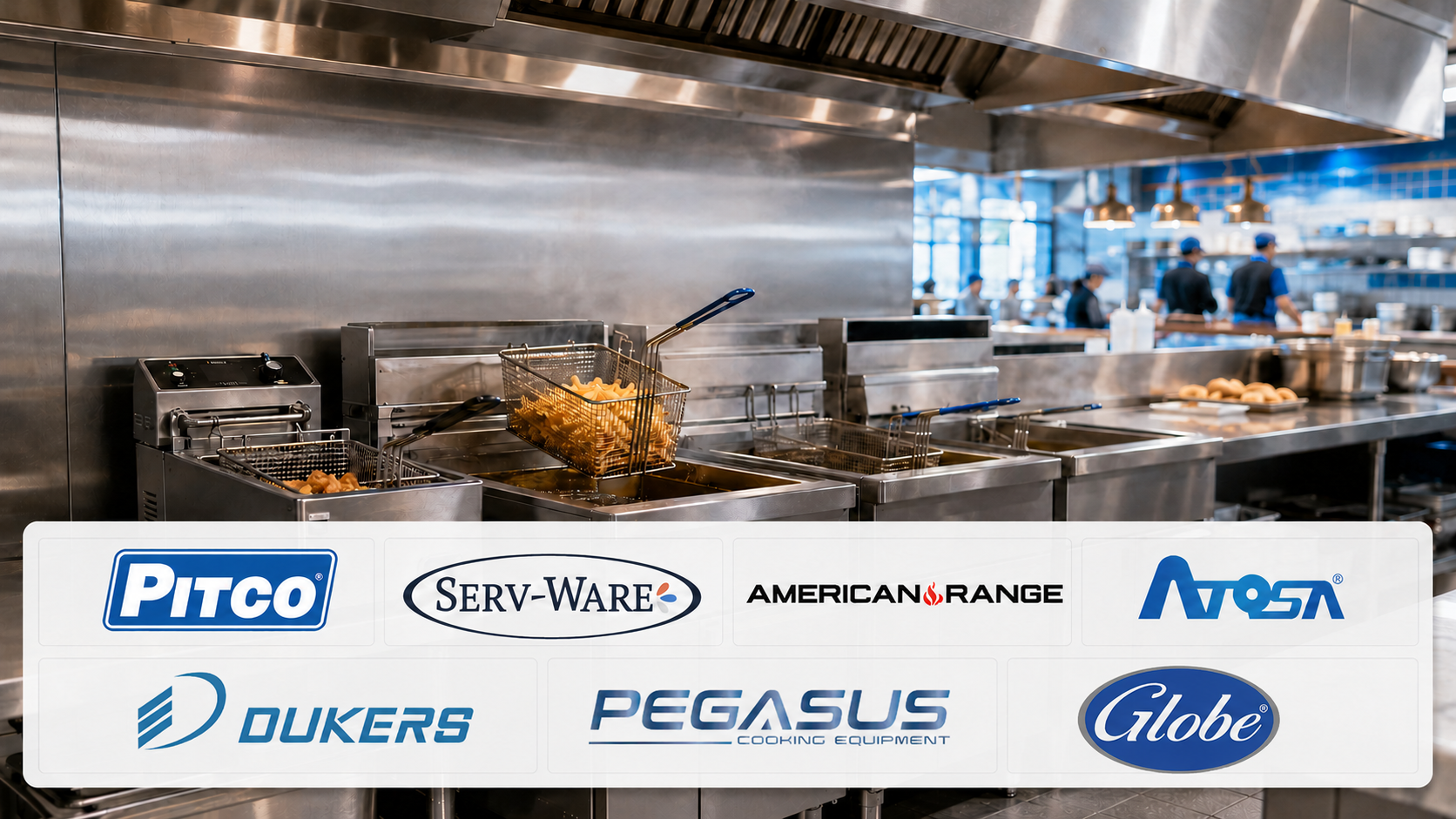
A commercial fryer can be one of the most productive pieces of equipment in a restaurant kitchen. It can also become one of the most expensive sources of wasted oil, inconsistent food, slow ticket times, and unnecessary maintenance when it is not properly matched to the operation.
So, what are the best commercial fryer brands for restaurants?
Based on equipment range, construction, heat recovery, oil management, cleaning access, available capacities, warranty coverage, and overall value, our top seven commercial fryer brands are:
- Pitco — Best Overall Commercial Fryer Brand
- Serv-Ware — Best Value for Everyday Restaurant Use
- American Range — Best Heavy-Duty Traditional Gas Fryer
- Atosa — Best Selection of Standard Fryer Capacities
- Dukers — Best Straightforward Gas Fryer
- Pegasus — Best Value for Commercial Electric Fryers
- Globe — Best for Countertop and Compact Frying
However, the best fryer brand is not automatically the best fryer for your restaurant.
A high-volume fried chicken restaurant needs a different frying system than a café adding french fries to its lunch menu. A seafood restaurant may need separate frypots, while a food truck may be limited by available space, propane capacity, ventilation, or electrical service.
This guide compares seven leading commercial fryer brands and explains how to choose the right brand, capacity, fuel type, and fryer configuration for your operation.
If you are ready to compare available models, explore Atlantic’s selection of commercial deep fryers for restaurants, bars, delis, food trucks, convenience stores, and other commercial food businesses.
Best Commercial Fryer Brands at a Glance
| Brand | Best for | Main fryer options | Primary advantage |
|---|---|---|---|
| Pitco | High-volume restaurants and demanding fry stations | Gas, electric, economy, high-efficiency and reduced-oil systems | Advanced fryer and oil-management technology |
| Serv-Ware | Independent restaurants seeking strong value | Gas floor fryers in multiple capacities | Practical construction at a competitive price |
| American Range | Busy traditional restaurant kitchens | Countertop, standard and high-capacity gas fryers | Heavy-duty design and effective heat transfer |
| Atosa | Restaurants needing standard capacity choices | Gas floor fryers and electric countertop fryers | Broad and straightforward selection |
| Dukers | Independent and medium-volume operations | Natural gas and liquid propane floor fryers | Simple operation and accessible frypot design |
| Pegasus | Restaurants that prefer electric equipment | Countertop and floor-model electric fryers | Flexible electric configurations |
| Globe | Compact kitchens and lighter frying demand | Gas and electric countertop fryers and gas floor fryers | Multiple space-saving formats |
How We Selected the Best Commercial Fryer Brands
This ranking is not based solely on brand popularity, BTU output, or initial price. We evaluated the factors that have the greatest effect on real restaurant operations:
- Heat recovery after food is added
- Oil capacity and usable frying area
- Production during peak service
- Gas and electric model availability
- Frypot and exterior construction
- Cold-zone design
- Oil filtration options
- Ease of draining and cleaning
- Temperature-control options
- Replacement parts and serviceability
- Warranty coverage
- Energy consumption
- Initial and long-term ownership costs
- Suitability for different restaurant concepts
A fryer with a higher BTU rating is not necessarily more productive than a lower-BTU model. Burner design, heating-element placement, frypot geometry, insulation, controls, oil volume, and basket loading all affect actual recovery and production.
For a deeper explanation of capacity, utilities, oil filtration, and fryer types, read Atlantic’s complete guide to choosing the best commercial fryer for your restaurant.
1. Pitco: Best Overall Commercial Fryer Brand

Pitco earns our best overall position because it serves nearly every level of commercial frying, from straightforward economy fryers to advanced high-efficiency fryer batteries with integrated oil management.

Pitco 35C+S Natural Gas 35-40 lb. Stainless Steel Floor Fryer
The brand is particularly well suited to restaurants where fried food represents a major portion of sales and the fryer must perform consistently through extended peak periods.
Why Pitco stands out
Pitco’s economy lineup includes models such as the 35C+S, which holds approximately 35 to 40 pounds of oil and uses a 90,000-BTU gas system. It provides an accessible starting point for restaurants that want a recognized commercial fryer without investing in a fully automated system.
Restaurants with greater production requirements can move into larger-capacity, Solstice, Solstice Supreme, electric, split-vat, filter-ready, or Reduced Oil Volume configurations.
Depending on the series and configuration, available features may include:
- Integrated oil filtration
- Automatic oil top-off
- Programmable cooking controls
- Split frypots
- Multiple fryers connected in a battery
- Reduced-oil-volume frypots
- High-efficiency burner systems
- Basket lifts
- Melt cycles
- Boil-out programs
- Drain safety controls
This range allows a restaurant to stay within the same brand as its business grows. An independent restaurant might begin with a conventional 35- to 40-pound fryer, while a high-volume quick-service operation may require multiple programmable fryers with centralized filtration.
Best for
- Quick-service restaurants
- Fried chicken concepts
- Seafood restaurants
- High-volume bars and sports venues
- Multi-unit restaurant groups
- Restaurants operating several fryers
- Kitchens prioritizing oil management
- Operations that may need to scale production
What to consider
Pitco’s premium equipment can require a significantly larger initial investment than a conventional mechanical fryer. Features such as automatic filtration, oil top-off, programmable controls, and basket lifts generate the most value when frying volume is high enough to produce measurable oil and labor savings.
Restaurants with moderate frying demand may be better served by an economy or standard gas model instead of an advanced fryer battery.
Atlantic currently offers models such as the Pitco 35C+S 35–40 lb. commercial gas fryer for restaurants seeking a traditional floor-fryer configuration.
Our verdict: Pitco is the strongest overall option for restaurants that depend heavily on fried food and want access to both conventional and advanced frying systems.
2. Serv-Ware: Best Value for Everyday Restaurant Use
Serv-Ware is a practical choice for independent restaurants that need reliable commercial frying capacity without paying for technology they may not use.

Serv-Ware SGF-40N 40 LB Deep Fryer, Natural Gas
Its fryers focus on familiar mechanical controls, common restaurant capacities, accessible components, and straightforward gas operation.
Why Serv-Ware stands out
The Serv-Ware SGF line includes 40-, 50-, and 70-pound gas fryers in natural gas and liquid propane configurations.
A standard 40-pound model uses three 30,000-BTU burners for a total input of 90,000 BTU per hour. The 50- and 70-pound models add burners and capacity for operations with heavier production.
Common features include:
- Temperature control from 200°F to 400°F
- Stainless steel fry tank
- Stainless steel front, top, header, and door
- Cold zone for collecting food sediment
- Full-port drain valve
- Double-rod basket hanger
- Adjustable stainless steel legs
- Natural gas and propane configurations
- Optional casters on qualifying models
The bottom cold zone helps separate crumbs and loose breading from the primary cooking area. When combined with proper skimming and filtration, this can slow the breakdown of oil and reduce flavor transfer from burned food particles.
Best for
- Independent restaurants
- Diners
- Delis
- Bars and pubs
- Takeout businesses
- Food trucks with approved gas systems
- Restaurants seeking a traditional floor fryer
- Operators prioritizing value and simple controls
What to consider
Serv-Ware fryers are designed primarily around conventional operation. Restaurants that require automatic filtration, programmable product controls, basket lifts, or centralized oil management may need a more advanced platform.
For growing food businesses, however, straightforward controls can also be an advantage. Employees may require less training, and the fryer can be easier to integrate into a traditional cookline.
Browse Serv-Ware commercial kitchen equipment available from Atlantic, including fryers and other essential cooking, refrigeration, prep, and storage equipment.
Our verdict: Serv-Ware offers one of the best combinations of price, capacity, and practical everyday operation for independent restaurants.
3. American Range: Best Heavy-Duty Traditional Gas Fryer
American Range is a strong choice for restaurants that prefer substantial construction, mechanical controls, and traditional tube-fired gas performance.

American Range AF-35/50 50 lb Gas Fryer - NG
Its fryer lineup covers compact countertop units, 25-pound models, standard floor fryers, high-capacity fryers, and high-efficiency configurations.
Why American Range stands out
American Range uses fryer tubes with internal deflectors and baffles designed to transfer and distribute heat through the tube walls. This supports consistent heating and recovery without relying on overly complicated controls.
Depending on the model, features may include:
- Stainless steel front and sides
- Heavy-gauge stainless steel fry tank
- Millivolt control system
- Automatic gas safety shutoff
- Thermostatic control from 200°F to 400°F
- Full-port drain valve
- Adjustable legs
- Optional casters
- Multiple frypot capacities
- High-efficiency configurations
The American Range AF-75, for example, provides a 75-pound oil capacity and an 18-by-18-inch frying area. This can be valuable for restaurants cooking larger products or producing multiple baskets continuously.
At the other end of the range, compact 25-pound fryers can support kitchens with limited production or menus where fried items are secondary.
Best for
- Full-service restaurants
- High-volume independent kitchens
- Fried chicken restaurants
- Seafood restaurants
- Restaurants needing a larger frying area
- Operators who prefer mechanical controls
- Kitchens already using American Range equipment
What to consider
Restaurants should compare both oil capacity and usable cooking area. Two fryers may have similar oil capacities but different basket arrangements, cooking surfaces, recovery characteristics, and external dimensions.
Gas-line capacity must also be verified. Installing a high-output fryer on an undersized gas line can prevent the equipment from operating as intended.
Explore Atlantic’s selection of American Range commercial cooking equipment, including fryers, ranges, griddles, broilers, and ovens.
Our verdict: American Range is one of the best choices for restaurants seeking a traditional, heavy-duty commercial gas fryer.
4. Atosa: Best Selection of Standard Fryer Capacities
Atosa provides a straightforward path through several common commercial fryer sizes. Its gas-fryer lineup covers approximately 35-, 40-, 50-, and 75-pound capacities, while countertop electric models support smaller kitchens and limited frying applications.

Atosa CookRite ATFS-40 HD 40 LB Stainless Steel Deep Fryer - NG
This variety helps operators match the fryer to expected production instead of purchasing more capacity than necessary.
Why Atosa stands out
Common Atosa gas-fryer features include:
- Stainless steel exterior and interior
- Welded stainless steel fry tank
- Heavy-duty burners
- Thermostatic temperature control
- Operating range from 200°F to 400°F
- Bottom cold zone
- High-temperature limit protection
- Twin nickel-plated baskets
- Basket hanger
- Natural gas and liquid propane options
Atosa also offers portable fryer-filter systems. A portable filter can be a practical addition for restaurants operating multiple conventional fryers without built-in filtration.
Instead of manually moving oil over long distances, the filter can be positioned near the fryer drain, subject to the manufacturer’s instructions and the restaurant’s safety procedures.
Best for
- Casual restaurants
- Diners
- Bars and taverns
- Asian restaurants
- Seafood restaurants
- Cafés
- Restaurants needing common capacity choices
- Kitchens planning to add portable filtration
What to consider
Atosa’s standard gas fryers are conventional models rather than highly automated frying systems. Restaurants with heavy oil usage should compare the cost of a portable filter against a fryer with factory-integrated filtration.
Browse Atosa commercial kitchen equipment available from Atlantic, including cooking, refrigeration, prep, and related foodservice equipment.
Our verdict: Atosa is a versatile option for restaurants that want familiar controls and several commonly requested fryer capacities.
5. Dukers: Best Straightforward Gas Fryer
Dukers offers gas floor fryers built around practical commercial features, standard capacity levels, and relatively simple operation.

Dukers DCF3-NG Natural Gas Fryer with 3 Tube Burners
Its lineup includes three-, four-, and five-burner configurations in natural gas and liquid propane versions.
Why Dukers stands out
The Dukers DCF3 is a 40-pound floor fryer with three 30,000-BTU tube burners, producing a total input of 90,000 BTU per hour.
Typical features include:
- Temperature range from 200°F to 400°F
- Millivolt safety-control system
- Tube-style cast-iron burners
- Large bottom cold zone
- Forward-sloping frypot bottom
- Accessible frypot surfaces
- Natural gas and propane configurations
- Temperature probe for burner response
The forward-sloping bottom helps direct crumbs and sediment toward the lower part of the frypot. This can simplify cleaning and reduce the amount of loose material remaining around the cooking area.
The design is particularly suitable for operators who want traditional gas performance without digital programming or complicated oil-management controls.
Best for
- Independent restaurants
- Delis
- Takeout businesses
- Medium-volume bars
- Small fried-food concepts
- Restaurants seeking a standard 40-pound fryer
- Operators prioritizing accessible manual cleaning
What to consider
Dukers does not provide the same level of automated oil management found in premium fryer systems. Before purchasing, operators should confirm local service access, replacement parts availability, warranty terms, and approved installation requirements.
View Dukers commercial cooking equipment available through Atlantic.
Our verdict: Dukers is a sensible option for independent restaurants seeking an uncomplicated commercial gas fryer.
6. Pegasus: Best Value for Commercial Electric Fryers

Pegasus stands out for restaurants interested in electric frying. Its lineup includes compact countertop units as well as larger 40-, 50-, and 75-pound electric floor fryers.

Pegasus FR-40E Electrical Fryer - 40lb
This gives operators more electric options than brands that limit their electric lineup to small countertop equipment.
Why Pegasus stands out
The Pegasus FR-40E uses a 40-pound frypot and a 14-kW heating system. Its lift-up heating element improves access to the frypot during cleaning, while the bottom drain valve supports controlled oil removal.
Depending on the model, features may include:
- Stainless steel construction
- Thermostatic temperature control
- Lift-up heating element
- Bottom oil-drain valve
- Overheat-protection thermostat
- Stainless steel frypot
- Included fry baskets
- Countertop configurations
- Multiple floor-model capacities
- Compatible single- or three-phase configurations
Electric fryers apply heat directly through elements located in or near the oil. This can provide efficient heat transfer and stable temperature control when the fryer is properly sized for the kitchen’s demand.
Best for
- All-electric commercial kitchens
- Ghost kitchens
- Cafés
- Food halls
- Compact restaurant kitchens
- Locations without gas service
- Restaurants needing countertop frying
- Businesses planning around electric cooking equipment
What to consider
Electrical compatibility must be confirmed before ordering. Commercial electric fryers may require 208 or 240 volts, high amperage, and either single- or three-phase service.
A fryer described as field-convertible still needs to be configured and installed by a qualified professional. The building’s electrical panel, breaker capacity, wiring, receptacle, and disconnect requirements must all support the chosen model.
Explore Pegasus commercial cooking equipment, including countertop and floor-model electric fryers.
Our verdict: Pegasus is one of the strongest value-focused options for restaurants that specifically need commercial electric frying equipment.
7. Globe: Best for Countertop and Compact Frying
Globe offers one of the most flexible fryer lineups for restaurants with limited space or moderate production.

Globe PF16E 16 lb. Countertop Electric Fryer
Its range includes electric countertop fryers, gas countertop fryers, and full-size gas floor fryers. This makes Globe especially useful for businesses adding fried foods to an existing menu rather than building the entire kitchen around frying.
Why Globe stands out
Globe’s electric countertop fryers are available in several sizes, including approximately 10-, 16-, and 32-pound oil capacities.
Its gas countertop options include 15- and 30-pound models. For restaurants requiring greater production, Globe also offers gas floor fryers in approximately 35-, 50-, and 80-pound capacities.
Depending on the model, features may include:
- Gas and electric countertop options
- Natural gas and propane configurations
- Stainless steel construction
- High-limit safety protection
- Removable electric elements
- Cold zones on floor models
- Drain valves
- Insulated basket handles
- Multiple capacity choices
This product range gives operators the ability to select a fryer according to both production and available space.
Best for
- Cafés
- Food trucks
- Concession stands
- Convenience stores
- Small restaurants
- Bars with limited fried-food menus
- Kitchens adding appetizers or side dishes
- Operations with limited floor space
What to consider
Some Globe and Chefmate electric fryers are designed for entry-level or lighter-duty production. A countertop model should not be expected to replace a full-size floor fryer during continuous peak-hour service.
Before choosing a countertop fryer, compare its stated production with the number of fried orders required during your busiest 60-minute period.
Browse Globe commercial kitchen equipment available from Atlantic.
Our verdict: Globe is one of the best choices for compact kitchens and businesses that need both countertop and floor-fryer options.
Which Commercial Fryer Brand Is Best for Your Restaurant?
The right brand depends on how important fried food is to your menu, how much you produce during peak service, and which utilities are available.
| Restaurant type or priority | Recommended brand |
|---|---|
| High-volume quick-service restaurant | Pitco |
| Fried chicken restaurant | Pitco or American Range |
| Seafood restaurant | Pitco, American Range or Atosa |
| Independent full-service restaurant | Serv-Ware or Atosa |
| Value-focused startup restaurant | Serv-Ware or Dukers |
| All-electric commercial kitchen | Pegasus |
| Café or convenience store | Globe |
| Food truck | Globe, Serv-Ware or Pegasus, depending on utilities |
| Restaurant needing several standard capacities | Atosa |
| Kitchen prioritizing advanced oil management | Pitco |
| Restaurant preferring mechanical controls | Serv-Ware, American Range or Dukers |
These recommendations are starting points. The final model should be selected according to menu, batch weight, peak-hour demand, installation space, oil-management plan, ventilation, and available gas or electrical service.
Restaurant owners planning an entire kitchen—not just a fry station—can use Atlantic’s restaurant equipment list and kitchen checklist to coordinate cooking, refrigeration, preparation, warewashing, and storage equipment.
Gas vs. Electric Commercial Fryers
Neither gas nor electric is automatically better for every restaurant.
Choose a gas fryer when:
- The building already has sufficient gas service
- Fried food is produced continuously
- A traditional floor fryer fits the cookline
- Local gas costs are favorable
- The ventilation system is designed for gas cooking equipment
- The operation prefers familiar mechanical controls
Choose an electric fryer when:
- Gas service is unavailable
- The kitchen is being designed around electric equipment
- Countertop frying is sufficient
- Stable temperature control is a priority
- The electrical panel can support the required voltage and amperage
- Local building or sustainability plans favor electrification
Electric fryers transfer heat through elements located directly in or near the oil. Gas fryers use burners beneath or through the frypot. Actual performance depends on the individual fryer design, not simply the fuel source.
When planning the complete cookline, compare fryers alongside Atlantic’s broader selection of commercial cooking equipment.
What Size Commercial Fryer Does Your Restaurant Need?
Oil capacity is not the same as hourly food output, but it provides a useful starting point.
| Oil capacity | Typical application |
|---|---|
| 10–20 lb. | Café, concession stand, food truck or limited appetizer menu |
| 25–40 lb. | Deli, bar, takeout operation or small restaurant |
| 40–50 lb. | Full-service restaurant or moderately busy fry station |
| 50–75 lb. | High-volume restaurant, seafood or chicken concept |
| 75 lb. and above | Continuous high-volume or large-batch production |
The correct way to size a fryer is to estimate demand during the busiest hour—not daily average volume.
For example, a restaurant selling 150 fried orders per day may appear to have moderate demand. But if 60 of those orders arrive between 7:00 and 8:00 p.m., the fryer must be sized around that peak-hour requirement.
Signs a fryer may be undersized
- Oil temperature falls sharply after every basket
- Cook times increase during busy periods
- Food becomes greasy or pale
- Employees overload baskets to catch up
- Fried items delay the rest of the ticket
- The fryer never has time to recover
Signs a fryer may be oversized
- A large volume of oil is maintained for limited production
- The fryer occupies unnecessary cookline space
- Oil remains in the vat too long before being replenished
- Energy is used to keep excess oil hot
- The restaurant paid for capacity it rarely uses
In some kitchens, two smaller fryers may be more useful than one large fryer. Separate vats can provide greater menu flexibility, improve peak-hour workflow, and reduce flavor transfer.
Why Recovery Is More Important Than BTU Alone
Recovery is the fryer’s ability to return to its set temperature after cold or frozen food is added.
When recovery is slow, the food remains in lower-temperature oil for too long. This can produce greasy texture, light color, weak crust formation, and longer ticket times.
A higher BTU or kilowatt rating may help, but it does not provide the complete answer. Recovery also depends on:
- Heat-transfer design
- Frypot geometry
- Heating-element placement
- Burner configuration
- Oil volume
- Insulation
- Temperature controls
- Basket load
- Product temperature
- Moisture content
Operators should compare rated production, cooking area, recovery design, and efficiency—not simply choose the highest BTU number.
The U.S. Department of Energy’s ENERGY STAR program reports that qualifying commercial gas fryers can be approximately 30% more energy efficient than standard models, while qualifying standard-vat electric fryers can be approximately 17% more efficient. Review the official ENERGY STAR commercial fryer guidance when energy use is a major purchasing consideration.
Oil Management Can Cost More Than the Fryer
The purchase price is only one part of fryer ownership. Cooking oil can exceed the original equipment cost many times over during the fryer’s service life.
Oil degrades faster when it is exposed to:
- Excessive heat
- Food particles and breading
- Salt
- Moisture
- Oxygen
- Cleaning chemical residue
- Long idle periods at full temperature
- Infrequent filtration
- Poorly calibrated controls
A lower-priced fryer that shortens oil life may become more expensive than a premium fryer with better filtration and temperature management.
Restaurants with heavy frying volume should compare:
- Built-in filtration
- Portable filtration compatibility
- Cold-zone size
- Automatic oil top-off
- Reduced-oil-volume designs
- Drain accessibility
- Frypot cleaning access
- Programmable idle modes
- Oil-quality monitoring procedures
For help choosing the correct oil for your food and operating temperature, see Atlantic’s guide to the best oil for commercial frying.
You can also compare commonly used oils in Atlantic’s cooking oil smoke point guide.
Commercial Fryer Features Worth Paying For
Not every restaurant needs every feature. The best investment depends on how often the fryer is used and how much labor and oil the feature can save.
Built-in oil filtration
Built-in filtration can reduce manual oil handling and encourage more frequent filtering. It is most valuable in operations that filter several times per day or run multiple fryers.
Large cold zone
A cold zone collects food particles beneath the main cooking area. It is particularly valuable when frying breaded chicken, fish, onion rings, mozzarella sticks, and other products that release crumbs.
Programmable controls
Product buttons and timers improve consistency across shifts. They can be useful in quick-service restaurants, multi-unit concepts, and kitchens with frequent employee turnover.
Split frypot
A split frypot provides two separately controlled oil zones. It may be used for lower-volume production, different cooking temperatures, or foods that should not share the same oil.
A split vat does not automatically make a kitchen allergen-safe. Dedicated equipment, ingredients, utensils, handling procedures, and employee training may all be necessary.
Automatic oil top-off
Automatic top-off maintains a more consistent oil level and reduces variation between employees and shifts.
Basket lifts
Automatic basket lifts can improve cook-time consistency and reduce the chance that products remain in the oil longer than intended.
Melt cycle
A melt cycle gradually heats solid shortening rather than applying full heat immediately. This helps protect both the shortening and heating components.
Easy-access drain and frypot
For many independent restaurants, a large drain and accessible frypot may provide more everyday value than advanced digital controls. Faster cleaning means less labor and a greater likelihood that employees will follow the correct maintenance schedule.
Fryer Safety and Installation Considerations
A commercial fryer involves hot oil, high surface temperatures, gas or high-amperage electrical connections, and potentially heavy oil containers. Installation and employee procedures must be treated seriously.
OSHA notes that restaurant employees can be burned by contact with the fryer, splashing oil, straining hot oil, cleaning the unit, or moving fryer equipment. Its official restaurant fryer safety guidance recommends appropriate protective equipment, safe handling tools, slip-resistant practices, and allowing oil to cool before disposal or filtration when required by the procedure.
Before ordering a fryer, confirm:
- Hood and ventilation capacity
- Fire-suppression coverage
- Required clearances
- Gas type and gas-line capacity
- Electrical voltage, phase, and amperage
- Available floor or counter space
- Drain and oil-handling procedures
- Local health and fire-code requirements
- Access for cleaning and servicing
- Delivery-path dimensions
The fryer should be installed by qualified professionals in accordance with the manufacturer’s instructions and applicable local codes.
Cleaning, Food Safety, and Cross-Contact
The best fryer will still perform poorly if the oil, baskets, frypot, drain, and surrounding cooking area are not maintained.
The FDA Food Code identifies contaminated equipment as one of the major foodborne-illness risk factors in retail and foodservice operations. Restaurant owners should use the current FDA Food Code together with state and local requirements when developing cleaning and food-safety procedures.
A basic fryer-maintenance routine should include:
During service
- Skim loose crumbs regularly
- Avoid overloading baskets
- Monitor cooking temperature
- Keep salt and seasoning away from the oil
- Remove unusually wet or icy product buildup
- Keep the floor surrounding the fryer dry
At the end of the shift
- Filter the oil according to the restaurant’s schedule
- Clean baskets and basket hangers
- Wipe exterior surfaces
- Check the drain area
- Remove accumulated food particles
- Inspect oil for color, odor, foaming, or smoke
On a scheduled basis
- Perform the approved boil-out procedure
- Verify thermostat accuracy
- Inspect burners or heating elements
- Check safety controls
- Examine the frypot for leaks or damage
- Clean the ventilation area according to the approved schedule
- Arrange professional service when required
If seafood, dairy, wheat, peanuts, or other major allergens are fried in shared oil, operators should not describe other foods from that fryer as allergen-free. Cross-contact procedures should be developed according to the menu and local food-safety requirements.

