

Opening a bagel shop requires more than a good bagel recipe. You need a concept that fits the local market, a kitchen designed around the production process, equipment that can survive dense bagel dough, and enough working capital to carry the business through its opening months.
A small bagel operation working from a shared commercial kitchen may be launched for less than $75,000. A brick-and-mortar shop producing bagels from scratch will more commonly require $100,000 to $500,000 or more, depending on the location, construction, production volume, and condition of the building.
The most important decisions should be made before signing a lease. This guide walks through the complete process, from selecting a business model and calculating production capacity to choosing equipment, securing permits, building a menu, and preparing for opening day.
1. Choose Your Bagel Shop Business Model
Your business model determines your space, staffing, menu, equipment, and startup budget. Decide how the bagels will be produced and how customers will buy them before looking at locations.
Traditional Bagel Shop
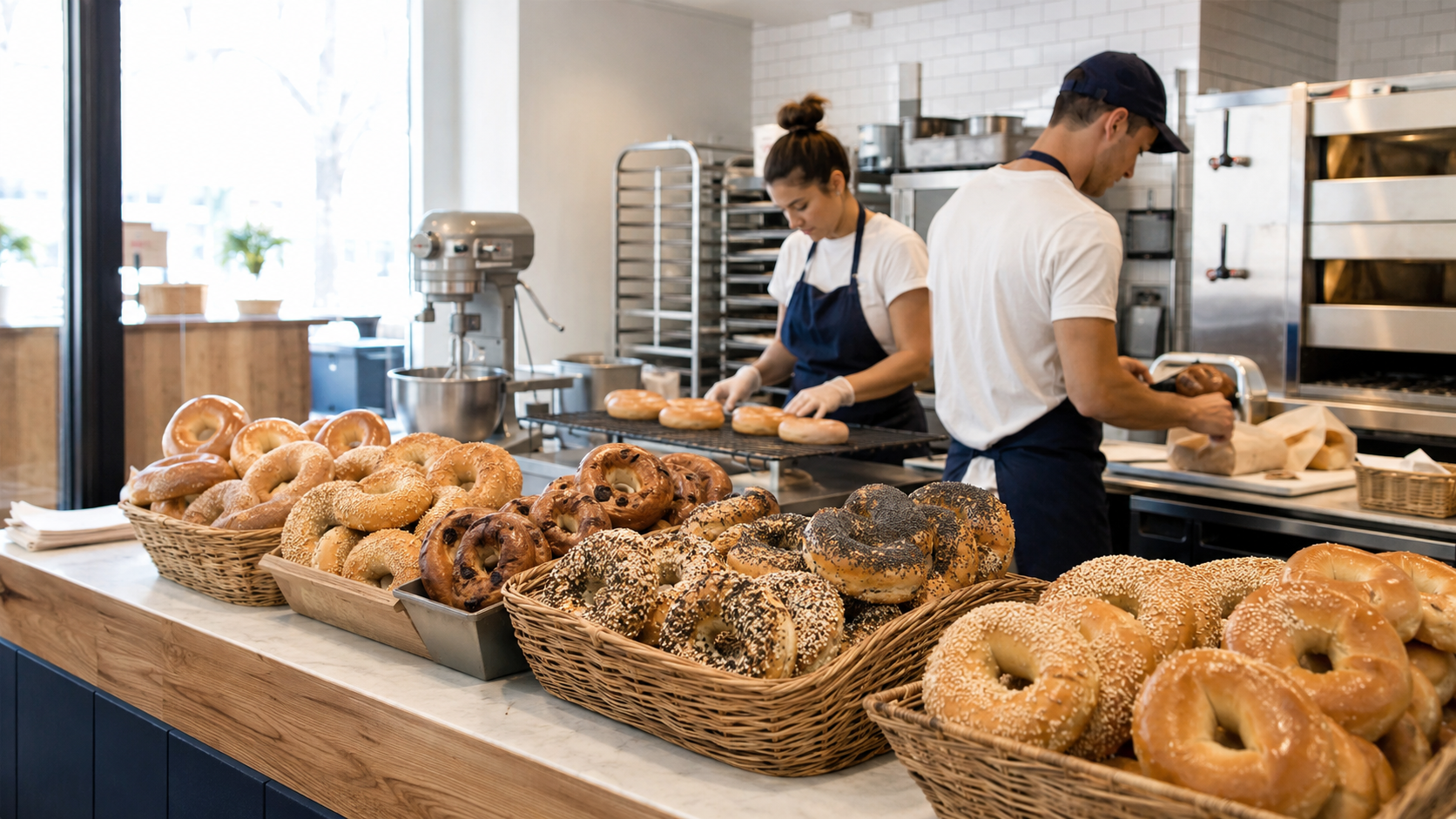
A traditional shop mixes, forms, proofs, boils, and bakes bagels on-site. Customers can purchase individual bagels, cream cheese, breakfast sandwiches, coffee, and bagels by the dozen.
This model provides the greatest control over freshness and product identity, but it also requires the most production equipment and skilled labor.
Bagel Café
A bagel café combines bagel production with a larger breakfast and lunch menu. It may serve eggs, breakfast meats, deli sandwiches, salads, specialty coffee, juices, and pastries.
The larger menu can increase the average transaction, but it also creates a more complex kitchen. You may need a griddle, range, fryer, sandwich prep station, additional refrigeration, dishwashing capacity, and more employees.
Bake-Off Bagel Shop
A bake-off operation purchases shaped frozen or refrigerated bagels and bakes them in the store. Some products may arrive fully baked and only require reheating.
This model reduces labor, production space, and specialized equipment. However, it provides less control over the recipe and may make it more difficult to build a reputation around an authentic house-made bagel.
Commissary and Retail Model
In this model, bagels are produced at a central commissary and delivered to one or more retail locations. The retail shops may bake, finish, toast, or assemble the products.
Centralized production can make future expansion easier, but delivery schedules, cold storage, transportation, and product consistency must be carefully managed.
Wholesale Bagel Bakery
A wholesale bakery produces bagels for cafés, hotels, grocery stores, delis, and other restaurants. It may have no customer-facing storefront at all.
Wholesale production requires higher-capacity mixers, forming equipment, ovens, racks, packaging systems, and storage. Profit per bagel may be lower than retail, so volume and production efficiency become critical.
Pop-Up or Shared-Kitchen Operation
A new business can test its concept through farmers markets, pop-ups, preorders, catering, or delivery while producing from a licensed shared commercial kitchen.
This is one of the least expensive ways to validate demand before committing to a long-term lease. The downside is limited scheduling control, transportation, storage, and production capacity.
2. Study Your Market and Customers
Market research should answer a specific question: Can this location generate enough profitable transactions during the hours when customers typically buy bagels?
Use the U.S. Census Bureau’s Census Business Builder to study population, income, employment, business activity, and local demographics. Then combine that data with in-person observation.
Evaluate:
- Residential and daytime population
- Morning pedestrian and vehicle traffic
- Nearby offices, schools, hospitals and transit stations
- Weekend versus weekday demand
- Parking and pickup convenience
- Delivery radius
- Existing bagel shops, cafés and breakfast restaurants
- Competitor prices, menus and customer reviews
- Gaps in the local market
- Planned residential or commercial development
Visit competing businesses during their morning rush. Count customers, observe wait times, review their menu structure, and note what customers praise or criticize online.
Your goal is not necessarily to find an area with no competition. An active breakfast market can be a positive sign. You need to identify how your shop will provide a better or meaningfully different experience.
That difference might be:
- Traditional kettle-boiled bagels
- Hand-rolled or sourdough bagels
- Montreal-style bagels
- Premium smoked fish and deli sandwiches
- Fast online pickup
- Strong coffee and espresso
- Creative cream cheese flavors
- Office catering and bagel boxes
- Vegan or allergy-conscious options
- Late-morning and lunch service
3. Build a Focused, Profitable Menu
A bagel shop menu should be broad enough to increase the average ticket but focused enough to maintain fast service and manageable inventory.
A practical opening menu might include:
- 8 to 12 core bagel varieties
- 4 to 6 cream cheese flavors
- Butter, jam and other simple spreads
- 5 to 8 breakfast sandwiches
- 4 to 6 lunch sandwiches
- Coffee, cold brew and bottled beverages
- Bagels by the half-dozen and dozen
- Catering boxes and sandwich platters
Start with fewer items than you ultimately expect to offer. Every additional menu item can require new ingredients, refrigeration space, prep labor, equipment, packaging, and employee training.
Build Around Cross-Utilization
Select ingredients that can be used across several menu items. Eggs, bacon, avocado, tomato, onions, cheese, smoked salmon, turkey, and greens can support multiple breakfast and lunch products without creating excessive inventory.
Use High-Value Attachments
A single bagel may create a low transaction value. Cream cheese, coffee, breakfast sandwiches, bottled beverages, and catering can turn the same customer visit into a much stronger sale.
Create combinations such as:
- Bagel, spread and coffee
- Breakfast sandwich and cold brew
- Half-dozen bagels with two spreads
- Office breakfast box
- Smoked salmon platter
- Baker’s dozen package
Cost Every Recipe
Do not price products based only on competitors. Calculate the cost of each ingredient, including toppings, cooking loss, packaging and portion size.
For each menu item, record:
- Ingredient quantity
- Cost per unit
- Total recipe cost
- Packaging cost
- Selling price
- Contribution margin
Review these costs whenever supplier prices or portions change.
4. Write a Bagel Shop Business Plan
A business plan turns your concept into measurable assumptions. It is also commonly required when applying for financing or presenting the business to investors.
The U.S. Small Business Administration provides templates for both traditional and lean business plans.
Your bagel shop business plan should cover:
- Concept and brand positioning
- Target customers
- Local market and competitor analysis
- Menu and pricing
- Production method
- Sales channels
- Location requirements
- Management and staffing
- Marketing plan
- Startup budget
- Sales forecast
- Monthly operating expenses
- Cash-flow projection
- Break-even analysis
- Funding requirements
- Expansion opportunities
Prepare conservative, expected, and optimistic sales projections. A business should be able to survive even if the first several months are slower than expected.
5. Calculate Your Bagel Shop Startup Costs
The cost to open a bagel shop varies widely. Construction and utility upgrades frequently cost more than the visible equipment.
These figures are broad planning ranges, not contractor or equipment quotes:
| Bagel shop model | Estimated planning range |
|---|---|
| Pop-up or shared commercial kitchen | $20,000–$75,000 |
| Small shop in a suitable second-generation space | $100,000–$250,000 |
| Full in-house bagel shop and café | $250,000–$500,000+ |
| High-volume retail and wholesale bakery | $350,000–$750,000+ |
A second-generation restaurant space already equipped with sufficient electrical power, gas, plumbing, drainage, ventilation, and foodservice-approved surfaces may substantially reduce construction costs. An empty retail space may require expensive upgrades before the first piece of equipment is installed.
Sample Startup Budget
| Expense | General planning range |
|---|---|
| Lease deposit and initial rent | $10,000–$30,000+ |
| Architect, engineer and professional fees | $10,000–$40,000+ |
| Permits and plan review | $3,000–$15,000+ |
| Construction and utility upgrades | $50,000–$250,000+ |
| Production and cooking equipment | $30,000–$150,000+ |
| Refrigeration and food preparation equipment | $15,000–$75,000+ |
| Furniture, décor and signage | $10,000–$50,000+ |
| POS, online ordering and technology | $3,000–$15,000 |
| Smallwares and opening inventory | $8,000–$25,000 |
| Pre-opening payroll and training | $10,000–$35,000+ |
| Launch marketing | $3,000–$20,000 |
| Working capital | $40,000–$150,000+ |
Add a construction contingency of at least 10% to 15%. Older buildings can reveal plumbing, electrical, structural, fire-safety, or ventilation issues after work begins.
The SBA provides a useful startup cost worksheet for separating one-time investments from monthly expenses.
6. Calculate Your Break-Even Point
Your break-even calculation estimates how many transactions the business needs to cover its expenses.
The basic formula is:
Monthly fixed costs ÷ contribution per transaction = monthly break-even transactions
Suppose your shop has:
- Average transaction: $12
- Food, packaging and other variable costs: 35%
- Contribution per transaction: $7.80
- Monthly fixed expenses: $45,000
The calculation would be:
$45,000 ÷ $7.80 = approximately 5,770 transactions per month
If the shop opens 30 days per month, it would need approximately 192 transactions per day to break even.
This is only an example. Replace each number with your actual rent, payroll, utilities, debt payments, menu prices, fees and product costs. The SBA break-even calculator can help organize the calculation.
7. Find the Right Location
A beautiful storefront cannot compensate for inadequate utilities or poor morning access. Evaluate both customer demand and the physical capability of the building.
Customer-Facing Considerations
Look for:
- Visibility during the morning commute
- Easy entry and exit
- Short-term parking
- Online-order pickup access
- Delivery-driver access
- Nearby employers and residences
- Exterior signage opportunities
- Sufficient morning traffic
- Rent that works with conservative sales
Technical Considerations
Before signing a lease, confirm:
- Zoning permits the intended use
- The certificate of occupancy is suitable
- Available gas service and pressure
- Electrical voltage, phase and amperage
- Water supply and water-heater capacity
- Floor drains and waste lines
- Grease interceptor requirements
- Hood and fire-suppression requirements
- HVAC and make-up air capacity
- Roof access for exhaust or refrigeration equipment
- Space for refrigeration and dry storage
- Accessibility requirements
- Trash, recycling and grease removal
- Delivery access
- Whether proposed equipment can physically enter the building
Have an architect, engineer, contractor and local authorities review the location before the lease becomes unconditional. Whenever possible, negotiate contingencies for permits, zoning, financing, and plan approval.
8. Design the Bagel Production Workflow
Traditional bagel production usually follows this sequence:
- Receive and store ingredients
- Measure ingredients
- Mix the dough
- Divide and form bagels
- Proof or cold-ferment the dough
- Boil the bagels
- Add toppings
- Load the oven
- Bake and cool
- Display, slice or package
- Assemble sandwiches
- Serve or stage orders
The physical layout should follow the same direction. Employees should not repeatedly carry heavy dough, hot bagels, or sheet pans across customer service and dishwashing paths.
A practical kitchen may include these zones:
- Dry ingredient storage
- Mixing and dough production
- Forming and proofing
- Retarded or refrigerated dough storage
- Boiling and topping
- Baking
- Cooling racks
- Bagel display
- Sandwich preparation
- Coffee and beverage service
- Warewashing and sanitation
Leave adequate aisle space around hot equipment, racks, doors and worktables. Account for sheet-pan movement, not just the external dimensions of the machines.
9. Determine Your Required Production Capacity
Do not select equipment based only on the number of bagels you expect to sell per day. Design for the busiest hour.
Suppose you expect:
- 80 transactions during the busiest hour
- An average of 1.4 bagels per transaction
- 20% additional capacity for catering, waste and unexpected demand
Your required hourly output would be:
80 × 1.4 × 1.20 = approximately 135 bagels per hour
Every part of the production line must support that target:
- The mixer must produce enough dough per batch.
- The forming process must keep pace with production.
- Refrigeration must hold the required dough.
- The kettle must process enough bagels per cycle.
- The oven must bake enough bagels per hour.
- Cooling racks must hold finished batches.
- Employees must be able to top, load and unload without creating a bottleneck.
An oven that holds 72 bagels and completes four cycles per hour has a theoretical capacity of 288 bagels per hour. Real production will be lower after loading, unloading, product changes, cleaning and human delays are considered.
Plan approximately 15% to 25% more capacity than your projected requirement rather than designing a system that only works under perfect conditions.
10. Bagel Shop Equipment List
The exact equipment depends on whether you produce bagels from scratch and how much breakfast, lunch, coffee, and catering business you plan to serve.
Atlantic’s commercial bakery equipment collection can be used as a starting point when planning the production line.
Dough Production Equipment
Spiral Mixer
Bagel dough is dense and places substantial stress on a mixer. A spiral mixer is often better suited to repeated production of stiff dough than a general-purpose planetary mixer.
Confirm:
- Maximum dough capacity, not just bowl volume
- Whether the rating applies to low-hydration dough
- Motor power and duty cycle
- Single- or three-phase electrical requirements
- Available mixing speeds
- Bowl clearance and loading height
- Local parts and service availability
Never assume that a mixer can handle bagel dough simply because the batch fits inside its bowl.
Dough Divider and Former
Small shops can divide and roll bagels by hand. Higher-volume operations may use a divider, former, or automated production line to improve consistency and reduce labor.
Automation becomes more valuable when hand-forming limits output during production or creates unacceptable variations in weight and size.
Scales and Ingredient Storage
Use accurate commercial scales to standardize dough and portion weights. Sealed ingredient bins protect flour, salt, sugar, malt and toppings while helping employees work efficiently.
Proofing and Cold Fermentation
Depending on the recipe, you may need:
- Proofing cabinet
- Retarder or retarder-proofer
- Reach-in refrigerator
- Roll-in refrigerator
- Walk-in cooler
- Sheet pans
- Proofing boards
- Pan racks and rack covers
Measure refrigeration capacity by the number of racks or trays required at peak production, not only by cubic feet.
Bagel Kettle or Boiling Station

Boiling develops the shiny surface and chewy crust associated with traditional bagels. Small operations may use large stockpots on a commercial range, while higher-volume shops may need a dedicated bagel kettle.
Consider:
- Hourly throughput
- Gas or electrical requirements
- Water fill and drainage
- Employee protection from steam and hot water
- Ventilation requirements
- Distance to the topping and oven stations
- Cleaning access
Confirm hood and fire-code requirements with local authorities before selecting the boiling equipment.
Commercial Oven
The oven determines product character as well as production capacity.
Common options include:
- Deck ovens: Provide strong bottom heat and can create an artisan-style crust.
- Convection ovens: Flexible and relatively compact, but the final texture can differ from that of a traditional bagel oven.
- Rack ovens: Suitable for high-volume production and easy rack loading.
- Revolving ovens: Common in traditional bagel operations and compatible with bagel boards.
- Combi ovens: Offer programmable humidity and flexibility for broader menus.
Compare models in Atlantic’s commercial oven collection, but select the oven only after testing the product and confirming utilities, ventilation, clearance, and capacity.
Refrigeration Equipment
A bagel café may require:
- Reach-in refrigerator
- Reach-in freezer
- Walk-in cooler
- Undercounter refrigerator
- Sandwich prep table
- Refrigerated display case
- Milk refrigerator
- Cold storage for smoked fish and cream cheese
Eggs, cream cheese, smoked salmon, deli meat and prepared sandwich ingredients require dependable temperature control. Do not use a display refrigerator as a substitute for production storage unless it is designed and approved for that use.
Sandwich and Breakfast Equipment
If the menu includes hot breakfast sandwiches, consider:
- Commercial griddle
- Range
- Egg station
- Cheese melter
- Panini press
- Conveyor or pop-up toaster
- Commercial microwave
- Sandwich prep refrigerator
- Food processor
- Approved slicer
- Hot holding equipment
The menu should determine the equipment. Avoid adding cooking equipment without confirming whether it triggers additional hood, fire suppression, gas, grease or electrical requirements.
Display and Front-of-House Equipment
Fresh bagels should be visible without disrupting service. Depending on the menu, you may need:
- Dry bakery display case
- Refrigerated deli or bakery case
- Bagel baskets and trays
- Menu boards
- POS terminals
- Online-order staging shelves
- Cup and lid dispensers
- Packaging and pickup station
Use refrigerated cases for products that require temperature control. Dry display baskets should be protected from customers and contamination as required by local code.
Coffee and Beverage Equipment
Coffee can increase both transaction value and repeat morning visits. A beverage station may include:
- Commercial coffee brewer
- Coffee grinders
- Espresso machine
- Hot-water dispenser
- Ice machine
- Water filtration
- Undercounter refrigerator
- Cup, lid and condiment organizers
- Cold brew system
- Bottled beverage merchandiser
Confirm water quality and filtration requirements before installing coffee, ice, steam or combi equipment.
Warewashing and Sanitation
Typical requirements may include:
- Three-compartment sink
- Handwashing sinks
- Mop or service sink
- Commercial dishwasher
- Drainboards
- Sanitizer test strips
- Shelving
- Waste containers
- Cleaning chemical storage
- Floor drains
Exact requirements vary by jurisdiction and menu. Include sanitation equipment in the initial plan rather than trying to fit it into leftover space.
11. Register the Business and Obtain Permits
Requirements vary by state, county, and municipality. Begin with your local health department, zoning department, building department, and fire authority.
Common registrations and approvals include:
- Business entity registration
- Employer Identification Number
- State and local tax registration
- Foodservice establishment permit
- Health department plan review
- Building and construction permits
- Zoning approval
- Certificate of occupancy
- Fire department inspection
- Hood and fire-suppression approval
- Sign permit
- Food protection manager certification
- Employee food-handler training
- Workers’ compensation coverage
- Unemployment insurance registration
- General and product liability insurance
- Outdoor seating permit, if applicable
- Music licensing, if copyrighted music is played publicly
The IRS allows eligible businesses to apply for an Employer Identification Number directly and without a fee. The SBA also explains how licenses and permits differ by location and activity.
Do not purchase major equipment or begin construction until the proposed plans have been reviewed by the appropriate professionals and authorities.
12. Create a Food Safety and Allergen Plan
Bagels themselves may be relatively low risk after baking, but a bagel shop commonly handles eggs, dairy, meat, smoked fish and prepared vegetables.
The FDA Food Code is a model rather than federal restaurant law, so your local requirements may differ. Common Food Code benchmarks include:
- Cold-holding applicable foods at 41°F or below
- Hot-holding applicable foods at 135°F or above
- Preventing cross-contamination
- Proper handwashing
- Cleaning and sanitizing food-contact surfaces
- Date marking applicable ready-to-eat foods
- Purchasing food from approved sources
Review the current FDA Food Code and confirm locally adopted rules with your health department.
Pay Special Attention to Allergens
A typical bagel shop may handle:
- Wheat
- Sesame
- Milk
- Eggs
- Fish
- Soy
- Tree nuts
- Peanuts
Sesame became the ninth federally recognized major food allergen in 2023. This is especially relevant for bagel shops because sesame seeds, everything seasoning, tahini and shared production surfaces are common. The FDA’s sesame allergen guidance explains the federal packaged-food labeling requirement.
Train employees never to promise that a product is allergen-free unless the business has validated procedures capable of supporting that claim. Separate utensils alone may not eliminate cross-contact in a bakery where airborne flour, seeds and shared equipment are present.
13. Hire and Train the Right Team
A small shop may need:
- General manager
- Head baker or production manager
- Dough and oven employees
- Prep cooks
- Sandwich-line employees
- Baristas
- Cashiers
- Dishwashing and utility employees
- Opening or closing supervisors
Bagel shops often begin production several hours before customer service starts. Labor planning must include mixing, forming, proofing, baking, cooling and stocking—not just the employees visible at the counter.
Cross-train employees, but assign clear responsibility for critical tasks such as:
- Dough formulation
- Oven settings
- Temperature logs
- Opening and closing
- Cash handling
- Allergen communication
- Online-order staging
- Equipment cleaning
Document recipes in weights rather than vague scoop or cup measurements. Record dough temperature, fermentation time, yield, bagel weight and bake settings to protect consistency across shifts.
14. Build a Fast Ordering System
Bagel shops generate concentrated morning demand. A slow ordering or sandwich assembly process can lose customers even when the food is excellent.
Consider:
- Counter ordering
- Online ordering
- Scheduled pickup
- Dedicated mobile-order shelf
- Delivery integration
- Self-service kiosks
- Separate catering ordering
- Clearly labeled bagel and spread options
- Pre-built popular sandwich combinations
Map the customer journey from entrance to exit. Customers waiting to order should not block customers collecting prepaid orders, adding coffee condiments, or leaving the store.
Measure ticket times during training and soft opening. The goal is not merely to work faster; it is to remove unnecessary decisions and movement from the process.
15. Market the Bagel Shop Before Opening
Begin building awareness before construction is complete.
A strong pre-opening plan can include:
- Claiming the Google Business Profile
- Creating location-specific website pages
- Publishing the menu and opening updates
- Sharing recipe and construction progress
- Collecting email and SMS subscribers
- Offering preview boxes to nearby offices
- Partnering with local schools and organizations
- Inviting local food creators to a preview
- Running a controlled soft opening
- Promoting catering before opening day
Do not rely entirely on discounts. Your marketing should establish why the product deserves repeat visits.
Useful content includes:
- How the bagels are made
- What makes the dough or boiling process different
- Introductions to the bakers
- Cream cheese flavor launches
- Behind-the-scenes production
- Catering options
- Seasonal bagels and sandwiches
16. Conduct a Soft Opening
A soft opening allows the team to test the operation with a limited audience or reduced menu.
Use it to evaluate:
- Morning production timing
- Actual batch yields
- Oven and kettle throughput
- Product availability
- Ticket times
- POS accuracy
- Online-order staging
- Coffee station capacity
- Employee positioning
- Customer flow
- Waste
- Packaging
- Cleaning and closing procedures
Limit the menu or operating hours if necessary. It is better to serve a smaller number of items consistently than to expose every weakness during the first day.
After each soft-opening shift, document what went wrong, assign responsibility for the fix, and retest the process.
