


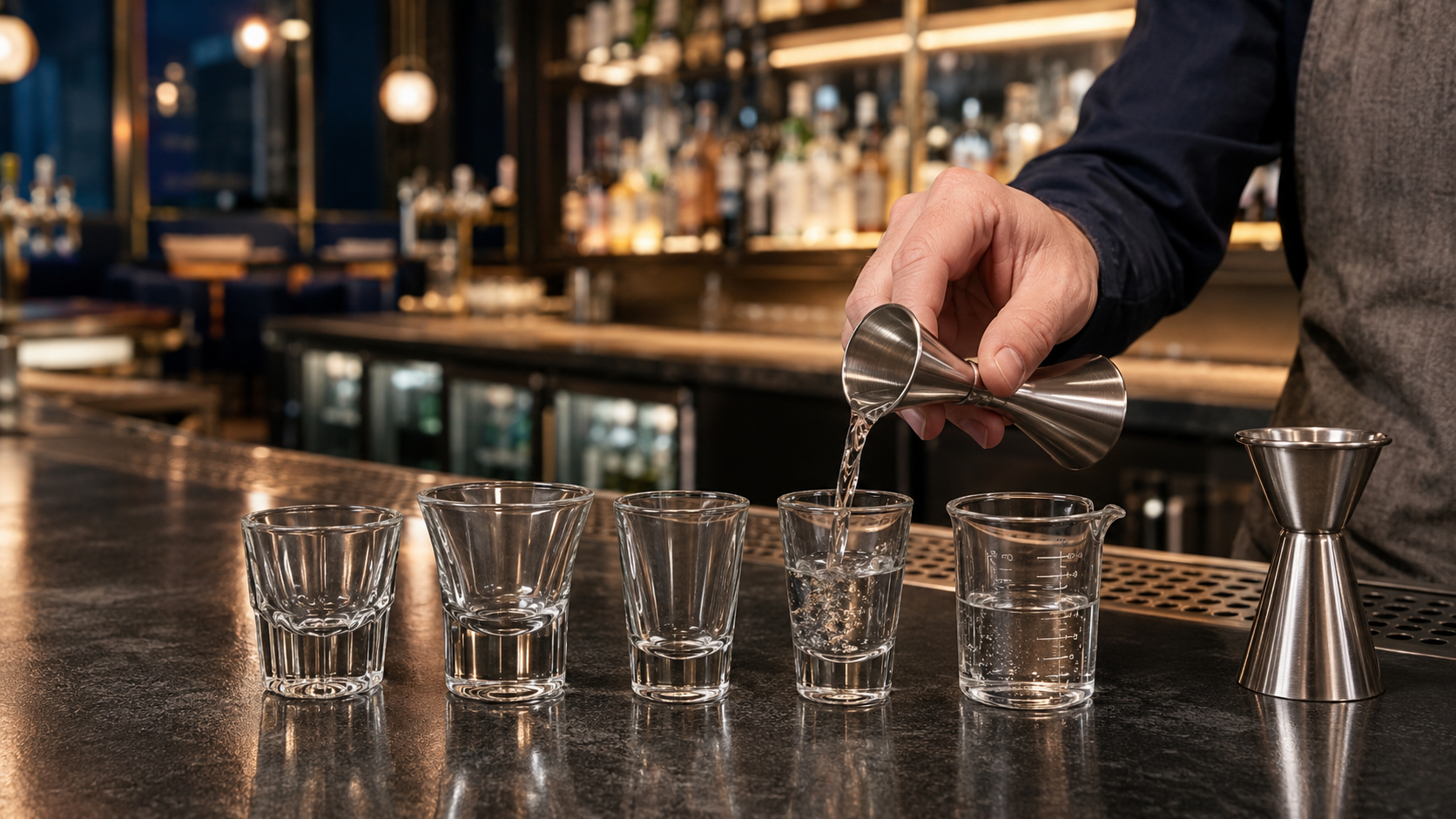
A shot in the United States is commonly treated as 1.5 fluid ounces, equal to approximately 44 milliliters, 3 tablespoons, or 9 teaspoons.
But 1.5 ounces is a convention—not a universal legal definition or a guarantee that every shot glass holds the same amount.
Depending on the bar, glassware, recipe, country, or local regulation, a shot may contain 1 ounce, 1.25 ounces, 1.5 ounces, 2 ounces, or another specified quantity. Some decorative shot glasses hold less than one ounce, while tall shooters may hold 2 to 5 ounces.
For a restaurant or bar, this is more than a trivia question. Shot size affects:
- Cocktail consistency
- Alcohol content
- Bottle yield
- Inventory variance
- Pour cost
- Menu pricing
- Responsible service
- Customer expectations
This guide explains how many ounces are in a shot glass, how shot sizes convert to milliliters and tablespoons, how a shot differs from a jigger or shooter, and how accurate pouring protects a bar’s profitability.

How Many Ounces Are in a Shot?
The most common U.S. reference for a shot is 1.5 fluid ounces.
A 1.5-ounce shot equals:
- 44.36 milliliters
- 3 U.S. tablespoons
- 9 U.S. teaspoons
- 0.1875 U.S. cups
For everyday bar use, this is normally rounded to 44 mL.
However, there is no single federal requirement that makes every shot served in the United States exactly 1.5 ounces. Bars establish house-pour standards according to their recipes, glassware, pricing, licensing requirements, and applicable state or local rules.
The 1.5-ounce reference is also used by the National Institute on Alcohol Abuse and Alcoholism. According to the NIAAA standard drink definition, 1.5 fluid ounces of 80-proof distilled spirits contains approximately the same amount of pure alcohol as a 12-ounce regular beer or a 5-ounce glass of table wine.
That does not mean every shot glass automatically contains one standard drink. The amount depends on both the pour volume and the alcohol percentage.
Shot Size Conversion Chart
The following table uses U.S. customary measurements. Metric values are rounded using the official NIST volume conversions.
| Shot size | Milliliters | Tablespoons | Teaspoons |
|---|---|---|---|
| 0.75 oz. | 22.18 mL | 1.5 Tbsp. | 4.5 tsp. |
| 1 oz. | 29.57 mL | 2 Tbsp. | 6 tsp. |
| 1.25 oz. | 36.97 mL | 2.5 Tbsp. | 7.5 tsp. |
| 1.5 oz. | 44.36 mL | 3 Tbsp. | 9 tsp. |
| 2 oz. | 59.15 mL | 4 Tbsp. | 12 tsp. |
| 2.5 oz. | 73.93 mL | 5 Tbsp. | 15 tsp. |
| 3 oz. | 88.72 mL | 6 Tbsp. | 18 tsp. |
These conversions describe liquid volume, not the capacity of every glass sold as a “shot glass.”
Before using shot glasses as measuring tools, test their actual capacity with an accurate jigger or graduated measuring vessel.
Is a Shot Glass 1 Ounce or 1.5 Ounces?
A shot glass can be either size.
Many American bars use 1.5 ounces as their house shot, but 1-ounce and 1.25-ounce pours are also used. A shot glass sold as a serving vessel may have a total capacity that differs from the bar’s official pour.
For example:
- A 1.5-ounce glass may be used for a 1.25-ounce house pour.
- A 2-ounce glass may contain a 1.5-ounce shot with headspace.
- A heavy-base glass may look full even though its usable capacity is relatively small.
- A tall shooter may hold multiple ingredients and more than one standard drink.
The correct answer should therefore be based on the bar’s established pour standard—not visual judgment.
Is a Shot the Same as a Standard Drink?
Not necessarily.
A shot describes a serving or pour. A standard drink estimates the amount of pure alcohol in that serving.
In the United States, one standard drink contains approximately 0.6 fluid ounces, or 14 grams, of pure alcohol. The CDC standard drink guidance identifies 1.5 ounces of 80-proof, or 40% ABV, distilled spirits as one standard drink.
The calculation can be expressed as:
Standard drinks = serving size in ounces × ABV as a decimal ÷ 0.6
Examples:
| Serving | Alcohol strength | Approximate U.S. standard drinks |
|---|---|---|
| 1 oz. | 40% ABV | 0.67 |
| 1.25 oz. | 40% ABV | 0.83 |
| 1.5 oz. | 40% ABV | 1 |
| 2 oz. | 40% ABV | 1.33 |
| 1.5 oz. | 50% ABV | 1.25 |
| 3 oz. | 40% ABV | 2 |
This distinction becomes especially important with double shots, high-proof spirits, and shooters made from several alcoholic ingredients.
A glass may appear to contain “one drink” while actually containing more than one standard drink.
How Many Ounces Are in a Double Shot?
A double shot should mean twice the establishment’s standard single pour.
That means a double is not automatically the same size everywhere.
| House single pour | Double shot |
|---|---|
| 1 oz. | 2 oz. |
| 1.25 oz. | 2.5 oz. |
| 1.5 oz. | 3 oz. |
| 2 oz. | 4 oz. |
In a bar where the standard shot is 1.5 ounces, a double shot is 3 ounces, or approximately 88.7 milliliters.
But a bartender should never assume that “double” means 3 ounces without checking the establishment’s recipe and pricing standards.
Menus and point-of-sale buttons should clearly reflect the bar’s approved pour quantities.
How Many mL Are in a Shot?
The common 1.5-ounce U.S. shot is approximately 44 mL.
Here are other frequently used conversions:
- 1 ounce = 29.57 mL
- 1.25 ounces = 36.97 mL
- 1.5 ounces = 44.36 mL
- 2 ounces = 59.15 mL
- 3 ounces = 88.72 mL
Metric recipes may round these to 30, 37, 45, 60, and 90 mL.
For high-volume commercial service, choose one measurement system for recipes and training. Constantly switching between approximate milliliters and fluid ounces can create avoidable inconsistency.
How Many Tablespoons Are in a Shot?
A 1.5-ounce shot equals 3 U.S. tablespoons.
Because one U.S. tablespoon equals one-half fluid ounce:
- 1 ounce = 2 tablespoons
- 1.25 ounces = 2.5 tablespoons
- 1.5 ounces = 3 tablespoons
- 2 ounces = 4 tablespoons
- 3 ounces = 6 tablespoons
Tablespoons may be useful for checking a measurement when no bar tools are available, but regular flatware spoons are not standardized measuring utensils.
A restaurant should not use dining spoons to portion liquor. Use a calibrated jigger, graduated vessel, approved pour-control system, or another measurement method permitted by local regulations.
Shot Glass vs. Jigger vs. Shooter
Shot glasses, jiggers, and shooters may all hold small amounts of liquid, but they serve different purposes.
| Item | Primary purpose | Typical capacity | Important distinction |
|---|---|---|---|
| Shot glass | Serving straight liquor | Approximately 1–2 oz. | Capacity varies and may not equal the house pour |
| Jigger | Measuring cocktail ingredients | Commonly 0.5–2 oz. per side | A bar tool, not normally a serving glass |
| Shooter | Serving mixed or layered shots | Commonly 2–5 oz. | Taller and often holds multiple ingredients |
| Pony glass | Small spirit or cordial serving | Varies | Historical term without one universal modern size |
| Graduated measure | Recipe and portion measurement | Varies | Includes marked volume increments |
What is a shot glass?
A shot glass is a small serving vessel used for straight spirits, chilled shots, mixed shots, tastings, or small food presentations.
Commercial shot glasses often have thick walls and heavy bases to improve durability and stability. However, a thick base reduces internal capacity and can make the glass appear fuller than it is.
What is a jigger?
A jigger is a bartender’s measuring tool. Many jiggers are double-sided, with each side holding a different amount.
Common configurations include:
- 1 ounce and 0.5 ounce
- 1.5 ounces and 0.75 ounce
- 2 ounces and 1 ounce
- 2 ounces and 0.5 ounce
These are common combinations, not universal rules. Bartenders should confirm the capacity and markings of each jigger before service.
What is a shooter?
A shooter is usually taller and larger than a traditional shot glass. It provides room for multiple ingredients, visible layers, whipped toppings, garnishes, or miniature dessert presentations.
Shooters may contain 2 to 5 ounces, but their capacities vary considerably.
Because shooters often contain several spirits or liqueurs, one shooter can represent more than one standard drink.
How to Measure a Shot Accurately
There are several ways to measure liquor, but they do not provide the same level of control.
Use a jigger
A jigger is one of the simplest and most accurate options for most independent bars. Fill the correct side to the intended measurement and pour it into the serving glass or cocktail.
Jiggers are affordable, easy to train with, and useful for both full-ounce and fractional measurements.
Use a graduated measuring tool
Graduated measures have visible marks for different volumes. They are useful for training, recipe development, batching, and verifying other bar tools.
Use measured pour spouts
Measured pour spouts are designed to dispense a specified quantity. They may improve consistency, but they must be used, cleaned, tested, and maintained correctly.
Local rules may govern which dispensing systems are permitted.
Use a regulated dispensing system
Some jurisdictions or business models require more controlled dispensing. Systems may record pours, restrict quantities, or connect to inventory-control software.
Utah, for example, requires applicable licensees to use metered systems that dispense primary spirituous liquor in calibrated quantities that do not exceed 1.5 ounces. This is more precise than saying Utah simply “defines every shot as 1.5 ounces.” Review the official Utah DABS dispensing-system requirements and rules applicable to the specific license.
Avoid relying on counting alone
Free-pour counting can be fast, but accuracy depends on the bartender, pour spout, bottle angle, product viscosity, and timing.
Even well-trained bartenders should be tested regularly against a measured standard.
Do not use an unverified shot glass as a jigger
A shot glass may hold more or less than its advertised size. Decorative glassware, heavy bases, unusual shapes, and fill-line differences can all affect the actual volume.
Calibrate the glass before treating it as a measuring tool.
How to Test a Shot Glass or Jigger
Bar owners should verify new glassware and measuring tools before putting them into service.
- Place the empty vessel on a level surface.
- Use a verified graduated measure to add the intended amount of water.
- Note where the liquid reaches inside the vessel.
- Repeat the test several times.
- Check multiple pieces from the same case or shipment.
- Record the vessel’s actual usable capacity.
- Train staff to pour to the approved level.
A glass may have a listed brimful capacity of 1.5 ounces but require a smaller practical pour to prevent spilling during service.
The usable serving capacity is often more important than the maximum volume to the rim.
Why Accurate Shot Measurements Matter
Precise pouring improves far more than inventory counts.
Cocktail consistency
A cocktail recipe is a ratio. Changing the amount of base spirit affects sweetness, acidity, dilution, aroma, color, and alcohol strength.
A half-ounce difference can noticeably change a small cocktail.
Responsible alcohol service
Overpouring increases the amount of alcohol served, even when the drink appears unchanged.
A large or high-proof pour may contain more than one standard drink. Employees should understand the difference between the number of glasses served and the actual alcohol content.
Inventory control
Consistent portioning makes theoretical usage easier to compare with actual bottle depletion.
Large unexplained variance may indicate:
- Overpouring
- Unrecorded drinks
- Incorrect recipes
- Spillage
- Waste
- Comps that were not entered
- Incorrect bottle transfers
- Inventory-counting errors
Menu pricing
If a cocktail is priced using a 1.5-ounce recipe but bartenders routinely pour 1.75 ounces, the drink’s actual cost is higher than the menu calculation.
Customer experience
Customers expect the same drink to taste and perform consistently regardless of bartender or shift.
Staff training
Written pour standards make training more objective. Instead of teaching “a little more” or “almost full,” the bar can specify an exact volume for every recipe.
How Many Shots Are in a Bottle?
The number of shots in a bottle depends on the bottle volume and the bar’s pour size.
Use this formula:
Theoretical pours per bottle = bottle volume in fluid ounces ÷ pour size
Common bottle conversions are:
- 750 mL = approximately 25.36 fluid ounces
- 1 liter = approximately 33.81 fluid ounces
- 1.75 liters = approximately 59.17 fluid ounces
Shot Yield by Bottle Size
| Bottle size | 1 oz. pours | 1.25 oz. pours | 1.5 oz. pours | 2 oz. pours |
|---|---|---|---|---|
| 750 mL | 25.4 | 20.3 | 16.9 | 12.7 |
| 1 liter | 33.8 | 27.0 | 22.5 | 16.9 |
| 1.75 liters | 59.2 | 47.3 | 39.4 | 29.6 |
These are theoretical yields. A bottle containing 16.9 pours does not provide 17 complete 1.5-ounce servings. It provides 16 full servings with less than one complete serving remaining.
Actual yield may also be lower because of:
- Spillage
- Product retained in the bottle
- Overpouring
- Samples
- Comps
- Recipe testing
- Breakage
- Inaccurate measurement
A bar should compare theoretical yield with actual inventory performance instead of assuming every bottle will produce the maximum mathematical result.
How to Calculate Liquor Cost per Shot
Use this formula:
Cost per pour = bottle cost ÷ theoretical number of pours
For example, consider a 750 mL bottle that costs the restaurant $30.
At a 1.5-ounce pour:
- Bottle volume: 25.36 ounces
- Theoretical pours: 16.9
- Product cost per pour: approximately $1.78
If the bar targets a 20% beverage cost for that item:
Illustrative menu price = $1.78 ÷ 0.20 = $8.90
This is only a product-cost example. Final menu pricing may also need to account for:
- Mixers
- Garnishes
- Ice
- Labor
- Glassware
- Waste
- Local taxes
- Market positioning
- Service style
- Desired margin
Changing the pour from 1.5 ounces to 2 ounces reduces the theoretical yield from approximately 16.9 to 12.7 servings. That difference can materially affect profit even if the menu price remains unchanged.
Shot Sizes Around the World
Shot sizes vary by country, jurisdiction, and establishment. A standard drink used for public-health guidance is not always the same as a legally required serving size.
| Location | Reference measure | Important qualification |
|---|---|---|
| United States | Commonly 1.5 oz., approximately 44 mL | No single universal federal shot-glass capacity |
| Utah | Primary spirit may not exceed 1.5 oz. under applicable metered-service rules | Requirements depend on license and drink construction |
| United Kingdom | 25 mL or 35 mL for gin, rum, vodka and whisky | A premises must use one selected measure, not both |
| Australia | 30 mL of 40% spirits equals one Australian standard drink | Alcohol-service laws are administered by states and territories |
| Ireland | 35.5 mL of 40% spirits is used as a standard-drink reference | Health guidance should not be confused with every service rule |
In the United Kingdom, gin, rum, vodka, and whisky sold by the glass must generally be offered in either 25 mL or 35 mL measures, or multiples of the selected measure. The same premises cannot ordinarily mix both standard sizes. See the official UK specified-quantity requirements.
The Australian Government uses 30 mL of 40% spirits as an example of one Australian standard drink in its standard drinks guide. This does not mean every venue worldwide uses 30 mL as its house shot.
Bars should verify the laws and licensing requirements in their own jurisdiction instead of copying measurements from another market.
Choosing Shot Glasses for a Commercial Bar
The right shot glass is not determined by appearance alone.
Confirm actual capacity
Check whether the listed size represents:
- Capacity to the rim
- Capacity to a marked line
- Recommended serving capacity
- Practical capacity with headspace
Match the glass to the house pour
A glass that is much larger than the house pour may appear underfilled. A glass filled to the rim can be difficult for servers to carry without spilling.
Look for commercial durability
Commercial shot glasses should withstand frequent handling, bussing, washing, storage, and temperature changes.
Consider the base
A thick base can improve stability and durability but reduces internal capacity. Always measure rather than estimating by appearance.
Check rim design
A smooth, consistent rim improves drinking comfort. Very delicate rims may chip more easily in high-volume service.
Plan warewashing capacity
Glassware decisions affect the bar’s washing and storage workflow. A busy bar may process hundreds of glasses during one service period.
Atlantic’s selection of commercial dishwashers and glass-washing equipment can help bars coordinate glassware volume with back-of-house cleaning capacity.
Check compatibility with racks and storage
Glass diameter and height affect rack selection, shelf clearance, and storage density. Test the selected glassware with the actual warewashing rack before placing a large order.
Popular Types of Shot Glasses
Standard shot glass
A compact, straight-sided glass used for spirits and simple shots. Capacity commonly falls between 1 and 2 ounces.
Tall shooter
A taller vessel that provides more room for mixed, layered, or garnished shots.
Fluted shot glass
A shot glass with a wider top and narrower base. The shape may improve presentation but can make volume harder to judge visually.
Heavy-base shot glass
A durable-looking glass with thick glass at the bottom. The external size may make the capacity appear larger than it is.
Graduated shot glass
A vessel with measurement marks. This can support recipe development or casual measuring, although markings should still be checked for accuracy.
Cordial glass
A small, often stemmed glass used for liqueurs, dessert drinks, or digestifs. It should not automatically be treated as a standard shot measure.
Plastic shot cup
Often used for events, sampling, or outdoor service. Capacity and local alcohol-service rules must still be confirmed.
Shot, Shooter, Neat Pour, and Cocktail: What Is the Difference?
Shot
A small serving intended to be consumed on its own, often quickly. It may contain one spirit or a simple mixture.
Shooter
A larger or more elaborate shot containing multiple ingredients. Shooters may be layered, chilled, topped, or garnished.
Neat pour
A spirit served without ice, water, or mixers. A neat pour may be larger than the establishment’s standard shot and is usually intended for sipping.
Cocktail
A mixed drink made from spirits and other ingredients. A cocktail can contain one or several standard drinks depending on recipe, volume, and ABV.
Tasting pour
A smaller portion used for guided tastings or flights. The size should be defined by the establishment rather than assumed from the glass.
Popular Shot Menu Ideas
A profitable shot menu should use standardized recipes, easy-to-source ingredients, and clear portioning.
Lemon Drop Shot
- Vodka
- Lemon juice
- Simple syrup or orange liqueur
- Optional sugar rim
Green Tea Shot
- Irish whiskey
- Peach schnapps
- Sour mix
- Small splash of lemon-lime soda
Kamikaze Shot
- Vodka
- Triple sec
- Lime juice
Atlantic’s guide to what triple sec is and how bars use it explains the role orange liqueur plays in drinks such as the Kamikaze and Margarita.
Washington Apple Shot
- Canadian whisky
- Sour apple schnapps
- Cranberry juice
Pineapple Upside-Down Cake Shot
- Vanilla-flavored vodka
- Pineapple juice
- Grenadine
Espresso Shot Cocktail
- Vodka
- Coffee liqueur
- Chilled espresso
Nonalcoholic Shooter
- Fruit puree or juice
- Citrus
- Flavored syrup
- Soda or sparkling water
Every recipe should specify exact quantities rather than relying on “equal parts” unless the final serving volume is also defined.
Building an Efficient Commercial Bar Around Beverage Service
Shot glasses and jiggers are small tools, but they operate within a larger bar system.
An effective commercial bar equipment plan should support beverage storage, ice production, glass cleaning, bottle access, preparation, and service.
Back bar refrigeration
Frequently used beer, wine, mixers, garnishes, and bottled beverages should be organized for fast access. Back bar coolers place refrigerated storage close to the bartender while keeping products visible and organized.
Bottle coolers
High-volume bars may use commercial bottle coolers for rapid access to beer and other bottled beverages.
Commercial ice machines
Ice volume and type affect nearly every cocktail program. A bar that runs out of clean ice cannot maintain normal drink service.
Atlantic offers commercial ice machines, including undercounter machines, modular heads, ice machines with bins, and high-production systems.
Glass chillers and frosters
A glass chiller or froster can support drinks that benefit from cold glassware while reducing the temptation to chill glasses directly in service ice.
Warewashing
Shot glasses are small, but their high turnover can create a significant warewashing load. Glass washer capacity, rack configuration, water treatment, and drying space should be planned according to peak service volume.
Bar layout
Bottles, jiggers, ice, sinks, glassware, garnishes, waste, refrigeration, and point-of-sale equipment should be arranged to minimize unnecessary movement.
A bar can have excellent recipes and still provide slow service if employees must repeatedly cross paths to reach ice, glassware, or refrigerated ingredients.
Shot Glass Cleaning and Sanitation
Shot glasses should be washed, rinsed, sanitized, and stored according to applicable foodservice requirements.
The FDA Food Code identifies contaminated equipment as a major foodborne-illness risk factor and provides model requirements for washing, sanitizing, and maintaining food-contact items. Operators should consult the current FDA Food Code together with their state and local health regulations.
Commercial practices should include:
- Using the correct glass-washing chemical concentration
- Following approved wash and sanitizing procedures
- Inspecting rims for chips
- Removing lipstick and visible residue
- Allowing glasses to air-dry
- Storing clean glasses in a protected area
- Separating clean and dirty glassware routes
- Replacing cracked or damaged glasses
- Cleaning glass-washing equipment on schedule
Do not towel-dry sanitized glassware unless the approved local procedure specifically allows it. Towels can reintroduce contamination or leave fibers on the glass.

