

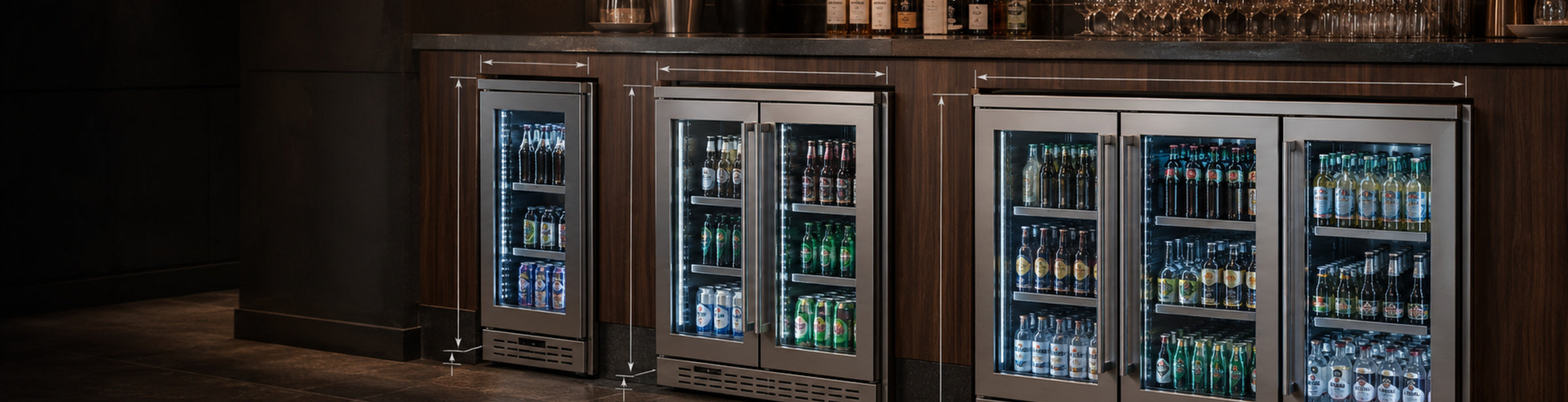
Choosing the correct back bar cooler size requires more than measuring an open space and selecting the closest number in a product title. A model marketed as a 60-inch cooler may not measure exactly 60 inches wide, and two refrigerators with similar widths can offer very different interior capacities.
Depth, height, compressor placement, shelf configuration, door style and ventilation requirements all affect whether a commercial bar refrigerator will fit—and whether it will hold enough bottles and cans during your busiest service.
This guide explains how to measure your bar, compare common back bar refrigerator dimensions and estimate the capacity your operation actually needs. When you are ready to compare models, explore Atlantic’s selection of commercial back bar coolers.
Back Bar Cooler Size at a Glance
Commercial back bar coolers generally range from compact one-door models around 24 inches wide to three- and four-section refrigerators approaching or exceeding 90 inches. However, these are product classes rather than guaranteed exterior dimensions.
A “48-inch back bar cooler” may measure exactly 48 inches wide, while another model in the same class may be slightly more than 49 inches. Nominal 69- and 72-inch models can also overlap in actual width and capacity.
| Nominal size | Common configuration | Typical application |
|---|---|---|
| 24″ | One door | Satellite bar, service station or limited beverage menu |
| 36″ | One door | Small restaurant bar or specialty beverage station |
| 48″ | Two doors | Compact primary bar or secondary service area |
| 59″–61″ | Two doors | Medium-volume restaurant, pub or hotel bar |
| 69″–73″ | Two or three doors | Busy restaurant, tavern or high-volume bar |
| 80″–90″+ | Three or four doors | Large beverage program or multi-bartender operation |
These categories are starting points—not standardized dimensions. Always use the current manufacturer specification sheet when planning an installation.
Real Back Bar Cooler Dimensions and Capacities
The following examples show why the model number and product title should never replace the technical specifications.
| Size class | Example model | Actual exterior dimensions: W × D × H | Capacity | Configuration |
|---|---|---|---|---|
| 24″ | Beverage-Air BB24HC-1-B | 24″ × 30⅛″ × 37¾″ with casters | 7.66 cu. ft. | One door, two shelves |
| 36″ | Beverage-Air BB36HC-1-B | 36″ × 24½″ × 34″ | 8.31 cu. ft. | One door, two shelves |
| 48″ | Atosa MBB48G-GR | 48″ × 28.1″ × 40⅛″ | 12.9 cu. ft. | Two glass doors, four shelves |
| 60″ class | Dukers DBB60-M2 | 56⅞″ × 24⅜″ × 38¾″ | 15.2 cu. ft. | Two solid doors, four shelves |
| 69″ | Atosa MBB69G-GR | 68″ × 28.1″ × 40⅛″ | 21.5 cu. ft. | Two glass doors, four shelves |
| 72″ class | Arctic Air ABB72 | 73⅛″ × 24″ × 39⅝″ | 20.7 cu. ft. | Three solid doors, six shelves |
| 90″ | Atosa MBB90G-GR | 89.3″ × 28.1″ × 40⅛″ | 30.1 cu. ft. | Three glass doors, six shelves |
Specifications can change. Confirm current dimensions, caster or leg height, voltage and clearance requirements on the product page and manufacturer specification sheet before ordering.
These examples reveal two important lessons.
First, nominal width is not always actual width. The Dukers DBB60-M2 is sold within the 60-inch class but lists an exterior width of 56⅞ inches. The Arctic Air ABB72, meanwhile, measures slightly more than 73 inches wide.
Second, a wider model does not automatically provide more cubic feet. The 68-inch-wide Atosa example offers 21.5 cubic feet, while the wider Arctic Air ABB72 provides 20.7 cubic feet. The difference is partly explained by cabinet depth and internal design. Atosa’s official specifications list the MBB69GGR at 68 inches wide and 28.1 inches deep, while the Arctic Air unit is approximately 24 inches deep.
How to Measure for a Back Bar Cooler
Record every measurement in inches and measure the installation area in at least three places. Walls, counters and floors are not always perfectly straight or level.
1. Measure the Available Width
Measure the clear opening at the:
- Front of the installation area
- Back wall
- Narrowest point between cabinets
- Counter supports, trim or plumbing penetrations
Use the smallest measurement as the available width.
Do not plan for a unit to fit tightly between two fixed surfaces. Installation tolerances, building irregularities, required ventilation and future service access can all require additional space.
A 48-inch opening is not automatically suitable for every product advertised as a 48-inch back bar cooler. Check the exact specification sheet and all manufacturer-required clearances.
2. Measure the Depth
Back bar refrigerator depth strongly affects both capacity and bartender workspace.
Narrow-depth models commonly measure approximately 24 to 25 inches deep and are useful where the working aisle behind the bar is limited. Standard-depth units may approach 28 to 31 inches and can provide more internal storage without using additional linear wall space.
Measure from the rear installation surface to the front edge of the available footprint. Then consider:
- Door handles
- Electrical plug and receptacle location
- Rear connections or protrusions
- Required ventilation space
- Counter overhang
- Bartender working aisle
- Nearby equipment and drawer handles
A deeper cabinet can hold more product, but it can also reduce the aisle behind the bar. The best model is the one that preserves both storage capacity and a safe, efficient workflow.
3. Measure the Height
Measure from the finished floor—not the subfloor—to the lowest point beneath the counter or bar structure.
Confirm whether the manufacturer’s listed height includes:
- Casters
- Adjustable legs
- Finished top
- Galvanized sub-top
- Optional accessories
Some back bar refrigerators are approximately 34 inches high, while models with taller cabinets or casters may approach 38 to 40 inches. Beverage-Air’s current manual, for example, specifically notes when listed height includes casters.
If the floor is uneven, measure at the left, center and right sides of the opening. Use the lowest available height.
Underbar, Counter-Height and Low-Profile Models
These terms are useful, but manufacturers do not always use them identically.
Underbar refrigerators
An underbar model is intended to fit beneath an existing bar or counter structure. It may have an unfinished or galvanized sub-top because the surrounding counter provides the finished work surface.
Counter-height refrigerators
A counter-height back bar cooler may have a finished stainless steel top that can function as an additional work surface when permitted by the manufacturer. These models are often taller than low-profile units.
Low-profile refrigerators
Low-profile models are designed for installations with reduced vertical clearance. They can be useful beneath custom bars, beer towers, drainboards or other fixed structures.
Never select a model based only on the terms “underbar” or “counter height.” Compare the actual cabinet height, top construction, legs or casters and required clearances.
Swing Doors vs. Sliding Doors
Door style affects both storage access and the amount of working space required in front of the cooler.
Swing doors
Swing doors provide broad access to each refrigerated section and can make it easier to load full cases or reorganize shelves. However, they project into the bartender’s working aisle when opened.
Before ordering a swing-door model:
- Find the door width or CAD drawing.
- Identify the hinge location.
- Measure the maximum outward projection.
- Check for conflicts with walls, ice bins, sinks and adjacent equipment.
- Confirm that staff can pass safely when the door is open.
Do not assume the required clearance equals the door width. Handles, hinges and the door’s opening angle can change the exact projection.
Sliding doors
Sliding doors do not swing into the working aisle, making them useful behind narrow bars and in busy service areas. They may also allow staff to access beverages without blocking a passage.
The tradeoff is that only part of the cabinet opening is accessible at one time. Tracks must also be kept clean and unobstructed.
For a tight working aisle, sliding doors may be more important than gaining a few additional cubic feet.
How Much Beverage Capacity Do You Need?
Do not calculate capacity from daily sales alone.
A bar that sells 300 beverages per day but receives deliveries once a week has a different storage requirement than a bar with the same sales volume and daily deliveries. You also need to consider how much product must be cold at the same time.
A more reliable formula is:
Required cold inventory = peak service inventory + replenishment buffer + reserve stock that must remain refrigerated
Include:
- Bottled beer
- Canned beer
- Soda and sparkling water
- Juice
- Mixers
- Non-alcoholic beverages
- Seasonal products
- Backup stock required before the next delivery
Then convert cases into individual containers:
Number of cases × containers per case = packaged beverage count
Compare that total with manufacturer-published pack-out data. Do not convert cubic feet directly into a bottle count unless the manufacturer provides an approved capacity figure or you have tested the exact shelf arrangement.
Why Cubic Feet Does Not Tell the Whole Story
Two coolers with identical cubic-foot ratings may not hold the same number of products.
Usable capacity is affected by:
- Compressor compartment size and location
- Interior cabinet shape
- Shelf depth
- Number of shelves
- Shelf spacing
- Evaporator and air-duct placement
- Bottle diameter and height
- Can format
- Required internal airflow
- Door openings and mullions
A cabinet filled entirely with 12-ounce cans will have a different pack-out than one holding a mix of long-neck bottles, wine bottles, tall cans and juice containers.
Manufacturers sometimes publish capacity in six-packs. For example, Arctic Air listings describe approximately:
- ABB48: 48 six-packs of 12-ounce cans
- ABB60: 72 six-packs of 12-ounce cans
- ABB72: 84 six-packs of 12-ounce cans
That represents theoretical pack-out using a particular package and shelf configuration. Actual operational capacity may be lower when the cooler holds different container shapes or when open space is left for circulation and quick restocking.
Which Back Bar Cooler Size Is Right for You?
24- to 36-inch models
Best suited for:
- Satellite service stations
- Small cocktail bars
- Limited beverage menus
- Hotel lounges
- Supplemental mixer storage
- Operations with frequent restocking
These compact units usually have one door and a smaller number of shelves. Their main advantage is footprint, not maximum capacity.
A 24-inch cooler can still be relatively deep or tall, so do not assume that its compact width guarantees an undercounter fit.
48- to 60-inch models
Best suited for:
- Small and medium restaurant bars
- Pubs with a focused beer selection
- Secondary hotel or event bars
- Bar stations operated by one bartender
- Operations that need separate product sections
This range commonly includes two-door configurations and offers a strong balance between storage and footprint.
Compare the actual width carefully. Models sold in the 60-inch class can measure less than 60 inches or slightly more than 61 inches.
69- to 72-inch models
Best suited for:
- Busy restaurants
- Taverns and sports bars
- Multiple-bartender stations
- High-volume bottled and canned beverage service
- Bars carrying many beverage varieties
Models in this range often have two or three doors and four to six adjustable shelves. Depth becomes especially important: a deeper 69-inch model may provide more interior volume than a shallower 72-inch unit.
80- to 90-inch and larger models
Best suited for:
- High-volume bars and nightclubs
- Large restaurants
- Entertainment venues
- Stadium and event operations
- Multi-station beverage programs
Large units can provide substantial capacity, but installation becomes more demanding. Verify:
- Delivery doorway width
- Hallway turns
- Elevator capacity
- Floor load
- Electrical access
- Condenser service access
- Final positioning clearance
A large refrigerator is not always the best solution. Two smaller units can sometimes provide better product separation, redundancy and bartender access—but they may require more electrical connections and total floor space.
Ventilation and Condenser Location
Never use a universal clearance recommendation for every back bar refrigerator.
Some models are front-breathing, while others need additional rear or side clearance. Even a front-breathing unit may have manufacturer-specific installation spacing. Continental, for example, identifies certain back bar models as front-breathing but still recommends clearances and requires the front grille to remain unobstructed.
Before ordering, identify:
- Air intake location
- Warm-air discharge location
- Compressor position
- Condenser service panel
- Required rear clearance
- Required side clearance
- Whether built-in installation is permitted
- Whether service can be performed from the front
Do not block a front grille with decorative panels, trim, boxes or floor mats. Restricted airflow can reduce cooling performance and increase stress on the refrigeration system.
Legs, Casters and Leveling
Casters and legs can change the installed height by several inches. Verify whether they are:
- Included
- Pre-installed
- Optional
- Adjustable
- Included in the listed exterior height
The refrigerator must also be level after installation. An uneven cabinet can affect door closing, gasket sealing and condensate drainage.
Do not remove required legs or casters simply to make a refrigerator fit beneath a counter. Doing so may reduce ventilation, affect sanitation clearance, interfere with drainage or violate the manufacturer’s installation instructions.
Measure the Delivery Route
A cooler that fits under the bar may still be impossible to deliver through the building.
Measure:
- Exterior entrance
- Loading dock opening
- Vestibule
- Interior doorways
- Hallways
- Corners and turning areas
- Stairs
- Elevator door and interior
- Final bar entrance
- Counter and doorway thresholds
Use the unit’s crated dimensions for the first part of the delivery route and its uncrated dimensions for the final placement plan.
Also check the shipping weight and determine whether lifting equipment, a pallet jack or additional installers will be required. Never assume that the cooler can be safely turned on its side. Follow the manufacturer’s handling and startup instructions if the cabinet has been tilted during delivery.
Electrical Requirements
Many commercial back bar coolers use a 115-volt connection and a NEMA 5-15P plug, but this should never be assumed.
Check the equipment data plate and specification sheet for:
- Voltage
- Phase
- Full-load amps
- Plug configuration
- Power cord length
- Dedicated-circuit requirements
- Local electrical code requirements
Do not rely on an extension cord to compensate for a poorly located receptacle. Plan the electrical connection before the refrigerator arrives.
Quick Back Bar Cooler Size Checklist
Before selecting a model, answer all of the following:
- What is the narrowest available width?
- What is the maximum usable depth?
- What is the lowest available height?
- Does the listed height include casters or legs?
- How wide is the bartender’s working aisle?
- Will swing doors open without blocking traffic?
- Where does the unit take in and discharge air?
- What clearances does the manufacturer require?
- Is the refrigerator approved for built-in installation?
- Where is the condenser located?
- How many beverages must be cold during peak service?
- What package sizes will be stored?
- How often is the cooler restocked?
- Can the unit pass through every doorway and hallway?
- Is the correct electrical receptacle available?
- Can the condenser be accessed for cleaning and service?
If any answer is unknown, resolve it before ordering.
