

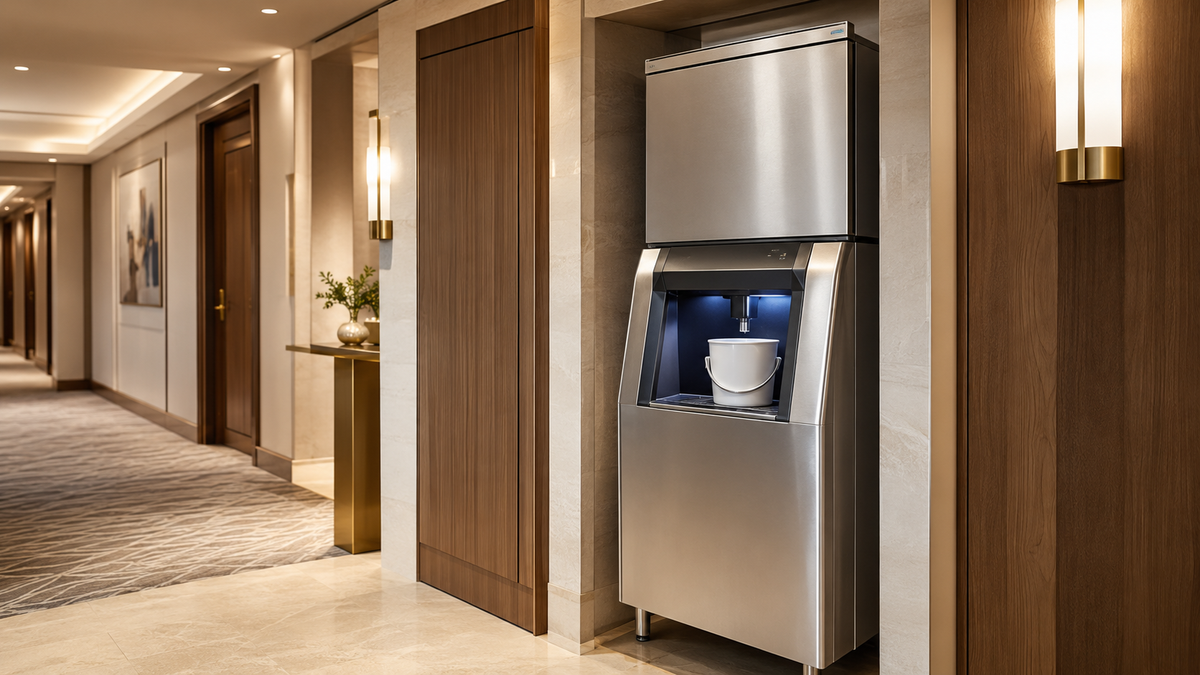
Ice may seem like a small amenity, until guests cannot find it.
A dependable hotel ice system quietly supports guest rooms, breakfast service, lobby hydration, bars, restaurants, room service, pools and banquets. When that system is undersized, poorly located or difficult to maintain, the problem quickly reaches the front desk in the form of empty dispensers, guest complaints and emergency purchases of bagged ice.
Choosing the best commercial ice machine for a hotel is therefore not simply a matter of comparing how many pounds of ice each model can produce. Hotel operators must consider where the ice will be used, when demand peaks, how guests will access it, what utilities are available and how the equipment will be cleaned and serviced without disrupting the property.
This guide compares some of the strongest hotel ice machine configurations available and explains how to select the right system for every area of your property.
The Best Hotel Ice Machines at a Glance

| Ice machine or system | Best application | Published production or storage | Why it stands out |
|---|---|---|---|
| Coldline ICE400-BD | Value-focused guest floors | 400 lb./day; 150 lb. storage | Narrow, complete hotel dispensing system |
| Atosa HD350-AP-161 | Mid-size hotels and motels | 350 lb./day; 160 lb. storage | Integrated package with filtration |
| Hoshizaki KM Series with DB/DBW dispenser | Premium guest floors and resorts | Depends on selected head; 130 or 200 lb. storage | Durable modular platform and multiple capacity options |
| Ice-O-Matic Elevation Series with CD400 dispenser | Hard-water locations and service-focused properties | Depends on selected head; 120 or 180 lb. storage | Excellent dispenser access and compact footprints |
| Scotsman Prodigy Plus with iceValet | Hotels prioritizing diagnostics and serviceability | Depends on selected head; 120 or 180 lb. storage | Self-monitoring platform and hospitality-specific dispenser |
| Follett 7, 15 or Symphony Plus Series | Lobbies, executive floors and breakfast rooms | Up to 125 or 425 lb./day, depending on series | Premium chewable ice and convenient ice-and-water dispensing |
| Hoshizaki C-80BAK-AD | Suites, pantries and compact hospitality areas | Up to 92 lb./day; 27 lb. storage | Compact ADA-height undercounter design |
Published production is normally measured under specified test conditions. Real output can be lower when incoming water or surrounding air is warmer. Storage capacity also describes how much ice a bin can hold—not how much ice the machine makes in 24 hours.
What Makes an Ice Machine Good for a Hotel?
The best hotel ice machines generally share six characteristics:
-
Reliable output under the property’s actual operating conditions
-
Enclosed, convenient dispensing for guest-facing areas
-
Enough storage to survive short periods of concentrated demand
-
Easy access for cleaning and preventive maintenance
-
Appropriate noise and heat levels for the installation location
-
Strong local parts and service support
Hotels create a more complicated demand pattern than many restaurants. A restaurant may use most of its ice during defined meal periods. A hotel can experience demand around the clock, with additional surges after check-in, during breakfast, before events, around pool hours and when guests return to their rooms in the evening.
The equipment also serves very different users. A guest-floor dispenser must be intuitive, accessible and sanitary. A banquet ice machine must prioritize production and storage. A lobby dispenser should look presentable and operate quietly. A hotel bar may require slower-melting cubes that protect drink quality.
That is why the best solution is often a coordinated ice system rather than one oversized machine placed in a central utility room.
1. Coldline ICE400-BD: Best Value Hotel Ice Machine
The Coldline ICE400-BD is a practical option for hotels that want a dedicated guest-floor machine without moving into the highest price tier.
The system combines a 22-inch-wide modular ice machine head with a hotel-style dispensing bin. It produces up to 400 pounds of half-cube ice per day and provides approximately 150 pounds of insulated storage.
Why it works well for hotels
-
Narrow 22-inch footprint
-
Integrated ice production and dispensing configuration
-
Push-to-dispense guest access
-
Half-cube ice suitable for ice buckets and beverages
-
Substantial storage for short demand surges
-
Competitive price relative to premium modular systems
-
Well suited to hotel corridors and self-service ice rooms
The narrow footprint is especially helpful when renovating an existing hotel where the available ice-room opening, hallway or utility chase cannot accommodate a 30-inch machine.
What to confirm before ordering
The ICE400-BD requires a suitable water connection, drainage, electrical service and airflow. Its advertised 400-pound production is a maximum rating rather than a guarantee under every installation condition. Review its production at the air and water temperatures expected inside the hotel.
Best for: Limited-service hotels, motels and mid-size properties seeking a cost-effective guest-floor dispenser.
2. Atosa HD350-AP-161: Best Integrated Hotel Ice Dispenser
The Atosa HD350-AP-161 combines ice production and guest dispensing in one hospitality-focused package.
It produces up to 350 pounds of cube ice per day and stores approximately 160 pounds. Its 23-inch width offers more flexibility than many traditional 30-inch hotel dispensers.
Notable features
-
Up to 350 pounds of daily ice production
-
Approximately 160 pounds of storage
-
Push-chute dispensing
-
Air-cooled condenser
-
Removable air filter
-
Stainless-steel exterior
-
Large drain pan
-
Included 3M water-filter system
-
Standard 115V configuration with NEMA 5-15P plug
Including a filtration system adds value, but hotel operators should still confirm that the supplied filtration is appropriate for the building’s water chemistry, pressure and consumption. Carbon filtration alone, for example, may improve taste and odor without adequately controlling hard-water scale.
For a deeper explanation, see Atlantic’s Commercial Ice Machine Water Filtration Guide.
Best for: Mid-size hotels that want an integrated, relatively straightforward guest-floor ice solution.
3. Hoshizaki KM Series with DB or DBW Dispenser: Best Premium Modular System
A compatible Hoshizaki KM Series cuber paired with a DB or DBW hotel dispenser is one of the strongest choices for properties that prioritize long-term durability and configuration flexibility.
Hoshizaki offers 22-inch and 30-inch hotel dispensers:
-
DB-130H and DBW-130H: approximately 130 pounds of storage
-
DB-200H and DBW-200H: approximately 200 pounds of storage
The DBW versions add water dispensing, while the standard DB versions dispense ice only. According to Hoshizaki, these dispensers have ADA-compliant dispensing areas, stainless-steel construction and insulated storage. Compatible ice machine heads are selected separately based on required production.
Why a modular system matters
The dispenser and ice-making head are separate components. This allows an operator to:
-
Match production to the number of rooms served
-
Select an appropriate 22- or 30-inch footprint
-
Replace or service one component without necessarily replacing the entire system
-
Choose ice-only or ice-and-water dispensing
-
Increase production without installing an unnecessarily large storage bin
Hoshizaki’s 30-inch DBW-200H, for example, stores up to 200 pounds and accepts selected top-mounted KM cubers. The manufacturer lists a dispensing rate of approximately 13 pounds per minute and an ADA-compliant dispensing area. The smaller DBW-130H stores about 130 pounds in a 22-inch cabinet.
The important limitation
A dispenser is not automatically an ice machine. Many hotel dispenser model numbers describe the storage and dispensing component only. The compatible ice-making head may be sold separately.
Before purchasing, confirm:
-
Ice maker and dispenser compatibility
-
Required adapter or top kit
-
Overall assembled height
-
Separate electrical requirements
-
Total heat rejection
-
Drain connections
-
Production under expected operating conditions
Best for: Upscale hotels, resorts and properties that want a configurable, serviceable modular ice platform.
4. Ice-O-Matic Elevation with CD400: Best for Cleaning Access and Tight Spaces
Ice-O-Matic’s CD400 hotel dispensers are designed around high storage capacity in relatively narrow cabinets.
The CD40022 provides approximately 120 pounds of storage in a 22-inch-wide footprint. The CD40030 increases storage to approximately 180 pounds in a 30-inch cabinet.
According to Ice-O-Matic, the CD400 includes front access to the bin through its Power Clean design. This can allow the dispenser to be cleaned without removing the top-mounted ice machine—an important advantage in a hotel where dismantling equipment creates longer service interruptions.
Why hotel engineering teams may prefer it
-
22- and 30-inch sizes
-
Front-access cleaning design
-
Insulated ice storage
-
Push-to-dispense operation
-
Stainless and corrosion-resistant construction
-
Optional water-filler configurations
-
Safety interlock for service access
-
Modular compatibility with selected ice machine heads
The Ice-O-Matic CD40022 stores around 120 pounds, while the CD40030 stores around 180 pounds. Production depends on the compatible ice machine installed above the dispenser.
Easy-clean claims do not eliminate manual maintenance. The chute, dispensing area, storage compartment, drains and internal water system still require cleaning and sanitizing according to the equipment manual.
Best for: Hotels with narrow ice rooms, hard-water concerns or engineering teams that prioritize access for routine cleaning.
5. Scotsman Prodigy Plus with iceValet: Best for Diagnostics and Serviceability
Scotsman’s iceValet dispensers are built specifically for hotel and motel applications.
The HD22 offers approximately 120 pounds of storage, while the HD30 provides approximately 180 pounds. Both are designed to pair with selected Scotsman Prodigy Plus ice machine heads.
Scotsman emphasizes self-monitoring, service access and one-touch cleaning features within the Prodigy Plus platform. The HD22 and HD30 dispensers also provide top access to the storage area for cleaning and service.
Why it stands out
-
Hospitality-specific dispenser design
-
22- and 30-inch footprints
-
Approximately 120 or 180 pounds of storage
-
Deep dispensing sink for hotel ice buckets
-
ADA-compliant dispensing reach
-
Compatible self-monitoring ice makers
-
Easy-access bin design
-
Optional water-filler configurations on selected models
This is an attractive configuration for hotel engineering departments that value diagnostic information and relatively straightforward access during scheduled maintenance.
Best for: Full-service hotels and properties where serviceability and equipment monitoring are major purchasing priorities.
6. Follett 7, 15 or Symphony Plus Series: Best for Lobbies and Executive Floors
Traditional cube dispensers are usually the practical choice for filling guest-room ice buckets. Lobby hydration stations, executive floors and breakfast rooms may benefit from a different experience.
Follett’s hospitality-oriented dispensers produce chewable Chewblet ice and can combine ice and water in a compact presentation. Certain Follett 7 and 15 Series machines produce up to approximately 125 pounds per day and can be installed without a drain, depending on the configuration. Follett identifies these systems for hotel lobbies, concierge floors, suites, hallways, pantries and breakfast rooms.
For higher demand, the Symphony Plus 110 Series produces up to approximately 425 pounds per day with around 90 pounds of internal storage. It is available in ice-only and ice-and-water versions, with lever or infrared dispensing options.
Best hotel applications
-
Lobby hydration stations
-
Executive and concierge floors
-
Club lounges
-
Breakfast rooms
-
Premium suites
-
Guest pantries
-
Meeting-room refreshment areas
The advantage is not simply production. A compact ice-and-water dispenser can create a more refined guest experience than an open-bin machine or a large industrial-looking cuber.
Follett’s hospitality application guide outlines different configurations for lobbies, suites, breakfast areas and guest hallways.
Where it may not be the right choice
A compact countertop dispenser should not automatically replace a high-storage bucket-filling machine on a busy guest floor. Its small internal reserve can be depleted quickly when several guests fill large ice buckets at once.
Best for: Boutique hotels, executive floors and guest-facing areas where presentation, water dispensing and premium chewable ice matter.
7. Hoshizaki C-80BAK-AD: Best for Suites and Compact Pantries
Some hotel spaces need a small self-contained ice maker rather than a full floor-standing dispenser.
The Hoshizaki C-80BAK-AD is an undercounter cubelet machine measuring less than 32 inches high. It produces up to approximately 92 pounds of ice per day and stores around 27 pounds.
Useful features
-
Compact undercounter design
-
ADA-compliant height
-
Front-in, front-out airflow
-
Approximately 92 pounds of daily production
-
Approximately 27 pounds of storage
-
115V electrical configuration
-
Reversible door
-
R290 refrigerant
-
Suitable for selected indoor and outdoor hospitality applications
Its front-breathing airflow can simplify installation where side and rear clearances are restricted. However, the machine still needs a water supply and correctly designed drain. An optional drain pump may be required when gravity drainage is not possible.
Best for: Luxury suites, penthouse pantries, pool cabanas, small club lounges and satellite service areas.
How Much Ice Does a Hotel Need?
A common preliminary benchmark is approximately five pounds of ice per occupied guest room per day. This is useful for early planning, but it should never be the entire calculation.
Use:
Occupied rooms × pounds per occupied room = guest-room demand
Then add every separate demand center:
Total hotel demand = guest rooms + breakfast + bar + restaurant + room service + pool + banquets + staff use
Finally, add a reasonable reserve for peak conditions:
Required production = total demand × peak-demand factor
Atlantic’s Commercial Ice Machine Sizing Guide explains this process in greater detail.
Example: 150-room hotel
Assume a 150-room hotel expects 85% occupancy during its busiest season.
-
Occupied rooms:
150 × 0.85 = 127.5 -
Guest-floor demand:
127.5 × 5 lb. = 637.5 lb. -
Breakfast service:
80 lb. -
Lobby bar:
120 lb. -
Back-of-house and staff use:
40 lb.
Peak-day subtotal:
637.5 + 80 + 120 + 40 = 877.5 lb.
With a 15% operating reserve:
877.5 × 1.15 = 1,009 lb. per day
The property should therefore investigate a system capable of approximately 1,000 pounds per day under its real operating conditions.
That does not necessarily mean installing one 1,000-pound machine. Multiple machines can improve guest access and provide partial redundancy if one unit requires service.
Banquet demand must be calculated separately
A 300-person ballroom event can create a short, concentrated demand that bears little relationship to the hotel’s room count. Cocktail service, table water, buffet displays and post-event cleaning may all draw from the same ice supply.
Hotels with active event calendars should calculate their largest realistic room-and-banquet day—not merely average annual occupancy.
Production Capacity and Storage Are Not the Same
This is one of the most important distinctions in hotel ice equipment.
Production capacity describes how much ice a machine can make over 24 hours under stated conditions.
Storage capacity describes how much ice is available in the bin at one moment.
A machine may produce 400 pounds per day but store only 150 pounds. If guests remove 150 pounds in a concentrated period, the dispenser can temporarily run empty even though the machine has sufficient theoretical daily production.
Conversely, a large storage bin cannot correct an ice maker that produces too little over the course of a full day.
Hotel operators should size both:
-
Production for total peak-day consumption
-
Storage for concentrated periods of use
Select the Right Machine for Each Hotel Zone
| Hotel area | Recommended configuration | Primary priorities |
|---|---|---|
| Guest floors | Modular cuber with enclosed hotel dispenser | Bucket clearance, storage, accessibility and simple operation |
| Lobby | Compact ice-and-water dispenser | Appearance, quiet operation and sanitation |
| Breakfast area | Countertop or freestanding dispenser | Fast service, small footprint and water dispensing |
| Hotel bar | Undercounter or modular cuber | Ice quality, cube consistency and recovery |
| Banquet department | High-capacity modular system with large bin | Production, storage and redundancy |
| Luxury suites | Compact undercounter ice maker | Quiet operation, appearance and footprint |
| Pool area | Outdoor-rated or protected commercial unit | Ambient-temperature performance and corrosion resistance |
| Back-of-house kitchen | Modular cuber with storage bin | Capacity, durability and easy staff access |
Which Type of Ice Is Best for a Hotel?
There is no universal hotel ice shape.
Half-cube ice
Half cubes are a strong general-purpose choice. They pack efficiently into hotel ice buckets, displace more beverage volume than larger cubes and work well in fountain drinks and blended beverages.
Best for: Guest floors, breakfast rooms and general beverage service.
Full-cube or crescent ice
Larger, harder cubes tend to melt more slowly and can offer better presentation in bar drinks, table water and room service.
Best for: Hotel bars, restaurants and premium beverage programs.
Nugget or cubelet ice
Nugget-style ice is chewable and popular with guests. It works especially well in lobby hydration stations, executive lounges and self-service beverage areas.
Best for: Lobbies, breakfast rooms, suites and premium guest amenities.
Gourmet ice
Clear specialty cubes can improve presentation in upscale cocktail and spirits programs, but they generally produce more slowly and should not be expected to supply the entire hotel.
Best for: Luxury bars and signature beverage service.
Atlantic’s guide to the different types of commercial ice provides a more detailed comparison.
Why Enclosed Dispensing Is Better for Guest Areas
Ice is considered food and should be produced, stored and handled accordingly. The FDA explains that ice must be made and handled under sanitary conditions.
In guest-accessible locations, an enclosed push-button or sensor-operated dispenser generally offers better control than an open storage bin with a scoop.
The CDC recommends minimizing direct hand contact with ice and identifies automatic dispensing into portable containers as a way to reduce contamination opportunities. It also recommends following manufacturer instructions for routine cleaning and maintenance. CDC ice-handling guidance
A dispenser does not make the system maintenance-free. Hotel staff must still clean and sanitize:
-
Dispensing chutes
-
Push buttons or levers
-
Drip trays
-
Storage compartments
-
Agitators
-
Water systems
-
Drains
-
Exterior high-touch surfaces
Atlantic’s commercial ice machine cleaning guide provides a step-by-step maintenance framework.
Air-Cooled, Water-Cooled or Remote?
Air-cooled machines
Air-cooled ice makers are the most common choice because they do not consume condenser water. They need adequate ventilation and can release noticeable heat and fan noise into the room.
Good for: Most hotel ice rooms, kitchens and utility areas with sufficient airflow.
Water-cooled machines
Water-cooled condensers are less affected by warm or restricted room air, but they can consume significantly more water. Local restrictions and utility costs should be evaluated before selection.
Good for: Specific installations where air-cooled operation is impractical and local water use is acceptable.
Remote-condensing machines
A remote condenser moves heat and condenser noise away from the ice-making area. This can improve conditions near guestrooms or in enclosed ice rooms, but installation is more complex.
Good for: Upscale properties, high-output systems and locations where guest comfort or heat rejection is a major concern.
Compare Real Performance, Not Just the Largest Number
Published “up to” production figures are often measured under favorable conditions. Warmer incoming water and higher surrounding temperatures can reduce output.
Before comparing two machines, review:
-
Production at approximately 70°F air/50°F water
-
Production at approximately 90°F air/70°F water
-
AHRI-certified harvest rate when available
-
Energy consumption per 100 pounds
-
Potable water consumption per 100 pounds
-
Machine clearances
-
Ambient operating limits
AHRI’s commercial ice maker certification program independently verifies performance ratings such as harvest rate, energy consumption and water use under standardized conditions. AHRI commercial ice maker certification
Consider Energy and Water Costs
A hotel ice machine operates every day, so modest efficiency differences can accumulate over its service life.
According to ENERGY STAR:
-
Certified batch-type machines are approximately 10% more energy efficient and 20% more water efficient than standard models.
-
Certified continuous-type machines are approximately 16% more energy efficient.
ENERGY STAR certification currently applies to qualifying commercial ice makers, but not every dispenser or water-cooled configuration is eligible. ENERGY STAR commercial ice machine guidance
Compare efficiency at the system level. A highly efficient machine can still perform poorly if it is installed in a hot, unventilated room, fed with warm water or allowed to operate with a clogged condenser.
Hotel Ice Machine Installation Checklist
Before ordering, verify:
-
Daily and peak-period ice demand
-
Machine and dispenser compatibility
-
Complete assembled dimensions
-
Ice-bucket clearance
-
ADA requirements
-
Voltage, phase and amperage
-
Plug type or hardwired connection
-
Number of required circuits
-
Water pressure and inlet temperature
-
Water treatment requirements
-
Drain size, location and air gap
-
Gravity drain or drain-pump requirement
-
Condenser airflow
-
Heat rejection
-
Noise near guestrooms
-
Doorways, elevators and delivery access
-
Required service clearances
-
Floor protection and leak detection
-
Local plumbing, electrical and health requirements
-
Availability of trained local service
Do not select a machine from its product title alone. Review the specification sheet, installation manual and compatibility documents for every component in the final configuration.
Build Redundancy Into Large Hotel Ice Systems
For a large hotel, two smaller systems may be operationally safer than one centralized machine.
If the property depends on one ice maker and that machine stops, the entire hotel may lose production. Multiple machines can provide:
-
Partial backup during service
-
Shorter trips for guests and staff
-
Better distribution across floors
-
Separation of guest and foodservice ice
-
Easier scheduling of maintenance
-
More flexible response to seasonal demand
Redundancy does cost more initially and creates additional equipment to maintain. However, the cost should be compared with guest complaints, banquet disruption, staff labor and emergency bagged-ice purchases during a major failure.
