

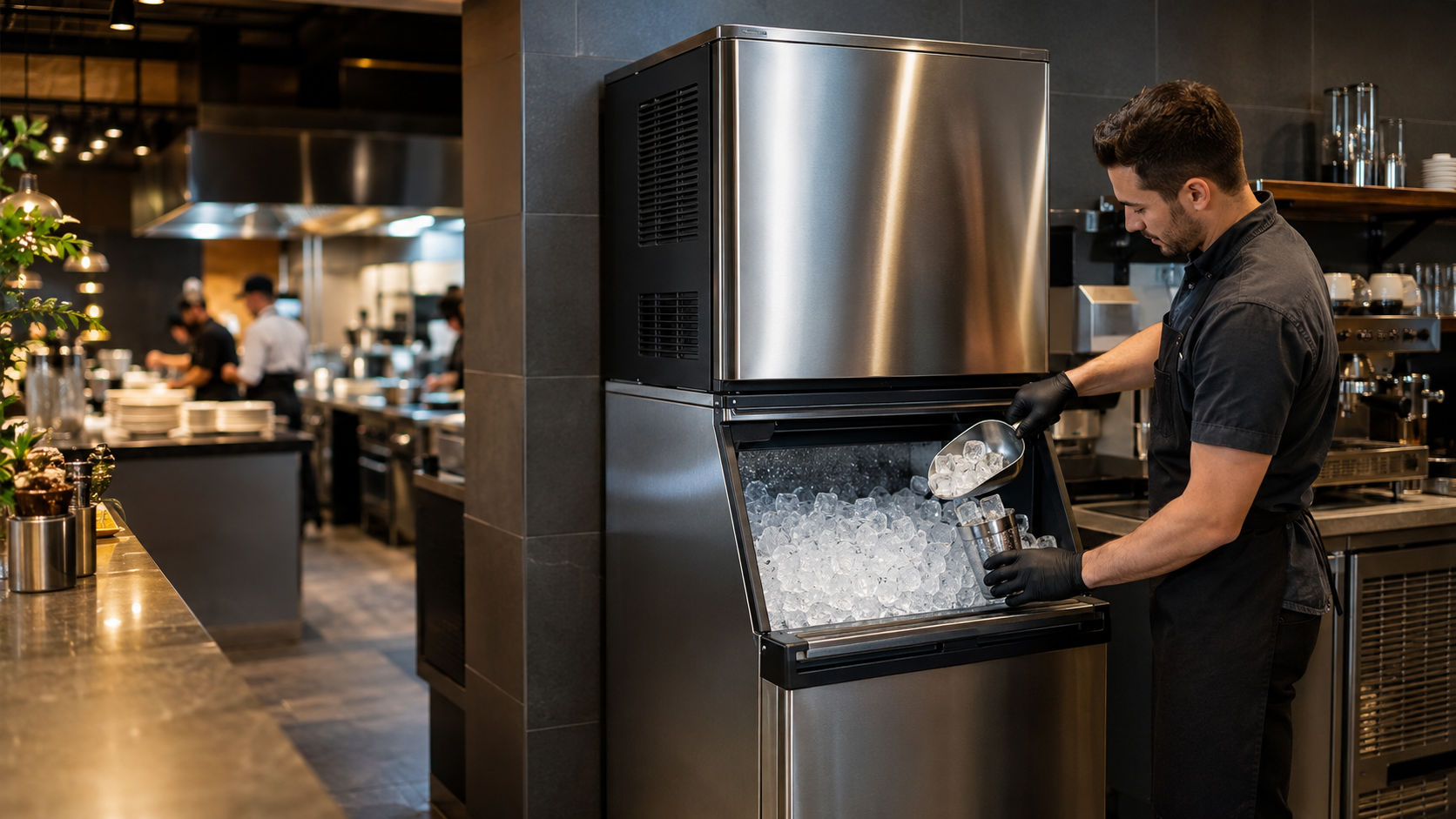
Ice is easy to overlook until a restaurant runs out of it during the busiest service of the week. From fountain drinks and cocktails to food preparation and cold displays, a dependable commercial ice machine supports multiple parts of a restaurant’s daily operation.
The best ice machine for a restaurant is not necessarily the model with the highest production rating. It is the machine that produces the right type and amount of ice, fits the available space and utilities, remains serviceable, and continues meeting demand when kitchen temperatures rise.
This guide explains how to compare commercial ice machines and highlights leading brands including Hoshizaki, Manitowoc, Ice-O-Matic, Atosa, Dukers, Coldline, ITV, Osion, and Serv-Ware.
What Type of Ice Machine Does Your Restaurant Need?
Commercial ice machines generally fall into two configurations.
Undercounter ice machines combine the ice maker and storage bin in one compact cabinet. They are a practical choice for cafés, small restaurants, server stations, and operations with limited floor space. Production and storage capacity are lower, but installation is often more straightforward.
Modular ice machines consist of a separate ice machine head installed over a compatible storage bin or dispenser. They are better suited to full-service restaurants, quick-service locations, cafeterias, and other high-volume operations. A modular system also lets the restaurant choose a bin size based on its service pattern instead of relying on a fixed built-in bin.
Remember that daily production and storage capacity are not the same. A machine may produce 500 pounds in 24 hours while the bin holds only 300 pounds. Once the bin is full, the machine stops making ice until staff removes some of the stored supply.
How Much Ice Does a Restaurant Need?
A useful starting point for a full-service restaurant is approximately 1.5 pounds of ice per customer per day. However, the final calculation should include every use of ice—not only what goes into water glasses.
Consider:
-
Fountain drinks and table service
-
Bar and cocktail preparation
-
Iced coffee, tea, and specialty beverages
-
Salad bars, seafood displays, or buffet stations
-
Food preparation and rapid cooling
-
Catering, takeout, and delivery orders
-
Employee beverage stations
Calculate demand using the restaurant’s busiest day rather than its weekly average, then include a reasonable safety margin. A restaurant serving 250 guests on a peak day might begin with an estimated requirement of 375 pounds before adding bar, kitchen, or display usage.
Published production ratings are also measured under specific air and incoming-water temperatures. Actual output may fall in a hot kitchen. In one example provided by Manitowoc, higher ambient temperature reduced a machine’s production from 590 to 490 pounds per day—a decrease of approximately 17%. That makes ventilation, installation location, and additional capacity especially important in demanding kitchens. Manitowoc explains how temperature affects ice production.
Choose the Right Ice Type

The shape of the ice affects beverage presentation, displacement, melting rate, and customer experience.
Half-cube ice is one of the most versatile options for restaurants. Its smaller size fills glasses efficiently and works well in soft drinks, iced tea, and mixed beverages.
Full-cube or dice ice melts more slowly and creates a polished presentation for table service, spirits, and cocktails.
Crescent ice has a hard, slow-melting shape that reduces splashing and works well in beverage service. Hoshizaki’s Crescent Cuber line includes undercounter, modular, dispenser-compatible, and stackable configurations.
Nugget or cubelet ice is softer and chewable. It is popular for fountain drinks and specialty beverages but may not be ideal for every cocktail program.
Flake ice is primarily used for seafood, produce, salad bars, food presentation, and certain preparation tasks rather than standard beverage service.
The Best Commercial Ice Machine Brands for Restaurants
Hoshizaki
Hoshizaki is a strong choice for restaurants prioritizing long-term performance and multiple ice options. Its lineup includes crescent, cubelet, flake, and specialty ice machines, with compact built-in-bin models and high-capacity modular systems. Hoshizaki’s clear, slow-melting crescent ice is particularly well suited to table-service beverages and general foodservice use. Explore Hoshizaki’s restaurant ice machine options.

Hoshizaki KM-116BAK 130 lb. Air Cooled Crescent Cube Ice Machine
Manitowoc
Manitowoc is well suited to operators looking for advanced controls, diagnostics, and a wide range of production capacities. Its commercial lineup includes undercounter, modular, remote, countertop, and ice-beverage systems. The Indigo NXT series offers programmable production and operating information that can help managers understand machine performance and maintenance needs. Manitowoc offers multiple shapes, including half dice, dice, nugget, flake, crushed, and gourmet ice. Review Manitowoc ice types and configurations.

Manitowoc Ice IDP0620A-161 482 lb. Air Cooled Full Cube Ice Machine
Ice-O-Matic
Ice-O-Matic offers machines for conventional cube ice as well as chewable Pearl and Quartz ice. The brand is worth considering when a restaurant wants flexibility across standard beverage service, dispensers, and specialty drink programs. Select machines also provide features such as one-touch cleaning and onboard diagnostics, which can simplify routine operation and troubleshooting.
Atosa
Atosa provides competitively positioned undercounter and modular ice machines for restaurants that want practical production capacity without moving into the highest equipment price tier. For example, its undercounter lineup includes machines with integrated storage, removable air filters, and half-dice ice designed for foodservice beverages. Larger modular units are available for restaurants with heavier demand.

Atosa YR140-AP-161 142 lb/24hr Undercounter Ice Maker
Dukers
Dukers offers an accessible range extending from compact machines with integrated bins to high-capacity restaurant systems. Current models cover daily production levels from approximately 156 pounds to more than 700 pounds, giving smaller and larger operations several options. Features vary by model but can include removable food-zone components, fault alerts, antimicrobial bin liners, and R290 refrigerant.

Dukers DIM-300 30" Air Cooled Half Cube 312 lb Undercounter Ice Machine with 88 lb Bin
Coldline
Coldline is a value-oriented option for restaurants seeking straightforward undercounter or modular cube ice production. Its undercounter machines can work well in cafés, smaller dining rooms, and secondary service stations, while larger modular configurations support higher-volume operations. Coldline deserves consideration when upfront cost, familiar cube formats, and simple operation are primary buying factors.

Coldline ICE280Y 280 lb. Commercial Half Cube Ice Machine with 80 lb. Bin, Air Cooled
ITV Ice Makers
ITV is especially compelling for restaurants where the appearance and performance of the ice are part of the beverage experience. Its lineup ranges from Spika dice and half-dice ice for quick-service applications to larger gourmet cubes for upscale dining and cocktail programs. ITV also offers nugget, crushed, and flake ice equipment.

Itv SPIKA NG 230 A1H 26"W Half Cube Undercounter Ice Maker - 223 lbs/day
Osion
Osion offers undercounter machines, modular ice makers, dispensers, and storage bins for small and large foodservice operations. The brand can be a practical alternative for operators comparing value-focused commercial equipment, particularly when standard cube production and straightforward electronic controls meet the restaurant’s needs.

Osion OCU-50 Ice Maker Self Contained Undercounter
Serv-Ware
Serv-Ware’s growing ice equipment lineup includes undercounter, modular cube, nugget, flake, and storage-bin options. Restaurants can select compact integrated machines or higher-capacity heads with separate bins. For example, Serv-Ware offers undercounter models with front ventilation for more flexible placement and modular cube machines designed for bars, restaurants, and cafés.

Serv-Ware SWUC-280H Undercounter Ice Machine - Half Cube, 280 lbs/ 24 hrs w/ 80 lb Bin
Air-Cooled, Water-Cooled, or Remote?
Air-cooled machines are the most common choice because they do not consume additional condenser water and are generally easier to install. However, they require adequate airflow and can release heat into the kitchen.
Water-cooled machines can perform more consistently in hot or confined locations, but they use more water and may be restricted by local utility requirements.
Remote-cooled systems move condenser heat and noise away from the ice machine. They can improve kitchen comfort but typically cost more to purchase and install.
Final Buying Checklist
Before choosing a restaurant ice machine, confirm:
-
Required daily production on the busiest service day
-
Ice needed for beverages, bar service, preparation, and displays
-
Desired ice shape and size
-
Storage-bin capacity
-
Machine and bin dimensions
-
Water, drain, voltage, and ventilation requirements
-
Local service and replacement-part availability
-
Water-filtration requirements
-
Sanitation and equipment certifications
-
Energy and water efficiency
ENERGY STAR reports that certified batch-type commercial ice makers are approximately 10% more energy-efficient and 20% more water-efficient than standard models. Over years of daily operation, efficiency can meaningfully affect the true ownership cost. See ENERGY STAR commercial ice maker guidance.
Find the Right Ice Machine for Your Restaurant
There is no single machine that is best for every restaurant. A small café may be well served by a compact undercounter unit, while a busy full-service restaurant may require a modular machine, oversized bin, and additional production capacity for hot summer service.
Atlantic Restaurant & Supermarket Equipment carries commercial ice machines from leading brands for restaurants of every size. Our equipment specialists can help you compare ice type, production, storage, installation requirements, and budget so you can select a system built around the way your restaurant actually operates.
