
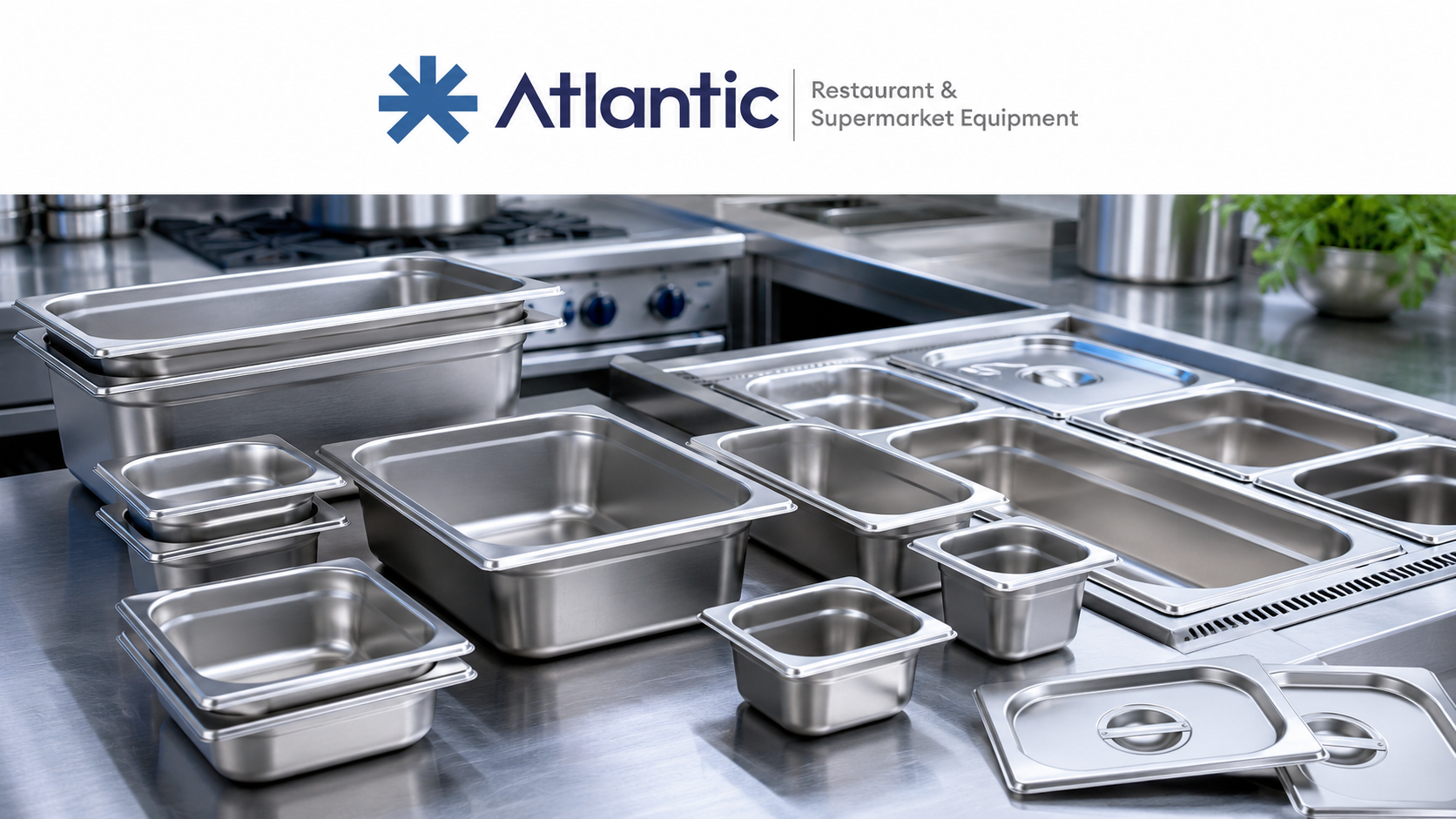
Hotel pans are some of the most important smallwares in any commercial kitchen. Restaurants, cafeterias, hotels, schools, catering companies, delis, supermarkets, salad bars, sandwich shops, bakeries, and institutional kitchens all rely on them for food prep, storage, holding, transport, and service.
They may look simple, but choosing the right hotel pan size can quickly become confusing. A “full-size pan,” “steam table pan,” “counter pan,” “food pan,” “service pan,” and “Gastronorm pan” may all refer to similar equipment, depending on the kitchen, supplier, or region. Add different depths, materials, lids, perforated options, anti-jam designs, and pan adapters, and it becomes clear why many operators need a practical size guide.
This guide explains hotel pan sizes in plain language. You will learn how full-size, half-size, third-size, quarter-size, sixth-size, ninth-size, and Gastronorm pans compare, how to choose the right depth, which material works best for each application, and how to build efficient pan layouts for steam tables, refrigerated prep tables, salad bars, buffet lines, and back-of-house storage.
What Is a Hotel Pan?
A hotel pan is a standardized rectangular food pan used in commercial foodservice operations for storing, cooking, holding, transporting, and serving food. Hotel pans are commonly used in steam tables, food wells, refrigerated prep tables, salad bars, buffet stations, hot bars, cold bars, holding cabinets, and catering setups.
They are also called:
- Steam table pans
- Food pans
- Counter pans
- Service pans
- Table pans
- Prep pans
- Gastronorm pans
- Insert pans
The standard U.S. full-size hotel pan footprint is commonly referred to as 12 inches by 20 inches, though actual outside dimensions are usually closer to 12 3/4 inches by 20 3/4 inches depending on the manufacturer and rim design.

The full-size pan is the base unit. Smaller pans are fractions of that footprint. For example, two half-size pans fit into the space of one full-size pan, three third-size pans fit into one full-size space, and six sixth-size pans fit into one full-size space.
Why Hotel Pan Sizes Matter
Choosing the right hotel pan size affects more than storage. It impacts food quality, labor speed, kitchen organization, temperature control, portioning, presentation, and equipment compatibility.
The right pan size can help a kitchen:
- Keep menu items organized
- Improve prep-line speed
- Reduce food waste
- Support proper hot holding or cold holding
- Maintain cleaner workstations
- Improve portion control
- Make better use of steam table wells
- Keep salad bars and sandwich stations efficient
- Improve catering transport
- Reduce unnecessary pan changes during service
The wrong pan size can create problems. Food may cool too slowly, dry out in a steam table, sit too deep in a cold well, become difficult to portion, or require too much staff handling during service.
Hotel Pan Size Chart
The chart below shows common U.S. hotel pan sizes and their approximate dimensions. Dimensions can vary slightly by manufacturer, especially around the rim, corner radius, anti-jam stacking lugs, and material thickness.
| Pan Size | Common U.S. Name | Approx. Outside Dimensions | Common GN Equivalent | How Many Fit in a Full-Size Opening |
|---|---|---|---|---|
| Double Size | Double Pan | 20 3/4" × 25 5/8" | GN 2/1 | Larger than full-size |
| Full Size | 1/1 Pan | 12 3/4" × 20 3/4" | GN 1/1 | 1 |
| Two-Thirds Size | 2/3 Pan | 12" × 13 1/3" | GN 2/3 | 1 plus extra space |
| Half Size | 1/2 Pan | 12" × 10" | GN 1/2 | 2 |
| Half-Long Size | 2/4 Pan | 6 3/8" × 20 3/4" | GN 2/4 | 2 long pans |
| Third Size | 1/3 Pan | 12" × 6 2/3" | GN 1/3 | 3 |
| Quarter Size | 1/4 Pan | 6" × 10" | GN 1/4 | 4 |
| Sixth Size | 1/6 Pan | 6" × 6 2/3" | GN 1/6 | 6 |
| Eighth Size | 1/8 Pan | 6 3/8" × 5 1/4" | Not always GN-standard | 8 |
| Ninth Size | 1/9 Pan | 4" × 6 2/3" | GN 1/9 | 9 |
For most U.S. commercial kitchens, the most common sizes are full-size, half-size, third-size, quarter-size, sixth-size, and ninth-size pans.
Common Hotel Pan Depths
Hotel pans are sold in different depths. The most common depths are:
- 2 1/2 inches
- 4 inches
- 6 inches
- 8 inches
Some pans are also available in shallow depths such as 1 1/4 inches or 2 inches, and deeper options may exist for specialty storage or high-volume holding.
Depth matters because it affects capacity, temperature control, portioning, line speed, and food quality.
2 1/2-Inch Deep Pans
A 2 1/2-inch hotel pan is shallow and easy to access. It works well for food that needs to be served quickly, presented attractively, or held in smaller batches.
Best uses include:
- Buffet service
- Hot bars
- Cold bars
- Baked items
- Fried foods
- Shallow sides
- Display foods
- Short service periods
Shallow pans can help reduce overfilling and make food easier to portion. They are also useful when frequent batch replacement is better than holding a large amount of food for too long.
4-Inch Deep Pans
A 4-inch pan is one of the most versatile hotel pan depths. It provides more capacity than a shallow pan without becoming too difficult to handle.
Best uses include:
- Steam table service
- Prep table ingredients
- Pasta
- Vegetables
- Sauces
- Rice
- Beans
- Proteins
- Salad bar ingredients
- Sandwich toppings
For many restaurants, 4-inch pans are the everyday workhorse depth.
6-Inch Deep Pans
A 6-inch pan offers high capacity and is commonly used for storage, batch prep, and high-volume holding.
Best uses include:
- Soups
- Stews
- Braised meats
- Large-volume sides
- Bulk prep
- Walk-in cooler storage
- Catering backup pans
- High-volume steam table wells
However, deeper is not always better. In some cases, food in a deep pan may be harder to portion, slower to cool, or more likely to be overheld. Use 6-inch pans when capacity is truly needed.
8-Inch Deep Pans
An 8-inch pan is typically used for bulk storage and very high-volume applications. It is less common on service lines because it can be heavy and difficult to handle when full.
Best uses include:
- Bulk storage
- Large batch prep
- Commissary kitchens
- Central kitchens
- High-volume catering
- Backup product in walk-in coolers
When using deep pans for cooling hot food, always follow local food safety rules and proper cooling procedures. Large, deep volumes of hot food can cool slowly if handled incorrectly.
Approximate Hotel Pan Capacities
Hotel pan capacity depends on size, depth, manufacturer, and whether the listed capacity is brimful or practical working capacity. In real commercial kitchen use, pans should usually not be filled to the very top.
The table below gives practical approximate capacity ranges.
| Pan Size | 2 1/2" Deep | 4" Deep | 6" Deep |
|---|---|---|---|
| Full Size | About 6.6 qt | About 11.2 qt | About 16.8 qt |
| Two-Thirds Size | About 4.5 qt | About 7.4 qt | About 11.2 qt |
| Half Size | About 3.4 qt | About 5.4 qt | About 8 qt |
| Half-Long Size | About 3 qt | About 4.8 qt | About 7 qt |
| Third Size | About 2.1 qt | About 3.3 qt | About 4.9 qt |
| Quarter Size | About 1.4 qt | About 2.4 qt | About 3.6 qt |
| Sixth Size | About 1 qt | About 1.4 qt | About 2.2 qt |
| Ninth Size | Not common | About 0.9 qt | Not common |
These capacities should be treated as approximate. For purchasing and prep planning, always check the exact product specifications from the manufacturer.
U.S. Hotel Pans vs. Gastronorm Pans
Hotel pans are commonly used in the United States, while Gastronorm pans are widely used internationally and in many imported commercial kitchen equipment lines.
Gastronorm, often abbreviated as GN, is a metric sizing system based on standardized pan dimensions. The most important size is GN 1/1, which measures 530 × 325 mm. Other GN sizes are fractions or multiples of GN 1/1.
Common Gastronorm sizes include:
| GN Size | Metric Dimensions |
|---|---|
| GN 2/1 | 650 × 530 mm |
| GN 1/1 | 530 × 325 mm |
| GN 2/3 | 354 × 325 mm |
| GN 2/4 | 530 × 162 mm |
| GN 1/2 | 325 × 265 mm |
| GN 1/3 | 325 × 176 mm |
| GN 1/4 | 265 × 163 mm |
| GN 1/6 | 176 × 162 mm |
| GN 1/9 | 176 × 108 mm |
U.S. hotel pans and GN pans are similar in concept, but they are not always perfectly interchangeable. Rim size, corner radius, depth, and equipment design can affect fit. This matters when using imported ovens, combi ovens, refrigerated prep tables, hot holding wells, display cases, transport carts, and pan racks.
If you are replacing pans for existing equipment, measure the actual well opening and check the equipment manual before ordering.
What Size Is a Full Hotel Pan?
A full hotel pan is the standard base size in U.S. foodservice. It is commonly described as 12 inches by 20 inches, with actual outside dimensions often around 12 3/4 inches by 20 3/4 inches.
Full-size pans are commonly used for:
- Steam tables
- Large entrees
- Roasted meats
- Fried chicken
- Lasagna
- Pasta dishes
- Rice and beans
- Bulk prep
- Catering transport
- Buffet service
- Hot holding cabinets
A full-size pan is ideal when you need volume. It is less ideal when you need several menu items in one well or want tighter portion control.
What Size Is a Half Hotel Pan?
A half-size hotel pan is commonly about 12 inches by 10 inches. Two half-size pans fit in one full-size pan opening.
Half-size pans are among the most useful sizes in a commercial kitchen because they balance capacity and flexibility.
Best uses include:
- Side dishes
- Sauces
- Proteins
- Pasta
- Roasted vegetables
- Prep ingredients
- Grab-and-go food prep
- Smaller buffet items
- Catering setups
Half-size pans work especially well when one full-size well needs to hold two menu items.
What Size Is a Third Hotel Pan?
A third-size hotel pan is commonly about 12 inches by 6 2/3 inches. Three third-size pans fit into one full-size opening.
Third-size pans are popular for:
- Soups
- Sauces
- Sides
- Salad bar items
- Dessert toppings
- Smaller hot line items
- Prep station organization
- Divided steam table wells
Third pans are very useful when a kitchen wants variety without using too much space.
What Size Is a Quarter Hotel Pan?
A quarter-size hotel pan is commonly about 6 inches by 10 inches. Four quarter-size pans fit into one full-size opening.
Quarter pans are useful for:
- Small sides
- Garnishes
- Condiments
- Prep ingredients
- Desserts
- Small-batch items
- Bakery toppings
- Cold bar ingredients
Quarter pans are compact and easy to handle, making them practical for prep, storage, and quick service.
What Size Is a Sixth Hotel Pan?
A sixth-size hotel pan is commonly about 6 inches by 6 2/3 inches. Six sixth-size pans fit into one full-size opening.
Sixth pans are extremely common in sandwich prep tables, pizza prep tables, salad stations, taco lines, and fast-casual restaurants.
Best uses include:
- Lettuce
- Tomatoes
- Onions
- Pickles
- Cheese
- Sauces
- Dressings
- Toppings
- Sliced proteins
- Pizza toppings
- Small mise en place items
Sixth pans help organize multiple ingredients in a compact refrigerated rail.
What Size Is a Ninth Hotel Pan?
A ninth-size hotel pan is commonly about 4 inches by 6 2/3 inches. Nine ninth-size pans can fit into a full-size opening.
Ninth pans are best for very small amounts of product, such as:
- Garnishes
- Sauces
- Salsa
- Chopped herbs
- Lemon wedges
- Pickled items
- Spices
- Specialty toppings
- Bar garnishes
They are useful when ingredient variety is more important than capacity.
How Hotel Pans Fit Together
One of the biggest advantages of hotel pans is modularity. You can mix different pan sizes in one full-size opening when using adapter bars, divider bars, or compatible rails.
Common full-size layouts include:
- 1 full-size pan
- 2 half-size pans
- 3 third-size pans
- 4 quarter-size pans
- 6 sixth-size pans
- 9 ninth-size pans
- 1 half-size pan + 2 quarter-size pans
- 1 half-size pan + 3 sixth-size pans
- 1 third-size pan + 2 sixth-size pans + 1 half-size pan, depending on the rail layout
This flexibility is especially useful in refrigerated prep tables, steam tables, salad bars, buffets, and sandwich lines.
Choosing the Right Hotel Pan Size by Application
Steam Tables and Hot Food Wells
For steam tables, choose pans based on menu volume and service pattern.
Full-size pans are best for high-volume items such as rice, pasta, fried chicken, roasted meats, and large sides.
Half-size pans work well for medium-volume sides and proteins.
Third-size pans are ideal when multiple menu items must fit in one well.
Shallow pans can improve food presentation and make portioning easier, while deeper pans provide more holding capacity.
Refrigerated Prep Tables
For sandwich prep tables, pizza prep tables, salad prep tables, and refrigerated rails, smaller pans are usually better.
Sixth-size pans and third-size pans are common because they let operators organize many ingredients in one rail. Half-size pans may be used for high-volume ingredients such as lettuce, cheese, sauce, or dough toppings.
For refrigerated prep, always make sure pans sit properly in the rail and do not block lid closure. A pan that is too tall, incorrectly placed, or overloaded can interfere with temperature control and workflow.
Salad Bars and Cold Bars
Salad bars often use a mix of half-size, third-size, sixth-size, and ninth-size pans.
Use larger pans for high-volume items such as lettuce, greens, pasta salad, and fruit. Use smaller pans for toppings, dressings, nuts, seeds, sauces, and garnishes.
Clear plastic pans can help staff see product levels quickly, but stainless steel pans may provide a cleaner, more premium look in some display settings.
Buffets and Catering
Buffets often use full-size and half-size pans because they provide good capacity and easy replacement.
For catering, pan depth and lid type become especially important. Deeper pans can transport more food, but they are heavier and may be harder to handle safely. Tight-fitting transport lids help reduce spills and preserve food quality.
Walk-In Cooler Storage
For storage, choose pans based on stacking, labeling, visibility, and food rotation.
Plastic pans are helpful when visibility matters. Stainless steel pans are durable and useful for heavy-duty storage, but contents may be harder to identify without proper labeling.
For walk-in coolers, consider pan covers, date labels, pan racks, and proper shelf organization.
Food Prep and Mise en Place
Prep cooks often prefer smaller pans for mise en place because they keep ingredients separated and easy to reach.
Sixth pans, ninth pans, and quarter pans are useful for small ingredients. Half pans and third pans are better for larger prep batches.
Hotel Pan Materials
Hotel pans are available in several materials. The right choice depends on whether the pan will be used for cooking, hot holding, cold holding, display, storage, prep, or transport.
Stainless Steel Hotel Pans
Stainless steel is the most common material for commercial hotel pans. It is durable, heat-resistant, easy to clean, and suitable for many hot and cold applications.
Best uses include:
- Steam tables
- Hot holding
- Ovens
- Food wells
- Catering
- Prep
- Heavy-duty storage
- High-volume kitchens
Stainless steel pans are often described by gauge. Lower gauge numbers generally mean thicker metal. For example, a 22-gauge pan is typically heavier than a 25-gauge pan.
Benefits:
- Strong and long-lasting
- Good for hot applications
- Resists warping better when heavy gauge
- Professional appearance
- Dishwasher safe
- Good for repeated commercial use
Considerations:
- Contents are not visible
- Can dent under heavy abuse
- May cost more than economy plastic options
- Gauge and steel quality vary by brand
Polycarbonate Food Pans
Polycarbonate pans are clear, durable plastic pans commonly used for cold storage, prep, and ingredient visibility.
Best uses include:
- Cold food storage
- Salad bars
- Prep tables
- Sandwich stations
- Walk-in cooler organization
- Ingredient identification
Benefits:
- Clear visibility
- Lightweight
- Resistant to staining and odors in many applications
- Useful for inventory control
- Good for cold prep environments
Considerations:
- Not for all high-heat applications
- Can scratch over time
- May crack under abuse
- Must be matched to proper temperature range
Polypropylene Food Pans
Polypropylene pans are usually more economical than polycarbonate. They are often translucent rather than fully clear.
Best uses include:
- Cold storage
- Dry storage
- Prep
- Low-cost ingredient organization
- Backup pans
Benefits:
- Cost-effective
- Lightweight
- Useful for basic storage
- Good for many cold applications
Considerations:
- Less clear than polycarbonate
- May stain or retain odors more easily
- Not ideal for premium display
- Heat limits vary by product
High-Heat Plastic Pans
High-heat food pans are designed for hotter applications than standard plastic pans. Some high-heat pans can be used in steam tables, microwaves, and other higher-temperature foodservice environments, depending on the product specifications.
Best uses include:
- Hot holding
- Steam tables
- Reheating
- Cook-chill systems
- Operations needing plastic visibility with higher heat tolerance
Benefits:
- Higher temperature resistance than standard plastic
- Lighter than stainless steel
- Some options are amber or translucent
- Useful for special workflows
Considerations:
- More expensive than standard plastic
- Not always suitable for every oven or broiler environment
- Always check manufacturer temperature limits
Melamine Pans
Melamine pans are often used for display and serving. They can provide a more attractive presentation than stainless steel or clear plastic.
Best uses include:
- Buffets
- Cold displays
- Salad bars
- Front-of-house presentation
- Bakery displays
Benefits:
- Attractive appearance
- Break-resistant compared with ceramic
- Good for presentation
Considerations:
- Not suitable for high-heat cooking
- Not ideal for ovens
- Can chip or crack
- Must be used within product guidelines
Stainless Steel Gauge: What Does It Mean?
Gauge refers to the thickness of the stainless steel. In general, lower gauge numbers mean thicker, heavier metal.
Common food pan gauges include:
- 20 gauge: heavy-duty
- 22 gauge: strong commercial use
- 24 gauge: standard commercial use
- 25 gauge: lighter-duty use
A thicker pan usually resists denting, bending, and warping better. If your kitchen uses pans heavily every day, investing in heavier-gauge stainless steel can reduce replacement frequency.
For light storage, occasional catering, or low-volume operations, lighter pans may be enough.
Anti-Jam Hotel Pans
Anti-jam pans are designed with stacking features that prevent pans from sticking tightly together. This matters in busy kitchens where staff need to pull pans quickly during prep, service, or warewashing.
Benefits of anti-jam pans:
- Easier stacking and unstacking
- Faster prep
- Less frustration during service
- Reduced risk of pan damage
- Better air circulation when stacked
Anti-jam design is especially useful if your kitchen uses large quantities of stainless steel pans.
Perforated Hotel Pans
Perforated hotel pans have small holes that allow liquid, steam, or moisture to pass through.
Best uses include:
- Draining vegetables
- Steaming
- Holding fried foods above moisture
- Seafood display prep
- Rinsing produce
- Draining pasta
- Defrosting with drainage
- Food items that should not sit in liquid
Perforated pans are often used with solid pans underneath to catch liquid.
Hotel Pan Lids and Covers
A hotel pan cover helps protect food, retain temperature, reduce contamination risk, control moisture loss, and improve transport.
Common lid types include:
Solid Covers
Solid covers are basic flat lids that help keep food protected and covered.
Best for:
- Storage
- Hot holding
- Cold holding
- Transport
- General use
Slotted Covers
Slotted covers have an opening for serving utensils.
Best for:
- Buffet lines
- Steam tables
- Self-service stations
- Serving spoons or ladles
Hinged Covers
Hinged covers provide access without removing the lid completely.
Best for:
- Buffets
- High-use service stations
- Self-service food bars
- Operations where lids are often misplaced
Sealing Lids
Sealing lids create a tighter fit and are often used with plastic food pans.
Best for:
- Storage
- Transport
- Prep
- Walk-in cooler organization
- Catering
Domed Covers
Domed covers add extra clearance for taller or bulkier foods.
Best for:
- Bakery items
- Roasted foods
- Fried foods
- Garnished platters
- Buffet presentation
Notched Covers
Notched covers allow utensils to remain in the pan while the cover stays mostly closed.
Best for:
- Sauces
- Soups
- Condiments
- Serving lines
Hotel Pan Accessories
Accessories make hotel pans more versatile and easier to use.
Adapter Bars
Adapter bars allow smaller pans to fit securely in full-size wells or steam tables. They are essential when mixing different pan sizes.
Pan Grates
Pan grates sit inside a pan and raise food above liquid or grease.
Best for:
- Fried food
- Roasted meats
- Bacon
- Draining vegetables
- Holding foods that should stay above moisture
Drain Shelves
Drain shelves perform a similar function by keeping food above liquid inside the pan.
Best for:
- Produce
- Seafood
- Fried items
- Marinated products
- Defrosting
Pan Racks
Pan racks organize pans for storage, cooling, staging, or transport.
Best for:
- Bakeries
- Catering
- Commissary kitchens
- Prep kitchens
- Banquet operations
Lid Organizers
Lid organizers keep covers accessible and reduce clutter in storage areas.
Transport Carriers
Insulated carriers and transport covers help move food safely between locations while preserving temperature and reducing spills.
How to Choose the Right Hotel Pan
Choosing the right hotel pan requires more than selecting a size. Consider the full workflow.
Ask these questions:
- Will the pan be used for hot food, cold food, storage, prep, display, or transport?
- Does it need to fit a steam table, prep table, salad bar, oven, or cart?
- How much product needs to be held during peak service?
- Will staff need to see the contents quickly?
- Does the pan need a lid?
- Does the pan need to stack easily?
- Will it be used in a high-volume kitchen?
- Is the food wet, dry, acidic, oily, heavy, or delicate?
- Does the food need drainage?
- Is portion control more important than capacity?
Best Hotel Pan Sizes by Kitchen Type
Restaurants
Most restaurants should keep a mix of full-size, half-size, third-size, and sixth-size pans. Full-size and half-size pans work well for hot line items, while third and sixth pans are useful for prep and refrigerated stations.
Cafeterias
Cafeterias often need full-size and half-size pans because they serve high volume. Shallow full-size pans work well for buffet presentation, while deeper pans are useful for backup production.
Delis
Delis benefit from third-size, quarter-size, sixth-size, and ninth-size pans for salads, toppings, sauces, prepared foods, and refrigerated displays.
Sandwich Shops
Sixth-size pans are essential for sandwich prep tables. Use half-size pans for high-volume ingredients and ninth-size pans for small toppings or specialty condiments.
Pizza Shops
Pizza prep tables commonly use sixth-size and third-size pans for toppings. Half pans may be used for cheese, sauce, dough toppings, or high-volume ingredients.
Hotels
Hotels need a broad mix because they use pans for breakfast buffets, banquets, room service prep, catering, and back-of-house storage. Full-size, half-size, and third-size pans are especially important.
Catering Companies
Caterers need durable stainless steel pans, secure lids, transport covers, and pan carriers. Full-size and half-size pans are the most common, but third pans and sixth pans are useful for sauces and sides.
Supermarkets and Food Bars
Supermarkets use hotel pans for hot bars, salad bars, deli cases, prepared foods, seafood displays, and grab-and-go production. A mix of stainless steel, clear plastic, and display-ready pans may be needed.
Hotel Pan Layout Examples
Standard Steam Table Layouts
For a full-size steam table well, common layouts include:
- One full-size pan for a high-volume entrée
- Two half-size pans for two sides
- Three third-size pans for multiple menu items
- One half-size pan plus two quarter-size pans
- Six sixth-size pans for sauces, toppings, or smaller items
Sandwich Prep Table Layout
A sandwich prep station may use:
- One half-size pan for lettuce
- One third-size pan for sliced tomatoes
- Several sixth-size pans for onions, pickles, cheese, proteins, and sauces
- Ninth-size pans for specialty toppings
Salad Bar Layout
A salad bar may use:
- Full-size or half-size pans for greens
- Third-size pans for pasta salad or fruit
- Sixth-size pans for toppings
- Ninth-size pans for seeds, nuts, croutons, or garnishes
Buffet Layout
A buffet may use:
- Full-size shallow pans for main items
- Half-size pans for sides
- Third-size pans for sauces
- Domed covers for bulky foods
- Slotted covers for serving utensils
Food Safety and Hotel Pans
Hotel pans come into direct contact with food, so food safety matters. Pans should be cleaned, sanitized, stored properly, and used within their intended temperature range.
Good practices include:
- Use food-contact-safe pans.
- Clean and sanitize pans after use.
- Do not use cracked plastic pans.
- Do not use heavily dented or damaged pans that are difficult to clean.
- Label stored food properly.
- Use proper lids during storage.
- Avoid cross-contamination between raw and ready-to-eat foods.
- Do not overfill pans in ways that interfere with temperature control.
- Follow local health department requirements for cooling, hot holding, and cold holding.
A hotel pan is not just a container. It is part of the food safety system in a commercial kitchen.
Common Hotel Pan Buying Mistakes
Mistake 1: Buying Only Full-Size Pans
Full-size pans are useful, but they are not always efficient. Smaller pans improve flexibility and portion control.
Mistake 2: Choosing Pans Too Deep for Service
Deep pans hold more food, but they can make portioning harder and may hurt presentation. Use the shallowest pan that still supports the service volume.
Mistake 3: Ignoring Equipment Compatibility
Not every pan fits every prep table, steam table, oven, rack, or carrier. Measure before ordering.
Mistake 4: Mixing U.S. and GN Pans Without Checking Fit
U.S. hotel pans and Gastronorm pans are similar but not identical. Always confirm compatibility.
Mistake 5: Using Standard Plastic Pans for High Heat
Not every plastic pan is safe for hot holding or heated applications. Check the manufacturer’s temperature rating.
Mistake 6: Not Buying Enough Lids
A pan without the right lid may create storage, transport, and food safety problems.
Mistake 7: Choosing Economy Pans for Heavy-Duty Use
Light-duty pans may be fine for occasional use, but high-volume kitchens usually benefit from heavier-gauge stainless steel.
Hotel Pan FAQ
What is the most common hotel pan size?
The most common hotel pan size is the full-size pan, commonly described as 12 inches by 20 inches. Half-size, third-size, and sixth-size pans are also extremely common in commercial kitchens.
Why is it called a hotel pan?
The term “hotel pan” is traditionally associated with commercial kitchens and hospitality operations. Today, the term is used broadly across restaurants, hotels, cafeterias, catering operations, and foodservice businesses.
Are hotel pans and steam table pans the same?
In many cases, yes. A steam table pan is usually a type of hotel pan used in a steam table or hot food well. However, hotel pans can also be used for cold storage, prep, transport, and display.
What is a full-size hotel pan?
A full-size hotel pan is the standard base pan size. It is commonly described as 12 inches by 20 inches, though actual outside dimensions may be closer to 12 3/4 inches by 20 3/4 inches.
How many half pans fit in a full pan?
Two half-size pans fit in one full-size pan opening.
How many third pans fit in a full pan?
Three third-size pans fit in one full-size opening.
How many sixth pans fit in a full pan?
Six sixth-size pans fit in one full-size opening.
What size pan fits in a steam table?
Most steam tables are designed around full-size hotel pan openings. You can use one full-size pan or combine smaller pans with adapter bars, depending on the steam table design.
What size pans fit in a prep table?
Many refrigerated prep tables use sixth-size, third-size, half-size, or full-size pans, depending on the rail design. Always check the prep table’s pan capacity and maximum pan depth.
What is a GN pan?
A GN pan is a Gastronorm pan. Gastronorm is a metric pan sizing system used internationally. GN 1/1 measures 530 × 325 mm.
Are GN pans and U.S. hotel pans interchangeable?
Sometimes, but not always. They are similar in concept, but rim dimensions, corner radius, and equipment design can affect fit.
What depth hotel pan should I buy?
For service, 2 1/2-inch and 4-inch pans are common. For storage and high-volume prep, 6-inch pans are common. For bulk storage, 8-inch pans may be useful. Choose the depth based on food volume, temperature control, service speed, and handling.
Are stainless steel or plastic hotel pans better?
Stainless steel is better for hot holding, ovens, steam tables, and heavy-duty use. Clear plastic pans are better for cold storage, prep visibility, and ingredient organization. High-heat plastic pans can work for some hot applications if rated for the temperature.
Can hotel pans go in the oven?
Stainless steel hotel pans are commonly used in ovens, but plastic pans should only be used according to their temperature rating. Always check the manufacturer’s instructions.
Can hotel pans go in the freezer?
Many stainless steel and plastic food pans can be used in cold storage or freezer applications, but temperature ratings vary by material and manufacturer. Always verify the product specifications.
What are perforated hotel pans used for?
Perforated pans are used for draining, steaming, rinsing, and holding foods above liquid. They are often paired with solid pans underneath.
Hotel pans are simple in appearance but essential to the efficiency of a commercial kitchen. The right pan size, depth, material, lid, and accessory can improve prep flow, food safety, temperature control, storage organization, and service speed.
For most foodservice businesses, a smart hotel pan setup includes a mix of full-size, half-size, third-size, quarter-size, sixth-size, and ninth-size pans. Stainless steel pans are the backbone of hot holding and heavy-duty use, while plastic pans are valuable for cold storage, visibility, and prep organization. Lids, adapter bars, drain shelves, and pan racks complete the system.
Whether you operate a restaurant, deli, supermarket, hotel, café, catering business, or institutional kitchen, understanding hotel pan sizes helps you build a more organized and productive back-of-house operation.
Atlantic Restaurant & Supermarket Equipment supplies commercial kitchen equipment, restaurant equipment, refrigeration equipment, food prep equipment, storage solutions, and foodservice essentials for professional kitchens. When choosing hotel pans or planning your kitchen setup, match your pan sizes to your menu, equipment, workflow, and service volume.